- 321 pages
- English
- PDF
- Available on iOS & Android
eBook - PDF
About this book
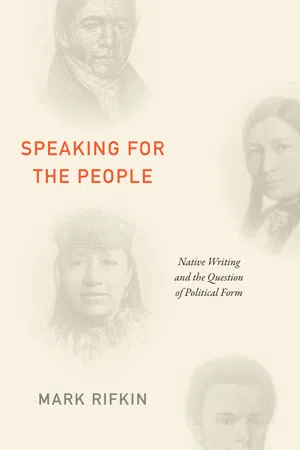
In Speaking for the People Mark Rifkin examines nineteenth-century Native writings to reframe contemporary debates around Indigenous recognition, refusal, and resurgence. Rifkin shows how works by Native authors (William Apess, Elias Boudinot, Sarah Winnemucca, and Zitkala-Ša) illustrate the intellectual labor involved in representing modes of Indigenous political identity and placemaking. These writers highlight the complex processes involved in negotiating the character, contours, and scope of Indigenous sovereignties under ongoing colonial occupation. Rifkin argues that attending to these writers' engagements with non-native publics helps provide further analytical tools for addressing the complexities of Indigenous governance on the ground—both then and now. Thinking about Native peoplehood and politics as a matter of form opens possibilities for addressing the difficult work involved in navigating among varied possibilities for conceptualizing and enacting peoplehood in the context of continuing settler intervention. As Rifkin demonstrates, attending to writings by these Indigenous intellectuals provides ways of understanding Native governance as a matter of deliberation, discussion, and debate, emphasizing the open-ended unfinishedness of self-determination.
Information
Publisher
Duke University Press BooksYear
2021Print ISBN
9781478014331
9781478013419
eBook ISBN
9781478021636
Table of contents
- Cover
- Contents
- Acknowledgments
- Introduction
- 1. What’s In a Nation? Cherokee Vanguardism in Elias Boudinot’s Letters
- 2. Experiments in Signifying Sovereignty: Exemplarity and the Politics of Southern New England in William Apess
- 3. Among Ghost Dances: Sarah Winnemucca and the Production of Paiute Identity
- 4. The Native Informant Speaks: The Politics of Ethnographic Subjectivity in Zitkala-Ša’s Autobiographical Stories
- Coda. On Refusing the Ethnographic Imaginary, Or Reading for The Politics of Peoplehood
- Notes
- Bibliography
- Index
Trusted by 375,005 students
Access to over 1.5 million titles for a fair monthly price.
Study more efficiently using our study tools.
Frequently asked questions
Yes, you can cancel anytime from the Subscription tab in your account settings on the Perlego website. Your subscription will stay active until the end of your current billing period. Learn how to cancel your subscription
No, books cannot be downloaded as external files, such as PDFs, for use outside of Perlego. However, you can download books within the Perlego app for offline reading on mobile or tablet. Learn how to download books offline
Perlego offers two plans: Essential and Complete
- Essential is ideal for learners and professionals who enjoy exploring a wide range of subjects. Access the Essential Library with 800,000+ trusted titles and best-sellers across business, personal growth, and the humanities. Includes unlimited reading time and Standard Read Aloud voice.
- Complete: Perfect for advanced learners and researchers needing full, unrestricted access. Unlock 1.5M+ books across hundreds of subjects, including academic and specialized titles. The Complete Plan also includes advanced features like Premium Read Aloud and Research Assistant.
We are an online textbook subscription service, where you can get access to an entire online library for less than the price of a single book per month. With over 1.5 million books across 990+ topics, we’ve got you covered! Learn about our mission
Look out for the read-aloud symbol on your next book to see if you can listen to it. The read-aloud tool reads text aloud for you, highlighting the text as it is being read. You can pause it, speed it up and slow it down. Learn more about Read Aloud
Yes! You can use the Perlego app on both iOS and Android devices to read anytime, anywhere — even offline. Perfect for commutes or when you’re on the go.
Please note we cannot support devices running on iOS 13 and Android 7 or earlier. Learn more about using the app
Please note we cannot support devices running on iOS 13 and Android 7 or earlier. Learn more about using the app
Yes, you can access Speaking for the People by Mark Rifkin in PDF and/or ePUB format, as well as other popular books in Social Sciences & North American Literary Criticism. We have over 1.5 million books available in our catalogue for you to explore.