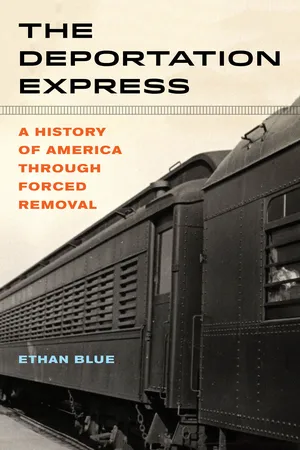
A history of the United States' systematic expulsion of "undesirables" and immigrants, told through the lives of the passengers who travelled from around the world, only to be locked up and forced out aboard America's first deportation trains.
The United States, celebrated as a nation of immigrants and the land of the free, has developed the most extensive system of imprisonment and deportation that the world has ever known. The Deportation Express is the first history of American deportation trains: a network of prison railroad cars repurposed by the Immigration Bureau to link jails, hospitals, asylums, and workhouses across the country and allow forced removal with terrifying efficiency. With this book, historian Ethan Blue uncovers the origins of the deportation train and finds the roots of the current moment, as immigrant restriction and mass deportation once again play critical and troubling roles in contemporary politics and legislation.
A century ago, deportation trains made constant circuits around the nation, gathering so-called "undesirable aliens"—migrants disdained for their poverty, political radicalism, criminal conviction, or mental illness—and conveyed them to ports for exile overseas. Previous deportation procedures had been violent, expensive, and relatively ad hoc, but the railroad industrialized the expulsion of the undesirable. Trains provided a powerful technology to divide "citizens" from "aliens" and displace people in unprecedented numbers. Drawing on the lives of migrants and the agents who expelled them, The Deportation Express is history told from aboard a deportation train. By following the lives of selected individuals caught within the deportation regime, this book dramatically reveals how the forces of state exclusion accompanied epic immigration in early twentieth-century America. These are the stories of people who traveled from around the globe, only to be locked up and cast out, deported through systems that bound the United States together, and in turn, pulled the world apart. Their journey would be followed by millions more in the years to come.
- 448 pages
- English
- ePUB (mobile friendly)
- Available on iOS & Android
eBook - ePub
About this book
Information
Publisher
University of California PressYear
2021Print ISBN
9780520304444
Edition
1eBook ISBN
9780520973107
PART ONE
Building the Deportation State
THE US SYSTEM OF FORCED EXPULSION was not born fully formed. It started small and was built piece by piece. Transcontinental deportation required unprecedented legal, administrative, material government infrastructures. It required workers—career employees and bureaucrats—to develop and administer those systems. Agents built the means to identify and imprison those whom they disdained and move them across vast distances cheaply and according to the law. In the process, they connected a host of carceral institutions: prisons and jails, hospitals and asylums, workhouses and welfare offices, and detention centers of all sorts. They joined forces with huge private railroad firms and linked multiple levels of government—from the municipal to state, federal, and international. It was a contentious process, even among the clerks and bureaucrats, but their efforts made this branch of the American state into the juggernaut it has since become.
ONE
Planning the Journey
IN JANUARY 1914 THE IMMIGRATION AGENT Henry Weiss said good-bye to his wife and four children, approached the Seattle railroad yards, and heaved his bags aboard the nation’s first Deportation Special. Weiss was in charge of the journey. His job was to collect the deportees from where they had been locked up and deliver them to the proper locations and agents who would take charge of the deportees’ international removal. Along the way, Weiss would keep track of their paperwork and bags, make sure they were fed and reasonably healthy, and guard them so that no one could escape. He spent the rest of his working life on these trains, and his career helped consolidate a nationally integrated, globe-spanning deportation regime.
Until deportation trains began their steady circuits around the United States, the federal government had yet to develop a smooth system to remove unwanted immigrants from within the nation’s borders. Congress had passed a series of increasingly restrictive immigration acts in the late nineteenth century—the Chinese Exclusion Act and the Immigration Act of 1882, the Foran Act of 1886, the Geary Act of 1892, along with others in 1903, 1907, and more to come in 1917, 1921, and 1924—but the government had largely focused its energies on policing ports of entry. For much of the nineteenth century, where deportation was concerned, states and localities held sway more than the federal government did. Funds were too scarce and distances too great for a national deportation regime to take shape. And there was simply no official guidance to specify how, for example, an Italian woman convicted of prostitution in Nevada could be shipped to New York and forced to travel across the Atlantic, or for how a Chinese man without papers in Chicago could be sent to California’s Angel Island to await deportation. Some immigrants were transferred by US marshals, and others, by immigration agents.1 Deportation still happened, but it tended to be locally administered and expensive. It was also frequently violent and typically ad hoc. The first decades of formal exclusion were characterized by widespread state uncertainty, administrative confusion, and questions about who would pay for removal.2
But as the years went on, federal bureaucrats worked hard to build a deportation regime that could make American nativist fantasies a reality. The railway was central to their success. It enabled them to compress continental distance and, by grouping so-called undesirable people together in barred train cars, to speed the pace and lessen the costs of removal. The trains certainly increased in number: eleven transcontinental trains ran between April 1914 and February 1916, nine in 1921, and nineteen in 1931.3 The National Commission on Law Observance and Enforcement reported more than ninety thousand people were deported between 1921 and 1931, with an additional ninety-five thousand coerced to “voluntarily depart” between 1925 and 1931, tamping down the numbers recorded.4
Officials had weighed the possibilities of coordinating deportation journeys as early as 1905, and there were further discussions in 1910, 1911, and 1912.5 After some trial runs organized by local governments, the Bureau of Immigration began partnering with private rail firms in 1914 to set up a nation-spanning deportation circuit. They partnered with local affiliates, some legally authorized, others less so, to sweep through asylums, hospitals, and prisons in search of immigrants deemed unfit for residence in the United States. They experimented with train car design to balance cost with surveillance and control capabilities. They hired a guard corps authorized and equipped to use physical force to detain deportees. And they centralized power over removal from regional immigration stations to the central offices in Washington, DC, a shift in governance that legitimated mass expulsion as a federal priority, centralized governmental responsibility, and helped weave a tighter, nationwide network to capture and expel so-called undesirable aliens.
The federal agency responsible for immigration control, and eventually forced removal, had gone through several iterations. In 1903 the Bureau of Immigration had been transferred from the Treasury Department to the Department of Labor and Commerce. Under the Treasury Department, migrants had been regulated, awkwardly, as either permitted or contraband goods, but under Labor and Commerce, immigrants were understood as sources of labor who needed to be managed accordingly. Just three years later, however, the office was renamed the Bureau of Immigration and Naturalization, reflecting administrative goals to assimilate some immigrants and to exclude others. By 1913 these priorities proved sufficiently incompatible that the Bureau of Naturalization became an altogether separate entity from the Bureau of Immigration, although both bureaus remained within the newly created Department of Labor.6 As the name changes suggest, the government’s efforts to control migration and manage and arrange deportation were always a work in progress, reflecting shifting policy priorities and tensions. Regardless of the name it took, the deportation regime was a deeply embedded and increasingly important part of the American carceral state, linked to prisons, hospitals, workhouses, and asylums. Beyond the name changes and overarching administrative structures, new technologies offered state agents novel means of identifying and caging so-called undesirable people and of handling their expulsion. In other words, the deportation state drew on and developed new methods of capture, control, and flow.
But it wasn’t just some vague abstraction called “the state” that developed efficiencies in deportation infrastructure. People did. The state—a complex amalgam of ideas, bureaucracies, personnel, buildings, and forces—was nothing without its employees. Opinions on those employees varied widely. Most, perhaps, saw immigration agents, and immigration agents likely saw themselves, as professional protectors of a sovereign but besieged land. Others, like Mary Roberts Coolidge, a critic of Chinese exclusion laws, reported that many immigrant inspectors were characterized by little more than “ignorance, prejudice, untrustworthiness and incompetence.”7 Whether agents approached their jobs with zealous dedication, dispassionate professionalism, or workaday indifference, immigration agents conjured the deportation state into existence. They transformed the words of deportation law into policy and—by applying brain, ink, muscle, and steel—set policy into practice. Their sweat and ideas put the technology to work and made it hum. In turn, deportation agents gave new definition to the immigration regime, and thus to the carceral state, and to the qualities of the people it counted as deportable aliens or worthy citizens.8
Henry Weiss entered the immigration bureaucracy in November 1903, when he applied to work as a translator at the Immigration Bureau. Born in Constantinople in January 1866, he grew up speaking German at home with his family, among the Germans promoting trade and colonial expansion across the Ottoman Empire and broader Middle East.9 His was a cosmopolitan upbringing in that cosmopolitan city: in addition to German, Weiss learned to speak French, Spanish, Italian, and English, and acquired a more-than-passing familiarity with Syrian, Hebrew, and Portuguese. He left Constantinople and made his way to San Francisco, where the twenty-four-year-old landed in 1890. He likely met his future wife there. They soon moved to New York City, where the first of their children was born and in 1896, Weiss was naturalized as a US citizen. After a stint as a proofreader, he worked for Cook’s Tourist Agency, which helped middle-class travelers navigate the railway system and the globe for pleasure. Later, he worked for the US Government Printing Office.10
When Weiss took a competitive language and civil service exam to apply for the translator job with the Immigration Bureau, he passed with high scores across multiple languages. In December 1903 he swore an oath of office to enforce immigration laws and defend the Constitution. The oath mentioned the $1,200 salary he would earn, but as it paid homage to God and Notary as witness, and to the state and nation, the oath ritually linked Weiss’s belief system and subjectivities to the state. The money mattered but for Weiss, an immigrant himself, it was more than just a job. It was a crucial form of upward mobility—a powerful assertion of American belonging. He was one of many first- or second-generation immigrants who dedicated their professional lives to immigration control. The United States, as a multicultural, settler-colonial nation, hired people of different ethnoracial groups to serve as immigration agents, offering a bargain by which people drawn from the peripheries of America’s imperial and economic networks could secure their own families’ freedoms by circumscribing others’.11 At Angel Island, Ellis Island, and along the nation’s borders, recent Chinese, Italian, and other immigrants or their children were tasked with regulating their erstwhile compatriots’ entry, exclusion, or as in Weiss’s case, removal. Fiorello La Guardia might be taken as an example of a child of immigrants who lobbied on immigrants’ behalf—even while working at Ellis Island—but others took more restrictionist turns.12
As a new member of the immigration bureaucracy, Weiss had little control over his professional fate. His superiors gave him about a week to move his family across the country, to Seattle, Washington.13 They had to pay for their own relocation, which came to about a third of Weiss’s annual salary. Just two months later, they were transferred to Port Townsend, Washington. As Weiss’s superiors described it, Port Townsend was a vital and hectic post for Pacific trade and travel, “where all incoming alien seamen are now being manifested” and which required “a constant demand for [Weiss’s] services.”14 His hours were long and difficult, and he was a hard worker. In order to interview incoming seamen, a category of traveler regulated by its own subset of immigration law, Weiss had to row a small boat through Port Townsend’s often rough weather, boarding and departing anchored ships from a swinging rope ladder. One stormy day, he was sure he’d been injured at work, with an abdominal rupture—perhaps a hernia—but he continued his labors.15 Though his official job was as an interpreter, he also mastered new recordkeeping and statistical methods, and by March 1904 he was Port Townsend’s acting immigrant inspector. The elevated title and responsibilities did not increase his salary, but his direct supervisors lauded his work. Inspector Estell, to whom he reported, rated Weiss as “one of the most valuable employees in this district.”16 Weiss applied for a promotion and had Estell’s support, but it was denied for unclear reasons.17
In correspondence, Weiss appears to have been frustrated that the Immigration Bureau failed to recognize his value. Perhaps he was stymied because he was working on a far periphery of the bureaucracy, or perhaps because he was an immigrant himself. Coworkers with fewer skills and responsibilities were paid more, and it grated.1...
Table of contents
- Title
- Copyright
- Subvention
- Contents
- List of Illustrations
- Acknowledgments
- Introduction
- Part One: Building the Deportation State
- Part Two: Eastbound
- Part Three: Westbound
- Epilogue
- Notes
- Bibliography
- Index
Trusted by 375,005 students
Access to over 1.5 million titles for a fair monthly price.
Study more efficiently using our study tools.
Frequently asked questions
Yes, you can cancel anytime from the Subscription tab in your account settings on the Perlego website. Your subscription will stay active until the end of your current billing period. Learn how to cancel your subscription
No, books cannot be downloaded as external files, such as PDFs, for use outside of Perlego. However, you can download books within the Perlego app for offline reading on mobile or tablet. Learn how to download books offline
Perlego offers two plans: Essential and Complete
- Essential is ideal for learners and professionals who enjoy exploring a wide range of subjects. Access the Essential Library with 800,000+ trusted titles and best-sellers across business, personal growth, and the humanities. Includes unlimited reading time and Standard Read Aloud voice.
- Complete: Perfect for advanced learners and researchers needing full, unrestricted access. Unlock 1.5M+ books across hundreds of subjects, including academic and specialized titles. The Complete Plan also includes advanced features like Premium Read Aloud and Research Assistant.
We are an online textbook subscription service, where you can get access to an entire online library for less than the price of a single book per month. With over 1.5 million books across 990+ topics, we’ve got you covered! Learn about our mission
Look out for the read-aloud symbol on your next book to see if you can listen to it. The read-aloud tool reads text aloud for you, highlighting the text as it is being read. You can pause it, speed it up and slow it down. Learn more about Read Aloud
Yes! You can use the Perlego app on both iOS and Android devices to read anytime, anywhere — even offline. Perfect for commutes or when you’re on the go.
Please note we cannot support devices running on iOS 13 and Android 7 or earlier. Learn more about using the app
Please note we cannot support devices running on iOS 13 and Android 7 or earlier. Learn more about using the app
Yes, you can access The Deportation Express by Ethan Blue in PDF and/or ePUB format, as well as other popular books in History & North American History. We have over 1.5 million books available in our catalogue for you to explore.