Intelligent Circuits and Systems
eBook - ePub

Intelligent Circuits and Systems

  1. 654 pages
  2. English
  3. ePUB (mobile friendly)
  4. Available on iOS & Android
eBook - ePub

Intelligent Circuits and Systems

About this book

ICICS-2020 is the third conference initiated by the School of Electronics and Electrical Engineering at Lovely Professional University that explored recent innovations of researchers working for the development of smart and green technologies in the fields of Energy, Electronics, Communications, Computers, and Control. ICICS provides innovators to identify new opportunities for the social and economic benefits of society.

This conference bridges the gap between academics and R&D institutions, social visionaries, and experts from all strata of society to present their ongoing research activities and foster research relations between them. It provides opportunities for the exchange of new ideas, applications, and experiences in the field of smart technologies and finding global partners for future collaboration.

The ICICS-2020 was conducted in two broad categories, Intelligent Circuits & Intelligent Systems and Emerging Technologies in Electrical Engineering.

Frequently asked questions

Yes, you can cancel anytime from the Subscription tab in your account settings on the Perlego website. Your subscription will stay active until the end of your current billing period. Learn how to cancel your subscription.
At the moment all of our mobile-responsive ePub books are available to download via the app. Most of our PDFs are also available to download and we're working on making the final remaining ones downloadable now. Learn more here.
Perlego offers two plans: Essential and Complete
  • Essential is ideal for learners and professionals who enjoy exploring a wide range of subjects. Access the Essential Library with 800,000+ trusted titles and best-sellers across business, personal growth, and the humanities. Includes unlimited reading time and Standard Read Aloud voice.
  • Complete: Perfect for advanced learners and researchers needing full, unrestricted access. Unlock 1.4M+ books across hundreds of subjects, including academic and specialized titles. The Complete Plan also includes advanced features like Premium Read Aloud and Research Assistant.
Both plans are available with monthly, semester, or annual billing cycles.
We are an online textbook subscription service, where you can get access to an entire online library for less than the price of a single book per month. With over 1 million books across 1000+ topics, we’ve got you covered! Learn more here.
Look out for the read-aloud symbol on your next book to see if you can listen to it. The read-aloud tool reads text aloud for you, highlighting the text as it is being read. You can pause it, speed it up and slow it down. Learn more here.
Yes! You can use the Perlego app on both iOS or Android devices to read anytime, anywhere — even offline. Perfect for commutes or when you’re on the go.
Please note we cannot support devices running on iOS 13 and Android 7 or earlier. Learn more about using the app.
Yes, you can access Intelligent Circuits and Systems by Rajesh Singh, Anita Gehlot, Rajesh Singh,Anita Gehlot in PDF and/or ePUB format, as well as other popular books in Technology & Engineering & Electrical Engineering & Telecommunications. We have over one million books available in our catalogue for you to explore.

1Post PV integration protection issues

B. Koti Reddy1,*, Amit Kumar Singh2,*

I. Introduction

The ongoing demand for continuous qualitative electrical power from consumers as well as electricity in remote areas opened the doors for de-regulated electricity markets and many innovations. Microgrids with small to medium distributed generators is one of the ideas developed to meet these demands. Even though it is at an infant stage, it will be a quick alternative to the existing power system problems of reliability, stability and efficiency (RSE). A microgrid is a group of interconnected loads and distributed energy resources (DER) within a clearly defined electrical boundary that acts as a single controllable entity with respect to the grid [1]. It can connect or disconnect from the grid to enable it to operate in both grid-connected or island (standalone) mode. A simple model of microgrid is shown in Figure 1.1 [2], which is self-explanatory. With the advances in power electronics, microgrids are set to grow in a fast phase in coming years [3].
There are many benefits with microgrids:
  • Useful to serve remote places.
  • Reduced transmission and distribution losses.
  • Improve stability of existing grids.
  • Meet mandatory requirements of DERs.
  • Offers different service options to customers.
  • Reduces grid congestion and peak load shedding.
Figure 1.1Microgrid concept.
Microgrids (MG) introduce many operational challenges, viz. technical, financial and legal issues, which must be addressed by utilities while adopting microgrids. The main technical issues are synchronism, voltage stability, fault currents and protection [4]. The other main challenges are the cost of DERs, cost of new protection and communication equipment, storage issues, advanced infrastructure like SCADA costs etc. The scope of this paper is restricted to protection issues, which will be discussed in subsequent paragraphs. The future DERs, storage devices and loads can be added without any hurdles like adding RAM or hard disks to the existing system in a desktop.

II. Description and methodology

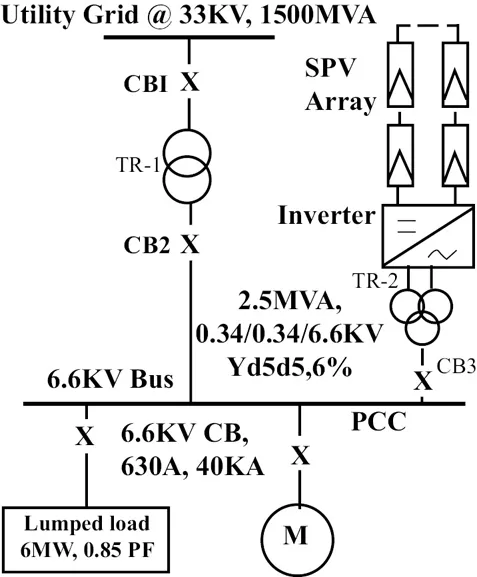
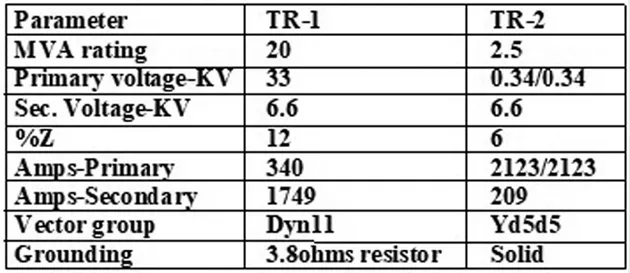
The industry under study is the chemical industry, whose power schematic diagram before PV integration is shown in Figure 1.2, which is self-explanatory. With the addition of a 2 MWp solar photo voltaic (SPV) power plant (SPP), the same has become as a microgrid, as shown in Figure 1.3. At point of common coupling (PCC), the CB-3 with its protective relay isolates the DER from the utility grid in the case of fault on either side. The brief technical particulars of transformers are shown in Figure 1.4.
Figure 1.2Pre-integration schematic.
Figure 1.3Post-integration schematic.
Figure 1.4Transformers details.
The protection system management (PSM) in microgrids is very challenging due to two-way or bi-directional power flow and device adequacy. The protection system has to isolate the microgrid from the utility grid in the case of fault on either side. It should protect the existing system and devices and grid when a fault occurs on either side. Hence, a properly co-ordinated protection system is required in a microgrid network with strict control of isolations. The protective relays shall be time-graded for over-current and earth faults [5]. Even though the total electrical network is large in size, the present study is restricted to 6.6 kV switchgear (popularly known as SWGR) i.e., PCC and its power “in” and “out” connections for fault current calculations and simulations. The total load of the industries was 10.2 MW which was totally met from...

Table of contents

  1. Cover
  2. Half Title
  3. Title Page
  4. Copyright Page
  5. Table of Contents
  6. Editors
  7. Organizing Committee
  8. Technical Committee
  9. Preface
  10. 1 Post PV integration protection issues
  11. 2 Case study on renewable energy integration (solar) challenges with captive/cogeneration plants and optimization of plant operation
  12. 3 Control of unmanned surface vehicles with randomized probabilistic approach
  13. 4 Islanding classification and low-voltage ride through for grid connected transformerless inverter
  14. 5 Machine learning classifier for fault classification in photovoltaic system
  15. 6 Performance analysis and comparison of 4-bit adder architectures
  16. 7 Improved image compression using lifting wavelet
  17. 8 A single cycle low latency bypass router based on network on chip
  18. 9 Proximal and remote sensing of abiotic stress in crops
  19. 10 Energy management strategy for plug-in electric vehicle with DFIG system
  20. 11 Energy harvesting cognitive radio: A review
  21. 12 Impact of geographical locations on the PV inverter lifetime considering mission profile and uncertainties
  22. 13 Feasibility analysis of smart grid distributed generation using RETScreen: A case study of industrial building
  23. 14 Mathematical modelling of semiconductor devices and circuits: A review
  24. 15 Small signal III-V high gain MOSFET
  25. 16 Impact of solar grid-based virtual power plant on grid flexibility
  26. 17 Oxide thickness variation effects in MOS AlGaN/GaN HFET
  27. 18 SAR based best designs for wearable antennas: A review
  28. 19 Design and development of electronic precipitator for particulate matter air purification processes
  29. 20 A critical survey on vertical handoff algorithms
  30. 21 A circular monopole ultra-wideband antenna with a notch band at 5.8 GHz
  31. 22 A comprehensive anatomy for handover probability in heterogeneous wireless networks
  32. 23 Secure communication channel for grid users using AES Encryption
  33. 24 SIC scheduling algorithm based MIMO technique for mobile ad-hoc networks
  34. 25 Detection of nitrous oxide gas using silicene nanoribbons
  35. 26 Placement of solar DGs and capacitors in distribution network using combined approach
  36. 27 iPlanty: A smart agriculture approach
  37. 28 Electrostatically actuated graphene NEMS switch with different bridge structures
  38. 29 Pre- and post-filter selection for image segmentation
  39. 30 Impact of temperature on 14 nm FINFET with high-K different oxide material
  40. 31 Violation of independence assumption in ICA and its consequences
  41. 32 Architecture, key technologies and emerging applications of 5G cellular networks
  42. 33 Exploration of recent medium access control (MAC) protocols for efficient transmission of data in wireless body area network
  43. 34 A review paper on improving the network efficiency of IEEE 802.11e networks
  44. 35 Cluster head selection with dynamic clustering technique using mobility and stability parameters
  45. 36 Optimization of fire disaster management technique using fuzzy tools
  46. 37 Plant species recognition using CNN
  47. 38 Multilevel coding scheme with trellis codes as component code in 5G scenario
  48. 39 Optimal control of renewable energy system integrated with electric vehicle
  49. 40 Energy efficient concurrent MAC transmission based UWASN for tsunami warning
  50. 41 Comparative analysis of congestion pricing using application of PTDF method and Bialek’s method in Indian Utility 146-Bus system
  51. 42 Motion detection and tracking of surveillance videos under distorted environments
  52. 43 An effective strategy for denoising of MRI images to detect brain tumour
  53. 44 Wideband MIMO antenna with improved isolation
  54. 45 BBO based location optimization of target nodes using single mobile anchor node in WSNs
  55. 46 Smart queue management system for public transportation
  56. 47 Proposal of new performance measures for ICA
  57. 48 WSN sensor deployment and sampling interval: Role of dynamics
  58. 49 Recognition and categorization of plant from leaf image using visual traits
  59. 50 Fast method of face recognition in real time using Raspberry-Pi and Intel Movidius NCS
  60. 51 Design of an automatic on-load tap changing distribution transformer
  61. 52 An advanced driver assistance system for autonomous vehicles: Design and test in virtual environment
  62. 53 Evaluation of additive manufacturing using Marlin firmware
  63. 54 Analysis of 5G channel parameters using mmWave channel simulator NYUSIM
  64. 55 Raspberry Pi-based smart waste management system using Internet of Things
  65. 56 Comparative performance analysis of service discovery protocol and interference management schemes for device to device communication in 5G network
  66. 57 Raspberry-Pi and Intel Movidius Assisted Framework for Fruit Quality Monitoring
  67. 58 Control scheme of doubly-fed induction generators applied in wind energy conversion systems
  68. 59 Stability assessment of single-area thermal automatic generation control system using eigenvalue analysis
  69. 60 Design and analysis of a shared charged dynamic latch comparator
  70. 61 Load flow studies of LV microgrid using ETAP
  71. 62 A universal memory that never runs out of steam
  72. 63 Fault simulation algorithm for transistor single stuck short faults
  73. 64 Qualitative performance analysis of greyscale image denoising techniques
  74. 65 A novel hybrid GWO-PS based solution approach for combinatorial unit commitment problem
  75. 66 Power quality based comparative analysis of resonant inverters
  76. 67 A comprehensive analysis of biosensor and performance parameters
  77. 68 A review: Building fire detection and emergency evacuation system
  78. 69 Statistical evaluation of colour image denoising techniques
  79. 70 Smart water quality analysis system using datapine
  80. 71 Design of MPPT based controller for BLDC motor drive
  81. 72 Hybrid channel estimation via fuzzy method over Nakagami-m fading in MIMO-OFDM system
  82. 73 Analysis of IoT sensors for monitoring the oil pipeline parameters
  83. 74 Crop survival analysis using machine learning and Internet of Things
  84. 75 A review on video forensics system using soft computing techniques
  85. 76 A new method for calculation of permittivity of spacer in gas insulated busduct
  86. 77 A performance study and PAPR assessment of OFDM system for the diverse modulation schemes
  87. 78 Power system security of distributed network using contingency analysis
  88. 79 4K HDMI USB3 capture card reference design
  89. 80 A comparative review of different TMOs for HDR images
  90. 81 Classification of P2P file-sharing traffic using heuristic based and statistical based techniques
  91. 82 A review of crop disease and pest forewarning using machine learning
  92. 83 Modelling of inverters using MoS2 based transistors
  93. 84 Hardware based design of smart warehouse monitoring system
  94. 85 Design of battery management and monitoring system for electric vehicles
  95. 86 Stewart Platform: The 6 DOF parallel manipulator
  96. 87 IoT security algorithms: A performance comparison
  97. 88 COVID-19 ramifications during pregnancy
  98. 89 Frame selection based video watermarking technique based on DWT, K-SVD, rail fence to address quality loss of data
  99. 90 Deep learning inspired continuous estimation framework for Scrum projects