eBook - ePub
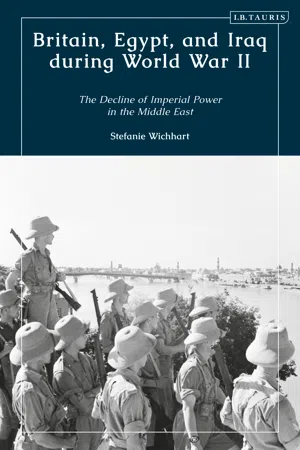
Britain, Egypt, and Iraq during World War II
The Decline of Imperial Power in the Middle East
- 240 pages
- English
- ePUB (mobile friendly)
- Available on iOS & Android
eBook - ePub
Britain, Egypt, and Iraq during World War II
The Decline of Imperial Power in the Middle East
About this book
This book explores the tumultuous war years through the lens of the British Embassies in Cairo and Baghdad, demonstrating the role that the Second World War played in shaping the political and social map of the contemporary Middle East. The war served as a catalyst for seismic changes in Arab society and the emergence of new movements that provided powerful critiques of British intervention and of the governments that facilitated it, making the war a critical turning point in Britain's empire in the Middle East.
Information
1
The Shadows of War, September 1938–August 1939
The September 1938 Munich crisis brought home for both Arab and British leaders the ways in which events in Europe would reverberate in the Middle East. In light of the Italian presence in Libya, Britain informed the Egyptian government that this was an “apprehended international emergency” and invoked its treaty rights. All three services reinforced their positions and British troops were sent to Mersa Matruh, with plans to send additional reinforcements from India. Britain found Prime Minister Muhammad Mahmoud’s government to be extremely helpful in facilitating these measures, and took its response as proof of the value of the Anglo-Egyptian Treaty.1
Yet the crisis also raised questions about Britain’s ability to protect small states and damaged its prestige in the Middle East. Both Egypt and Iraq were in treaty relations with Britain that were designed to provide for their defense and they had just witnessed the dismantlement of Czechoslovakia, a country that had a military treaty with France. Would their treaties be enough to protect them, or would the obligations they entailed undermine their sovereignty and put them in harm’s way? Takla Pasha, proprietor of the Egyptian newspaper al-Ahram, told an embassy official that Egypt needed a strong ally and the clear lesson from Munich was that “England had given way to a show of force … Egyptians were seriously asking themselves whether the Anglo-Egyptian Alliance was really worth the candle.”2 Britain faced a real public relations challenge in Egypt; as one British official noted, “The moral of the recent crisis, as far as Egypt is concerned, seems to be that Egyptian policy in the event of war or rumours of war will depend partly on how much Egypt fears Italy, but even more on how much she respects our armed strength.”3
The December 1938 Speech from the Throne to the Egyptian Parliament addressed the shadow of Munich, leading to a debate among Egypt’s political elite as to the country’s treaty obligations. Under Article 7 Egypt was committed to offer “all the facilities and assistance in his power, including the use of his ports, aerodromes and means of communication,” but did this mean that Egypt would be required to declare war?4 In the ensuing debate former Prime Minister Isma‘il Sidqi concluded that it did not but warned that the requirements of Article 7 would make Egypt a belligerent party by default. The country would pay a high price for cooperating with Britain in war and the treaty needed to permit Egypt to place its own interests first and act freely in decisions affecting its defense. As he later stated in defending his position: “In the light of the crisis of September … is not an Egyptian justified when he asks that Egypt and her inhabitants, to whom the Sudeten question is of very secondary importance to Egypt, shall not be dragged into a possible future conflict arising from this or from a similar cause?”5
Sidqi’s speech caused an uproar and sparked an extended discussion in both Egyptian and British official circles as to Egypt’s obligations to Britain should war break out in Europe. Sa‘dist Party leader Ahmad Mahir argued that Egypt should declare war when the time came and Prime Minister Muhammad Mahmoud reaffirmed the government’s commitment to fulfill all of the terms of the treaty. He privately approached British Ambassador Sir Miles Lampson and suggested that an article in the Times responding to Sidqi’s speech would be a useful warning. The article, which highlighted the fact that Sidqi was undermining the 1936 treaty which he had himself signed, had the desired result. It was widely quoted in the Egyptian press and Lampson was particularly amused by an Egyptian cartoon that showed Britannia, representing the Times, spanking Sidqi while the world looked on.6 Yet the damage had been done, and Lampson reflected that “the evil seed sown during the September crisis, of the idea of Egyptian neutrality in the event of war began to bear poisonous flowers” in the following months.7
The Egyptian debate over Munich was part of a broader exchange in the local press about the rise of fascism, the health of Egypt’s parliamentary system, and the merits of the Anglo-Egyptian Treaty. While many of these voices were quick to point out the threat that aggressive Italian and German expansionism posed to Egypt, these developments had troubling implications for Britain on the verge of war, exposing alternative visions for Egypt’s future.8 British officials had long described Egyptian politics using the analogy of the three-legged stool. According to this model the palace, the nationalist Wafd Party, and the British were the three pillars of stability, with power circulating among them in an orderly pattern that could, in the estimation of many British officials, predict future political developments.9 By 1939 it was clear to the embassy that the other two legs of the Egyptian stool might prove obstructive to wartime preparations.
Sidqi’s speech in support of Egyptian neutrality and sympathy for the fascist model was particularly troubling given his close ties to the palace and King Farouk. A long-time advocate of authoritarian government, Sidqi placed Egypt’s response to the crisis within the larger global debate over the merits and weaknesses of fascism compared to Western liberalism. He called on the Egyptian people to follow Germany’s example “to sacrifice individual interest for the good of the collective, in order to make Egypt a strong nation.”10 King Farouk, in a meeting with embassy officials in August 1939, echoed this argument, observing that given the serious international climate “it was surely advisable for Egypt to discard such aspects of democratic procedure as had proved useless or inapplicable and supplant them by something more calculated to ‘get a move on.’”11
Lampson attributed these developments to the influence of Italian propaganda as “both the Italians and Germans were exploiting the idea that Egypt might be dragged by the Anglo-Egyptian Alliance into a war which was not directly her concern, and that her path of safety lay in re-insurance with Great Britain’s probable adversaries.”12 Egypt had a sizeable Italian community and the Egyptian monarchy had long-standing ties to Italy, where Farouk’s father had lived in exile. The palace had many Italian courtiers, from the king’s hairdresser to his masseur to his mistress, all of whom were perfect mediums for the Italian legation to spread its message among Egypt’s elite.13
The other leg of the stool, the Wafd Party, endorsed the fulfillment of Egypt’s treaty obligations in the midst of the Munich crisis, but it weighed in on the broader debate over democracy versus fascism from a different perspective. The Wafd had its origins in the events surrounding the 1919 Egyptian Revolution and party leader Mustafa al-Nahhas had served as the main Egyptian negotiator of the 1936 Anglo-Egyptian Treaty during his tenure as prime minister. The Wafd prized its role as the nationalist and democratic voice in Egypt and argued that the problem was not liberal democracy itself but rather the way in which Britain had interfered with its smooth functioning by sins of both omission and commission. When the Wafd fell from power in 1937 Nahhas blamed Britain for failing to protect his administration from attacks by the palace and refusing to intervene in the 1938 parliamentary election in which, as the embassy admitted, “every form of pressure was applied to voters to support the Government candidates and to prevent them from voting for the Wafd.”14 In a spring 1939 anti-British press campaign the Wafdist press publicized examples of British intervention in internal Egyptian affairs that overstepped the parameters of the treaty. Lampson reported that the Wafd were now “encouraging non co-operation with us in any war on the grounds that the Egyptian people deprived of their democratic liberties, have no interest in fighting for democracies and that Egyptians should not be sent to be killed for British interests.”15 Nahhas informed a British official that, if allowed to enjoy a truly democratic political system, free of British interference, Egypt would gladly fight to defend freedom.16
In light of these challenges, in February 1939 Lampson undertook a detailed examination of the status of democracy in Egypt but reached a different conclusion. Democracy in Egypt was flawed not due to British intervention but due to internal factors, particularly the way in which it threatened the ruling class, who undermined it at every step. Experience had, in Lampson’s opinion, proven that the constitutional model was unsuitable for Egypt and created the difficult situation where the king and court “must obviously dislike this democratic virus with which we have inoculated the Egyptian people.” British intervention had not stifled democracy, and in fact those who yearned for a viable constitutional system in Egypt “turn naturally to England as the legendary Deus ex Machina, who, in spite of treaty fictions, is still confidently believed to be able to exercise decisive influence in these directions.” Yet this very intervention further undermined Britain’s ability to sell itself as a democratic power, a tension that lay at the heart of the three-legged stool model of Egyptian politics.17
How, then, could the British effectively respond to these threats and the trend toward Egyptian neutrality? In a statement that would define Lampson’s doctrine for relations with the palace throughout the war, he wrote: “A youthful and headstrong Oriental potentate can in the end only be swayed by considerations of force. It lies with us so to strengthen our position in the Eastern Mediterranean that neither King Farouk nor his entourage can have any doubt of our power to defend Egypt, and, if necessary, to force her rulers to comply with our wishes.”18 This sentiment reveals the rationale behind Lampson’s relentless requests for troop reinforcements for Egypt, to the great frustration of the military authorities, but also provides insight into Lampson’s notoriously strained relationship with King Farouk. The ambassador repeatedly vacillated between a strongly held conviction that Farouk must go, and a hope that “the boy may yet make good.”19
The three-legged stool provided a convenient model for evaluating and predicting Egyptian politics, but it obscured a number of forces that were becoming increasingly important in the interwar period. The Wafd supported a paramilitary organization called the Blue Shirts while Misr al-Fatat (Young Egypt), an ultra-nationalist group led by Ahmad Husayn, organized the rival Green Shirts movement. Both provided the impetus for street protests and violence until the Mahmoud government banned paramilitary groups in 1938. Al Ikhwan al-Muslimun (the Muslim Brotherhood), established in 1928 by Hassan al–Banna, provided another focal point of opposition to the political status quo. Islamic movements in Egypt were emboldened by the palace’s 1938–9 campaign to position Farouk as Caliph, with visions of leadership of the Islamic world. While the palace’s effort ultimately failed, it added a religious dimension to Egyptian advocacy of the Palestinian Arab cause in the midst of the Arab revolt of 1936–9. The Muslim Brotherhood was particularly active in organizing protests and raising funds and in autumn 1938 Cairo hosted the World Inter-Parliamentary Congress of Arab and Muslim Countries for the Defence of Palestine.20
The status of Palestine became a lightning rod for growing anti-British rhetoric in Egypt in the late 1930s. The spring 1939 Wafdist anti-British press campaign, examined above, included attacks on Britain’s Palestine policy sparked by the St. James Conference on Palestine held in London in February and March. In addition to the Zionist and Palestinian Arab delegations, the Arab states of Transjordan, Saudi Arabia, Iraq, and Egypt were invited to send representatives. When the conference ended in March without a resolution Ambassador Lampson was instructed to continue discussions with the Arab representatives in Cairo. The May 1939 White Paper, drafted with the changing international context and the looming conflict in mind, was designed to assuage Arab concerns. It set limits on Jewish immigration and land purchases and established a framework for a unified state in treaty relations with Britain.21 These developments presented multiple problems for the British. Writing in May 1939, Lampson reflected on the events of 1938:
The situation in Palestine was, indeed, a matter of the utmost concern on strategical grounds throughout the whole year. It placed the Egyptian Government in a very awkward position and complicated their day to day relations with the Embassy; it tended to detract from the mutual confidence which was essential for the implementation of the treaty; it was a happy hunting ground for the anti-British propagandist who did not shrink from endeavouring to enlist the sympathies of powerful Moslem divines in Egypt and elsewhere; and finally it denuded Egypt of much needed British troops just at a moment when their presence at their normal stations was most necessary.22
Preparing for War in Egypt
Britain praised Egypt’s cooperation during the September crisis, which served as a “valuable rehearsal” for war, but it also exposed some worrying vulnerabilities in British defense plans for Egypt.23 In February 1939 Sir Thomas Russell Pasha, the British head of the Egyptian police, bewailed the lack of preparedness for the impending conflict: “Never have things been more unsatisfactory out here … A complete lack of direction either from the Government or from the Embassy … ‘Make believe’ rules the country.” As for intelligence, “no such thing exists. We know nothing of what … the Germans are doing inside the country.”24 Russell Pasha’s comments reflect a sense of unease common among British officials in the Middle East in the early months of 1939. Given its strategic significance and geopolitical location, Cairo saw an expansion of the British presence on the eve of the war to address military, intelligence, and propaganda needs. Wartime organizations-in-waiting were placed under the umbrella of either the embassy or the military mission, in keeping with the terms of the Anglo-Egyptian Treaty.
Egypt’s most immediate threat came from the Italian presence in neighboring Libya and East Africa, as the Italian garrison in Libya slowly expanded to a total of 215,000 men by August 1939.25 The disparity in British and Italian air power in the region was a particular point of concern for the Egyptian prime minister, who requested that Britain send additional reinforcements.26 The threat of an Italian air attack loomed large in the minds of both British planners and the Egyptian public. Air defenses were vital to protect key strategic assets such as Alexandria harbor and the Suez Canal. A British anti-aircraft brigade arrived in Egypt in 1938 and trained local troops, and even at a time when there were great demands for anti-aircraft equipment around the empire and at home Britain sent additional guns to Egypt in 1939.27 The decision was both strategic and political, as Axis propaganda capitalized on the threat bombi...
Table of contents
- Cover
- Halftitle Page
- Title Page
- Contents
- List of Illustrations
- List of Maps
- Acknowledgements
- Note on Names and Transliteration
- Introduction
- 1 The Shadows of War, September 1938–August 1939
- 2 “We Have Nothing to Do with That War,” September 1939–April 1940
- 3 Calling Britain’s Bluff in the Middle East, May 1940–January 1941
- 4 Iraq and the Rashid ‘Ali Coup, January 1941–May 1941
- 5 Getting the “Muddle out of ‘Muddle East,’” June 1941–December 1941
- 6 Abdin Palace and “British Bayonets,” January 1942–October 1942
- 7 “The Cause of the United Nations Is the Cause of the Arab Nation,” November 1942–June 1943
- 8 “Let Us Stand by Our Friends,” March 1943–December 1943
- 9 Democracy and Development, January 1944–September 1944
- 10 Fighting the New Protectorate and the New Mandate, September 1944–May 1945
- 11 War’s End, May 1945–September 1945
- 12 The Postwar “Bill of Reckoning” and the Decline of Imperial Power, 1945–6
- Notes
- Bibliography
- Index
- Imprint
Trusted by 375,005 students
Access to over 1.5 million titles for a fair monthly price.
Study more efficiently using our study tools.
Frequently asked questions
Yes, you can cancel anytime from the Subscription tab in your account settings on the Perlego website. Your subscription will stay active until the end of your current billing period. Learn how to cancel your subscription
No, books cannot be downloaded as external files, such as PDFs, for use outside of Perlego. However, you can download books within the Perlego app for offline reading on mobile or tablet. Learn how to download books offline
Perlego offers two plans: Essential and Complete
- Essential is ideal for learners and professionals who enjoy exploring a wide range of subjects. Access the Essential Library with 800,000+ trusted titles and best-sellers across business, personal growth, and the humanities. Includes unlimited reading time and Standard Read Aloud voice.
- Complete: Perfect for advanced learners and researchers needing full, unrestricted access. Unlock 1.5M+ books across hundreds of subjects, including academic and specialized titles. The Complete Plan also includes advanced features like Premium Read Aloud and Research Assistant.
We are an online textbook subscription service, where you can get access to an entire online library for less than the price of a single book per month. With over 1.5 million books across 990+ topics, we’ve got you covered! Learn about our mission
Look out for the read-aloud symbol on your next book to see if you can listen to it. The read-aloud tool reads text aloud for you, highlighting the text as it is being read. You can pause it, speed it up and slow it down. Learn more about Read Aloud
Yes! You can use the Perlego app on both iOS and Android devices to read anytime, anywhere — even offline. Perfect for commutes or when you’re on the go.
Please note we cannot support devices running on iOS 13 and Android 7 or earlier. Learn more about using the app
Please note we cannot support devices running on iOS 13 and Android 7 or earlier. Learn more about using the app
Yes, you can access Britain, Egypt, and Iraq during World War II by Stefanie Wichhart in PDF and/or ePUB format, as well as other popular books in History & Middle Eastern History. We have over 1.5 million books available in our catalogue for you to explore.