Highly Commended, Society for Renaissance Studies Biennial Book Prize 2022
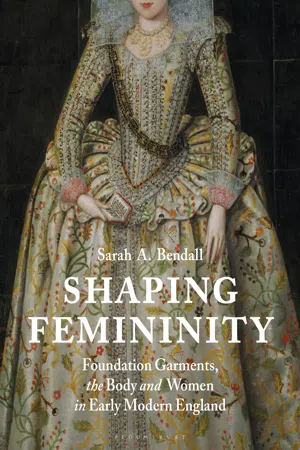
In sixteenth and seventeenth-century England, the female silhouette underwent a dramatic change. This very structured form, created using garments called bodies and farthingales, existed in various extremes in Western Europe and beyond, in the form of stays, corsets, hoop petticoats and crinolines, right up until the twentieth century. With a nuanced approach that incorporates a stunning array of visual and written sources and drawing on transdisciplinary methodologies, Shaping Femininity explores the relationship between material culture and femininity by examining the lives of a wide range of women, from queens to courtiers, farmer's wives and servants, uncovering their lost voices and experiences. It reorients discussions about female foundation garments in English and wider European history, arguing that these objects of material culture began to shape and define changing notions of the feminine bodily ideal, social status, sexuality and modesty in the early modern period, influencing enduring Western notions of femininity.
Beautifully illustrated in full colour throughout, Shaping Femininity is the first large-scale exploration of the materiality, production, consumption and meanings of women's foundation garments in sixteenth and seventeenth-century England. It offers a fascinating insight into dress and fashion in the early modern period, and offers much of value to all those interested in the history of early modern women and gender, material culture and consumption, and the history of the body, as well as curators and reconstructors.
eBook - ePub
Shaping Femininity
Foundation Garments, the Body and Women in Early Modern England
- 352 pages
- English
- ePUB (mobile friendly)
- Available on iOS & Android
eBook - ePub
Shaping Femininity
Foundation Garments, the Body and Women in Early Modern England
About this book
Information
1
The foundations of the body
Foundation garments and the early modern female silhouette
It was in the late fifteenth century when the now tired proverb ‘clothes make the man’ was first recorded in English, referring to the way that people are judged according to their dress. At the start of the sixteenth century, the Dutch humanist Desiderius Erasmus also famously noted that clothing is ‘the body’s body, and from this too one may infer the state of a man’s character’.1 Although these sayings were uttered decades apart, what they have in common is an understanding of the ways that dress and the body are intimately connected, and how in the minds of many early modern people they were often inseparable. This chapter will consider how foundation garments came to make the early modern English woman, creating a new female form out of materials other than flesh.
Historical dress and dressing norms can seem foreign to modern readers. ‘If the past is a foreign country,’ Susan Vincent has observed, ‘then it certainly dresses in alien ways.’2 Just as solid additions to clothing began to form the foundation of the female figure in England during the sixteenth and seventeenth centuries, this chapter will form the foundation of this book by shedding light on early modern dress norms. Charting fashionable changes in dress in England from the late medieval period to the late Stuart period, it will uncover the emergence of foundation garments from underneath the many layers of clothing worn by English women. As this chapter focuses on fashionable change during these centuries, it primarily draws on sources relating to the social elites who dictated many of these styles. However, due to the fragmentary nature of early modern evidence, I also draw on other European examples, primarily from Spain, France and the Low Countries, to create a more accurate picture of fashionable change during these centuries.
In addition to providing an overview of historical silhouettes, fashions and terminology, this chapter also explores how English sources from the early modern period materially, visually and linguistically conflated foundation garments with the parts of the body that they clothed or concealed. As Laura Gowing and Patricia Simons have argued, early modern bodies existed ‘in a different conceptual world’.3 Mental, emotional and physical experiences were entwined and metaphors had real influence on the ways that gendered bodies were understood, and these metaphors about bodies played roles in everyday life through ‘practice, spectacle, object and sign’.4 Establishing the ways that the social female body was imagined from the objects that covered it, this chapter takes as its foci the latter two aspects – object and sign. Whalebone hips replaced real hips of human bone, boned bodies were seen to correct the physical faults of real female torsos, and foundation garments were often used to construct the recognizable feminine silhouette on boy actors on the theatre stage. Consequently, in early modern England, foundation garments became constitutive of not just fashion but of the female body itself as they irrevocably shaped how it was understood and perceived. Acknowledging these popular metaphors for foundation garments and female bodies allows us to understand how different ideals of femininity were mediated by these objects. Subsequent chapters will further explore these ideals through the three lenses of spectacle, embodiment and actual lived experience.
Women’s structural fashions before the mid-sixteenth century
The basic elements of early modern English dress were established in the Tudor courts of Henry VII and Henry VIII, where fashionable styles evolved from dress and tailoring developments of the preceding late medieval period. Men and women’s styles of the early medieval period were characterized by simplicity, with garments often made from simple T-shaped patterns with flowing lines of draped fabric that followed the natural contours of the body or loosely concealed it. Beginning in the fourteenth century, innovations in tailoring such as curved seams, buttons and tight sleeves saw the cut and construction of men and women’s dress become more complex.5 For women, surcoats or bliauts were worn over the top of cottes, sleeved garments that were laced at the front, and chemises or smocks made of plain linen. Bliauts were also laced at the sides to create shape to the figure.6 These garments were not stiffened but they did give a level of support to the breasts and define the shape of the body.7
For many years the garments described above were believed to be the extent of medieval women’s underdress. That was until 2008 when excavations at Lengberg Castle in East Tyrol, Austria, uncovered approximately 2,700 individual textile fragments that were carbon dated to the mid-fifteenth century.8 Among these textiles were many types of female undergarments, including what modern observers would term a corselet – a modern bra-like garment with additional fabric that extended to the navel, which was then fastened at the side with laces.9 The garment gave support to the breasts and it is also possible that it had an attached skirt, making it similar to what the English called a cotte.10 The very design of this undergarment indicates that during the fifteenth century the female body had already undergone some form of body shaping. Most probably these garments were used to create a sleek and slender looking torso, removing unsightly bulges where gowns would have hugged the figure.
By 1450 a soft and wide silhouette characterized by the houppelande, a voluminous gown that could have a wide V-neck that revealed the contrasting kirtle underneath, was preferred.11 These gowns were widely worn and were often girdled or belted just below the breasts, sometimes with contrasting fabrics, and laced at the back, as is visible in an illuminated manuscript bearing the arms of Margaret of York and Edward VII (see Fig. 1.1). The soft silhouette of the female torso during the late medieval period was contrasted with highly sculptural headdresses that were popular among elite women. Two common styles during the fifteenth century were the escoffion and the hennin. The escoffion wa...
Table of contents
- Cover
- Half-title Page
- Title Page
- Contents
- Acknowledgements
- Notes to the reader
- List of abbreviations
- Introduction: Investigating the structured female body
- 1 The foundations of the body: Foundation garments and the early modern female silhouette
- 2 The artificial body: Courtiers, gentlewomen and disputed visions of femininity, 1560–1650
- 3 The socially mobile body: Consumption of foundation garments by middling and common women, 1560–1650
- 4 The body makers: Commissioning and making foundation garments in early modern England
- 5 The everyday body: Assumptions, tropes and the lived experience
- 6 The sexual body: Eroticism, reproduction and control
- 7 The respectable body: Rising consumption and the changing sensibilities of late seventeenth- and early eighteenth-century England
- Conclusion: Misconceptions and legacies
- Glossary
- Notes
- Bibliography
- Illustrations
- Index
- Copyright
Trusted by 375,005 students
Access to over 1.5 million titles for a fair monthly price.
Study more efficiently using our study tools.
Frequently asked questions
Yes, you can cancel anytime from the Subscription tab in your account settings on the Perlego website. Your subscription will stay active until the end of your current billing period. Learn how to cancel your subscription
No, books cannot be downloaded as external files, such as PDFs, for use outside of Perlego. However, you can download books within the Perlego app for offline reading on mobile or tablet. Learn how to download books offline
Perlego offers two plans: Essential and Complete
- Essential is ideal for learners and professionals who enjoy exploring a wide range of subjects. Access the Essential Library with 800,000+ trusted titles and best-sellers across business, personal growth, and the humanities. Includes unlimited reading time and Standard Read Aloud voice.
- Complete: Perfect for advanced learners and researchers needing full, unrestricted access. Unlock 1.5M+ books across hundreds of subjects, including academic and specialized titles. The Complete Plan also includes advanced features like Premium Read Aloud and Research Assistant.
We are an online textbook subscription service, where you can get access to an entire online library for less than the price of a single book per month. With over 1.5 million books across 990+ topics, we’ve got you covered! Learn about our mission
Look out for the read-aloud symbol on your next book to see if you can listen to it. The read-aloud tool reads text aloud for you, highlighting the text as it is being read. You can pause it, speed it up and slow it down. Learn more about Read Aloud
Yes! You can use the Perlego app on both iOS and Android devices to read anytime, anywhere — even offline. Perfect for commutes or when you’re on the go.
Please note we cannot support devices running on iOS 13 and Android 7 or earlier. Learn more about using the app
Please note we cannot support devices running on iOS 13 and Android 7 or earlier. Learn more about using the app
Yes, you can access Shaping Femininity by Sarah Bendall,Sarah A. Bendall in PDF and/or ePUB format, as well as other popular books in Design & Fashion Design. We have over 1.5 million books available in our catalogue for you to explore.