In Philosophical Enactment and Bodily Cultivation in Early Daoism, Thomas Michael illuminates the formative early history of the Daodejing and the social, political, religious, and philosophical trends that indelibly marked it. This book centers on the matrix of the Daodejing that harbors a penetrating phenomenology of the Dao together with a rigorous system of bodily cultivation. It traces the historical journey of the text from its earliest oral circulations to its later transcriptions seen in a growing collection of ancient Chinese excavated manuscripts. It examines the ways in which Huang-Lao thinkers from the Han Dynasty transformed the original phenomenology of the Daodejing into a metaphysics that reconfigured its original matrix, and it explores the success of the Wei-Jin Daoist Ge Hong in bringing the matrix back into its original alignment. This book is an important contribution to cross-cultural studies, bringing contemporary Chinese scholarship on Daoism into direct conversation with Western scholarship on Daoism. The book also concludes with a discussion of Martin Heidegger's recognition of the position and value of the Daodejing for the future of comparative philosophy.
Trusted by 375,005 students
Access to over 1.5 million titles for a fair monthly price.
The basic perspective of this study is rooted in the difference between two separate versions of an early Chinese Daodejing, the first called the Laozi Daodejing and the second the Huang-Lao Daodejing. There are multiple ways to conceive of this difference, but they are possible only if one accepts that there are these two separate versions to begin with. Establishing this is the objective of this study and not its starting point, which begins by letting the two versions announce themselves by way of their English translations of the first chapter of the Daodejing. In order to display more clearly their difference, I set them against each other line by line, with the Laozi Daodejing on the left column and the Huang-Lao Daodejing on the right:
Dao’s can guide, but they are not the temporalizing Dao.
The Dao that can be spoken is not the constant Dao.
Names can name, but they are not the temporalizing Name.
The name that can be named is not the constant name.
Nothingness names the beginning of Heaven and Earth
The Nameless is the origin of Heaven and Earth
Being names the mother of the myriad beings.
The Named is the mother of the myriad things.
For this reason,
For this reason,
Hold to the standpoint of Nothingness with the intent to witness its wonders.
Constantly be without desire to see its wonders.
Hold to the standpoint of Being with the intent to witness its manifestations.
Constantly be with desire to see its manifestations.
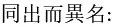
These two arise from the same but with different names.
These two are the same but diverge in name as they issue forth
and both can be called Mystery.
and they are called the profound.
Mystery upon Mystery: the gateway of the many and the wonders.
More profound than the profound: the gateway of manifold wonders.
The difference between the two versions is that the Laozi Daodejing is grounded in a phenomenology while the Huang-Lao Daodejing is grounded in a metaphysics. However, I do not here analyze just what the various terms in each version refer to or how they refer; I do not describe the differences between “Being” and “Nothingness” next to “the Named” and “the Nameless”; I do not discuss “the standpoints” of Being and Nothingness or their possible connections to “being with or without desire”; and I do not consider the consequences of “arising from the same” versus “being the same” in origin. I also do not here explain my use of Being and Nothingness to translate you
and wu
I do not discuss what I mean by phenomenology and metaphysics; I explore neither the historical nor the philosophical priority of either version; finally, I do not engage with the difference between “temporalizing” heng and “constant” chang.
These issues are the matter of everything that follows in this book. Nonetheless, equipped with these parallel translations of Daodejing chapter 1 in two versions, the reader is better equipped to follow the course of this study with a clear picture of what the destination will look like. In sum, the difference between the Laozi Daodejing and the Huang-Lao Daodejing is encapsulated in the difference between “temporalizing”
heng and the pristine Dao, and “constant”
chang and the cosmic Dao. The reader will not be entirely wrong to expect that the matrix of the Daodejing should arise from the Laozi Daodejing rather than the Huang-Lao Daodejing.
The image of a matrix is useful in exploring the early career and vicissitudes of the Daodejing as well as the life course of Yangsheng Daoism. As a substance, entity, or environment, a matrix is a wellspring or ground source with two aspects: gestating, it inwardly contains and nurtures, while birthing, it outwardly generates and produces. This study more specifically concentrates on the matrix of the Daodejing with respect to two aspects or refractive perspectives on it: the first is nameable and the other is unnameable.
The Daodejing can be compared to an analogue program consisting of hundreds of semi-autonomous units of thought pulsating through the continuously variable time-space field that is the amorphous text itself. Daodejing chapter 1 displays several of these units of thought as it explores rich and various ways of conceiving the Dao, for which logical or epistemological standpoints are inadequate.
As the Daodejing presents a sustained meditation on the Dao, its first chapter presents a refracted reflection on the text as a whole. Even if we want to provide a more historically precise translation of the chapter that turns out to be more philosophically accurate or more intellectually provocative than the standard translation that states, “The Dao that can be spoken is not the constant Dao,” it still raises a host of intriguing questions. The understood claim of that standard reading is that we in fact speak about the Dao, but this speakable Dao, according to the strict terms of metaphysics, is not the real Dao because that lies beyond language. Therefore, it is fruitful to inquire into the relationship between the nameable Dao that we can talk about and the unnameable Dao that we cannot.
The first line of the chapter introduces the text as one that gathers into itself a profundity of words that are directed to something that cannot be put into words. Lines three and four initially introduce the two aspects of the matrix: “unnamed”
and “named”
In conjunction with line one, the text appears to identify (that aspect of) the Dao that “can be spoken”
as “named,” and (that aspect of) the Dao that cannot be put into language as “unnamed.” Are these two separate Daos, or two conditions, modes, or aspects of the same Dao?
Immediately following this claim that implies that there are two aspects of the Dao, one of which is unnamed, the text proceeds to speak about the Dao at great length. Is this a contradiction or a paradox? Is the text’s speaking about the Dao then an impossibility in some logical sense that it simply evades by way of sleight of hand? But it cannot be an impossibility, because this demonstration is right in front of us, we are holding it, reading it, possibly reciting it, and this “it” is itself the Daodejing. But we might rephrase the question and ask, Is the Dao about which the text speaks the nameable Dao or the unnameable Dao?
Line 6 tells us that these two aspects of this Dao “arise from the same but with different names”
the unnamed Dao “is the beginning of Heaven and Earth”
while the named Dao is “the Mother of the myriad beings”
Line 8 further states that the “mystery upon mystery”
lies precisely in the primordiality of the pristine Dao in both of its aspects.
Yoan Ariel and Gil Raz write that “the first chapter was consciously composed as an introduction to the Daodejing, and the author or redactor of the chapter in fact responded to the very questions concerning the possibility of discussing the Dao. This response is encoded in the first chapter.”1 Ariel and Raz discuss multiple instances throughout the Daodejing of these sorts of “encoded” double meanings, and they argue that they represent two different readings of the text. Accordingly, the exoteric reading sends a political message about r...
Table of contents
Cover
Halftitle Page
Title Page
Dedication Page
Contents
Acknowledgments
Prologue Approaching the Matrix
Part One: Yangsheng Daoism and the Matrix
Part Two: Huang-Lao Daoism and the Matrix
Part Three: Ge Hong and the Matrix
Epilogue: Yangsheng Daoism and Comparative Philosophy
9 Heidegger and the Philosophy of the Dao
Notes
Works Cited
Index
Imprint
Frequently asked questions
Yes, you can cancel anytime from the Subscription tab in your account settings on the Perlego website. Your subscription will stay active until the end of your current billing period. Learn how to cancel your subscription
No, books cannot be downloaded as external files, such as PDFs, for use outside of Perlego. However, you can download books within the Perlego app for offline reading on mobile or tablet. Learn how to download books offline
Perlego offers two plans: Essential and Complete
Essential is ideal for learners and professionals who enjoy exploring a wide range of subjects. Access the Essential Library with 800,000+ trusted titles and best-sellers across business, personal growth, and the humanities. Includes unlimited reading time and Standard Read Aloud voice.
Complete: Perfect for advanced learners and researchers needing full, unrestricted access. Unlock 1.5M+ books across hundreds of subjects, including academic and specialized titles. The Complete Plan also includes advanced features like Premium Read Aloud and Research Assistant.
Both plans are available with monthly, semester, or annual billing cycles.
We are an online textbook subscription service, where you can get access to an entire online library for less than the price of a single book per month. With over 1.5 million books across 990+ topics, we’ve got you covered! Learn about our mission
Look out for the read-aloud symbol on your next book to see if you can listen to it. The read-aloud tool reads text aloud for you, highlighting the text as it is being read. You can pause it, speed it up and slow it down. Learn more about Read Aloud
Yes! You can use the Perlego app on both iOS and Android devices to read anytime, anywhere — even offline. Perfect for commutes or when you’re on the go. Please note we cannot support devices running on iOS 13 and Android 7 or earlier. Learn more about using the app
Yes, you can access Philosophical Enactment and Bodily Cultivation in Early Daoism by Thomas Michael in PDF and/or ePUB format, as well as other popular books in Teología y religión & Filosofía oriental. We have over 1.5 million books available in our catalogue for you to explore.