- 345 pages
- English
- PDF
- Available on iOS & Android
eBook - PDF
About this book
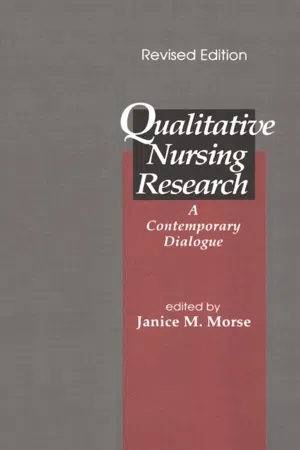
An American Journal of Nursing 1991 Book of the Year Debates about counting and coding data, ethical issues of interviewing, improving the use of self, examining one?s own culture--these are but a few of the troublesome issues nursing researchers face on a daily basis. Written for nursing researchers and graduate students, Qualitative Nursing Research addresses many of the problematic issues described above. Leading qualitative methodologists with backgrounds in phenomenology, grounded theory, and ethnography contribute specific chapters on their favorite sticky issues--which in turn form the basis for the informative dialogues at the beginning of each chapter. These stimulating dialogues reflect the active disagreements and different solutions presented, thus accurately indicating the state of the science in nursing today. In addition, contributors also examine the importance of funding, institutional review, and peer reviews. Qualitative Nursing Research is a vital resource for all nursing researchers and their advanced students. "The book is a valuable contribution grounded in the current state of qualitative research. There are some answers, solutions, suggestions offered for teaching, for conducting or not conducting research in your own culture, for getting a proposal funded, for interviewing, for choosing a sample, for combining different methods in the same study, among others. The chapters are practical, reality-based; offering concrete examples to illustrate issues discussed. . . . There are insightful critiques of research throughout the book--identifying strengths, weaknesses, or inaccurate use of methods." --Phenomenology and the Human Sciences "The book?s mix of contributors is one of its major strengths. The authors represent a cross section of major qualitative researchers. The perspectives represented include ethnography, phenomenology, and grounded theory. Collectively, they provide a vibrant and vital discussion of qualitative research in the 1990s. . . . The writing style is clear and readable. The editor has maintained the flavor of the original authors and blended the work into a consistent whole." --Rehabilitation Nursing Research "There are only a few substantial revisions to the first edition, but they are useful and important. . . .In her chapter ?Issues of Reliability and Validity?, Pamela Brink adds two very helpful sections in which she compares how the concepts of reliability and validity are treated differently in other qualitative research texts. Kathleen Knafl and Bonnie Breitmayer enhance their concluding discussion of triangulation and a solid bibliography on grant writing is added by Toni Tripp-Reimer and Marlene Zichi Cohen to their chapter ?Funding Strategies for Qualitative Research?. Moving through the book the reader will find the chapters to be . . . of high quality. . . Vangie Bergum?s ?Being a Phenomenological Researcher?, shine in their clarity and resonance. There is much that is useful here. . . practical pointers are offered in the various chapters, such as schedules for research projects, tips for interviewing and access, suggestions for getting qualitative research through institutional review boards, and how to teach qualitative research methods. Thought-provoking issues are raised, such as Brink?s notion that nursing practice as a process demands longitudinal research. Morse?s aim, to address some of the gaps in the qualitative text books, is well met. Graduate students and experienced researchers alike will find the book useful. It is one that a researcher can, in the spirit of dialogue, repeatedly return to in order to explore the questions which arise in the reading. Engaging in dialogue is made easier by the book?s format. . . . Each chapter is preceded by excerpts of dialogue from the discussion [Chicago symposium, 1987]. Some of the most interesting points are raised in these excerpts. The establishment of strong qualitative research programs by the book?s contributors . . . is noteworthy. . . . Qualitative Nursing Research: A Contemporary Dialogue makes an important contribution to the developing body of knowledge in the exploration of meaning in experience in health and illness and in nursing." --International Journal of Nursing Studies "[This book] represents an important addition to the former dearth of texts on qualitative research methods for nurses who wish to pursue ethnographic, grounded theory, and phenomenological approaches. Not only does this book make clear the distinct nature of each of these traditions, but it also wrestles with the contentious issues of sampling, to count or not to count during analysis, reliability and validity, and triangulation in qualitative research." --Palliative Medicine "I have found the book to be one of the best available on issues surrounding qualitative nursing research. . . . The strengths of Dr. Morse?s book are clear articulation of the issues on a wide range of topics pertinent to qualitative research, description of possible solutions, and recognition that other points of view are valid. . . . An additional unique feature is the short ?dialogues? between chapters. These dialogues provide the reader with an opportunity to trace the thought processes of the contributors as they struggle with the issues. The dialogues raise to consciousness those often unrecognized problems with which qualitative nurse researchers must deal in order to develop the methodology for nursing." --Joan E. Haase, Ph.D., R.N., The University of Arizona "A whole range of methodological, conceptual and technical complexities are exposed and examined. All kinds of questions which I have pondered over are raised here. . . . This is a book which makes a scholarly and significant contribution to an important debate. It should be compulsory reading for all those who claim to be doing supervising or teaching qualitative research." --Nursing Standard "This book is timely because of the tremendous debate going on about the American health care system and how it may be improved. Now, more than ever, nurses have an opportunity to prove to people in decision-making roles that ?Nursing? can contribute more to the solution of the problems than has been allowed in the past." --Health Values From the first edition: "This book is a compilation of richly textured, intelligent, well documented, and personally informed papers on issues facing qualitative nurse researchers today. . . . The discussions are refreshingly direct, uncompromised, and spirited in tone, perhaps because, initially, the target audience was made up of peers engaged in qualitative research." --Nursing Research "[Provides] salient writings of leading qualitative nursing researchers from the United States and Canada. . . . The book provides a much needed exchange of the ideas related to ?sticky issues? in qualitative research and promotes concepts that can be used by qualitative researchers and reviewers." --Gerontological Nursing
Information
Table of contents
- Cover page
- Contents
- Preface
- Preface to the Revised Edition
- Dialogue Is Qualitative Research an End in Itself or the Beginning of a Process?
- Chapter 1 - Qualitative Nursing Research: A Free-For-All?
- Dialogue On Bracketing
- Chapter 2 - The Phenomenological Perspective
- Dialogue On Developing Theory Inductively
- Chapter 3 - Ethnography and Epistemology: Generating Nursing Knowledge
- Dialogue On Ethics and Validity
- Chapter 4 - Being a Phenomenological Researcher
- Dialogue On Fieldwork in Your Own Setting
- Chapter 5 - The Use of Self in Ethnographic Research
- Dialogue On Nursing Phenomena
- Chapter 6 - Doing Fieldwork in Your Own Culture
- Dialogue On the Evolving Nature of Qualitative Methods in Nursing
- Chapter 7 - Qualitative Clinical Nursing Research When a Community is the Client
- Dialogue On Terminology
- Chapter 8 - Strategies for Sampling
- Dialogue On Replicability
- Chapter 9 - Are Counting and Coding A Cappella Appropriate in Qualitative Research?
- Dialogue On Issues about Reliability and Validity
- Chapter 10 - Issues of Reliability and Validity
- Dialogue On Interviewing
- Chapter 11 - Interview Techniques in Qualitative Research: Concerns and Challenges
- Dialogue On the Relationship Between the Researcher and the Subject
- Chapter 12 - Conducting Qualitative Studies with Children and Adolescents
- Dialogue On Triangulation
- Chapter 13 - Triangulation in Qualitative Research: Issues of Conceptual Clarity and Purpose
- Dialogue The Granting Game
- Chapter 14 - Funding Strategies for Qualitative Research
- Dialogue On Muddling Methods
- Chapter 15 - Institutional Review of Qualitative Research Proposals: A Task of No Small Consequence
- Dialogue On the Team Approach
- Chapter 16 - Field Research: A Collaborative Model for Practice and Research
- Dialogue On Teaching Qualitative Methods
- Chapter 17 - Teaching Qualitative Research: Perennial Problems and Possible Solutions
- Dialogue The Last Word
- Author Index
- Subject Index
- About the Authors
Trusted by 375,005 students
Access to over 1.5 million titles for a fair monthly price.
Study more efficiently using our study tools.
Frequently asked questions
Yes, you can cancel anytime from the Subscription tab in your account settings on the Perlego website. Your subscription will stay active until the end of your current billing period. Learn how to cancel your subscription
No, books cannot be downloaded as external files, such as PDFs, for use outside of Perlego. However, you can download books within the Perlego app for offline reading on mobile or tablet. Learn how to download books offline
Perlego offers two plans: Essential and Complete
- Essential is ideal for learners and professionals who enjoy exploring a wide range of subjects. Access the Essential Library with 800,000+ trusted titles and best-sellers across business, personal growth, and the humanities. Includes unlimited reading time and Standard Read Aloud voice.
- Complete: Perfect for advanced learners and researchers needing full, unrestricted access. Unlock 1.5M+ books across hundreds of subjects, including academic and specialized titles. The Complete Plan also includes advanced features like Premium Read Aloud and Research Assistant.
We are an online textbook subscription service, where you can get access to an entire online library for less than the price of a single book per month. With over 1.5 million books across 990+ topics, we’ve got you covered! Learn about our mission
Look out for the read-aloud symbol on your next book to see if you can listen to it. The read-aloud tool reads text aloud for you, highlighting the text as it is being read. You can pause it, speed it up and slow it down. Learn more about Read Aloud
Yes! You can use the Perlego app on both iOS and Android devices to read anytime, anywhere — even offline. Perfect for commutes or when you’re on the go.
Please note we cannot support devices running on iOS 13 and Android 7 or earlier. Learn more about using the app
Please note we cannot support devices running on iOS 13 and Android 7 or earlier. Learn more about using the app
Yes, you can access Qualitative Nursing Research by Janice M. Morse, Janice Morse in PDF and/or ePUB format, as well as other popular books in Social Sciences & Social Science Research & Methodology. We have over 1.5 million books available in our catalogue for you to explore.