- 329 pages
- English
- PDF
- Available on iOS & Android
eBook - PDF
About this book
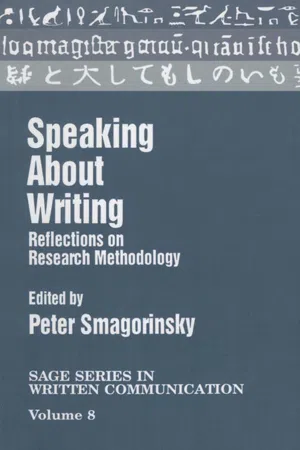
This is not a ?how-to-do? book; it is a ?why-to-do? book. What is powerful about these chapters is that they are theory driven, and they thus allow us as researchers to understand when and why particular methodologies are appropriate for investigating particular problems in particular situations. The book is, therefore, in an important sense, a ?why-you-shouldn?t? book because the authors deliberate on how the motivating theory for research is tied to the theoretical grounds for choosing a methodology. The authors grasp and reflect on the need for a researcher to fully understand a methodology?s power and its limitations. They urge researchers to consistently pose the questions: Why should I use this method? What does it yield? What lens does it provide for the problem I am investigating? What must I account for in employing it? Speaking About Writing provides not only a range of methodologies to consider for the investigation of writing, but situating them in the context of one another enables the reader to consider the relative merits of each. Above all, the authors stress that research is driven by problems rather than methods, and that premise helps researchers consider what is potentially available through the tools provided by different methodologies." --William Smith, University of Pittsburgh Used as a comprehensive text and research tool, Speaking About Writing focuses on the issues involved in the collection, analysis, and interpretation of data. The approach goes beyond mere quantitative/qualitative differences to examine and critique the very underpinnings and assumptions of the distinct methodologies. Distinguished scholars discuss different writing methods--stimulated recall, think-aloud analysis, retrospective analysis, and intervention analysis. Contributors in discourse analysis look at the ways in which individuals interact with other members of the writing community during a more extended writing process--problem discussion, draft feedback and revision, and teacher conferences. Finally, concluding chapters allow for responses from critics to earlier chapters in order to provide clarification and explanation. Speaking About Writing is the perfect text for scholars and students in written communication (composition and english), communication, research methods, and psychology (cognition).
Information
Table of contents
- Cover
- Contents
- Acknowledgments
- Introduction: Potential Problems and Problematic Potentials of Using Talk About Writing as Data About Writing Process
- Part I - Think-Aloud Protocol Analysis
- Chapter 1 - Think-Aloud Protocol Analysis: Beyond the Black Box
- Chapter 2 - Think-Aloud Protocols, Protocol Analysis, and Research Design: An Exploration of the Influence of Writing Tasks on Writing Processes
- Chapter 3 - Substance and Romance in Analyzing Think-Aloud Protocols
- Chapter 4 - Reactivity in Concurrent Think-Aloud Protocols: Issues for Research
- Part II - Retrospective Accounts of Writing Process
- Chapter 5 - "Once Upon a Time": The Use of Retrospective Accounts in Building Theory in Composition
- Chapter 6 - Using Intervention Protocols to Study the Effects of lnstructional Scaffolding on Writing and Learning
- Chapter 7 - Stimulated Recall in Research on Writing: An Antidote to "I Don't Know, It Was Fine"
- Part III - Analysis of Collaborative Discourse
- Chapter 8 - Interpreting and Counting: Objectivity in Discourse Analysis
- Chapter 9 - Discourse Analysis of Teacher–Student Writing Conferences: Finding the Message in the Medium
- Chapter 10 - What's All This Talk I Hear?: Using Sociolinguistic Analysis to Locate and Map Themes in Teacher/Student Talk about Writing
- Part IV - Interviews in the Field
- Chapter 11 - Ethnographic Interviews and Writing Research: A Critical Examination of the Methodology
- Part V - Counterpoint
- Chapter 12 - Whither Wisdom?
- Chapter 13 - Withered Wisdom: A Reply to Dobrin
- Author Index
- Subject Index
- About the Contributors
Trusted by 375,005 students
Access to over 1.5 million titles for a fair monthly price.
Study more efficiently using our study tools.
Frequently asked questions
Yes, you can cancel anytime from the Subscription tab in your account settings on the Perlego website. Your subscription will stay active until the end of your current billing period. Learn how to cancel your subscription
No, books cannot be downloaded as external files, such as PDFs, for use outside of Perlego. However, you can download books within the Perlego app for offline reading on mobile or tablet. Learn how to download books offline
Perlego offers two plans: Essential and Complete
- Essential is ideal for learners and professionals who enjoy exploring a wide range of subjects. Access the Essential Library with 800,000+ trusted titles and best-sellers across business, personal growth, and the humanities. Includes unlimited reading time and Standard Read Aloud voice.
- Complete: Perfect for advanced learners and researchers needing full, unrestricted access. Unlock 1.5M+ books across hundreds of subjects, including academic and specialized titles. The Complete Plan also includes advanced features like Premium Read Aloud and Research Assistant.
We are an online textbook subscription service, where you can get access to an entire online library for less than the price of a single book per month. With over 1.5 million books across 990+ topics, we’ve got you covered! Learn about our mission
Look out for the read-aloud symbol on your next book to see if you can listen to it. The read-aloud tool reads text aloud for you, highlighting the text as it is being read. You can pause it, speed it up and slow it down. Learn more about Read Aloud
Yes! You can use the Perlego app on both iOS and Android devices to read anytime, anywhere — even offline. Perfect for commutes or when you’re on the go.
Please note we cannot support devices running on iOS 13 and Android 7 or earlier. Learn more about using the app
Please note we cannot support devices running on iOS 13 and Android 7 or earlier. Learn more about using the app
Yes, you can access Speaking About Writing by Peter Smagorinsky in PDF and/or ePUB format, as well as other popular books in Languages & Linguistics & Communication Studies. We have over 1.5 million books available in our catalogue for you to explore.