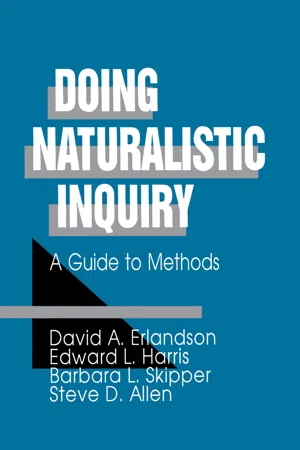
While much has been written on alternative paradigm research, there is little concrete advice on how to effectively use the theoretical notions of naturalistic inquiry in practice. Doing Naturalistic Inquiry is the practical guide designed to help beginning researchers apply the constructivist paradigm. Based upon the theoretical work of Lincoln and Guba in developing the naturalistic—or constructivist--paradigm, Erlandson and his colleagues show readers how these ideas shape the practice of conducting alternative paradigm research. The book covers the research process from design through data collection analysis and presentation and examines important issues generally minimized in positivist research texts ethics, trustworthiness, and authenticity. Cases from a wide variety of disciplines demonstrate the efficacy of the methods described.
Doing Naturalistic Inquiry is a highly useful teaching tool for anyone using a constructivist lens on research.
eBook - ePub
Doing Naturalistic Inquiry
A Guide to Methods
- 224 pages
- English
- ePUB (mobile friendly)
- Available on iOS & Android
eBook - ePub
Doing Naturalistic Inquiry
A Guide to Methods
About this book
Information
1

A Posture Toward Research:
The Need for a New Paradigm
WE HAVE WRITTEN this book at least partially because we have seen the wonder go out of research for many researchers, and we would like to help restore it. Many researchers seem to treat their work as a routine exercise, following very specific rules and denying much of the human capacity for flexible thinking, the extension of which, we believe, is the basis for scientific advance and the most satisfying aspect of research. Though we will follow a research paradigm that runs counter to the prevailing one, we nevertheless really believe that “good research is good research” and that whatever model significant research follows, it will capitalize on the wonderful flexible capacity of the human mind. Our posture toward research is caught fairly well by the following story, from more than a century ago, about research training in a field very different from our own.
LOOK AT YOUR FISH1
Samuel H. Scudder
Every Saturday, April 4, 1874.
It was more than fifteen years ago that I entered the laboratory of Professor Agassiz, and told him I had enrolled my name in the Scientific School as a student of natural history. He asked me a few questions about my object in coming, my antecedents generally, the mode in which I afterwards proposed to use the knowledge I might acquire, and, finally, whether I wished to study any special branch. To the latter I replied that, while I wished to be well grounded in all departments of zoology, I purposed to devote myself specially to insects.
“When do you wish to begin?” he asked.
“Now,” I replied.
This seemed to please him, and with an energetic “Very Well!” he reached from a shelf a huge jar of specimens in yellow alcohol. “Take this fish,” he said, “and look at it; we call it a haemulon; by and by I will ask what you have seen.”
With that he left me, but in a moment returned with explicit instructions as to the care of the object entrusted to me.
“No man is fit to be a naturalist,” said he, “who does not know how to take care of specimens.”
I was to keep the fish before me in a tin tray, and occasionally moisten the surface with alcohol from the jar, always taking care to replace the stopper tightly. Those were not the days of ground-glass stoppers and elegantly shaped exhibition jars; all the old students will recall the huge neckless glass bottles with their leaky, wax-besmeared corks, half eaten by insects, and begrimed with cellar dust. Entomology was a cleaner science than ichthyology, but the example of the Professor, who had unhesitatingly plunged to the bottom of the jar to produce the fish, was infectious; and though this alcohol had a “very ancient and fishlike smell,” I really dared not show any aversion within these sacred precincts, and treated the alcohol as though it were pure water. Still I was conscious of a passing feeling of disappointment, for gazing at a fish did not commend itself to an ardent entomologist. My friends, at home, too, were annoyed when they discovered that no amount of eau-de-Cologne would drown the perfume which haunted me like a shadow.
In ten minutes I had seen all that could be seen in that fish, and started in search of the Professor—who had, however, left the Museum; and when I returned, after lingering over some of the odd animals stored in the upper apartment, my specimen was dry all over. I dashed the fluid over the fish as if to resuscitate the beast from a fainting fit, and looked with anxiety for a return of the normal sloppy appearance. This little excitement over, nothing was to be done but to return to a steadfast gaze at my mute companion. Half an hour passed—an hour—another hour; the fish began to look loathsome. I turned it over and around; looked it in the face—ghastly; from behind, beneath, above, sideways, at a three-quarters’ view—just as ghastly. I was in despair; at an early hour I concluded that lunch was necessary; so, with infinite relief, the fish was carefully replaced in the jar, and for an hour I was free.
On my return, I learned that Professor Agassiz had been at the Museum, but had gone, and would not return for several hours. My fellow-students were too busy to be disturbed by continued conversation. Slowly I drew forth that hideous fish, and with a feeling of desperation again looked at it. I might not use a magnifying-glass; instruments of all kinds were interdicted. My two hands, my two eyes, and the fish; it seemed a most limited field. I pushed my finger down its throat to feel how sharp the teeth were. I began to count the scales in the different rows, until I was convinced that that was nonsense. At last a happy thought struck me—I would draw the fish; and now with surprise I began to discover new features in the creature. Just then the Professor returned.
“That is right,” said he; “a pencil is one of the best of eyes. I am glad to notice, too, that you keep your specimen wet, and your bottle corked.”
With these encouraging words, he added:
“Well, what is it like?”
He listened attentively to my brief rehearsal of the structure of parts who names were still unknown to me: the fringed gill-arches and moveable operculum; the pores of the head, fleshy lips and lidless eyes; the lateral line, the spinous fins and forked tail; the compressed and arched body. When I finished, he waited as if expecting more, and then, with an air of disappointment:
“You have not looked very carefully; why,” he continued more earnestly, “you haven’t even seen one of the most conspicuous features of the animal, which is as plainly before your eyes as the fish itself; look again, look again!” and he left me to my misery.
I was piqued; I was mortified. Still more of that wretched fish! But now I set myself to my task with a will, and discovered one new thing after another, until I saw how just the Professor’s criticism had been. The afternoon passed quickly; and when, towards its close, the Professor inquired:
“Do you see it yet?”
“No,” I replied, “I am certain I do not, but I see how little I saw before.”
“That is next best,” said he, earnestly, “But I won’t hear you now; put away your fish and go home; perhaps you will be ready with a better answer in the morning. I will examine you before you look at the fish.”
This was disconcerting. Not only must I think of my fish all night, studying, without the object before me, what this unknown but most visible feature might be; but also, without reviewing my discoveries, I must give an exact account of them the next day. I had a bad memory; so I walked home by Charles River in a distracted state with my two perplexities.
The cordial greeting from the Professor the next morning was reassuring; here was a man who seemed to be quite as anxious as I that I should see for myself what he saw.
“Do you perhaps mean,” I asked, “that the fish has symmetrical sides with paired organs?”
His thoroughly pleased “Of course! of course!” repaid the wakeful hours of the previous night. After he had discoursed most happily and enthusiastically—as he always did—upon the importance of this point, I ventured to ask what I should do next.
“Oh, look at your fish!” he said, and left me again to my own devices. In a little more than an hour he returned, and heard my new catalogue.
“That is good, that is good!” he repeated; “but that is not all; go on”; and so for three long days he placed that fish before my eyes, forbidding me to look at anything else, or to use any artificial aid. “Look, look, look,” was his repeated injunction.
This was the best entomological lesson I ever had—a lesson whose influence has extended to the details of every subsequent study; a legacy the Professor had left to me, as he has left it to so many others, of inestimable value, which we could not buy, with which we cannot part.
We would urge anyone who aspires to meaningful research to take a stance similar to that mandated by Professor Agassiz (though we will find that the task of the naturalistic researcher, who interacts with the languages and meanings of human beings, is much more complex than examining a soggy fish). This stance is particularly important for doctoral students, for whom the dissertation is likely to be the first significant piece of independent research in which they will be involved. For a certain proportion of these students the dissertation will be the first step in research careers; the habits and attitudes they develop in their dissertation studies are likely to be those that characterize what they do subsequently. Much of the research that is used to provide examples in this book is doctoral dissertation research and may be particularly relevant to those who are at this stage in their careers.
The pedagogical posture taken by Professor Agassiz is also instructive for our purposes. He did not prescribe a set of rules and procedures for his student to follow, only the admonition: “Look at your fish!” Yet not all of the student’s observations were of equal worth. Observations were validated by the sloppy, lifeless form of a fish placed in front of the student and by logical extensions from those observations. This is very similar to the process that we will try to develop in this book. The process of observing, recording, analyzing, reflecting, dialoguing, and rethinking are all essential parts of the research process as we seek to develop it. All are validated by their contributions to understanding the context in which the observed events have taken place. The importance of context will be examined further later in this chapter.
Research in Social Settings
In this initial chapter of the text we note briefly some of the frustrations that good researchers of human interaction have experienced in doing their work. These frustrations, it appears, have not come entirely from the complexities of the fields they have been researching but from a prevailing model for research that has denied access to some potentially powerful research tools and procedures. This chapter explores some alternative procedures that have been tried and briefly describes current thinking about a shift in research paradigms. It concludes with a brief consideration of the critical importance of social context in doing naturalistic inquiry.
In an article in The Sport Psychologist, Rainer Martens (1987) recounted his own experience as a researcher:
For about 15 years I studied sport psychology using the methods of science that had been taught to me in graduate school. As the years passed I became increasingly discontent with these methods, not because of lack of interest in the phenomena I was studying, for I am today even more fascinated with the subject matter of sport psychology. Instead, I became dissatisfied with the methods for studying the phenomena of our field, but I did not fully understand why. I could not explain it intellectually, but emotionally these methods did not “seem right” for wanting to truly understand human behavior (p. 29).
With minor adjustments Martens’s statement would probably describe the experience of many researchers whose major focus has been on human behavior and the settings in which that behavior takes place. Students of educational organizations have regularly been disappointed in how feeble the “best” research methods have been in obtaining answers to significant questions. If what Martens senses is accurate and if it reflects a general dilemma for students of human behavior, then what it suggests is that what have been considered the “best methods” are not good enough.
In an article in Social Service Review (1981), Heineman noted the impact of methodology and design in the field of social work:
[T]he prevailing model of social work research posits a hierarchy of research designs [that] runs the gamut from least to most scientific and is ordered by the extent to which the criterion of prediction and its concomitant requirements—such as experimental manipulation, control groups, and randomization—are satisfied. (p. 374)
She goes on to say:
The problem is not that these assumptions about what constitutes good science and hence good social work research never lead to useful knowledge, but, rather, that they are used normatively, rather than descriptively, to prescribe some research methodologies and proscribe others. (p. 374)
Heineman contends that the prescriptive nature of current social work conceptualizations of science, as embodied in the preferred forms of research design and methodology, effectively determine the nature of practice rather than allowing practice to determine the form of scientific inquiry.
The experience of Martens and the comments of Heineman ring true for the authors of this book, and we suspect they do also for many readers. We have easily accepted the prescriptions of the scientific method without questioning its underlying assumptions, particularly the assumption of the objectivity of knowledge. Since our days in elementary school we have heard the virtues of the scientific method extolled and have thoroughly digested the history that was presented to us of its contributions to human welfare. The ingrained bias in favor of an oversimplified representation of the scientific method has often led us to question ourselves and our abilities when the results we have achieved have been unresponsive to the problems we have posed. We have persistently hoped for statistical procedures and computer capabilities that would enable us to quantify and manipulate the subtle and complex differences that we encounter in social settings, never suspecting that objective quantification might be a part of the problem, not the solution.
Martens found himself living two different lives:
I have come to know quite intimately two very different sport psychologies—what I term academic sport psychology and practicing sport psychology. They have caused me to lead two very different lives. One is academic, scientific, and abstract; the other practical, applied and, as seen by some, mystical. Why are these two sport psychologies on diverging courses? The answer, I contend, lies in sport psychologists’ perceptions of what constitutes legitimate knowledge. (p. 30)
According to Martens, the chief concern of academic sport psychology is the application of the rules of science in a way that is considered acceptable by behavioral researchers. However, he found that his second life as a practicing sport psychologist was considerably more productive because he gained more knowledge by practicing sport psychology than he did from using the orthodox scientific method to study sport psychology. Martens sees this disjuncture between the two methods of identifying and acquiring “legitimate knowledge” as reflective of what Thomas Kuhn (1970) associates with a paradigm crisis.
A paradigm, according to Kuhn, provides a way of looking at the world. It exerts influence on a field of study by providing the assumptions, the rules, the direction, and the criteria by which “normal science” is carried out. The accepted work of scientists in a field of study consists of working out the details that are implied by the paradigm and, in so doing, fulfilling the promise of the paradigm. But as Kuhn demonstrates in a number of different fields, this work inevitably produces anomalies that cannot be fully contained by the prevailing paradigm. This paves the way for a new paradigm (for example, the replacement of a geocentric view of the universe with a heliocentric view) that better explains the anomalies and enables a new phase of normal science to be initiated. However, the shift from an old paradigm to a new one is typically not smooth. The older, established scientists within a field have built their careers around the earlier paradigm, and they control the rules by which rewards are given for scientific work. The conflict continues until the emergent paradigm prevails, usually not until the older paradigm has died, along with the last of the eminent scientists who protected it.
Haworth, writing in Social Service Review (1984), considers the implications of the Kuhnian theses for the social sciences:
Whether one agrees with all the implications of Kuhn’s historical analysis, one consequence is observable. Since 1962, an increasing “consciousness of paradigm” has been chipping away at the assumptions of social scientists. The pressure has been toward making the intuitive and implicit more explicit. . . . This process is even more chaotic in the preparadigmatic social sciences, where assumptions are generally borrowed naively, learned authoritatively, and held tenaciously. (p. 351)
Probably the broadest statement regarding a shift in paradigms has been provided by Peter Schwartz and James Ogilvy in their monograph, The Emergent Paradigm: Changing Patterns of Thought and Belief (1979). From their analysis of what is happening in a wide variety of fields of study, inclu...
Table of contents
- Cover Page
- Title
- Copyright
- Contents
- Foreword by Egon G. Guba
- Preface
- 1. A Posture Toward Research: The Need for a New Paradigm
- 2. The Process of Inquiry: Some Basic Considerations
- 3. Getting Started on the Study
- 4. Designing a Naturalistic Inquiry
- 5. Gathering Data
- 6. Data Analysis
- 7. Quality Criteria for a Naturalistic Study
- 8. Preparing the Report
- Afterword
- References
- Index
- About the Authors
Trusted by 375,005 students
Access to over 1.5 million titles for a fair monthly price.
Study more efficiently using our study tools.
Frequently asked questions
Yes, you can cancel anytime from the Subscription tab in your account settings on the Perlego website. Your subscription will stay active until the end of your current billing period. Learn how to cancel your subscription
No, books cannot be downloaded as external files, such as PDFs, for use outside of Perlego. However, you can download books within the Perlego app for offline reading on mobile or tablet. Learn how to download books offline
Perlego offers two plans: Essential and Complete
- Essential is ideal for learners and professionals who enjoy exploring a wide range of subjects. Access the Essential Library with 800,000+ trusted titles and best-sellers across business, personal growth, and the humanities. Includes unlimited reading time and Standard Read Aloud voice.
- Complete: Perfect for advanced learners and researchers needing full, unrestricted access. Unlock 1.5M+ books across hundreds of subjects, including academic and specialized titles. The Complete Plan also includes advanced features like Premium Read Aloud and Research Assistant.
We are an online textbook subscription service, where you can get access to an entire online library for less than the price of a single book per month. With over 1.5 million books across 990+ topics, we’ve got you covered! Learn about our mission
Look out for the read-aloud symbol on your next book to see if you can listen to it. The read-aloud tool reads text aloud for you, highlighting the text as it is being read. You can pause it, speed it up and slow it down. Learn more about Read Aloud
Yes! You can use the Perlego app on both iOS and Android devices to read anytime, anywhere — even offline. Perfect for commutes or when you’re on the go.
Please note we cannot support devices running on iOS 13 and Android 7 or earlier. Learn more about using the app
Please note we cannot support devices running on iOS 13 and Android 7 or earlier. Learn more about using the app
Yes, you can access Doing Naturalistic Inquiry by David A. Erlandson,Edward L. Harris,Barbara L. Skipper,Steve D. Allen in PDF and/or ePUB format, as well as other popular books in Social Sciences & Social Science Research & Methodology. We have over 1.5 million books available in our catalogue for you to explore.