eBook - PDF
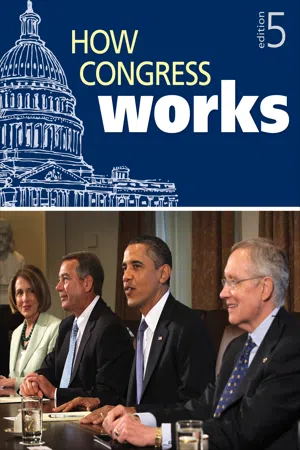
How Congress Works
About this book
In simple, clear language, the new edition of this classic work presents basic explanations of the procedures and rules that govern the U.S. Senate and House of Representatives. Highlighted sidebars further detail the impact of congressional action with interesting narrative examples from history, along with charts and tables that provide a complete overview of congressional procedures. This edition has been thoroughly updated to reflect the changes on Capitol Hill since 2008. How Congress Works helps readers place recent events in the context of the entire picture of how Congress operates. A detailed index rounds out this introduction to the real Congress.
Information

Table of contents
- HOW CONGRESS WORKS-FRONT COVER
- HOW CONGRESS WORKS
- TABLE OF CONTENTS
- PREFACE
- CONTRIBUTORS
- CHAPTER 1: PARTY LEADERSHIP IN CONGRESS
- Congressional Leadership Structure
- Leadership Functions
- Messages through the Media
- Tools of Persuasion
- The House Speaker
- Framers’ Intentions
- Clay and the Shift of Power
- From Clay to Colfax
- Rise of Minority Obstructionism
- Reed Rules
- “Cannonism”
- Decline of the Speaker’s Power
- The Power of Persuasion: Rayburn
- Transitional Speakers: McCormack, Albert
- The Modern Speakership: O’Neill
- The Limits of Power: Wright
- End of an Era: Foley
- Transforming the House and Beyond: Gingrich
- Absolute Power: Hastert (and DeLay)
- The House: A Woman’s Place
- Boehner: A Careful Balancing Act
- House Leadership: A Hierarchy of Support
- The Majority Leader
- The Minority Leader
- Party Whips
- The Party Caucuses
- Making Committee Assignments
- Policy and Strategy Committees
- Leadership in the Senate: “We Know No Masters”
- Evolution of Senate Leadership
- Emergence of Republican Leaders
- Emergence of Democratic Leaders
- Early Effective Leaders
- The Johnson Years
- The Age of Collegiality
- The Modern Leadership: Mitchell
- Reid: The Return of the Insider
- Modern Republican Leadership
- Dole: Sharp Tactics, Hard Edges
- Lott: Pragmatic Ideologue
- Frist: The Outsider Within
- Party Support Structure in the Senate
- Party Whips
- Party Conferences
- Other Party Committees
- Notes
- Selected Bibliography
- CHAPTER 2: THE LEGISLATIVE PROCESS
- Rules Guide the Process
- Evolution of Rules
- Change in Party Control
- Pitfalls to Passage
- Developing Legislation
- Introduction of Legislation
- In Committee
- House Floor Action: Structured Efficiency
- Scheduling Floor Action
- House Floor Procedures
- Senate Floor Action: Flexibility, Informality
- Scheduling in the Senate
- Senate Floor Procedures
- Final Action: Resolving Differences
- Conference Action
- Final Legislative Action
- Notes
- Selected Bibliography
- CHAPTER 3: THE COMMITTEE SYSTEM
- Committees in Transition
- The History of Committee Evolution
- Expansion of the Standing Committee Systems
- Committee Membership
- The Seniority System
- Harbingers of Reform
- Revival of the Democratic Caucus
- 1970s Reform Movements
- House Committee Changes
- Senate Committee Changes
- Committee Structure
- Standing Committees
- Subcommittees
- Select and Special Committees
- Joint Committees
- Ad Hoc Committees
- Task Forces
- Committee Sizes and Ratios
- The Chair’s Role
- Committee Assignments
- The Assignment Process
- The Seniority Factor
- Plum Assignments
- Committee Procedures
- Jurisdictional Conflicts
- Multiple Referrals
- Spending Rivals
- Budget Brinksmanship
- Oversight Mandate
- Notes
- Selected Bibliography
- CHAPTER 4: CONGRESSIONAL STAFF
- Postwar Waves of Staff Expansion
- Explaining Staff Growth
- Employment Practices
- Evolution of the Congressional Staff
- Birth of the Modern Congress: The 1946 Reorganization Act
- Reform Era: Reorganization Act of 1970
- Changes in 1974–1979
- Staff Contraction in the 1980s and 1990s
- Committee and Personal Staff: What They Do
- Committee Staffs
- Personal Staff
- Qualifications and Tenure of Hill Staffers
- The Cost and Pay of Congressional Staff
- House Allowance
- Senate Allowance
- Changes in Staff Salaries
- Congressional Staff: Ethics and Legalities
- Workplace Compliance
- Legislative Work versus Politics
- Questionable Hiring Practices
- Moving Beyond a Staff Job
- Notes
- Selected Bibliography
- REFERENCE MATERIALS
- How a Bill Becomes a Law
- Political Party Affiliations in Congress and the Presidency, 1789–2011
- Speakers of the House of Representatives, 1789–2011
- House Floor Leaders, 1899–2011
- Senate Floor Leaders, 1911–2011
- Recorded Votes in the House and Senate, 1947–2011
- Attempted and Successful Cloture Votes, 1919–2011
- Congressional Information on the Internet
- INDEX
Trusted by 375,005 students
Access to over 1.5 million titles for a fair monthly price.
Study more efficiently using our study tools.
Frequently asked questions
Yes, you can cancel anytime from the Subscription tab in your account settings on the Perlego website. Your subscription will stay active until the end of your current billing period. Learn how to cancel your subscription
No, books cannot be downloaded as external files, such as PDFs, for use outside of Perlego. However, you can download books within the Perlego app for offline reading on mobile or tablet. Learn how to download books offline
Perlego offers two plans: Essential and Complete
- Essential is ideal for learners and professionals who enjoy exploring a wide range of subjects. Access the Essential Library with 800,000+ trusted titles and best-sellers across business, personal growth, and the humanities. Includes unlimited reading time and Standard Read Aloud voice.
- Complete: Perfect for advanced learners and researchers needing full, unrestricted access. Unlock 1.5M+ books across hundreds of subjects, including academic and specialized titles. The Complete Plan also includes advanced features like Premium Read Aloud and Research Assistant.
We are an online textbook subscription service, where you can get access to an entire online library for less than the price of a single book per month. With over 1.5 million books across 990+ topics, we’ve got you covered! Learn about our mission
Look out for the read-aloud symbol on your next book to see if you can listen to it. The read-aloud tool reads text aloud for you, highlighting the text as it is being read. You can pause it, speed it up and slow it down. Learn more about Read Aloud
Yes! You can use the Perlego app on both iOS and Android devices to read anytime, anywhere — even offline. Perfect for commutes or when you’re on the go.
Please note we cannot support devices running on iOS 13 and Android 7 or earlier. Learn more about using the app
Please note we cannot support devices running on iOS 13 and Android 7 or earlier. Learn more about using the app
Yes, you can access How Congress Works by CQ Press in PDF and/or ePUB format, as well as other popular books in Politics & International Relations & American Government. We have over 1.5 million books available in our catalogue for you to explore.