- 192 pages
- English
- ePUB (mobile friendly)
- Available on iOS & Android
eBook - ePub
Ohio Government and Politics
About this book
Ohio Government and Politics provides a thorough, highly readable overview of the history, processes, and institutions of the state's government and politics. In a country increasingly divided into blue and red states, Ohio is "purple" – one of the few states that is not dominated by a single political party. Covering the crucial strategies of both the republicans and democrats as they vie for power in Ohio, this new title demonstrates the "nationalizing" of Ohio politics. However, contemporary issues specific to Ohio politics are not neglected; coverage of important issues such charter reform in Cuyahoga County and the controversies over the regulation of "fracking" is included.
Information
Chapter 1 The Politics of a Purple State
“Operation Clark County”
A few weeks before the 2004 U.S. presidential election, Oliver Burkeman, a columnist for the British newspaper, The Guardian, came up with a rather audacious idea. Since he felt that the American election would have global ramifications, he urged his readers to take an active role in trying to influence the U.S. campaign. Specifically, he proposed “to match individual Guardian readers with individual voters in Clark County, in the crucial swing state of Ohio,” so that the British citizens could draft personal letters to these American voters, letting them know how citizens from another country understood global political issues.1 Not unexpectedly, the effort, branded “Operation Clark County,” met with considerable backlash. Angry citizens from throughout the U.S. wrote hostile e-mails to the Guardian, accusing the newspaper of facilitating an improper and perhaps illegal attempt by non-U.S. citizens to change the outcome of an American election. The director of the board of elections in Clark County was even quoted as saying “the American Revolution was fought for a reason.”2
In the end—at least from the point of view of the Guardian writer—Operation Clark County was a failure. Burkeman had hoped to convince voters to support the Democratic challenger, John Kerry; instead, Clark County was won by President George W. Bush, even though Bush had lost the county to Al Gore four years earlier. What is most interesting for students of Ohio politics, however, is to recognize that when it came time for a European newspaper to try to influence an American presidential election, the publication quite naturally focused on Ohio. Indeed, it would not be much of an exaggeration to claim that when it comes to U.S. presidential politics, the whole world directs its gaze to Ohio. Of course, they are just reflecting the behavior of the candidates themselves. For example, the Washington Post estimated that during their first term in office, either President Barack Obama or Vice President Joseph Biden visited Ohio on average once every three weeks!3 But is all of this attention justified?
In the 82-year span between 1841 and 1923, the United States elected 21 individuals as president. Eight of those presidents, or nearly 40 percent, were from Ohio. Only the state of Virginia has sent an equal number to the White House (although, technically, the first president from Virginia, George Washington, did not occupy the famous address at 1400 Pennsylvania Avenue). Still, no Ohioan has sat behind the desk in the Oval Office since Blooming Grove native President Warren G. Harding’s death on August 2, 1923.
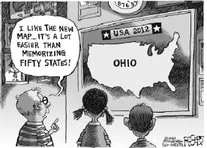
Pittsburgh Post-Gazette
Although no longer supplying presidential timber, Ohio has clearly remained at the center of presidential contests. The political mantra, repeated every four years, is that since 1960, no one has been elected president without capturing a plurality of the popular vote in Ohio. Unlike many such mantras, this one has the virtue of being true. As Table 1.1 shows, however, this does not mean that a candidate must win Ohio in order to capture the White House. Of the eight individuals elected in the 13 elections beginning in 1964, only George W. Bush (in both 2000 and 2004) needed Ohio’s electoral votes to claim a victory. Every other president could have garnered an electoral majority without Ohio’s votes. Moreover, in 2000 at least, President Bush, with only 271 electoral votes (one more than he needed) could not have lost any of the 30 states that he won and still claimed victory.
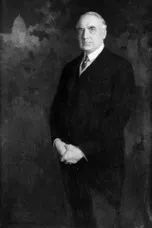
President Warren G. Harding
White House Historical Association
Table 1.1 does demonstrate a second important point. With every new census, Ohio’s representation in Congress, and therefore the total number of electors representing the State, declines. In 1964, Lyndon Johnson gained 26 votes by capturing Ohio. When Barack Obama won Ohio in 2012, only 18 electoral votes were earned. In a sense, therefore—and again, by looking at the numbers—Ohio is becoming less and less significant in presidential politics. So why is Ohio still considered, even by the candidates themselves, a crucial battleground state in U.S. presidential elections? There are two related reasons.
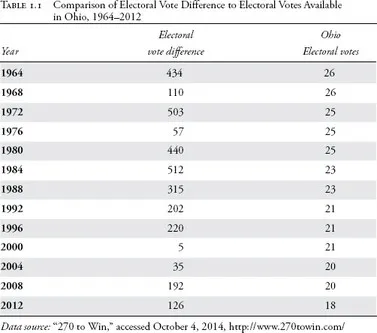
Data source: “270 to Win,” accessed October 4, 2014, http://www.270towin.com/
When political pundits talk about red states and blue states, they are acknowledging that, even before anyone casts their vote in a presidential election, it is not hard to predict with a high degree of certainty which party’s candidate will ultimately win the popular vote. Republicans dominate in red states and Democrats control blue states. So, for example, the two most populous states (and therefore the two most electorally rich states), Texas and California, are not currently considered competitive.4 It is a foregone conclusion that Texas is red and will support the Republican candidate, while a majority of voters in blue California will cast their ballots for the Democratic Party’s nominee. Texas and California are not alone when it comes to states that are considered noncompetitive. As Map 1.1 shows, a total of 38 states and the District of Columbia are considered fairly secure states for either the Democratic or the Republican nominee. That leaves 12 so-called swing states. Swing states are states where the outcome is difficult to predict because voters swing back and forth from election to election between the Republican and Democratic candidates. Swing states are also sometimes called purple states, since their electoral status is derived from the near-equal numbers of solid red and blue voters.
Map 1.1 Swing States
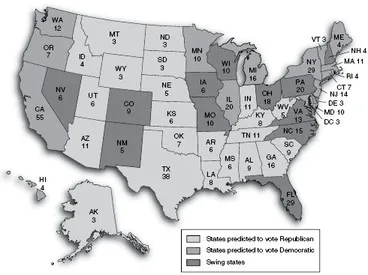
Source: “Electoral Vote Predictor,” accessed October 8, 2014, http://www.electoral-vote.com/evp2012/Pres/Maps/Aug07.html
Using this definition, it is hard to imagine a state more purple than Ohio. For example, if one adds up all the Democratic votes for president between 2000 and 2012 and then compares that number to all the corresponding Republican votes during that same period, the difference is only about 150,000 votes out of more than 21 million cast. This comes out to a difference of less than 1 percent (see Table 1.2).
Looking at only the purple states in Map 1.1, one sees that only Florida and Pennsylvania have more electoral votes than Ohio. Since it is difficult to label Pennsylvania as a pure purple state (voters there having supported only Democratic candidates for president since 1988), among the truly purple states, Ohio trails only Florida in electoral clout.
Beyond electoral votes and the closeness of presidential races in Ohio, there is an additional argument to be made about the significance of Ohio in presidential campaigns. As Table 1.3 shows, Ohio is, demographically, somewhat of a microcosm of the United States. With the notable exception of the very low number of Hispanic voters in the state, Ohio looks like the United States. From this perspective, Ohio is important because it is an ideal test market for political candidates. Put another way, if a candidate is popular in Ohio, they are likely to have qualities that will appeal to voters throughout the U.S. Hence, winning Ohio is important not because of the electoral votes gained but because of what it says about a candidate.
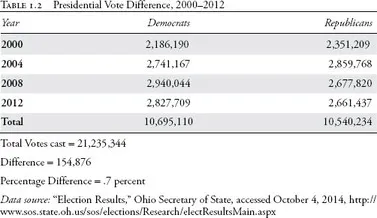
Total Votes cast = 21,235,344
Difference = 154,876
Percentage Difference =.7 percent
Data source: “Election Results,” Ohio Secretary of State, accessed October 4, 2014, http://www.sos.state.oh.us/sos/elections/Research/electResultsMain.aspx
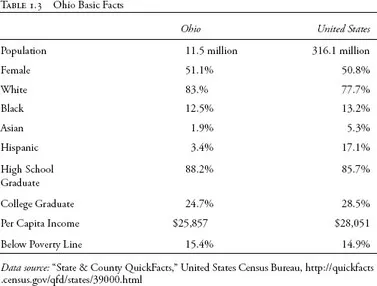
Data source: “State & County QuickFacts,” United States Census Bureau, http://quickfacts.census.gov/qfd/states/39000.html
Purple State Politics
More than 50 years ago, Thomas A. Flinn, a political science professor at Oberlin College, wrote an often-cited article describing Ohio politics.5 Reading that article today, it is remarkable how much of what Flinn documented in 1960 remains unchanged. Flinn concluded, for example, that “Ohio is now and has long been a competitive two-party state in which Republicans have an advantage.”6 He based this statement on the partisan results in presidential, gubernatorial, and state legislative elections in Ohio from 1895 through the 1958 election. Using these same data points for the years beginning in 1960, one finds similar results. From 1895 to 1958, Flinn found that Republicans won 10 presidential elections while Democrats came out ahead in six contests. From 1960 through 2012, the numbers are almost exactly the same, with Ohio voters giving a plurality of their support to Republicans in a little more than half (8) of the 14 contests. Gubernatorial elections, however, tell a slightly different story. By a count of 19 to 12, Flinn’s study found that Democrats were more succe...
Table of contents
- Cover
- Half Title
- Publisher Note
- Title Page
- Copyright Page
- About the Authors
- Brief Contents
- Detailed Contents
- Illustration List
- Preface
- Chapter 1 The Politics of a Purple State
- Chapter 2 A Brief History of Ohio
- Chapter 3 The Ohio Legislature
- Chapter 4 The Ohio Executive Branch
- Chapter 5 Courts in Ohio
- Chapter 6 Local Government in Ohio
- Chapter 7 Financing the State Government of Ohio
- Chapter 8 Political Parties, Interest Groups, and Elections in Ohio
- Chapter 9 Direct Democracy in Ohio
- Index
- Publisher Note
Trusted by 375,005 students
Access to over 1.5 million titles for a fair monthly price.
Study more efficiently using our study tools.
Frequently asked questions
Yes, you can cancel anytime from the Subscription tab in your account settings on the Perlego website. Your subscription will stay active until the end of your current billing period. Learn how to cancel your subscription
No, books cannot be downloaded as external files, such as PDFs, for use outside of Perlego. However, you can download books within the Perlego app for offline reading on mobile or tablet. Learn how to download books offline
Perlego offers two plans: Essential and Complete
- Essential is ideal for learners and professionals who enjoy exploring a wide range of subjects. Access the Essential Library with 800,000+ trusted titles and best-sellers across business, personal growth, and the humanities. Includes unlimited reading time and Standard Read Aloud voice.
- Complete: Perfect for advanced learners and researchers needing full, unrestricted access. Unlock 1.5M+ books across hundreds of subjects, including academic and specialized titles. The Complete Plan also includes advanced features like Premium Read Aloud and Research Assistant.
We are an online textbook subscription service, where you can get access to an entire online library for less than the price of a single book per month. With over 1.5 million books across 990+ topics, we’ve got you covered! Learn about our mission
Look out for the read-aloud symbol on your next book to see if you can listen to it. The read-aloud tool reads text aloud for you, highlighting the text as it is being read. You can pause it, speed it up and slow it down. Learn more about Read Aloud
Yes! You can use the Perlego app on both iOS and Android devices to read anytime, anywhere — even offline. Perfect for commutes or when you’re on the go.
Please note we cannot support devices running on iOS 13 and Android 7 or earlier. Learn more about using the app
Please note we cannot support devices running on iOS 13 and Android 7 or earlier. Learn more about using the app
Yes, you can access Ohio Government and Politics by Paul Sracic,William Binning in PDF and/or ePUB format, as well as other popular books in Politics & International Relations & American Government. We have over 1.5 million books available in our catalogue for you to explore.