"Rarely do I find a book that so clearly and concisely presents the material is such an accessible engaging manner. I just hope it never goes out of print!"
– Chris Adamski-Mietus, Western Illinois University
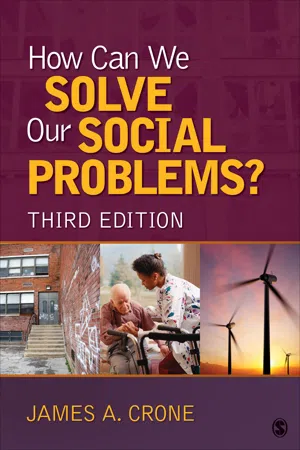
Many of today's social problems—poverty, crime, racism, sexism, drug abuse, unequal access to quality health care or education, threats to the environment, over-population—can seem intractable. James A. Crone's How Can We Solve Our Social Problems?, Third Edition is designed to give students studying these types of social problems a sense of hope. Unlike the standard survey texts that focus heavily on the causes and consequences of problems, this book is devoted to analyzing possible solutions. It maintains a sense of sociological objectivity throughout, and without moralizing, describes what could be done in America and on a global scale, through government policies, private sector initiatives, and the collective actions of citizens, to address even our most pervasive social problems.
Contributor to the SAGE Teaching Innovations and Professional Development Award
- 344 pages
- English
- ePUB (mobile friendly)
- Available on iOS & Android
eBook - ePub
How Can We Solve Our Social Problems?
About this book
Information
1 Preparing to Solve Our Social Problems
Have you ever been concerned about a social problem? I imagine that you have. You may have been concerned about poverty, racial prejudice and discrimination, or the inequality between men and women. Well, you are not alone. Many other Americans and people in other countries are also concerned about these and other social problems. One way to address these problems is to read about and study social problems and think about how we might address these problems realistically. This book is a good place to start.
Before we begin to study specific social problems and consider how we can solve them, we need to learn a few things that will provide a foundation on which to build a more comprehensive understanding of social problems. With a fuller understanding, we will be better prepared to think about how we can solve these social problems. So, let us first build this foundation of understanding in Chapters 1 and 2, and then we will be ready to address our social problems.
What Is a Social Problem?
Before we turn to the main emphasis of this book, namely how we can solve our social problems, we need to define what a social problem is. One thing it is not is a personal problem that others do not experience. As C. Wright Mills, a respected American sociologist, pointed out, a personal problem can also be a social problem if a number of people experience the same personal problem when certain social conditions are causing these people to experience the same personal problems. For example, many families experience poverty personally, but all of them are a part of a larger social pattern of unemployment, a social factor not caused by these families (Mills, 1959). Consequently, a key element in deciding whether something is a social problem is to discover how people’s personal problems, for example, experiencing unemployment, poverty, prejudice, and discrimination, are related to the social conditions of a society.
Many social problems, such as poverty, racial/ethnic discrimination, and gender inequality, occur at the societal level. Also, local communities can define certain social conditions such as high rates of unemployment, juvenile delinquency, gangs, illegal drug use, and family break-up as social problems (Fuller & Myers, 1941). In addition to recognizing local and societal social problems, we are becoming more aware of global social problems, such as the world’s population problem where many people throughout the world do not have their simplest needs met, for example, enough water to drink and enough fertile land to grow a minimum of food, just to survive each day. A social problem can therefore be at the local, societal, or global level.
Part of defining a social condition as a social problem is that we subjectively say to ourselves that something is wrong and that we believe it should be changed. For example, we say that we believe poverty is wrong and that we as a community, society, or world should do something about this. In addition to our personal concerns, Fuller and Myers (1941) asserted that social problems need to have objective elements to them (p. 320). That is, we need to show that there is empirical evidence of a social problem. For example, when we collect data to show that poor people have lower incomes, lower quality of housing, and overall lower quality of life than people who are not poor, we demonstrate that a social problem also has an objective element to it. We therefore need to have both subjective and objective elements in a definition of a social problem.1
Taking all of these things into consideration, we include the following elements as part of a definition of a social problem. First, certain social conditions cause personal problems. Second, social problems can be local, societal, or global. Third, social problems consist of both subjective perceptions and objective evidence. Hence, we use the following definition:
A social problem exists when people subjectively perceive and have empirical evidence to show that social conditions combine at a local, societal, or global level to cause personal problems.2
History of Studying Social Problems
People have thought about social problems for a long time. In fact, the field of sociology—the scientific study of society and social interaction—developed during the early 1800s. Early social thinkers (they were not called sociologists back then) during the late 1700s and early 1800s were concerned about all of the social changes that were occurring and wondered whether societies were falling apart. At that time, more and more people were moving from rural areas to cities to get new kinds of jobs called factory jobs. Slums and crowded housing began to emerge. Some people lost their jobs and experienced extreme poverty. The people who had no jobs and therefore no income would at times steal or rob, thereby making crime a social problem. As a result of these social changes, social problems of unemployment, poverty, slums, crowded housing, and crime grew and became a typical part of the urban scene.
So much social change was occurring that some people such as Auguste Comte, a social thinker in France during the early 1800s, became conscious of and concerned about these social changes and resulting social problems.3 He believed that society was falling apart due to too much disorder and therefore believed that something needed to be done to bring some semblance of order and harmony to people’s lives. Comte concluded that a new discipline was needed to study society—how it works, why it works that way, and where it is headed. He was concerned about what could be done about all of the social problems people were facing. He created the new discipline of sociology to study society scientifically in order to see what could be done to make a more stable and orderly society, under these newly emerging social conditions of urbanization and industrialization and resulting unemployment, poverty, and crime. Hence, the new discipline of sociology was born.
Later during the 1800s and early 1900s, other social thinkers began to study the society in general and social problems in particular. Emile Durkheim, a French sociologist, had concerns similar to those of Comte.4 With the fall of monarchies and the apparent decline in the influence of religion, Durkheim, like Comte, wondered how modern society could keep any sense of order. German social thinkers, such as Karl Marx during the mid-1800s and Max Weber during the early 1900s, also became interested in how society worked and the social problems people faced.
Marx was greatly troubled by the increasing poverty and inequality he saw around him.5 He was concerned that people had factory jobs that were alienating because the jobs were so boring, people were paid so poorly that they could hardly survive, and yet they worked 12 hours per day, 6 days per week. Moreover, they did not have much choice in life. They either took alienating factory jobs or had no jobs and hence no means to sustain themselves. They were stuck in a social system that was brutal and inhumane, and they did not know what to do about their situation. As Marx pointed out, previous generations created the very conditions that factory workers lived in—unemployment, poverty, alienating jobs, and the lack of much choice in life. He further asserted that because our ancestors created these social conditions, we could—and should—change these social conditions. Marx helped us realize that we humans created our existing social conditions; therefore, we can change our social conditions. That is, we did not need to accept the existing social conditions as the only way to live.
Marx developed solutions to these problems that he thought would create a more humane society. He focused on what he thought was the main cause of many modern social problems: capitalism. He noted that although capitalism produced material benefits for many people and much profit for some people, at the same time it created alienating jobs, unemployment, poverty, and much inequality. He concluded that since we humans created our own social conditions and that we could change these social conditions, we therefore had the power and the responsibility to create a more humane and just society and world.
Another giant in the field of sociology was Max Weber.6 He was concerned about the modern social problem of all the bureaucracies and institutions we live in and how these bureaucracies and institutions have considerable power over us. If we want to work within these bureaucracies and institutions (and therefore survive in the society we are living in), we must go by their norms, values, beliefs, and regulations—even if we do not agree with these things. He predicted that individuals would feel helpless in the face of such large and powerful institutions. Consequently, Weber wondered how we would be able to solve the problem of our powerlessness in the face of these modern bureaucracies and institutions.
As you can see, from its beginning, the new discipline of sociology focused on the study of social problems and how these problems could be solved. Contemporary sociologists have the same focus. We too are curious about how society works, why it works the way it does, and what may happen in the future. We too are interested in how social conditions create social problems. And we too are interested in how we can change our social conditions to solve our social problems.
Teaching About Social Problems in Today’s World
In sociology today, there are courses and textbooks devoted solely to the study of social problems. In these courses and the textbooks that are used for these courses, there is usually a focus on 10 to 15 social problems that are of current concern. Some of these problems are a concern and have been so for many years. For example, in our country we have been especially troubled about poverty, crime, and racial prejudice and discrimination. Other social problems have become of increasing concern to us since the 1950s, including the growth in the world’s population and the burden it plays on our limited resources, the deterioration of our global environment, and the inequality between women and men in our country and throughout the world.
In our social problems courses, we focus on certain aspects of a social problem. For example, we describe a social problem, such as how many people are affected and where the problem is most prevalent (in cities, in the lower social classes, among women, and so forth). We search for the causes of the problem, usually finding that there are a number of causes for each social problem, and that some causes have greater impacts than others. We point out the intended consequences that are readily apparent and dig deeper to discover the unintended consequences that are not so apparent. We also make predictions as to what will most likely occur given certain social conditions. Finally, we discuss possible solutions, which is what this book addresses specifically.
How Can Sociologists Address Social Problems and Yet Remain Objective?
The study of social problems presents a dilemma for sociologists. The dilemma does not occur at the point of choosing a topic of research, of gathering facts in the research process, or of choosing certain methods of gathering data such as the survey, participant observation (when a sociologist lives with a certain group for a period of time to learn about the group), or the interview. Sociologists, in general, agree that these kinds of activities are what sociologists need to do. These activities are an integral part of our being sociologists. The dilemma also does not occur at the point of discovering the causes or uncovering the unintended consequences related to each social problem. Sociologists, in general, seek to pinpoint causes and find unintended consequences.
The dilemma, however, occurs at the point of dealing with the solution part of social problems. That is, what should we say about the solving of social problems? Should we say what we personally think should be done? Should a group of sociologists come together to decide what should be done? Should we remain objective and not take a personal stance on what should be done and yet, in some way, contribute to what we know about the solving of social problems?
Many sociologists contend that our role is to state only what is—that is, to study only what occurs, focusing on description, causes, consequences, and prediction but not saying what should occur.7 They begin to feel uncomfortable when it comes to the solving of social problems because they worry that they or other sociologists may go beyond their role in being objective. They fear that if the general public no longer sees sociology as objective, sociology will lose its credibility.
The result would be that sociologists would be seen as just another interest group with its own vested interests, with sociologists looking out for what benefits them instead of being a group that the public and government can trust to report valid data and provide objective knowledge about a subject so that others can make more informed judgments as to what should be done. Consequently, a number of sociologists conclude that, rather than risk losing our credibility as an objective source of data, knowledge, and understanding, maybe it is better to stay away from recommending solutions. Instead, we need to leave this area to the policymakers of the society, such as members of Congress or state legislatures, and focus solely on descriptions, causes, consequences, and predictions.
There is another group of sociologists who see their role not only as stating what is but also stating what should be. Their belief is similar to that of Marx ([1845]1972), who said, “The philosophers have only interpreted the world, in various ways; the point, however, is to change it” (p. 107). That is, these sociologists ask, “What is the point of doing all of this studying of society, collecting mountains of data, and discovering causes and consequences if we do not take the next step to change the society for the better?” They argue that if we study the problem more than anyone else in society and understand it best, especially its causes and consequences, why not take the next step and say what should be done about it? After all, they say, sociologists are the most expert on the study of social problems.
It seems to be a great waste of our knowledge and understanding of social problems if we cannot, in some way, venture into the realm of solving social problems. The key question then becomes the following: How can we study the solving of social problems and yet maintain our objectivity and credibility? Is there, in other words, a common ground to stand on for all sociologists?
Yes, there is a common ground on which we all sociologists can stand. On this common ground, there are at least five areas within which we can achieve the goal of contributing to the solving of social problems and yet remain objective and maintain our credibility.
One way sociologists can help to solve social problems is to look at what sociologists know about social patterns in social problems and how knowing about these social patterns can help us to solve our social problems. We have a good idea of a number of social patterns that typically occur within various kinds of social problems.
A second way in which sociologists can contribute to the solving of social problems and yet remain objective is to study the aspects of a social problem that prevent it from being solved. That is, sociologists can help us to become more aware of the barriers that prevent a social problem from being solved. Once we know these barriers, we can focus on how we can work around these barriers.
A third way sociologists can remain objective and yet contribute to solving our social problems is to study empirical examples of how social problems have been solved in the past in this or in other countries and reflect on how these solutions could be applied to solving our current social problems. That is, what can we learn from the social problems that we have already solved that can be applied to the solving of our current and future social problems?
Fourth, all sociologists stand on a common ground when they make predictions about potential new social problems on the horizon and about...
Table of contents
- Cover
- Half Title
- Acknowledgements
- Title Page
- Copyright Page
- Detailed Contents
- Publisher Note
- Preface to the Third Edition
- Acknowledgments
- About the Author
- 1 Preparing to Solve Our Social Problems
- 2 Barriers, Possibilities, and How Sociology Can Help
- 3 How Can We Solve the Problem of Increasing Inequality?
- 4 How Can We Solve the Problem of Poverty?
- 5 How Can We Solve the Problem of Racial/Ethnic Inequality?
- 6 How Can We Solve the Problem of Gender Inequality?
- 7 How Can We Solve the Problem of Unequal Education?
- 8 How Can We Solve the Problem of Crime?
- 9 How Can We Solve the Problem of Drugs?
- 10 How Can We Solve the Problem of Health Care?
- 11 How Can We Solve the Problems of Families?
- 12 How Can We Solve the World’s Population Problem?
- 13 How Can We Solve the World’s Environmental Problem?
- 14 Solving Our Social Problems Predictions and Conclusions
- References
- References
- References
- References
- References
- References
- References
- References
- References
- References
- References
- References
- References
- References
- Index
Trusted by 375,005 students
Access to over 1.5 million titles for a fair monthly price.
Study more efficiently using our study tools.
Frequently asked questions
Yes, you can cancel anytime from the Subscription tab in your account settings on the Perlego website. Your subscription will stay active until the end of your current billing period. Learn how to cancel your subscription
No, books cannot be downloaded as external files, such as PDFs, for use outside of Perlego. However, you can download books within the Perlego app for offline reading on mobile or tablet. Learn how to download books offline
Perlego offers two plans: Essential and Complete
- Essential is ideal for learners and professionals who enjoy exploring a wide range of subjects. Access the Essential Library with 800,000+ trusted titles and best-sellers across business, personal growth, and the humanities. Includes unlimited reading time and Standard Read Aloud voice.
- Complete: Perfect for advanced learners and researchers needing full, unrestricted access. Unlock 1.5M+ books across hundreds of subjects, including academic and specialized titles. The Complete Plan also includes advanced features like Premium Read Aloud and Research Assistant.
We are an online textbook subscription service, where you can get access to an entire online library for less than the price of a single book per month. With over 1.5 million books across 990+ topics, we’ve got you covered! Learn about our mission
Look out for the read-aloud symbol on your next book to see if you can listen to it. The read-aloud tool reads text aloud for you, highlighting the text as it is being read. You can pause it, speed it up and slow it down. Learn more about Read Aloud
Yes! You can use the Perlego app on both iOS and Android devices to read anytime, anywhere — even offline. Perfect for commutes or when you’re on the go.
Please note we cannot support devices running on iOS 13 and Android 7 or earlier. Learn more about using the app
Please note we cannot support devices running on iOS 13 and Android 7 or earlier. Learn more about using the app
Yes, you can access How Can We Solve Our Social Problems? by James A. Crone in PDF and/or ePUB format, as well as other popular books in Social Sciences & Sociology. We have over 1.5 million books available in our catalogue for you to explore.