The path to becoming a leader for your students, faculty, and community begins here.
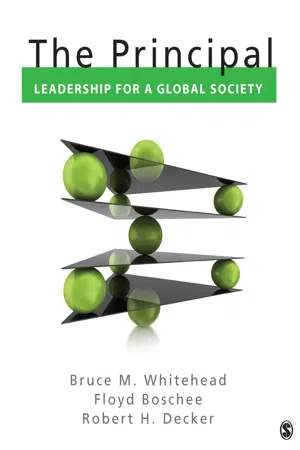
The Principal: Leadership for a Global Society is the core textbook for aspiring and practicing K-12 school principals. Taking a practical and research-grounded approach, this inspiring text prepares school leaders to successfully face the challenges that they will deal with on a day-to-day basis and throughout their careers. From curriculum development to staff development to policy and discipline, it addresses the most up-to-date practices in developing leadership skills. The book provides a wide array of pedagogical features to help practicing and aspiring school principals improve programs, create a safer and more enriching environment for students and faculty; meet school, district, community, state, and national ideologies and standards; and much more. After reading The Principal, the educational leaders of tomorrow will be equipped with innovative, practical, and successful leadership concepts and ideas that will help them make a powerful impact on not just those who walk through the school doors, but the community as well.
eBook - ePub
The Principal
Leadership for a Global Society
- 520 pages
- English
- ePUB (mobile friendly)
- Available on iOS & Android
eBook - ePub
About this book
Information
Part I Foundations of Principal Leadership
Reflecting on the foundation of leadership, school principals globally appear to be at the heart of change and awareness. Their role, perhaps more than any other, emphasizes the societal uniqueness of people and cultural values, as well as organizational and political challenges that lay before them. The purpose of Part I is to provide a firm understanding as to the history of the principalship as well as a strong background in leadership theory and research applications. Thus, it is through these perspectives of the past as well as our shared visions of the future that principals worldwide, with unparalleled integrity, continue to shape history as well as our destiny.
Chapter 1 Nature of Leadership: Challenge of the Times
Public and private schools and school principals are experiencing one of the most challenging times in education. In an educational caldron of rejuvenated processes, school leaders, experienced and aspiring, through research and experience are learning more about their own vulnerabilities as well as their newly found successes.
Research studies by the National Center for Analysis of Longitudinal Data in Education (CALDER) “provide evidence that the quality of a principal affects a range of school outcomes including teachers' satisfaction and their decisions about where to work, parents' perceptions about the schools their children attend, and, ultimately, the academic performance of the school” (Rice, 2012, p. 1). Further, the evidence provided by CALDER “demonstrates that the school principal's job is complex and multifaceted, and effectiveness of principals depends on their level of experience, their sense of efficacy on particular kinds of tasks, and their allocation of time across daily responsibilities” (Rice, 2012, p. 1). Unfortunately, the research, as reported by Rice (2012), “demonstrate[s] that principals with the experience and skills found to be related to effectiveness are less likely to be working in high-poverty and low-achieving schools, raising equity concerns about the distribution of effective principals” (p. 1).
Subsequently, today's principals have to view education as more than just tests, charts, and graphs. They have to reconnect with core principles supported by research conducted by the Wallace Foundation since 2000 in order to acknowledge and validate the undertaking. In addition, as a team, today's principals and teacher leaders need to explore ideas and find alternative ways to become more audacious in their approach to education. At the same time, building-level administrators and teacher leaders will need to become more humanistic in their day-to-day practice.
From a realistic perspective, this book presents an easy-to-understand and practical nature of the principalship—as well as the critical correlation between leadership and student academic achievement. More importantly, it provides the “big picture” for effective leadership. A key during these trying times is to know what will be different for the principal in the future—as well as how to improve and accentuate educational leadership on a global scale. Our focus is to present what is attainable for principals as well as what is possible for teacher leaders. Simply putting theory into practice is no longer acceptable. If school leaders are to excel, they must magnify an awareness of what elements for leadership have a research base that works and then move toward a locus for increasing student success.
For the purpose of this book, the authors will also utilize elements of the Educational Leadership Constituent Council (ELCC) standards as intercessors to build a framework for learning the roles of the principalship. Collaborative roles include the principal as a visionary, a planner, an instructional leader, a change agent and systemic leader, a manager and operations director, a supervisor, a behavioral specialist, an evaluator, a community leader, a cultural advisor, and a public relations specialist.
Key to Leadership
The principal remains the central source of leadership influence in a school.
The focal point of this textbook is based on valid research and practical applications by the authors that will help practicing and aspiring principals to excel. For example, successful principals of turnaround schools learn quickly what matters the most and then focus on what actions are needed to produce significant transformations (Protheroe, 2012). Consequently, approaching the principalship with knowledge of valid research and a plan of action will help individuals avoid the edges of panic and failure. If principals and teacher leaders at the elementary, middle, or high school levels are to excel, they must be able to handle management, operations, and curriculum and be accountable for their actions. Learning how to plan with and negotiate the unexpected is crucial to this undertaking. In addition, as any experienced principal or teacher leader will tell you, raising the awareness of educational risks and providing options can make the difference in a school.
Questions Addressed in this Chapter are the following
- What definite elements help a principal excel as a school leader?
- Who is the model principal?
- Why is it important for principals to become leaders in our global society?
- What is the global achievement gap and how are elementary, middle, and secondary school principals working cooperatively to address this problem?
- How has the principalship changed and what will it be like in the future?
Preparing to Excel as a Principal
Until the 21st century, school leadership, especially the principalship, was noticeably deficient from most major reform agendas. As noted by the Wallace Foundation (2012), “the people saw leadership as important to improving schools, there was uncertainty about how to proceed” (p. 3). Today, however, improving school leadership ranks high on the list for school reform. For example, in a detailed survey conducted in 2012 by the Wallace Foundation, it was found that
school and district administrators, policymakers, and others declared principal leadership as among the most pressing matters on a list of issues in public school education. [Only] teacher quality stood above everything else, but principal leadership came next, outstripping subjects including dropout rates, STEM (science, technology, engineering and math) education, student testing, and preparation for college and careers. (p. 3)
Subsequently, as reported by the Wallace Foundation (2012), an emphasis on the principal's role is getting attention from state education agencies and the U.S. Department of Education to transform the nation's 5,000 troubled schools, “a task that depends on the skills and abilities of thousands of current and future school leaders” (p. 3).
Empirical Links between School Leadership and Student Achievement
In the past, the principalship resembled the middle manager as suggested in William Whyte's 1950s classic The Organization Man—an overseer of buses, boilers, and books. As the Wallace Foundation (2012) reports that
Today, in a rapidly changing era of standards-based reform and accountability, a different conception [for the principalship] has emerged—one closer to the model suggested by Jim Collins' 2001 Good to Great, which draws lessons from contemporary corporate life to suggest leadership that focuses with great clarity on what is essential, what needs to be done and how to get it done. (p. 4)
This transformation brings with it notable changes in what public education desires from principals. “They can no longer function simply as building managers, tasked with adhering to district rules, carrying out regulations, and avoiding mistakes. They have to be (or become) leaders of learning who can develop a team delivering effective instruction” (p. 4).
Tip for Principals: 1.1
“Having high expectations for all is one key to closing the achievement gap between advantaged and less advantaged students.”
The Wallace Foundation, 2012, p. 5
The research findings by the Wallace Foundation (2012) since 2000 on the school principal as leader purport five key responsibilities required to excel:
- Shaping a vision of academic success for all students, one based on high standards (Wallace Foundation, 2012, p. 4).
Rationale: In contrast to the past when principals were seen as managers and high standards were considered the province for college-bound students only, two realizations are prevalent today. First, in a global economy, career success depends on a strong education. Second, the vision of academic success for all is contagious to faculty and underpins a schoolwide learning environment that focuses on goals for student progress.
A shared vision developed around standards and success for all students is an essential element of principal leadership. As researchers at the University of Washington indicated, “as the Cheshire cat pointed out to Alice, if you don't know where you're going, any road will lead you there.” (Wallace Foundation, 2012, p. 6)
- Creating a climate hospitable to education in order that safety, a cooperative spirit, and other foundations of fruitful interaction prevail.
Rationale: A hospitable climate allows both adults and children to put learning at the center of their daily activities. It also combats teacher isolation, closed doors, negativism, defeatism, and teacher resistance. An effective principal will focus on building a sense of school community “with the attendant characteristics—respect for every member of the school community; an upbeat, welcoming, solution-oriented, no blame professional environment; and efforts to involve staff and students in a variety of activities, many of them school wide” (Wallace Foundation, 2012, p. 6).
- Cultivating leadership in others so that teachers and other adults assume their part in realizing the school vision (Wallace Foundation, 2012, p. 4).
Rationale: A longstanding truism in leadership theory holds that leaders in all walks of life and all kinds of organizations, private and public, “n...
Table of contents
- Cover
- Half Title
- Title Page
- Copyright Page
- Detailed Contents
- Preface
- Acknowledgements
- ELCC Standards
- Part I Foundations of Principal Leadership
- Chapter 1 Nature of Leadership: Challenge of the Times
- Chapter 2 Metaphorical History of the Principalship: A Perspective of the Past
- Chapter 3 Theory: A Cornerstone of Leadership
- Chapter 4 Principals and Political Issues
- Part II Process of Leadership for the Principalship
- Chapter 5 The Wisdom of Planning
- Chapter 6 The Principal's Role in Curriculum Development and Implementation
- Chapter 7 Implementing Change
- Chapter 8 Developing Systemic Leadership
- Part III Forces of Leadership
- Chapter 9 Managing Schools
- Chapter 10 Leadership and Supervision
- Chapter 11 Improving Staff Evaluation
- Chapter 12 Discipline: A Principal's Challenge
- Part IV Current Trends
- Chapter 13 Leadership and Public Relations
- Chapter 14 Practical Applications of Leadership
- Chapter 15 Current Trends in Leadership
- Chapter 16 Principal Alerts: Issues in School Leadership
- Appendix A: Evaluation Handbook
- Appendix B: Administrator Evaluation Handbook
- Index
- About the Authors
Trusted by 375,005 students
Access to over 1.5 million titles for a fair monthly price.
Study more efficiently using our study tools.
Frequently asked questions
Yes, you can cancel anytime from the Subscription tab in your account settings on the Perlego website. Your subscription will stay active until the end of your current billing period. Learn how to cancel your subscription
No, books cannot be downloaded as external files, such as PDFs, for use outside of Perlego. However, you can download books within the Perlego app for offline reading on mobile or tablet. Learn how to download books offline
Perlego offers two plans: Essential and Complete
- Essential is ideal for learners and professionals who enjoy exploring a wide range of subjects. Access the Essential Library with 800,000+ trusted titles and best-sellers across business, personal growth, and the humanities. Includes unlimited reading time and Standard Read Aloud voice.
- Complete: Perfect for advanced learners and researchers needing full, unrestricted access. Unlock 1.5M+ books across hundreds of subjects, including academic and specialized titles. The Complete Plan also includes advanced features like Premium Read Aloud and Research Assistant.
We are an online textbook subscription service, where you can get access to an entire online library for less than the price of a single book per month. With over 1.5 million books across 990+ topics, we’ve got you covered! Learn about our mission
Look out for the read-aloud symbol on your next book to see if you can listen to it. The read-aloud tool reads text aloud for you, highlighting the text as it is being read. You can pause it, speed it up and slow it down. Learn more about Read Aloud
Yes! You can use the Perlego app on both iOS and Android devices to read anytime, anywhere — even offline. Perfect for commutes or when you’re on the go.
Please note we cannot support devices running on iOS 13 and Android 7 or earlier. Learn more about using the app
Please note we cannot support devices running on iOS 13 and Android 7 or earlier. Learn more about using the app
Yes, you can access The Principal by Bruce M. Whitehead,Floyd Boschee,Robert H. Decker in PDF and/or ePUB format, as well as other popular books in Education & Education Administration. We have over 1.5 million books available in our catalogue for you to explore.