![]()
CHAPTER 1
Designing and Conducting Research with Online Interviews
by Janet Salmons, Ph.D.
Capella University School of Business and Technology and Vision2Lead, Inc.
At its heart research is research--regardless of methodology and methods. All research begins with a burning question, a sense of curiosity and an openness to discovery. All research is conducted to serve a purpose, answer questions or prove an hypothesis, and all use some combination of methods to find and analyze whatever information is needed to answer the question. Researchers have devised numerous ways to carry out these steps.
Qualitative interview research is unique because the researcher is the instrument for data collection. Qualitative interview research contrasts with quantitative approaches such as surveys, where a conscious effort is made to insert a validated and (ideally) objective instrument between the researcher and the research participants. Interview research is unique in its reliance on direct, usually immediate, interaction between the researcher and participant. The successful researcher draws on the best of human qualities when conducting an interview: trust, thoughtful questioning and perceptive probing, empathy and reflective listening.
To understand a piece of research and assess its credibility and potential contribution to knowledge in the field, we need to understand the researcher’s motivations, purpose and designs. We need to understand how the study was conducted so we can grasp implications of its conclusions. If the study was based on data collected through qualitative interviews we also need to know who the participants were, why and how they were chosen. We want to grasp the nature of the interaction between researcher and participant that allowed data to be collected or generated.
Studies using data collected through online interviews follow fundamental steps and thinking involved in any research as well as those involved more specifically with qualitative interview research—then add an important dimension, the technology. When the direct interaction between researcher and participant occurs through computer-mediated communications (CMC), technology is more than a simple transactional medium. The human qualities so important to interview communications are experienced differently; the technology delimits the form of the communication in ways both subtle and obvious.
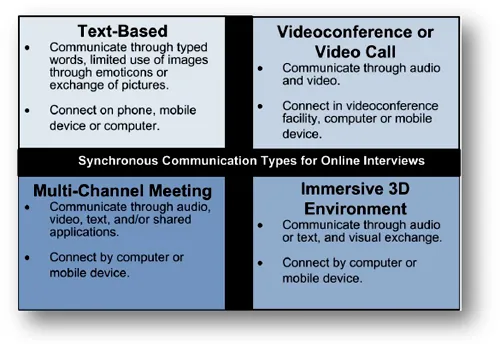
Some information and communications technologies (ICTs) allow for a full range of visual and verbal exchange. Some ICTs, such as videoconferencing, allow for an interview that closely resembles the natural back-and-forth of face-to-face communication, including verbal and non-verbal signals.
begin text box
Types of nonverbal communication include the following:
Chronemics communication describes the use of pacing and timing of speech and length of silence before response in conversation. Paralinguistic or paralanguage communication describes variations in volume, pitch, and quality of voice Kinesic communication includes eye contact and gaze, facial expressions, body movements, gestures, or postures. Proxemic communication is the use of interpersonal space to communicate attitudes (Gordon, 1980; Guerrero et al., 1999; Kalman et al., 2006a).
Nonverbal signals can be noted during an interview, or categorized as part of the transcription process when reviewing a recorded interview.
end text box
Other ICTs allow for written text, with limited visual elements such as colored fonts or graphic emoticons. While text-only studies do not allow researchers to observe participants’ non-verbal signals, they allow participants with mobile devices to participate in interviews anytime, anywhere. Indeed, participants could converse with the researcher from the field or report live while experiencing an event related to the research phenomenon.
Still other ICTs allow participants to share real or imagined visual artifacts, images or environments. Web conferencing tools allow researchers and participants to look at or generate visual images. In immersive Multi-User Visual Environments (MUVEs) researchers and participants can navigate the virtual worlds or environments chosen or created by the researcher or the participant.
insert figures and table
Figure 1.1: Four Types of Synchronous Communication (Salmons, 2010)
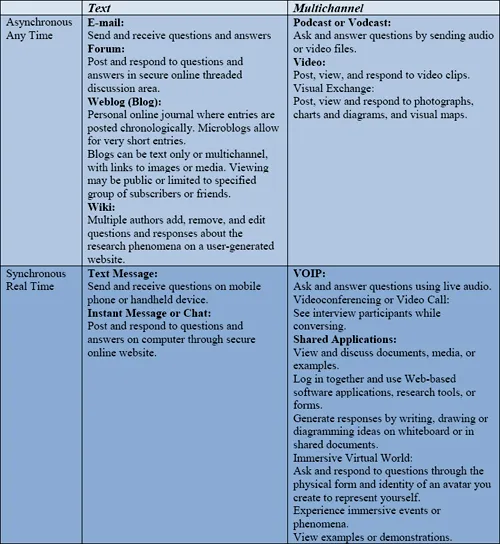
Table 1.1. Communication Options for Preparation, Interviews and Follow-ups with Participants (Salmons, 2010)
How do these varied styles of computer-mediated communication impact the quality or perception of the dialogue between researcher and participant? This is a question researchers are beginning to explore as they experiment with the use of ICTs and CMC in scholarly research interviews. Each study conducted in this way provides us with an instructive exemplar for the opportunities and challenges this method offers contemporary researchers.
For the purpose of this book online interviews or e-interviews refer to in-depth interviews conducted with CMC. While any ICT can be used for online interviews, the focus here is on the kinds of communication technologies that enable real-time dialogue between researchers and participants. Online interviews are used for primary Internet-mediated research (IMR), that is, they are used to gather original data via the Internet with the intention of subjecting them to analysis to provide new evidence in relation to a specific research question (Hewson, 2010). This type of research contrasts with secondary Internet research, that is, the use of existing documents or information sources found online (Hewson, 2010). Scholarly online interviews are conducted in accordance with ethical research guidelines; verifiable research participants provide informed consent before participating in any interview.
begin text box
In-depth interviews involve interrelationships among the following (Salmons, 2010):
The interviewer, who, regardless of interview style, is responsible for ethical, respectful inquiry and accurate collection of data relevant to the research purpose and questions. As a researcher the interviewer places the interview exchange within a scholarly context. The interviewee, who responds honestly to questions or participates in discussion with the researcher to provide ideas or answers that offer insight into his or her perceptions, understandings, or experiences of personal, social, or organizational dimensions of the subject of the study. Depending on the nature and expectations of the research, they may also be called subjects, respondents, or research participants.
The research purpose and questions, which serve as the framework and offer focus and boundaries to the interactions between researcher and interviewee.
The research environment, which provides a context for the study. Depending on the nature of the study, the environment may be significant to the researcher’s understanding of the interviewee. Cyberspace is the research milieu for online interviews. end text box
Understanding E-Interview Research
To understand e-interview research we need to pose many of the same questions we would ask about any study. Additionally we need to inquire about the influences of the technology on research design, conduct and ultimately on the study’s conclusions and on generalizations the researcher offers. The use of the term understand is intentional here to encompass both evaluative and instructional purposes. We may look at an e-interview study as an prototype for an approach we want to use in our own research. We may examine the approach because we want to teach or learn about—or develop—interview research methods. Or, we may need to take an evaluative position and review a research proposal, thesis or dissertation or article for potential publication. Working from any of these perspectives we need to know what questions to ask.
text box starts
Evaluating Qualitative Research
Another qualitative research “Quality Framework” (Spencer, Ritchie, Lewis, & Dillon, 2002) was developed by a team from the National Centre for Social Research. Drawing on a review of the literature and existing frameworks, they identified four central principles (p.7):
- Contributory in advancing wider knowledge or understanding about policy, practice, theory or a particular substantive field;
- Defensible in design by providing a research strategy that can address the evaluative questions posed;
- Rigourous in conduct through the systematic and transparent collection, analysis and interpretation of qualitative data;
- Credible in claim through offering well-founded and plausible arguments about the significance of the evidence generated.
This Quality Framework includes 18 key questions. They suggest beginning with assessment of the findings, moving through different stages of the research process (design, sampling, data collection, analysis and reporting). They suggest ending the appraisal by looking at research conduct (reflexivity and neutrality, ethics and auditability).
text box ends
When we look at a study based on data collected with online interviews we want to know why and how the researcher made choices about the ICTs used for the interviews, and how the interviews were carried out. How did the participant respond to the process, as well as to the interview questions? Did it the e-interviews proceed as planned or were adjustments needed—why or why not? What would another researcher need to know if choosing a similar approach? What types of data were collected, was the data adequate and appropriate given the purpose of the study? Ultimately, did the data allow the researcher to construct an analysis and generate conclusions that achieved the purpose of the study?
begin text box
Thinking about emergent methods…
Sharlene Nagy Hesse-Biber and Patricia Leavy observe that research methods exist to “service research questions that advance our understanding of the social world or some aspect of it. Therefore, as the social world and our understanding of it have progressed, so too has our repertoire of social research methods…. Sometimes the field of emergent methods is fueled not by new paradigmatic perspectives but through technological innovation that pushes on the boundaries of methodology” (Hesse-Biber & Leavy, 2010, pp. 1-2, 7) end text box
Online interview research is an emergent method so a widely accepted set of review questions does not currently exist. Jaccard and Jacoby suggest that when creating a new theoretical framework or model, a first step may involve “generating ideas about new exp...