This middle and secondary school methods text introduces pre-service teachers in teacher credential programs and in-service teachers pursuing a Masters degree in Education to the field of young adult literature for use in contemporary contexts. The text introduces teachers to current research on adolescent life and literacy; the new and expanding genres of young adult literature; teaching approaches and practical strategies for using young adult literature in English and Language Arts secondary classrooms and in Content Area Subjects (e.g. History); and ongoing social, political and pedagogical issues of English and Language Arts classrooms in relation to contemporary young adult literature.
This text will prepare teachers to engage with student populations that exhibit greater social, cultural, and linguistic diversity than ever before. Teachers will learn to create effective learning environments using activity-based teaching approaches and strategies for diverse student groups. They will also learn how to incorporate discussions and strategies related to dynamic new literacies, including the digitally mediated texts and multimedia compositions that are so prevalent in young adult literature and in students? creative and critical responses to this genre.
eBook - ePub
Teaching Young Adult Literature
Developing Students as World Citizens
- 368 pages
- English
- ePUB (mobile friendly)
- Available on iOS & Android
eBook - ePub
Teaching Young Adult Literature
Developing Students as World Citizens
About this book
Information
PART I
Foundations for the Teaching of Young Adult Literature
Chapter 1: An Introduction to Adolescent Life, Texts, and Teaching
Chapter 2: The Nature and History of Young Adult Literature
Chapter 3: The Teaching of Young Adult Literature
Chapter 4: Young Adult Literature and Exceptional Learners
Chapter 1
An Introduction to Adolescent Life, Texts, and Teaching
Adolescent life is often viewed as a tumultuous time of physical, cognitive, social, and psychological development (Latrobe & Drury, 2009). For example, as early as 1904, G. Stanley Hall, often referred to as the “father of adolescence” commented: “Adolescence is a time of storm and stress.” But more contemporary views suggest that adolescents are much more complex, less homogenized, and actually very diverse (Lesko, 2001). Indeed, according to recent demographics, the adolescent population is growing and immigration accounts for much of that growth with the fastest growing group largely Hispanic (Bean & Harper, 2011; Campano & Ghiso, 2011).
In this and the chapters that follow, we explore the dynamic nature of young adult literature, and the current and possible use of young adult literature in contemporary English classrooms as well as in other content subjects. We define young adult literature as literary works (usually fiction but not always) intended for readers between the ages of 12 and 18.
Each chapter in the book provides specific leaning objectives, and discussion questions based on the learning objectives are located at the end of each chapter to deepen your knowledge of young adult literature and related teaching practices.
We begin this chapter by going into an urban, middle school English/Language Arts classroom where young adult literature figures prominently. This is a real classroom and a real teacher facing difficult but not uncommon pedagogical challenges. The remainder of the chapter provides a rationale for the book and a consideration of the changing nature of adolescent life, texts, and teaching in relation to young adult literature.

Learning Objectives
• Understand the importance of adolescents reading across a broad range of young adult literature for pleasure and information on a variety of issues.
• Consider and be able to discuss the changing nature of young adult literature including online communication technologies.
• Develop an initial understanding of the relationship between students’ ethnic and cultural diversity and available young adult literature that engages students’ interests.
• Know how to use online lesson planning resources to create engaging young adult literature lessons.
• Begin creating a database of young adult literature.

Vignette: Ashley’s Middle School English Class
As a way to begin thinking about young adult literature in the classroom, we follow Ashley Norton into her middle school English/Language Arts classroom. Ashley is a young teacher, intelligent, dedicated, and relatively new to the profession. She is currently working on her master’s degree while teaching full time. Her school is located in a high-density, urban area in the southwestern United States. A large number of students at her school live in poverty, and there is a substantial population of second-language learners. Indeed, 65% of the students are English language learners with the majority speaking Spanish as their first language. Many students struggle with literacy in both English and their native language. All of the students in Ashley’s class are functioning below grade level, although there is considerable variation. The students’ reading levels (in English) range from second to sixth grade.
The school itself is an attractive oasis in a depressing sea of casinos, small bars, and older strip malls in decline. The faculty is dedicated to creative and engaging teaching, fostered by a principal who supports their ongoing professional development and, in particular, the use of multimedia technology. The school operates using a middle school philosophy and organization. This allows Ashley to work in a core team with science and social science teachers, co-planning a thematic unit centered on social justice.
The students in Ashley’s English Language Arts class had recently completed their reading and discussion of Walter Dean Myers’s young adult novel Monster (1999).
The novel takes the reader into a county jail as the main character, Steve Harmon, a 16-year-old African American, goes on trial as an accomplice in a convenience store robbery and murder. Throughout the novel, Steve’s guilt or innocence remains a question. The novel format features time-bending, shifts in scenes, voice and font, and a variety of text genres. For example, the author includes diary entries, court transcripts, and photo images to forward the plot. The novel, like many contemporary young adult books, appealed to Ashley’s students. With help, her students were able to read and engage the novel with success. In class discussions, the students addressed the stereotyping of delinquent teens, especially minority teens, in popular and school culture.
As a culminating activity, Ashley’s students created Body Biographies (Bean, Readence, & Baldwin, 2012; Smagorinsky & O’Donnell-Allen, 1998) depicting Steve’s struggles. Body biographies involve tracing the outline of a life-sized human body on butcher paper, on which collage-like images culled from magazines, the Internet, and the like, along with key quotes are positioned to capture themes and character elements in a novel. Once they completed their body biographies, students in Ashley’s class conducted a “gallery walk” during which time students presented (in English with occasional code-switching to Spanish) their biographies and talked about the particular elements they included. Figure 1.1 displays an example Body Biography.
FIGURE 1.1 Body Biography
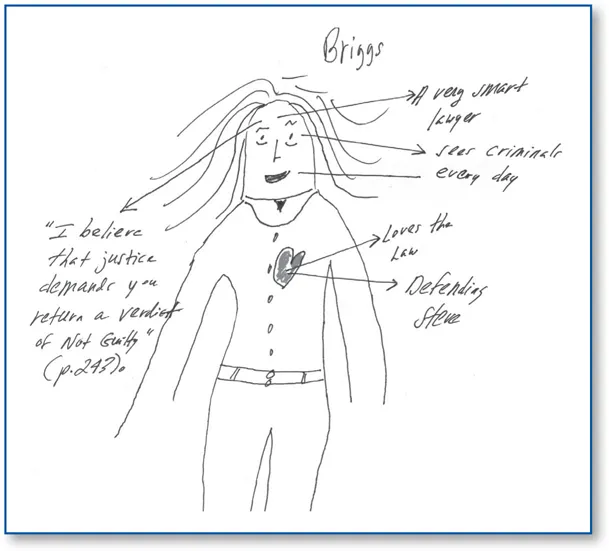
Body biographies represent one of many ways to engage students in the reading and discussion of young adult literature. As this text progresses, we introduce a wide array of strategies for readers to consider. For now, we simply want to introduce the possibility of using contemporary young adult literature in English Language Arts classrooms, including Ashley’s, and to begin to think more deeply about our individual and collective notions of text, teens, and teaching. To initiate such thinking, Activity 1.1 asks you to discuss the following questions and, of course, to add your own.
ACTIVITY 1.1: Professional Reflection and Discussion
Discuss the following questions individually and then in small groups. Record your answers.
1. Text: What is the difference between “text” and “book”? What texts were evident in the students’ experience of Monster in Ashley’s classroom? What counts as “legitimate” text in many of today’s classrooms? What counts as school literature? What texts are used to evaluate students’ reading ability?
2. Adolescents: Who is the adolescent reader? What is the usual image of the adolescent reader in schools? From what we know, how do Ashley’s students confirm or belie this image?
3. Teaching: What needs to be done to help improve adolescents’ literacy? What is contemporary young adult literature, and should it be included in school curriculum? What might be the benefits and limits of this literature for Ashley’s students? How might it be best taught?
Consider these questions and your discussion as you continue to read this and upcoming chapters.
YOUNG ADULT LITERATURE AND THE CHANGING NATURE OF TEXT
As beginning or seasoned teachers, readers are undoubtedly aware that the nature of adolescents, texts, and teaching is changing rapidly. These new times include emerging communication technologies and the incumbent changes in textual and linguistic practices—what is generally referred to as new literacies (Bean, 2010; Kist, 2010; Knobel & Lankshear, 2008)—are demanding new approaches to the teaching of literacy. Many adolescents are comfortable users of the new technologies, and they are engaging with multiple forms of text including print-based novels, nonfiction books, and magazines, but increasingly, more media or computer-based texts, for example graphic novels, hypertext fiction, podcasts, blogs, social media sites, and websites, along with cell phones, text messaging, and other text forms and modalities not yet imagined (Bean, 2010).
The diversity of texts students encounter out of, if not in, school demands change in school literacy programs. And indeed, curriculum principles and standards documents support reading across multiple forms of text. For example, Elizabeth Sturtevant et al. (2006) developed case studies of outstanding teaching in middle and secondary classrooms based on principles set forth by the International Reading Association Adolescent Literacy Commission (Moore, Bean, Birdyshaw, & Rycik, 1999). Principle 3 noted that: “Adolescents need opportunities to engage with print and nonprint texts for a variety of purposes” (Sturtevant et al., 2006, p. 42). The National Governors Association Center for Best Practices national core standards in reading include analysis of characters in fiction and nonfiction materials (see www.corestandards.org).
A new, revised position statement, Adolescent Literacy: A Position Statement of the International Reading Association (2012), updates the original work to include 21st-century digital literacy practices. The new statement can be accessed in a PDF format (www.reading.org/Libraries/Resources/ps1079_adolescentliteracy_rev2012.pdf).
Many professional organizations support the use of multiple texts to foster students’ consideration of societal issues. For example, professional organizations including the National Council of Teachers of English (NCTE), National Council for the Social Studies, National Council of Teachers of Mathematics, National Science Teachers’ Association, and National Standards for the English Language Arts, among many, recommend the use of multiple texts and text forms including novels, films, and video (Sturtevant et al., 2006). Certainly these recommendations are in concert with a view of the adolescent reader as highly interested if not involved i...
Table of contents
- Cover
- Title Page
- Copyright
- BRIEF CONTENTS
- Detailed Contents
- Foreword by Matthew D. Zbaracki
- Preface
- Acknowledgments
- About the Authors
- Part I: Foundations for the Teaching of Young Adult Literature
- Part II: Established and Emerging Genres of Young Adult Literature
- Part III: Critical Issues in Young Adult Literature
- Glossary
- Author Index
- Subject Index
Trusted by 375,005 students
Access to over 1.5 million titles for a fair monthly price.
Study more efficiently using our study tools.
Frequently asked questions
Yes, you can cancel anytime from the Subscription tab in your account settings on the Perlego website. Your subscription will stay active until the end of your current billing period. Learn how to cancel your subscription
No, books cannot be downloaded as external files, such as PDFs, for use outside of Perlego. However, you can download books within the Perlego app for offline reading on mobile or tablet. Learn how to download books offline
Perlego offers two plans: Essential and Complete
- Essential is ideal for learners and professionals who enjoy exploring a wide range of subjects. Access the Essential Library with 800,000+ trusted titles and best-sellers across business, personal growth, and the humanities. Includes unlimited reading time and Standard Read Aloud voice.
- Complete: Perfect for advanced learners and researchers needing full, unrestricted access. Unlock 1.5M+ books across hundreds of subjects, including academic and specialized titles. The Complete Plan also includes advanced features like Premium Read Aloud and Research Assistant.
We are an online textbook subscription service, where you can get access to an entire online library for less than the price of a single book per month. With over 1.5 million books across 990+ topics, we’ve got you covered! Learn about our mission
Look out for the read-aloud symbol on your next book to see if you can listen to it. The read-aloud tool reads text aloud for you, highlighting the text as it is being read. You can pause it, speed it up and slow it down. Learn more about Read Aloud
Yes! You can use the Perlego app on both iOS and Android devices to read anytime, anywhere — even offline. Perfect for commutes or when you’re on the go.
Please note we cannot support devices running on iOS 13 and Android 7 or earlier. Learn more about using the app
Please note we cannot support devices running on iOS 13 and Android 7 or earlier. Learn more about using the app
Yes, you can access Teaching Young Adult Literature by Thomas W. Bean,Judith Dunkerly-Bean,Helen J. Harper in PDF and/or ePUB format, as well as other popular books in Education & Secondary Education. We have over 1.5 million books available in our catalogue for you to explore.