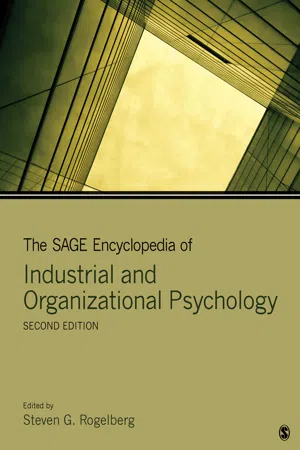
The well-received first edition of the Encyclopedia of Industrial and Organizational Psychology (2007, 2 vols) established itself in the academic library market as a landmark reference that presents a thorough overview of this cross-disciplinary field for students, researchers, and professionals in the areas of psychology, business, management, and human resources. Nearly ten years later, SAGE presents a thorough revision that both updates current entries and expands the overall coverage, adding approximately 200 new articles, expanding from two volumes to four. Examining key themes and topics from within this dynamic and expanding field of psychology, this work offers a truly cross-cultural and global perspective.
- 2,008 pages
- English
- ePUB (mobile friendly)
- Available on iOS & Android
eBook - ePub
The SAGE Encyclopedia of Industrial and Organizational Psychology
About this book
Information
Index
Entry titles and their page numbers are in bold. Page numbers follow the number of the volume they are found in (1:, 2:, 3:, 4:).
- Abbreviated Self-Leadership Questionnaire (ASLQ), 3:1414
- Absenteeism, 4:1734–1737
- attitude-absence hypothesis, 4:1735
- compressed workweek and, 1:202–203
- fear of terrorism, 4:1594–1595
- grievance systems and, 1:370
- incentives and, 2:699
- lateness, 4:1737–1740
- variance theories, 4:1735
- See also Turnover
- Abusive supervision, 1:1–4, 4:1708, 1709. See also Machiavellianism; Sexual harassment; Workplace incivility
- Academic careers in industrial and organizational psychology, 1:4–7, 161
- graduate degree programs, 1:5, 7, 4:1620–1624, 1791–1800
- income and employment survey results, 4:1807–1822
- internship tips, 4:1628–1631
- job tasks, 1:6
- preparing for, 3:1245–1248
- succeeding in, 4:1550–1553
- tips for applying to graduate school, 4:1620–1624
- Academic performance, action-state orientation, 1:19
- Academy of Management, 1:7–9, 3:1356, 4:1801
- Code of Ethics, 1:430
- Accident, defining, 4:1782
- Accident proneness, 4:1778
- Accident rate data, 3:1176
- Accidents and safety. See High-reliability organizations; Workplace safety
- Accommodation, 1:22, 31, 50–51, 4:1772–1773
- choosing selection procedures, 1:384
- misconceptions regarding, 3:1212
- religious practices, 1:22, 3:1346
- Accomplishment striving, 2:934
- Achievement needs, power needs, affiliation needs, and goal orientation, 1:9–13
- Across-the-board audit, 1:417
- ACT, 4:1498
- ACT World-of-Work Map, 2:824
- Action, theory of, 4:1604–1606
- Action regulation theory, 1:13–15
- Action-state...
Table of contents
- Cover
- Half Title
- Editorial Board
- Title Page
- Copyright Page
- Contents
- About the Editors
- Acknowledgments
- Acknowledgements
- Contributors
- Publisher Note
- Introduction
- A
- Abusive Supervision
- Academic Careers in Industrial and Organizational Psychology
- Academy of Management
- Achievement Needs
- Achievement Needs, Power Needs, Affiliation Needs, and Goal Orientation
- Action Regulation Theory
- Action-State Orientation
- Adverse Impact/Disparate Treatment/Discrimination at Work
- Affective Events Theory
- Affective Traits
- Affiliation Needs
- Affirmative Action
- Affordable Care Act
- After Action Reviews
- Age Discrimination in Employment Act
- Alliance for Organizational Psychology
- Ambition
- American Psychological Association, Association for Psychological Science
- Americans with Disabilities Act
- Applicant/Test-Taker Reactions
- Approach–Avoidance Motivation and Regulatory Focus
- Arbitration
- Archival Data/Secondary Data Techniques
- Armed Conflicts: Implications for Organizations
- Army Alpha/Army Beta
- Assessing Organizational Culture
- Assessment Center
- Assessment Center Methods
- Attitudes and Beliefs
- Attraction–Selection–Attrition Model
- Attractiveness
- Automation/Advanced Manufacturing Technology/Computer-Based Integrated Technology
- Autonomy
- B
- Background Checks/Credit Checks
- Balanced Scorecard
- Banding
- Bayesian Statistics
- Behavioral Approach to Leadership
- Benchmarking
- Big Data: Implications for Organizations
- Big Data Techniques/Analytics and I-O Psychology
- Big Five Taxonomy of Personality
- Biographical Data
- Bona Fide Occupational Qualifications
- Boomerang Employees
- Bootstrapping
- Boredom at Work
- Boundaryless Careers/Protean Mindset
- Building a Talent Pipeline
- Bullying at Work
- C
- Campbell, John P.: Ninth Recipient, SIOP Distinguished Scientific Contributions Award
- Career Development
- Career Success
- Career Transitions
- Careers
- Careers for Industrial and Organizational Psychologists
- Case Study Method
- Changing Demographics: Implications for Organizations
- Charismatic Leadership Theory
- Civil Rights Act of 1964, Civil Rights Act of 1991
- Classical Test Theory
- Classification
- Climate Change: Implications for Organizations
- Coercive Citations
- Cognitive Abilities
- Cognitive Ability Tests
- Common Method Variance
- Comparable Worth
- Compensation
- Competency Modeling
- Compressed Workweek
- Computer Adaptive Testing
- Computer-/Web-Based Assessment/Computer Adaptive Testing
- Conditional Reasoning
- Confidence Intervals/Hypothesis Testing/Effect Sizes
- Confirmatory Factor Analysis
- Conflict at Work
- Conflict Management
- Construct
- Contextual Performance/Prosocial Behavior/Organizational Citizenship Behavior
- Control Theory
- Convenience Sampling
- Core Self-Evaluations
- Corporate Ethics
- Corporate Social Responsibility
- Counterpoductive Behaviors
- Counterproductive Work Behaviors, Interpersonal Deviance
- Counterproductive Work Behaviors, Organizational Deviance
- Creativity at Work
- Credentialing
- Criterion Theory
- Critical Incident Technique
- Cross-Cultural Research Methods and Theory
- Crowdsourcing
- Customer Satisfaction and Service
- Cyberattacks: Implications for Organizations
- Cyberloafing at Work
- D
- Data Mining
- Data Privacy
- Data Sampling
- Data Visualization
- Dependent Care Support
- Descriptive Statistics
- Developing Leadership Talent Through Multiple Experiences
- Dictionary of Occupational Titles
- Differential Item Functioning
- Dirty Work
- Dispositional Resistance to Change
- Distance Learning
- Diversity Climate
- Diversity in the Workplace
- Diversity Training
- Downsizing
- Dual-Career Family Issues
- Dunnette, Marvin D.: Third Recipient, SIOP Distinguished Scientific Contributions Award
- Dyadic Data Analysis
- E
- Electronic Human Resource Management
- Electronic Performance Monitoring
- Emergent Leadership
- Emerging Markets and Globalization: Implications for Organizations
- Emotional Burnout
- Emotional Intelligence
- Emotional Labor
- Emotions
- Employee and Leader Self-Talk
- Employee Assistance Programs
- Employee Grievance Systems
- Employee Participation and Voice
- Employee Performance Recognition
- Employee Selection
- Employee Wellness Programs
- Employment at Will
- Employment Interview
- Empowerment
- Engagement
- Enron Scandal
- Entrepreneurship
- Epidemics: Implications for Organizations
- Equal Pay Act of 1963
- Equity Theory
- Ergonomics
- Error Management Training
- Ethical Decision Making and Behavior, Promotion of
- Ethics in Industrial and Organizational Practice
- Ethics in Industrial and Organizational Publishing
- Ethics in Industrial and Organizational Research
- Ethics Scandals in Organizations
- Ethics Training
- Ethnography
- European Association of Work and Organizational Psychology
- Eustress
- Executive Attention
- Executive Coaching
- Executive Selection
- Exit Survey (Exit Interview)
- Exogeneity
- Expatriate Assignments
- Expectancy Theory of Work Motivation
- Experience Sampling Technique
- Experimental Designs
- Exploratory Factor Analysis
- F
- Facilitating Survey Response
- Factor Analysis
- Faking and Intentional Distortion
- Family and Medical Leave Act
- Family Business
- Faultlines
- Feedback
- Feedback Seeking
- Flexible Work Schedules
- Flow
- Focus Groups
- Followership
- Founders of Industrial and Organizational Psychology
- Free Riding
- Funding Sources for Industrial and Organizational Psychology Research
- Furloughs
- G
- Gainsharing and Profit Sharing
- Gamification at Work
- Gay, Lesbian, and Bisexual Issues at Work
- Gay Rights Laws and Legislation
- Generalizability Theory
- Generational Issues in Working With Others
- Genetics and Industrial and Organizational Psychology
- Glass Ceiling
- Glass Cliff
- Global Leadership and Organizational Behavior Effectiveness Project
- Global Political Instability: Implications for Organizations
- Goal Orientation
- Goal-Setting Theory
- Graphology
- Gravitational Hypothesis
- Grounded Theory
- Group Cohesiveness
- Group Decision-Making Quality and Performance
- Group Decision-Making Techniques
- Group Development
- Group Dynamics and Processes
- Group Mental Model
- Groups
- Groupthink
- Guanxi
- Guion, Robert M.: Fifth Recipient, SIOP Distinguished Scientific Contributions Award
- H
- Hackman, J. Richard: Tenth Recipient, SIOP Distinguished Scientific Contributions Award
- Hardiness
- Hawthorne Studies/Hawthorne Effect
- HEXACO Model of Personality
- High-Performance Organization Model
- High-Potential Identification
- High-Potential Initiatives
- High-Reliability Organizations
- History of Industrial and Organizational Psychology in Africa
- History of Industrial and Organizational Psychology in Asia
- History of Industrial and Organizational Psychology in Chile
- History of Industrial and Organizational Psychology in Europe and the United Kingdom
- History of Industrial and Organizational Psychology in North America
- History of Industrial and Organizational Psychology in Other Parts of the World
- Honesty Testing
- Human Capital
- Human Factors
- Human Factors and Ergonomics
- Human Factors and Ergonomics Society
- Human Relations Movement
- Human Resource Information Systems
- Human Resource Management
- Human Resource Strategy
- Human-Centered Design
- Human–Computer Interaction
- Humor in the Workplace
- I
- Identity
- Identity Management Strategies
- Illegitimate Tasks
- Immigration: Implications for Organizations
- Immigration Law and Work
- Implicit Attitudes
- Implicit Theory of Leadership
- Incentives
- Incremental Validity
- Individual Differences
- Individual Psychological Assessment
- Industrial and Organizational Psychology Journals
- Industrial and Organizational Psychology, Poverty Reduction, and Prosocial Initiatives
- Industrial Relations
- Inferential Statistics
- Initial Screening
- Innovation
- Input–Process–Output Model of Team Effectiveness
- Institutional Theory
- Integrity at Work
- Integrity Testing
- Intergroup Relations
- International Association of Applied Psychology
- Interpersonal Communication
- Interpersonal Communication Styles
- Interpersonal Skills
- Interrater Reliability/Agreement
- Interviewing Considerations Beyond Applicant Ability
- Intrapreneurship
- Intrinsic and Extrinsic Work Motivation
- Item Response Theory
- J
- Job Advertisements
- Job Analysis
- Job Analysis Methods
- Job Characteristics Theory
- Job Choice
- Job Control
- Job Crafting
- Job Demands–Control Theory
- Job Description
- Job Design
- Job Evaluation
- Job Involvement
- Job Knowledge Testing
- Job Performance Models
- Job Rotation
- Job Satisfaction
- Job Satisfaction Measurement
- Job Search
- Job Security/Insecurity
- Job Sharing
- Job Typologies
- Journal of Applied Psychology
- Judgment and Decision-Making Process
- Judgment and Decision-Making Process: Advice Giving and Taking
- Judgment and Decision-Making Process: Heuristics, Cognitive Biases, and Contextual Influences
- Justice in Teams
- K
- Katzell, Raymond A.: Sixth Recipient, SIOP Distinguished Scientific Contributions Award
- Knowledge Management
- L
- Labor Law
- Labor Unions
- Latent Trait Theory
- Lawler, Edward E. III: Eighth Recipient, SIOP Distinguished Scientific Contributions Award
- Layoffs
- Leader–Member Exchange Theory
- Leadership and Gender
- Leadership and Neuroscience
- Leadership and Supervision
- Leadership Circumplex
- Leadership Development
- Learning Agility
- Learning Organizations
- Least Preferred Coworker Theory
- Lens Model
- Letters of Recommendation
- Linkage Research and Analyses
- Locus of Control
- Longitudinal Research
- M
- Machiavellianism
- Machine Learning
- Managing Talent in China
- Managing Talent in Global Organizations
- Mayflower Group
- McCormick, Ernest J.: Fourth Recipient, SIOP Distinguished Scientific Contributions Award
- Measurement Invariance
- Measurement of Implicit Attitudes
- Measurement Scales
- Measures of Association/Correlation Coefficient
- Mediating Variables
- Mediation
- Meetings at Work
- Mentoring
- Mergers, Acquisitions, and Strategic Alliances
- Meta-Analysis
- Micro Breaks
- Microaggressions at Work
- Mindfulness at Work
- Missing Data
- Mixed-Methods Designs
- Moderated Mediation and Mediated Moderation Models
- Moderator Variables
- Mood
- Morale
- Motherhood Penalty/Fatherhood Bonus
- Motivational Traits
- Motives
- M-Turk Data Collection
- Multilevel Modeling
- Multilevel Modeling Techniques
- Multimodal Performance Measurement and Assessment
- Multitrait–Multimethod Matrix
- N
- Narcissism
- National Institute for Occupational Safety and Health/Occupational Safety and Health Administration
- Naturalistic Observation
- Need Theories of Work Motivation
- Negotiation
- Negotiation, Mediation, and Arbitration
- Nepotism
- Networking
- New Employee Orientation
- Nomological Networks
- Nonexperimental Designs
- Nonparametric Tests
- Nonverbal Communication
- Normative Models of Decision Making and Leadership
- Normative Versus Ipsative Measurement
- Norms
- O
- Occupational Health Psychology
- Occupational Information Network (O*NET)
- Older Worker Issues
- Online Assessment
- Online Qualitative Methods
- Online Support
- Online Survey Data Collection Methods: Leveraging Qualtrics and SurveyMonkey
- Open Systems Theory
- Optimism and Pessimism
- Organizational Attraction
- Organizational Behavior
- Organizational Behavior Management
- Organizational Change
- Organizational Change, Resistance to
- Organizational Climate
- Organizational Commitment
- Organizational Communication, Discipline of
- Organizational Communication, Formal
- Organizational Communication, Informal
- Organizational Culture
- Organizational Cynicism
- Organizational Development
- Organizational Identification
- Organizational Image
- Organizational Justice
- Organizational Politics
- Organizational Retaliatory Behavior
- Organizational Sensemaking
- Organizational Socialization
- Organizational Socialization Tactics
- Organizational Sociology
- Organizational Structure
- Organizational Surveys
- Originality
- Outsourcing and Temporary Work
- Owens, William A.: First Recipient, SIOP Distinguished Scientific Contributions Award
- P
- Part-Time Work
- Passion at Work
- Path–Goal Theory
- Perceived Organizational Support
- Performance Appraisal
- Performance Appraisal, Objective Indices
- Performance Appraisal, Subjective Indices
- Performance Feedback
- Personality
- Personality Assessment
- Person–Environment Fit
- Person–Job Fit
- Personnel Psychology
- Person–Organization Fit
- Person–Vocation Fit
- Phenomenology
- Physical Disabilities at Work
- Physical Performance Assessment
- Placement and Classification
- Policy Capturing Method
- Political Polarization: Implications for Organizations
- Political Skill
- Polychronicity
- Porter, Lyman W.: Seventh Recipient, SIOP Distinguished Scientific Contributions Award
- Positive Psychology Applied to Work
- Power Needs
- Practical Intelligence
- Practice Careers in Industrial and Organizational Psychology: External Consulting Roles
- Practice Careers in Industrial and Organizational Psychology: Internal Roles
- Pregnancy Discrimination Act
- Prejudice
- Preparing for Academic Careers in Industrial and Organizational Psychology
- Preparing for Careers in Industrial and Organizational Psychology Practice
- Prescreening Assessment Methods for Personnel Selection
- Privacy at Work
- Proactive Personality
- Procrastination
- Profit Sharing
- Program Evaluation
- Project A
- Prosocial Values
- Prospect Theory
- Protestant Work Ethic
- Psychological Contract
- Psychological Resilience
- Q
- Qualitative Analytic Software
- Qualitative Research Approach
- Quality of Work Life
- Quantitative Research Approach
- Quasi-Experimental Designs
- Queen Bee Syndrome
- Questionnaires
- R
- Race Norming
- Rater Training
- Rating Errors and Perceptual Biases
- Rational Decision Making Theory
- Realistic Job Preview
- Recovery From Work/Psychological Detachment
- Recruitment
- Recruitment Sources
- Registered Reports Publication Model
- Regression Techniques
- Reinforcement Theory of Work Motivation
- Relative Importance
- Reliability
- Religious Discrimination
- Results-Only Work Environment
- Retesting
- Retirement
- Rightsizing
- Rise of Africa: Implications for Organizations
- Rise of China: Implications for Organizations
- Role Ambiguity
- Role Conflict
- Role of Theory in Research
- Role Overload and Underload
- S
- Safety Climate
- Sampling Techniques
- Scale Creation
- Scale Development
- Scientific Management
- Scientist–Practitioner Model
- Selection: Occupational Tailoring
- Selection Strategies
- Self-Concept Theory of Work Motivation
- Self-Determination Theory
- Self-Efficacy
- Self-Esteem
- Self-Fulfilling Prophecy: Pygmalion Effect
- Self-Leadership Theory
- Self-Regulation Theory
- Servant Leadership
- Service Climate
- Sexual Discrimination
- Sexual Harassment
- Shared Leadership
- Shift Work
- Simulation, Computer Approach
- Situational Approach to Leadership
- Situational Judgment Tests
- Situational Leadership Theory
- Smith, Patricia C.: Second Recipient, SIOP Distinguished Scientific Contributions Award
- Social Cognitive Theory
- Social Comparison Theory
- Social Exchange Theory
- Social Loafing
- Social Media: Implications for Organizations
- Social Media in Selection
- Social Norms and Conformity
- Social Relations Model
- Social Support
- Socialization
- Socialization, Employee Proactive Behaviors
- Society for Human Resource Management
- Society for Industrial and Organizational Psychology
- Sociotechnical Approach
- Space and Spaceflight: Implications for Organizations
- Stakeholder Theory
- Standardized Testing
- Statistical Power
- Status Characteristics Theory
- Stereotype Threat
- Stereotyping
- Stigma
- Strategic Human Resources
- Strategic Planning
- Strategic Talent Management
- Strategy
- Stress, Consequences
- Stress, Coping and Management
- Stress, Models and Theories
- Stress and Physiological Indicators
- Stress Management Interventions
- Structural Equation Modeling
- Subconscious Motivation
- Succeeding in Academic Careers in Industrial and Organizational Psychology
- Succeeding in Careers in Industrial and Organizational Psychology Practice
- Succession Planning
- Survey Approach
- Survey Nonresponse Bias
- Survivor Syndrome
- Sustainability: Implications for Organizations
- T
- Team Building
- Team Development
- Team Mental Model
- Team-Based Rewards
- Teams
- Teams, Creativity and Innovation
- Telecommuting
- Temporary Workers
- Terrorism: Implications for Organizations
- Terrorism and Work
- Test Security
- Tests of Mean Differences
- Theft at Work
- Theory of Action
- Theory of Reasoned Action/Theory of Planned Behavior
- Theory of Work Adjustment
- Theory X/Y
- 360-Degree Feedback
- Time Management
- Tips for Applying to Industrial and Organizational Psychology Graduate School
- Tips for Creating a Consulting Practice
- Tips for Getting an Internship
- Total Quality Management
- Trade Unions
- Trainability and Adaptability
- Training
- Training Evaluation
- Training Methods
- Training Needs Assessment and Analysis
- Trait Approach to Leadership
- Transfer of Training
- Transformational and Transactional Leadership
- Triple Bottom Line
- Trust
- Two-Factor Theory
- Type A/Type B Personality
- U
- Underemployment
- Unethical Data Analytic Practices
- Uniform Guidelines on Employee Selection Procedures
- Union Commitment
- Union Law
- Unions
- U.S. National Debt: Implications for Organizations
- User Experience
- Utility Analysis
- V
- Validation Strategies
- Validity
- Verbal Protocol Analysis
- Veterans in Civilian Work
- Victimization
- Violence at Work
- Virtual Interactions
- Virtual Organizations
- Virtual Teams
- Vocational Interests/Choice
- Volunteer Management
- W
- Web-Based Assessment
- What Is Theory?
- Whistle-Blowers
- Withdrawal Behaviors, Absenteeism
- Withdrawal Behaviors, Lateness
- Withdrawal Behaviors, Turnover
- Work as a Calling
- Work Ethic
- Work Motivation
- Work Samples
- Work Values
- Workaholism
- Workers’ Compensation Law
- Work–Life Balance
- Work–Life Conflict
- Work–Life Enrichment
- Workplace Accommodations for People With Disabilities
- Workplace Exclusion
- Workplace Incivility
- Workplace Injuries
- Workplace Romance
- Workplace Safety
- Workplace Spirituality and Spiritual Leadership
- Appendix A: Graduate Training Programs in Industrial and Organizational (I-O) Psychology and Organizational Behavior and Human Resources (OBHR)
- Appendix B: Groups Related to Industrial and Organizational Psychology
- Appendix C: 2012 lncome and Employment Survey Results for the Society for Industrial and Organizational Psychology
- Appendix D: Policy on Licensure
- Index
Trusted by 375,005 students
Access to over 1.5 million titles for a fair monthly price.
Study more efficiently using our study tools.
Frequently asked questions
Yes, you can cancel anytime from the Subscription tab in your account settings on the Perlego website. Your subscription will stay active until the end of your current billing period. Learn how to cancel your subscription
No, books cannot be downloaded as external files, such as PDFs, for use outside of Perlego. However, you can download books within the Perlego app for offline reading on mobile or tablet. Learn how to download books offline
Perlego offers two plans: Essential and Complete
- Essential is ideal for learners and professionals who enjoy exploring a wide range of subjects. Access the Essential Library with 800,000+ trusted titles and best-sellers across business, personal growth, and the humanities. Includes unlimited reading time and Standard Read Aloud voice.
- Complete: Perfect for advanced learners and researchers needing full, unrestricted access. Unlock 1.5M+ books across hundreds of subjects, including academic and specialized titles. The Complete Plan also includes advanced features like Premium Read Aloud and Research Assistant.
We are an online textbook subscription service, where you can get access to an entire online library for less than the price of a single book per month. With over 1.5 million books across 990+ topics, we’ve got you covered! Learn about our mission
Look out for the read-aloud symbol on your next book to see if you can listen to it. The read-aloud tool reads text aloud for you, highlighting the text as it is being read. You can pause it, speed it up and slow it down. Learn more about Read Aloud
Yes! You can use the Perlego app on both iOS and Android devices to read anytime, anywhere — even offline. Perfect for commutes or when you’re on the go.
Please note we cannot support devices running on iOS 13 and Android 7 or earlier. Learn more about using the app
Please note we cannot support devices running on iOS 13 and Android 7 or earlier. Learn more about using the app
Yes, you can access The SAGE Encyclopedia of Industrial and Organizational Psychology by Steven G. Rogelberg in PDF and/or ePUB format, as well as other popular books in Psychology & Industrial & Organizational Psychology. We have over 1.5 million books available in our catalogue for you to explore.