
eBook - ePub
Handbook of Group Counseling and Psychotherapy
- 656 pages
- English
- ePUB (mobile friendly)
- Available on iOS & Android
eBook - ePub
Handbook of Group Counseling and Psychotherapy
About this book
The most comprehensive and thoroughly researched text available on this topic, Handbook of Group Counseling and Psychotherapy, Second Edition underscores the notion that group work is improved through increased collaboration between researchers and practitioners. Edited by renowned leaders in the field, this thoroughly updated and revised Second Edition explores current literature and research and offers suggestions for practice in psycho-educational, counseling, and therapy groups. The Handbook is divided into five main sections: current and historical perspectives, best practices, multicultural and diverse groups, groups in special settings, and an introduction to special topics.
Information
Part I Current and Historical Perspectives on the Field of Group Counseling and Psychotherapy
Introduction
Group counseling and psychotherapy has a vibrant and complex history that is
not always known to those persons who conduct and study groups. Yet gaining
an understanding of the historical challenges and contributions made by
devoted group facilitators, researchers, and teachers provides us with a
great opportunity to assess where we are currently. Thankfully, the study
and practice of group counseling and psychotherapy has made huge strides in
what we know. It now provides us with confidence based on empirical data
that groups are effective and, thus, rapidly becoming more respected and
widely practiced in the field. We owe much credit to those who have carved
out our current and promising future path. Because our present is grounded
in our past, the lead chapter of this Handbook by Sally Barlow
reviews the history of group counseling and psychotherapy. In this chapter,
she examines the multifaceted history that includes the key contributors,
the wide array of group types, and the evolution of group research across
the past 100 years. Guided by these historical roots, Barlow also provides
recommendations as to how research and practice needs to move forward,
including areas that have had limited attention in the past such as “the
underserved and decidedly underresearched segments of our society such as
the severely and persistently mentally ill” (Chapter 1). The second
chapter describes a unifying theory of group counseling and psychotherapy
instead of seeing theories as discreet entities or a view that there is a
best theory. Susan X. Day states that we need to “reach beyond a
list of which theories inform which therapies, and to look for a common
foundation from which various approaches are constructed as an organizing
structure.” This chapter provides a clearly marked road map that will guide
group facilitators and those who train group leaders. The next chapter
discusses the important topic of group dynamics and group development.
Donelson Forsyth and Leann Diederich provide wonderful examples that give a
vivid snapshot of how a group develops across sessions. These examples are
embedded in the theories of group development and underscore for the group
psychotherapist a conceptual filter by which a group can be viewed.
Following the information on group development is a chapter that discusses
the current theory and research on therapeutic factors. It is clear that
groups have components or factors that can increase the effectiveness of the group. More
recent research has begun to look more carefully at the number and type of
therapeutic factors that occur within groups. Dennis Kivlighan Jr. and D.
Martin Kivlighan III help clarify the large and often confusing body of
research on therapeutic factors. They offer a hope that researchers will
continue to broaden the existing body of literature on these important
therapeutic components and that research studies will examine the
relationship of these factors with other group processes and outcomes. As
with the other chapters in this section, Gary Burlingame, Kaity Whitcomb,
and Sean Woodland articulate a current perspective on the status of process
and outcome research in group counseling and psychotherapy. In many ways,
this chapter brings together what we know about the effectiveness of groups
and how group research has become stronger and more rigorous over the past
10 years. These excellent chapters in this section underscore how far we
have come as a field and how the emphasis on theory, group development,
therapeutic factors, and on processes and outcomes in group psychotherapy
are still some of the most essential elements in our group practice and
research.
Chapter 1 The History of Group Counseling and Psychotherapy
This chapter examines historical aspects of group counseling and psychotherapy by presenting key contributors, types of groups, and research (review articles, group vs. individual meta-analyses, themes from small group psychology, and substantive themes by clinical population). Group psychotherapy and counseling have a multifaceted history founded on over 100 years of theory, research, and clinical practice that informs this specialty in evidence-based professional psychology. Medicine, psychoanalysis, theater, communications, social psychology, evolution, and other domains have contributed. Group counseling, group psychotherapy, and group treatments are terms used interchangeably, although some controversy exists about the exact demarcation between these. Figure 1.1 depicts the placement of these group therapies among other kinds of groups. “Many professional national and international organizations have promoted the place of experts in many kinds of groups by their involvement in the education, training, and credentialing of group leaders, group therapists, as well as promoting groups to the public” (Barlow, 2013).
A brief view of contributions of key figures and their ideas related to group phenomenon include William James’ theory of social facilitation, Norman Triplett's first social psychology investigation of groups, Joseph Pratt's first group psychotherapy study, Sigmund Freud's notion of the social as mediator in Group Psychology: The Analysis of the Ego, Trigant Burrow's coining of “group therapy,” Kurt Lewin's establishment of the Center for Group Dynamics, S. H. Foulkes’ establishment of the Institute of Group Analysis, Wilfred Bion's Experiences in Group, Henri Tajfel's Social Identity Theory, Irving Janis’ Groupthink, Urie Bronfenbrenner's Social Ecological Model, Irvin Yalom's text The Theory and Practice of Group Psychotherapy (Yalom & Leszca, 2005), and Donelson Forsyth's social psychology text Group Dynamics (see Barlow, 2013). Each contributor in turn examined theoretical, empirical, and practical mechanisms of group psychology and group psychotherapy, laying the foundation for group history and research.
Figure 1.1 Group Types Flowing From the Foundations of Group Dynamics
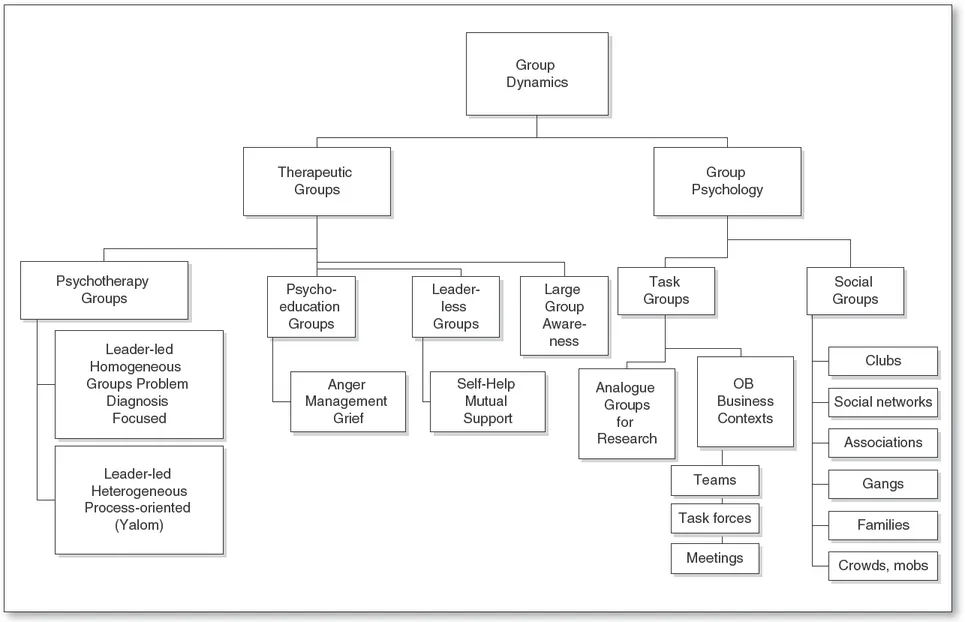
Note: Thank you to Donelson Forsyth for his help on this flow chart.
Source: © By permission of Oxford University Press, USA.
A Historical Review
Amperican physician Joseph Pratt published his study of treating tuberculosis patients in a group setting in 1905, using “thought control classes,” which likely gave the written history of group research a beginning point (Barlow, Fuhriman, & Burlingame, 2000), while Freud (1922), Adler (1955), Moreno and Whitin (1932), in turn, published accounts about the theoretical underpinning of the group “cure.” The history of psychotherapy research in general and group in particular can be sandwiched between two physicians working with tuberculosis patients. Archie Cochrane, a Scottish physician, realized he couldn't go on collapsing lungs (one of the two treatment strategies for this illness) if he did not have more empirical data to guide him. He founded what came to be known as the Cochrane Library, an enormous electronic database that rates scientific findings according to a scale that prioritizes the best research available (Cochrane & Blythe, 1989).1 In the 50-year span of time from Pratt to Cochrane, tuberculosis went from an almost incurable disease to a treatable one with effective vaccines and improved health care; but given antibiotic resistant strains, it still represents a health threat in the medical world. Serious mental health issues represent health threats as well such as depression and schizophrenia, just to name two. Depression is considered a leading cause of the “disease burden,” which determines the impact of health problems—for instance, financial costs—by combining quality of life years (QALYs) and disability-adjusted life years (DALYs)—indexes that examine morbidity and mortality rates in North America that are expected to increase worldwide. Like Cochrane, mental health professionals are searching for viable treatments.2 Efficient and effective treatments for an array of disorders may include the careful use of group treatments for depression, anxiety, schizophrenia, and other mental health issues.
Cochrane was a leading medica...
Table of contents
- Cover
- Half Title
- Acknowledgements
- Title Page
- Copyright Page
- Contents
- About the Editors
- Contributing Authors
- Acknowledgements
- Introduction to the Second Edition of the Handbook of Group Counseling and Psychotherapy
- Part I Current and Historical Perspectives on the Field of Group Counseling and Psychotherapy
- Chapter 1 The History of Group Counseling and Psychotherapy
- Chapter 2 A Unifying Theory for Group Counseling and Psychotherapy
- Chapter 3 Group Dynamics and Development
- Chapter 4 Therapeutic Factors: Current Theory and Research
- Chapter 5 Process and Outcome in Group Counseling and Psychotherapy: A Perspective
- Part II Best Practices of Group Counseling and Group Psychotherapy
- Chapter 6 Guidelines for Ethical and Legal Practice in Counseling and Psychotherapy Groups
- Chapter 7 Effective Processing in Groups
- Chapter 8 Selecting and Using Activities in Groups
- Chapter 9 Effective Group Leader Skills
- Chapter 10 Unleashing the Healing Power of the Group: The Mutual Aid Process
- Chapter 11 An Overview of Current Research and Best Practices for Training Beginning Group Leaders
- Chapter 12 Supervision of Group Leaders
- Chapter 13 Measures of Group Process, Dynamics, Climate, Behavior, and Outcome: A Review
- Chapter 14 Best Practices in Group Counseling and Psychotherapy Research
- Part III Introduction to Multicultural and Diverse Counseling and Psychotherapy Groups
- Chapter 15 Understanding Racial/Cultural Identity Development Theories to Promote Effective Multicultural Group Counseling
- Chapter 16 Group Therapy with Native People
- Chapter 17 Group Counseling for African Americans: Research and Practice Considerations
- Chapter 18 Group Counseling with Asians
- Chapter 19 Psychoeducational and Counseling Groups with Latinos/as
- Chapter 20 Group Work with Gay, Lesbian, Bisexual, Transgender, Queer, and Questioning Clients
- Chapter 21 Group Counseling Services for Persons with Disabilities
- Chapter 22 Group Work with Those in Later Life
- Chapter 23 Using Groups to Facilitate Social Justice Change: Addressing Issues of Privilege and Oppression
- Part IV Introduction to Counseling and Psychotherapy Groups in Special Settings
- Chapter 24 Advancing Evidence-Based Group Work in Community Mental Health Settings: Methods, Challenges, and Opportunities
- Chapter 25 Group Work in Schools
- Chapter 26 Group Work in Colleges and University Counseling Centers
- Chapter 27 Groups in Behavioral Health Settings
- Chapter 28 Group Treatments within the Department of Veterans Affairs
- Part V Introduction to Special Topics
- Chapter 29 Groups for Depression
- Chapter 30 Groups for Anxiety Disorders
- Chapter 31 Group Psychotherapies for Complicated Grief
- Chapter 32 Group Approaches for Addictive Behaviors
- Chapter 33 Group Work with Individuals who have Committed Interpersonal Violence
- Chapter 34 Group Work with Offenders and Mandated Clients
- Chapter 35 Group Psychotherapy and Insecure Adult Attachment
- Chapter 36 Groups for Survivors of Childhood Sexual Abuse
- Chapter 37 Mindfulness and Group: Mindfulness-Based Stress Reduction and Dialectical Behavior Therapy
- Chapter 38 Psychoeducational and Counseling Groups to Prevent and Treat Eating Disorders and Disturbances
- Chapter 39 Psychoeducational and Counseling Groups for Bullying
- Chapter 40 Women's Groups: Research and Practice Trends
- Chapter 41 Gender-Sensitive Group Counseling and Psychotherapy with Men
- Chapter 42 Prevention Groups
- Chapter 43 Career and Transition Counseling in Groups
- Chapter 44 Adventure Therapy with Groups
- Chapter 45 Post-Disaster Group Counseling: A Multicultural Perspective
- Chapter 46 Counseling and Therapy Groups with Children and Adolescents
- Reflections and Final Comments
- Index
Trusted by 375,005 students
Access to over 1.5 million titles for a fair monthly price.
Study more efficiently using our study tools.
Frequently asked questions
Yes, you can cancel anytime from the Subscription tab in your account settings on the Perlego website. Your subscription will stay active until the end of your current billing period. Learn how to cancel your subscription
No, books cannot be downloaded as external files, such as PDFs, for use outside of Perlego. However, you can download books within the Perlego app for offline reading on mobile or tablet. Learn how to download books offline
Perlego offers two plans: Essential and Complete
- Essential is ideal for learners and professionals who enjoy exploring a wide range of subjects. Access the Essential Library with 800,000+ trusted titles and best-sellers across business, personal growth, and the humanities. Includes unlimited reading time and Standard Read Aloud voice.
- Complete: Perfect for advanced learners and researchers needing full, unrestricted access. Unlock 1.5M+ books across hundreds of subjects, including academic and specialized titles. The Complete Plan also includes advanced features like Premium Read Aloud and Research Assistant.
We are an online textbook subscription service, where you can get access to an entire online library for less than the price of a single book per month. With over 1.5 million books across 990+ topics, we’ve got you covered! Learn about our mission
Look out for the read-aloud symbol on your next book to see if you can listen to it. The read-aloud tool reads text aloud for you, highlighting the text as it is being read. You can pause it, speed it up and slow it down. Learn more about Read Aloud
Yes! You can use the Perlego app on both iOS and Android devices to read anytime, anywhere — even offline. Perfect for commutes or when you’re on the go.
Please note we cannot support devices running on iOS 13 and Android 7 or earlier. Learn more about using the app
Please note we cannot support devices running on iOS 13 and Android 7 or earlier. Learn more about using the app
Yes, you can access Handbook of Group Counseling and Psychotherapy by Janice L. DeLucia-Waack,Cynthia R. Kalodner,Maria Riva, Janice L. DeLucia-Waack, Cynthia R. Kalodner, Maria T. Riva in PDF and/or ePUB format, as well as other popular books in Education & Education Counseling. We have over 1.5 million books available in our catalogue for you to explore.