In a 'video first' world, video is one of the most effective tools marketers can use to raise brand awareness, engage consumers, drive website traffic and increase sales.
Video Marketing takes a step-by-step and in-depth look at planning and creating great video campaigns, as well as activating, testing and measuring their success. Featuring case studies from global household names such as adidas, Kleenex, and Red Bull, it explores which video types and platforms brands should use, using multi-video campaigns, live videos and webinars, as well as creating and editing video campaigns on a budget using DSLRs and smartphones.
Updated with the latest developments, this second edition of Video Marketing contains new chapters on understanding your audience and buying media space on ad networks and social media, as well as further content on personal and personalized content and avoiding potential pitfalls such as frauds, fake views and updates. Accompanying online resources consist of video links for campaigns discussed in the book and a downloadable strategy planner for readers to complete and put into action.
eBook - ePub
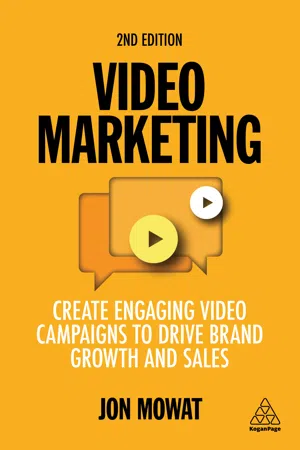
Video Marketing
Create Engaging Video Campaigns to Drive Brand Growth and Sales
- English
- ePUB (mobile friendly)
- Available on iOS & Android
eBook - ePub
About this book
Information
06
Step 1: planning
The first of my three steps to building a successful video campaign is planning. The very phrase ‘planning’ means so much to so many people. A TV agency, engineering firm and accountancy practice will all have a very different idea of what a planner does. So, what do I mean by planning in the context of this book? In short, I mean making a plan to grow your business with video. Creating a plan before you jump into the fun creative stuff is essential, as imaginative ideas without direction or goals will fail to generate profit or grow brands. In this chapter I will look at the steps needed to make a good video plan and the information you need to start getting one together. Before launching into how to plan for video, though, I have to make it clear that video is only one marketing channel. It’s a very powerful channel, but any video planning must sit within your wider marketing plans and goals, so avoid thinking of it in isolation.
By planning, you are doing what some people do full-time. Those of you inside agencies or companies with larger marketing departments will be well versed in the dark arts of the ‘planner’. These immensely clever people bring insight and results to the creative process. There haven’t always been planners in agencies, and indeed agencies have been very successful in making decent profits without them. But it is fair to say that before the 1980s many areas of advertising lacked intellectual rigour. This changed when Stephen King of JWT and Stanley Pollitt of BMP (the undisputed forefathers of account planning) became unhappy with the basis of decision making within the advertising industry. They felt that creative teams had little actual insight behind their decision making and also that marketing departments (clients) and the agency account managers of the agency were not interacting as well as they could. In answer to this they developed teams that used market research and other data to add intellectual rigour to the development of ideas. The manipulation and analysis of data has grown up a lot since those initial days, and now that the discipline has reached maturity planners are using ever more precise (or at least, more complicated) tools and basing their thoughts on proven scientific principles drawn from behavioural economics and psychology.
In this book, we’re going to streamline the planning process, and I give you a practical approach to building your own campaign. It’s built around a seven-question process that will generate all the details you need to build a killer video campaign.
SEVEN QUESTIONS FOR SUCCESS
I’ve been planning videos and the campaigns around them for 20 years, and along the way I’ve come up with some good systems and practices to make it work. To help you, I’ve created a template ‘video marketing planner’ (VMP), which you can download and fill in. The VMP reflects the seven questions in this chapter, and it’s a super practical way for you to start building a complete strategy. You can use it for one video or to build a multi video monster that works across multiple channel (see more on this in Section Four).
The VMP prompts you through the seven questions that are at the heart of video marketing:
- What are your campaign objectives?
- Who are you talking to?
- When are you talking to viewers?
- Where is your audience?
- What are you saying?
- How will you activate?
- What are your campaign KPIs and metrics?
You can download the template VMP at www.koganpage.com/vm2
1 What are your campaign objectives?
Let’s start at the very beginning… what are you actually trying to achieve? This seems like it should be an easy enough question, but answering it precisely almost always raises interesting dynamics. The normal dynamic for a brand project is to have multiple stakeholders from across the business, and these people invariable have slightly different objectives. The head of sales will want something very different from the CTO, who in turn will want something different from someone on the customer support team. In the middle of all of this is you! At the very start of the process, it’s worth visiting all the stakeholders in your project to understand what they are expecting, then combine these into a single document, simplify them, and reflect them back. If nothing else, this will give you insights into stakeholders that are destined to be disappointed so you can manage their expectations. The main mantra with campaign objectives is that ‘less is more’. One specific thing is going to be much easier to achieve than a catch-all solution. Get agreement on what it is you actually want to do, and you are off to a great start. It’s worth having your allies lined up at this point to help you keep on track, and a top tip from me is that multiple stakeholders can be offered different versions of videos (or other video projects entirely) to meet their needs. I’ve found that as long as people know they will get the tools they require in the end they tend to go along with the overall plan.
The things that are most hotly contested in brand team meetings are the list below. Once you know them, you are in a good place to start:
- What is the business need for this film?
- If there is more than one need, which is the most important?
- What is the best outcome for the film?
- Who has sign-off on the project (and who is paying for it)?
- What are the measures of success? (We will cover this more in question 7)
- What timescales are you working to?
If you are thinking of using my downloadable VMP template, now is a good time to start. You will see that it includes space to put your project and company goals. Don’t worry if there appear to be a lot of boxes that you cannot fill in yet, as that is what the rest of this chapter is about.
Planning for short- and long-term goals
Optimum campaign strategy will be different depending on whether you set long-term or short-term goals. Short-term goals are best served by behavioural triggers that are immediate, for example dealing with simple logic such as pricing, new products or specific timed events. Long-term goals (such as growing market share) will need a brand-building element that is more suited to emotional drivers aimed at the System 1 mind (which we talk about at length in Chapter 2). Knowing your goals will directly affect the kinds of video content you choose to create.
A lot of marketing activity goes into growing current customers, be that loyalty campaigns, regular content, newsletters and so forth. Yes, this is important, but radical improvements in turnover and sales will only come from a heavy focus on new customers. A central tenet of your marketing strategy should therefore be to grow the fame of the brand. For more on this you should read the IPA’s book The Long and the Short of It, but for now here is a key paragraph from the publication:
Across the board, in terms of metrics used, campaigns targeting new customers outperform those targeting existing customers. In terms of the business effects reported, the former are almost three times as effective as those targeting existing customers; in terms of total effects, they are more than twice as effective.1
This means that brands looking to grow must reach beyond existing social channels.2 A nice video that is sent to people that already know you will not grow your business as much as getting something, of any level, in front of new people. It seems obvious but many times it’s easy to go for the shortest route of talking to people you already know, rather than striking up a new conversation. A good video strategy will work for you across the sales funnel with a truly win–win goal being a strategy that balances long-term brand goals with short-term sales targets.
2 Who are you talking to?
Now that you know what it is your business is trying to achieve, it’s time to clarify who you are talking to. What are the personas of your customers? What are the emotions that are going to encourage them to take action? Unless you can really say what your audience looks like, you’re going to be stuck. All great videos start with an understanding of what makes the audience t...
Table of contents
- List of figures
- List of tables
- About the author
- Preface
- Acknowledgements
- Section One Video marketing strategy: an introduction
- 01 What is video marketing?
- 02 Why video marketing works
- 03 Video types and approaches
- 04 Video platforms: what you need to know
- SECTION TWO Creating great videos
- 05 The basics of video marketing
- 06 Step 1: planning
- 07 Step 2: production
- 08 Step 3: activation
- 09 The dark underbelly of video advertising: how to avoid losing money
- Section Three DIY video projects
- 10 DIY video production: so, it’s up to you now?
- 11 DIY video: advanced tips
- 12 DIY video: editing your work
- Section Four Creating effective video campaigns
- 13 Multi-video campaigns: an introduction
- 14 Steps 1 and 2: reviewing brand content and setting goals
- 15 Step 3: content planning and programming strategy
- 16 Step 4: building the perfect content hub
- 17 Step 5: create high-volume video content – easily
- 18 Step 6: activate your multi-video campaign and test
- 19 Live video: online events and webinars
- Index
Trusted by 375,005 students
Access to over 1.5 million titles for a fair monthly price.
Study more efficiently using our study tools.
Frequently asked questions
Yes, you can cancel anytime from the Subscription tab in your account settings on the Perlego website. Your subscription will stay active until the end of your current billing period. Learn how to cancel your subscription
No, books cannot be downloaded as external files, such as PDFs, for use outside of Perlego. However, you can download books within the Perlego app for offline reading on mobile or tablet. Learn how to download books offline
We are an online textbook subscription service, where you can get access to an entire online library for less than the price of a single book per month. With over 1.5 million books across 990+ topics, we’ve got you covered! Learn about our mission
Look out for the read-aloud symbol on your next book to see if you can listen to it. The read-aloud tool reads text aloud for you, highlighting the text as it is being read. You can pause it, speed it up and slow it down. Learn more about Read Aloud
Yes! You can use the Perlego app on both iOS and Android devices to read anytime, anywhere — even offline. Perfect for commutes or when you’re on the go.
Please note we cannot support devices running on iOS 13 and Android 7 or earlier. Learn more about using the app
Please note we cannot support devices running on iOS 13 and Android 7 or earlier. Learn more about using the app
Yes, you can access Video Marketing by Jon Mowat in PDF and/or ePUB format, as well as other popular books in Business & Digital Marketing. We have over 1.5 million books available in our catalogue for you to explore.