eBook - ePub
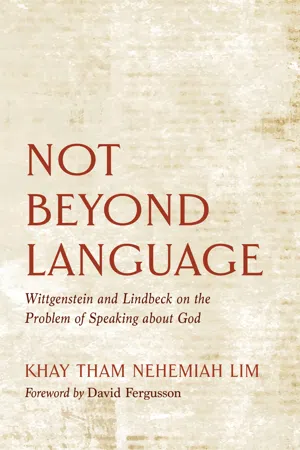
Not Beyond Language
Wittgenstein and Lindbeck on the Problem of Speaking about God
- 262 pages
- English
- ePUB (mobile friendly)
- Available on iOS & Android
eBook - ePub
Not Beyond Language
Wittgenstein and Lindbeck on the Problem of Speaking about God
About this book
The problem of speaking about God arises from the presumed notion that God is utterly transcendent and is "wholly other" from human existence. Moreover, a profound sense of mystery is held to surround God's being. Even so, Not Beyond Language maintains that it is still possible for human beings to express and describe God in words--that language can bring genuine disclosure and understanding of the divine. However, given that religious language is problematic because inadequate, those who engage in speaking about God must accept that the words they use cannot be pressed to yield precise definitions or complete explanations of the divine. The author proposes a nuanced approach to the use of religious language which revolves more around meaning and relevance of the discourse about divine reality, than objective claims about who or what God is.
Information
Topic
Theology & ReligionSubtopic
Language in PhilosophyChapter 1
“Discovery” of Language
Man possesses the ability to construct languages capable of expressing every sense, without having any idea how each word has meaning or what its meaning is—just as people speak without knowing how the individual sounds are produced.1
—Ludwig Wittgenstein
Introduction
The “discovery” of language—by which I mean the preoccupation with or the awareness of what language is and how it bears and conveys meaning—has been likened to a commonplace scenario portrayed by the British writer and philosopher Iris Murdoch (1919–1999). In her book about the “romantic rationalist” Jean-Paul Sartre who had repeatedly called attention to the crisis of language, Murdoch writes, “We can no longer take language for granted as a medium of communication. Its transparency has gone. We are like some people who for a long time looked out of a window without noticing the glass—and then one day began to notice this too.”2 The parallel drawn by Murdoch aptly illustrates how we have become more conscious that language is our window into reality and that instead of looking through words or signs as a matter of routine, we are beginning to look at them. Naturally, such close attention to language itself has brought about a further awareness, the awareness that “the glass” through which we see may actually reduce or obscure our vision, should it become stained or smudged. This raises the question whether language is capable of accurately expressing reality or whether words can bear their semantic freight or cope with the use they are put to. For some of us, there is the further question posed by Wittgenstein, whose resources we have chosen to draw on for our present study: why has it never occurred to us to take off the “pair of glasses on our nose through which we see whatever we look at”?3
The discovery of language is, however, about much more than not taking language for granted. It is also not a recent phenomenon. Philosophers and other thinkers have long been preoccupied with the question of language—especially its epistemic primacy. Since early times, they have been beset by the perplexities that the use of words entails. Nor is the enduring concern with language an isolated movement. In this chapter, I will outline the key currents of thought on this subject-matter in the history of philosophy. As my objective is to set the stage for the larger argument of my project, I shall not be concerned to present a systematic or an exhaustive account of how language has evolved since the earliest years of human civilization; for such an undertaking would take us beyond the scope of our present study. What I wish to cover, namely the main outlines of the “story” at least up to the period of Wittgenstein, will for many be familiar territory; still I hope my recapitulation will help to generate a certain sensibility about how language has been perceived or understood as the centuries advanced, and serve to indicate how the fascination with language has impacted our present day understanding of this very human feature.
What has just been said about language in general applies naturally to the narrower phenomenon of “religious language,” though the latter, in the sense in which I shall be using the term, does not refer to a natural language like English, French, or some other. The jibe, “Do you speak English, French, or religious?”4 drives home this point for us. According to William Alston (1921–2009), whose jibe I have just used, “the term ‘religious language’ is a special case of the bad habit of philosophers to speak of a special language for each terminology or broad subject matter (the ‘language of physics,’ the ‘language of ethics,’ etc.)” in which the distinction between language and speech (or better, discourse) is neglected.5 Alston further notes,
The former is an abstract system that is employed primarily for communication, and the latter is that employment. What is erroneously called “religious language” is the use of language (any language) in connection with the practice of religion—in prayer, worship, praise, thanksgiving, confession, ritual, preaching, instruction, exhortation, theological reflection, and so on.6
So when we are engaged in speaking of God we are using the same concepts that we use in our social intercourse. Notwithstanding what was just said, however, we shall following Alston continue to use “religious language” because the term is now fully entrenched in popular parlance, as well as in academic literature.
In addition to what has been said, it may be helpful to distinguish the two ways in which the term “religious language” is used: one narrow, one broad. Narrowly, “religious language” occurs when a direct reference to God is made. Broadly and more widely, the term is used to cover ordin...
Table of contents
- Title Page
- Foreword
- Preface
- Acknowledgements
- List of Abbreviations
- Introduction
- Chapter 1: “Discovery” of Language
- Chapter 2: Wittgenstein’s Relevance for Theology
- Chapter 3: Applying Wittgenstein
- Chapter 4: The Mystical: What We Cannot Speak About
- Chapter 5: The Question of Truth: Finding “the Road from Error to Truth”
- Chapter 6: Linguistic Analogy in Lindbeck’s Theories of Religion and Doctrine
- Chapter 7: Conclusions: Reordering How We See Language
- Bibliography
Trusted by 375,005 students
Access to over 1.5 million titles for a fair monthly price.
Study more efficiently using our study tools.
Frequently asked questions
Yes, you can cancel anytime from the Subscription tab in your account settings on the Perlego website. Your subscription will stay active until the end of your current billing period. Learn how to cancel your subscription
No, books cannot be downloaded as external files, such as PDFs, for use outside of Perlego. However, you can download books within the Perlego app for offline reading on mobile or tablet. Learn how to download books offline
Perlego offers two plans: Essential and Complete
- Essential is ideal for learners and professionals who enjoy exploring a wide range of subjects. Access the Essential Library with 800,000+ trusted titles and best-sellers across business, personal growth, and the humanities. Includes unlimited reading time and Standard Read Aloud voice.
- Complete: Perfect for advanced learners and researchers needing full, unrestricted access. Unlock 1.5M+ books across hundreds of subjects, including academic and specialized titles. The Complete Plan also includes advanced features like Premium Read Aloud and Research Assistant.
We are an online textbook subscription service, where you can get access to an entire online library for less than the price of a single book per month. With over 1.5 million books across 990+ topics, we’ve got you covered! Learn about our mission
Look out for the read-aloud symbol on your next book to see if you can listen to it. The read-aloud tool reads text aloud for you, highlighting the text as it is being read. You can pause it, speed it up and slow it down. Learn more about Read Aloud
Yes! You can use the Perlego app on both iOS and Android devices to read anytime, anywhere — even offline. Perfect for commutes or when you’re on the go.
Please note we cannot support devices running on iOS 13 and Android 7 or earlier. Learn more about using the app
Please note we cannot support devices running on iOS 13 and Android 7 or earlier. Learn more about using the app
Yes, you can access Not Beyond Language by Khay Tham Nehemiah Lim in PDF and/or ePUB format, as well as other popular books in Theology & Religion & Language in Philosophy. We have over 1.5 million books available in our catalogue for you to explore.