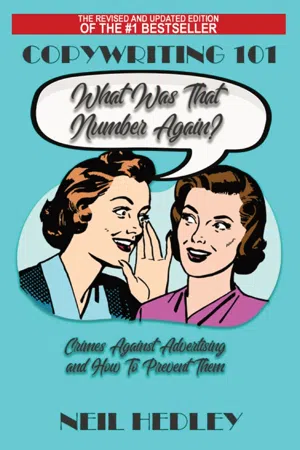
Copywriting 101 - What Was That Number Again?
eBook - ePub

Copywriting 101 - What Was That Number Again?

Crimes Against Advertising, and How to Prevent Them

  1. English
  2. ePUB (mobile friendly)
  3. Available on iOS & Android
eBook - ePub

Copywriting 101 - What Was That Number Again?

Crimes Against Advertising, and How to Prevent Them

About this book

The intersection of art and science is where legends are born. Luminaries as diverse as Beethoven, Rembrandt and Frank Lloyd Wright knew that a thorough understanding of the fundamentals allowed for a seamless handoff to seemingly unbridled creativity. Now, no book can teach you to be talented. However, this one aims to find the sweet spot between the time-honored foundational principles of marketing, and the stories behind iconic works to serve as inspiration and unleash talent. And while the primary focus is on the copywriting that leads to great radio commercials, there are plenty of takeaways for anyone creating any kind of advertising. Even your next Craigslist add will benefit from the information contained here.

Need a different metaphor? It's cool to be able to throw a baseball at 102mph. Except that tons of people can throw a ball 102mph. If you're lucky enough to get the guidance to show you where the strike zone is, the wisdom to know when to throw the fastball versus your other pitches, and the inspiration to pursue mastery, you might just wind up in the Hall of Fame.

More than four decades ago, someone saw raw talent in Neil Hedley. They gave him exactly the same information you'll find in the pages of this book. Six months later, Neil won the first of a laundry list of national and international awards for commercials he's written.

Your mileage, as they say, may vary. But you'll have access to the same foundation that led to an entire career.

Frequently asked questions

Yes, you can cancel anytime from the Subscription tab in your account settings on the Perlego website. Your subscription will stay active until the end of your current billing period. Learn how to cancel your subscription.
No, books cannot be downloaded as external files, such as PDFs, for use outside of Perlego. However, you can download books within the Perlego app for offline reading on mobile or tablet. Learn more here.
Perlego offers two plans: Essential and Complete
  • Essential is ideal for learners and professionals who enjoy exploring a wide range of subjects. Access the Essential Library with 800,000+ trusted titles and best-sellers across business, personal growth, and the humanities. Includes unlimited reading time and Standard Read Aloud voice.
  • Complete: Perfect for advanced learners and researchers needing full, unrestricted access. Unlock 1.4M+ books across hundreds of subjects, including academic and specialized titles. The Complete Plan also includes advanced features like Premium Read Aloud and Research Assistant.
Both plans are available with monthly, semester, or annual billing cycles.
We are an online textbook subscription service, where you can get access to an entire online library for less than the price of a single book per month. With over 1 million books across 1000+ topics, we’ve got you covered! Learn more here.
Look out for the read-aloud symbol on your next book to see if you can listen to it. The read-aloud tool reads text aloud for you, highlighting the text as it is being read. You can pause it, speed it up and slow it down. Learn more here.
Yes! You can use the Perlego app on both iOS or Android devices to read anytime, anywhere — even offline. Perfect for commutes or when you’re on the go.
Please note we cannot support devices running on iOS 13 and Android 7 or earlier. Learn more about using the app.
Yes, you can access Copywriting 101 - What Was That Number Again? by Neil Hedley in PDF and/or ePUB format, as well as other popular books in Business & Advertising. We have over one million books available in our catalogue for you to explore.

Information

Year
2021
eBook ISBN
9780987857545
Edition
2
Subtopic
Advertising

1

Preface

When it was first conceived in 2011, What Was That Number Again was intended to be a 150-page business card. I was considering the idea of taking on a limited number of clients as a consultant and copywriter but wanted to have a vision statement of sorts, so that prospective creative partners would have a clear picture of my thought processes, my philosophies and, by extension, my expectations.
What ended up happening instead was that my business card became a #1 Bestseller. A series of invitations followed to speak in front of Chambers of Commerce, as did media appearances as one of those ā€œtalking headsā€ that gets to weigh in on things like SuperBowl commercials, and a rewarding experience that allowed me to create the curriculum for a post-graduate writing program at one of the most highly respected college programs for radio broadcasting in North America.
As the tenth anniversary of the original’s release approached, I learned that it was still being carried in some college libraries, and even remained on the reading list in a few others. Just as I couldn’t envision allowing the same script to run in a radio commercial for ten years, I decided the content of the book could use a touch-up.
However, as I looked through the pages of the first edition and thought about how many things had changed, I was struck by how many things have also stayed the same. The principles outlined in the first edition of the book are still as sound and as relevant as when they were originally conceived. The legends of the industry are still legendary. And people still buy stuff for the same reasons they always have.
One thing that has exploded in the ten years since I wrote the first edition is that there seem to be more voices than ever, screaming for our attention. Attention is currency. It’s why we use the expression, ā€œpay attentionā€. Attention is a finite resource; perhaps that’s why in many circles it is coveted even more than cash. The pursuit of attention, in its most egregious forms, is why people spend money they don’t have on things they don’t need and can’t afford, in order to get more likes (more attention) on social media. It’s why the effort to attract attention leads to people saying and doing things that just seem to get crazier and crazier, even in the face of irrefutable proof of the contrary.
Sadly, however, the explosion of media platforms has meant that virtually everyone has access to the bullhorn, while an ever-shrinking percentage of people have truly taken the time to make deliberate choices about what to do with it based on sound judgment and enduring principles.
One of the most glaringly obvious examples of this phenomenon is so pervasive that it’s hard to escape: There was a time when, in order to get a job with a news outlet - whether in print, radio, television or otherwise - you had to go to journalism school. Now, it sometimes feels like good looks will get you on TV faster than good grades, and if you lack the credibility to work at a major news outlet, you can simply start your own ā€œnews channelā€ online, or start your own ā€œnewsā€ website simply by writing a pile of crazy garbage, stamping the word ā€œnewsā€ on it, and wait for fellow crazies to come flocking.
To put it less delicately: More bullhorns equals exponentially more bullshit. In the current media landscape, quality seems inversely proportional to quantity.
The same is true in the advertising world, where people are writing things - and actually having the gall to sell those things - without having a clue what they’re doing.
You paid for this book. (Well, I hope you did. Three-year-olds don’t pay for their own groceries.) You paid money, you’re spending time and you’re paying attention.
I’ll do my best over these pages to respect all three expenditures and give your attention the honor it deserves.

2

Introduction

Most radio advertising is bland, boring, poorly written, shoddily produced, offers little value for the advertiser’s investment, and insults the listener’s intelligence.
Seth Godin, the Godfather of all modern marketing wisdom, refers to radio and television advertising as ā€œinterruption marketingā€. That is to say, we’re enjoying a particular program when an advertiser barges in, puts a kink in our enjoyment like it was a garden hose, and unilaterally decides that right now is the best time to listen to what they have to say. They’re not far removed from the drunk at the party who knocks over the cabinet with the stereo equipment in it.
Seth has become an icon in the marketing business (and deservedly so) while predicting - and usually calling for - the death of advertising as we’ve come to know it. The statistics appear to cheer Seth on; an Edison Media Research/Arbitron study showed that radio stations lose as much as 42% of their audience when an ā€œintrusive or annoyingā€ commercial comes on.
But it doesn’t have to be this way.
Ā 
WHAT THIS BOOK IS FOR
Ā 
I mentioned earlier that the ideas expressed in this book led me to be able to create the curriculum for a post-graduate writing course in a heavy-duty college Radio Broadcasting program. I remember those earliest sessions where I tried to convey to the students just how impactful radioĀ used to be. We talked about the biggest moments in radio history, and not just the famousĀ War Of The Worlds broadcast that we'll cover in detail shortly. We talked about the S.W.A.T. team that showed up when a local radio host had himself "assassinated" live on the air as an April Fool's joke; in fact, we coveredĀ tons of April Fool's jokes that huge numbers of listeners fell for, including some that didn't justĀ fool people, they caused them to take significant action. We looked at a point in history where, if people saw their favorite radio host walking down the street with Paul McCartney, they might actually pause for a second to think about whose autograph to get first. Several of the students had a hard time envisioning such a scenario, and it was at that point I realized just how important it was to keep some of these ideas in the conversation.
Indeed, as I prepared the audiobook version of this special second edition, I decided early on that because I wouldn't be able to do justice to some of those original award-winning performances, I would include the original commercials themselves. It was then I discovered that due to a variety of circumstances, most of the incredible work that inspired the early days of my copywriting career is just... plain... gone. Collections have fallen victim to disasters and tragedies. Digital archives have gone mysteriously missing. Memories have faded. And in at least one case I'm aware of, a huge chunk of the catalog of one of radio advertising's most legendary figures... was simply thrown in a dumpster.
If you're already an established copywriter who's been practicing your craft for a years already, we're going to cover a lot of stuff you already know. (In my own case, though, I found such refreshers to be helpful for reconnecting to my "why".) But virtually everyone in history who has ever been inspired to pursue any kind of artistic endeavor has had that moment where they really connected with just how much it could mean to them. Every great actor saw a performance that made them realize "that's what I'm meant to do." Every great singer heard a voice that made them think, "that's the way I want to make other people feel." Or, to put it less delicately, I'll quote legendary driving range pro Roy McAvoy, played by Kevin Costner in what might be the greatest golf movie ever made, Tin Cup. McAvoy describes the feeling that virtually everyone who's ever played a round of golf can identify with: "If you hit one good shot, and that tuning fork rings in your loins, and you can't wait to get back."
This book is meant to give you the foundation to get you easier access to that tuning fork.
Ā 
WHAT THIS BOOK IS NOT
Ā 
This book is not going to pretend to give you a magical formula for writing great commercials. Despite what some "gurus" might have you believe, there’s no recipe. A radio commercial is not a Twinkie. You can’t add a teaspoon of this, half an ounce of that, make sure you do ā€˜x’ a certain number of times and be guaranteed a great commercial. Anyone who claims that there is a formula has misled you. It’s like saying that a great romantic comedy has to have a kiss every seventeen minutes, or that a great rock and roll song has to have a drum solo within the first twelve seconds. It’s bunk.
This book is not written for style and usage devotees, and those expecting graphs, charts, illustrated concepts and a million footnotes. It is largely written in the style in which I speak which can, at times, be irreverent, meandering and oversimplified. I will try to organize things into chapters with common threads, but sometimes a great story might require jumping around topics to provide the background that makes it a great story.
This book is not going to walk on eggshells, either. If you’re a professional copywriter, an advertising student, or a business owner who for God knows what reason has ever written their own commercial, you’ll likely be either challenged or offended somewhere in these pages. That’s why, later on, there’s a link to the website where you can come and tell me why you believe I don’t know what I’m talking about. In fact, I encourage that conversation.
Because although I agree with Seth in that radio’s viability as an advertising medium is under greater scrutiny now than ever before (that’s a very mild version of how Seth puts it), it’s not like the medium is going away any time soon. In fact, recent studies are starting to show that some people – both listeners and advertisers – might be starting to lean back toward radio. So as long as radio is still breathing, it makes sense to figure out ways to maximize whatever impact it still has left.
Ā 
Ready? Let’s get started.

3

In The Beginning Were The Words

I was 15 years old and living in a bedroom community just east of Toronto when, on my summer vacation, I walked into Bob Humenick’s office for the first time. Bob was the colorful Creative Director for the two local radio stations where we both worked, and I was learning the ropes of the business as one of the technical producers. Bob's role as Creative Director meant that the copy for all our commercials (even material produced by outside advertising agencies) went through him before it got on the air.
He was a giant of a man - physically, he reminded me of Kevin James if Kevin James were about eight inches taller - with arms as big as my legs, and Bob was passionate about everything he did. Bob’s passion for life and for radio would sometimes materialize in the form of laughing fits that were contagious enough to bring the productivity level of the entire building to zero for half a day. Once, his passion made itself clear when he picked up an IBM Selectric typewriter (those ones with the ball inside, that weighed as much as Buick) and heaved it out of a second-floor window after a sales rep had completely butchered one of his scripts at a client meeting.
Bob Humenick lit a fire in me that still hasn’t gone out nearly four decades later. While I had always loved to read, Bob showed me that I also could write. He inspired me through his own award-winning work, and by giving me a massive library of some of the best advertising in radio history. He taught me that a radio commercial is just as much an art as it is a science, and that you can’t truly do a good job until you understand both aspects. He sparked an enduring interest in marketing, advertising, communicating ideas and crafting the written word; and about halfway into those months we spent working together, he wrote me perhaps the most entertaining and most effective disciplinary letter in the history of employee relations.
At the time, I had been working in radio on a part-time basis for a couple of years already, but still didn’t know which part of radio was going to become my specialty (something that in some ways remains true to this day). But that first day, Bob made the one move that had more impact on my career than anything else that would ever happen. When I wandered into his Creative Department, he handed me some information he’d just received to write a commercial for a local appliance store, and told me to go ahead and write a 30-second spot. Thinking I was in way over my head, I spent the better part of a day working on those thirty seconds; and for whatever reason, Bob saw fit to get the commercial produced and put it on the air without any changes.
He then entrusted me with a huge box filled with dozens of cassettes, and several reels of tape; they were the finalists and the winners from competitions put on every year by the Radio Advertising Bureau and the Radio Bureau of Canada. Each tape had dozens of commercials on it, written in a variety of categories - national spots, local spots, 60-second spots, 30-second spots, spots for restaurants, spots for retailers, spots for car dealers, public service announcements, spots done in big markets, medium markets, and small markets. Bob told me the one thing they all had in common was that they were written by people who, like me, at some point knew nothing about how to write a radio commercial. He said that I had the advantage of starting young, and that if I worked hard, there was no reason these tapes couldn’t be filled with my work.
That was all I needed to hear.
Those cassettes became my best friends. For years, I would pull them out for inspiration anytime I had hit a creative roadblock, or needed something that would shift my brain into a gear that would help me get out of a rut and raise the bar to elevate the standard of my work.
Through those cassettes, I was introduced to a Burger King jingle that was more like an alternate version of the National Anthem; the singers weren’t just singing about pickles and onions, they were making me feel like it was my patriotic duty to order a Whopper.
I heard a commercial for a furniture store in Chicago that really made me believe a guy had arrived at the store after having pushed a grand piano up the street so he could try out his crazy ideas for new jingles on them.
And once I was introduced to the work of the inimitable Dick Orkin, I was hooked for life.

4

Dick Who?

Legendary singer Ella Fitzgerald once said, ā€œI stole everything I ev...

Table of contents

  1. Half-Title
  2. Full-Title
  3. Contents
  4. Copyright
  5. 1 - Preface
  6. 2 - Introduction
  7. 3 - In The Beginning Were The Words
  8. 4 - Dick Who?
  9. 5 - Claude C. Hopkins
  10. 6 - David Ogilvy
  11. 7 - Dick Orkin
  12. 8 - The 4th Member Of The Trinity
  13. 9 - What Makes A Great Radio Commercial?
  14. 10 - What Makes People Buy?
  15. 11 - The Copywriter's Toolbox
  16. 12 - Exploring The Battlefield
  17. 13 - Finding The Right Approach
  18. 14 - How To Write A Great Jingle
  19. 15 - Writing For Theater Of The Mind
  20. 16 - How To Write Straight-Read Commercials
  21. 17 - How To Write Funny Radio Commercials
  22. 18 - How To Write Funny Radio Commercials, Part Two
  23. 19 - How To Tell The Client They're Wrong
  24. 20 - Things To Avoid
  25. 21 - The Nitty-Gritty
  26. 22 - The Red-Headed Stepchild
  27. 23 - That's A Wrap
  28. 24 - One Final Thought