An illuminating reassessment of the architect whose innovative drawings of ruins shaped the enduring image of ancient Rome
Giuliano da Sangallo (1443–1516) was one of the first architects to draw the ruins and artifacts of ancient Rome in a systematic way. Cammy Brothers shows how Giuliano played a crucial role in the Renaissance recovery of antiquity, and how his work transformed the broken fragments of Rome's past into the image of a city made whole.
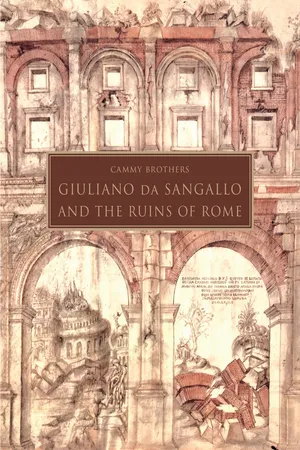
Drawing new insights from the Codex Barberini and the Taccuino Senese—two exquisite collections of Giuliano's drawings on parchment—Brothers reveals how the Florentine architect devoted enormous energy to the representation of ruins, and how his studies of Rome formed an integral part of his work as a designer. She argues that Giuliano's inventive approach, which has often been mischaracterized as fantastical or naive, infused the architect's craft with the sensibilities of a poet and painter. Brothers demonstrates how his drawings form the basis for a reevaluation of the meaning and method of the Renaissance study of ancient artifacts, and brings to life the transformative moment when artists and architects began to view the fragments of ancient Rome not as broken artifacts of little interest but as objects of aesthetic contemplation.
Featuring a wealth of Giuliano's magnificent drawings, this compelling book provides an incomparable lens through which to explore essential questions about the aesthetic value, significance, and the uses of the past for today's architects.
- 320 pages
- English
- ePUB (mobile friendly)
- Available on iOS & Android
eBook - ePub
Giuliano da Sangallo and the Ruins of Rome
About this book
Information
Topic
ArtSubtopic
History of ArchitectureTable of contents
- Cover
- Title Page
- Copyright
- Dedication
- Contents
- Acknowledgments and Note to the Reader
- Introduction
- 1. The Architect as Bookmaker
- 2. What Is Antique?
- 3. Ornament and Abstraction
- 4. Ruins and Representation
- 5. Research, Reconstruction, and Design
- Epilogue: Rome Remade
- Notes
- Bibliography
- Index of Folios
- General Index
- Photography and Copyright Credits
Trusted by 375,005 students
Access to over 1.5 million titles for a fair monthly price.
Study more efficiently using our study tools.
Frequently asked questions
Yes, you can cancel anytime from the Subscription tab in your account settings on the Perlego website. Your subscription will stay active until the end of your current billing period. Learn how to cancel your subscription
No, books cannot be downloaded as external files, such as PDFs, for use outside of Perlego. However, you can download books within the Perlego app for offline reading on mobile or tablet. Learn how to download books offline
Perlego offers two plans: Essential and Complete
- Essential is ideal for learners and professionals who enjoy exploring a wide range of subjects. Access the Essential Library with 800,000+ trusted titles and best-sellers across business, personal growth, and the humanities. Includes unlimited reading time and Standard Read Aloud voice.
- Complete: Perfect for advanced learners and researchers needing full, unrestricted access. Unlock 1.5M+ books across hundreds of subjects, including academic and specialized titles. The Complete Plan also includes advanced features like Premium Read Aloud and Research Assistant.
We are an online textbook subscription service, where you can get access to an entire online library for less than the price of a single book per month. With over 1.5 million books across 990+ topics, we’ve got you covered! Learn about our mission
Look out for the read-aloud symbol on your next book to see if you can listen to it. The read-aloud tool reads text aloud for you, highlighting the text as it is being read. You can pause it, speed it up and slow it down. Learn more about Read Aloud
Yes! You can use the Perlego app on both iOS and Android devices to read anytime, anywhere — even offline. Perfect for commutes or when you’re on the go.
Please note we cannot support devices running on iOS 13 and Android 7 or earlier. Learn more about using the app
Please note we cannot support devices running on iOS 13 and Android 7 or earlier. Learn more about using the app
Yes, you can access Giuliano da Sangallo and the Ruins of Rome by Cammy Brothers in PDF and/or ePUB format, as well as other popular books in Art & History of Architecture. We have over 1.5 million books available in our catalogue for you to explore.