Shortlisted for the AATSEEL 2022 Award for Best Edited Multi-Author Scholarly Volume (AATSEEL is The American Association of Teachers of Slavic and East European Languages)
Theory in the "Post" Era brings together the work and perspectives of a group of Romanian theorists who discuss the morphings of contemporary theory in what the editors call the "post" era. Since the Cold War's end and especially in the third millennium, theorists have been exploring the aftermath - and sometimes just the "after" - of whole paradigms, the crisis or "passing" of anthropocentrism, the twilight of an entire ontological and cultural "condition," as well as the corresponding rise of an antagonist model, of an "anti," "meta," or "neo" alternative, with examples ranging from "posthumanism" and "post-postmodernism" to "post-aesthetics," "postanalog" interpretation or "digicriticism," "post-presentism," "post-memory," "post-" or "neo-critique," and so forth.
It is no coincidence, the contributors to this volume argue, that this "post" moment is also a time when theory is practiced as a world genre. If theory has always been a "worlded" enterprise, a quintessentially communal, cross-cultural and international project, this is truer at present than ever. Perhaps more than other humanist constituencies, today's theorists work and belong in a theory commons that is transnational if still uneven economically, politically, and otherwise. Theory in the "Post" Era reports the results of Romanian theory experiments that join efforts made in other places to foster a theory for the "post" age.
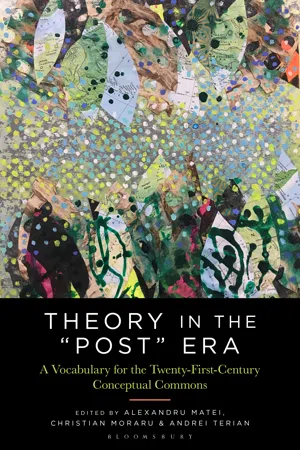
eBook - ePub
Theory in the "Post" Era
A Vocabulary for the 21st-Century Conceptual Commons
- 376 pages
- English
- ePUB (mobile friendly)
- Available on iOS & Android
eBook - ePub
Theory in the "Post" Era
A Vocabulary for the 21st-Century Conceptual Commons
About this book
Information
PART ONE
Aesthetics
1
CONSTRUCTALISM: Literary Evolution as Multiscalar Design
In what follows, I take several steps toward a transdisciplinary and transsystemic approach to literary and critical-theoretical practices by drawing on the constructal theory physicist Adrian Bejan has formulated chiefly in his 2012 book Design in Nature. By virtue of its unifying power as a “primordial principle,” Bejan’s scientific theoretical model sets out to integrate the dynamics of living and nonliving systems from a perspective that takes its cue from thermodynamics while diverging from other “holistic” paradigms, be they classical systems theory similar to that of Ludwig von Bertalanffy or those of the more recent “network” type. I argue that, still untapped by literary and cultural theorists, constructalism may offer at this stage in critical theory history solutions superior to other scientifically minded theoretical ventures and thus overcome the epistemological polarities that usually accompany the importation of scientific modes of analysis into research taking place outside the traditional purview of sciences. In that sense, what I do here is assess the possibility of introducing constructalism into literary and cultural studies. To that effect, I will run a test of sorts, consisting in “constructalizing” some theoretical scenarios from literary scholarship and in evaluating the critical benefits accrued through this operation. The focus of this experiment is Franco Moretti’s work, in particular his influential 2005 book Graphs, Maps, Trees: Abstract Models for Literary History.
The first two sections of my contribution turn to the basics of constructalism, which have to do with mechanics and thermodynamics. Admittedly on the technical and “dense” side, this lays the groundwork for the remainder of the chapter. As I show there, constructal theory may prove capable of eliminating a series of rigid oppositions encountered in literary-cultural interpretation, most of which are derived from the nature/culture antinomy and its variations implicating predominantly Marxist determinism, the evolutionism of Charles Darwin and its descendants, as well as the theories of emergence and their emphasis on the geometric engendering of all reality, to list but a few. This “constructalist deconstruction,” I suggest, is useful not only for revisiting Morettian analysis. More generally, and more significantly still, it can also participate in the ongoing, post-anthropocentrist and post-aesthetic reconstruction of modern aesthetics, which has been indebted to a humanism excessively anchored in the abovementioned nature-culture binary and, subsequently, in a mimetic philosophy of art.
A Scientific Model for Literary Studies
As is well known, modern literary theory, history, and criticism have attempted repeatedly to incorporate scientific concepts. The transfer of analytic models from sciences into literary research has been going on for roughly two centuries. It was, essentially, with Auguste Comte’s positivist sociology and Jean-Baptiste Lamarck’s, Herbert Spencer’s, and Darwin’s evolutionism that the sciences of life started joining or influencing theories of Hippolyte Taine, Ferdinand Brunetière, and other critics. By adopting such approaches, criticism and literary history began to represent literature as less idealistically and anthropocentrically grounded and, instead, more and more realistically and materially oriented, increasingly resembling scientific thinking, and moving away from the theological and the metaphysical. The classical “anthropomorphization” of nature was thus gradually replaced by the “naturalization” of humankind and human creations, and so, from ancilla philosophiae, literary scholarship became ancilla scientiae, a true knowledge form connected to the epoch’s scientific advancements. Thus, criticism and literary history entered relatively easily into dialogue with biological, economic, and sociological theories, and, although more difficult to handle, mathematics, physics, and their theoretical applications such as chaos theory (Henri Poincaré, Edward Lorenz), the theory of relativity (Albert Einstein), the principle of uncertainty (Werner Heisenberg), catastrophe theory (René Thom), and the geometry of fractals (Benoît Mandelbrot) were, one after another, drawn into the orbit of literary studies as well. Thermodynamics would not remain an exception either, given that energetism has influenced not only Freudian psychoanalysis but also symbolism theories. Likewise, entropy has also made quite a career in postmodernism and posthumanism. Under these circumstances, if I pick out a model from the sciences—and one from a hard science such as physics to boot—so as to broaden the range of theoretical options with innovative potential in literary investigations, I do so, first and foremost, to provide the latter with a more realistic grounding, in Karl R. Popper and Steven Weinberg’s tradition of overcoming various anthropocentric and relativist philosophies. For, by reducing knowledge to the incommensurable and infinitely subjective parameters of the sociohuman, these philosophies have often led to unproductive disciplinary isolationism, one that has been hostile to projects of objective unification of knowledge across disciplinary domains. And so the questions are: can one hope that the “post” moment in critical theory will overcome this isolationism? Should this happen, how might the constructalist paradigm be instrumental to this process?
To answer, I would like to point out that, in opposition to theories that cast haphazard and unpredictability as leading characters in physics, chemistry, and biology, constructalism affirms, through its constructal principle or law, the need for a heightened and steady efficiency of flow, movement, and transmission of matter and information across the terrestrial ecosystem. Once achieved, this improvement is likely to forge in a number of fields, including the arts, and at all levels of the world’s “existents,” a hierarchical multiscale design that, when seen from above, looks like a multiple overlay of tree-shaped flows with a network appearance. According to Bejan, this complex design is non-random, deductible, and predictable at all echelons of existence. The action of the constructal law is empirically evident in the plethora of designs with arborescent, divergent, or convergent patterns one comes across in the world. The shape of a thunderbolt in the sky, the forms of trees and river basins, the structures of respiratory, circulatory, and nervous systems, the architecture of an airport, the spatial configuration of urban traffic, and, in classical artifacts, the formal plays of the “divine” ratios derived from the “golden number” are only a few illustrations of such energy-, matter-, and life-molding circulation. An innovative insight of constructalism is, in fact, that life is born not with the first forms of organic matter, as biologists believe, but with movement in the inorganic world.
Now, if in the nineteenth century, biologists took the first step toward understanding the living as a unit by discovering that plant and animal cells had similar structures, and the advances in genetics made it more pertinent to speak, à la François Jacob, of a “logique du vivant,” physicists were even more forward-looking. In his 1917 On Growth and Form, D’Arcy Wentworth Thompson attempted, without buying into the theory of natural selection, a conceptual unification of the living and non-living by positing that the morphology of the organic world is ruled by the laws of mechanics. Bejan’s contribution aligns itself with this view. In effect, he reopens the discussion around Darwin’s evolutionism along the lines of Thompson’s hypotheses. Yet constructalism “subsumes” both Darwinism and Thompson’s theory to a scientific model that preserves the explanatory force of both—Bejan shows that “selected” (Darwin’s term) are biological mechanisms that more effectively fit the laws of physics (Thompson) in a complex, long-term process called evolution.1 Thus, constructal thinking leaves behind not only the theories based on the living/nonliving binary but also, within the living, the scenarios informed by the culture/nature dyad. Either by reducing the natural to the human or by rejecting the possibility of a realistic-objective cognition, constructal theory denounces anthropocentrism and relativism. If, to a relativist, science and, moreover, nature itself are “social constructs,” Bejan sees things from a diametrically opposed angle. To him, the sciences, technology, the arts, and culture overall are nature and therefore operate under the same laws as those governing nonhuman existents. The constructal image of overlapping, network-like arborescent structures unfolding entire tapestries of divergences and convergences may thus reconcile the philosophers of the living—anthropologists, biologists, and theorists of culture—with physicists and with their discipline, which is conventionally understood as a science of the non-living.
On account of this revision, constructalism is well positioned to contribute to the post-anthropocentric turn affecting contemporary epistemology across a range of disciplines, including the study of literature. The premise of Bejan’s joining this broad conceptual reform is in place. Sociology and neuroaesthetics have already come into contact with his writings,2 and studies currently limited to introducing the thermodynamic model of entropy to information theory, neurobiology, and related disciplines are, in my view, highly compatible with the relaunch of knowledge pursuits on constructalist bases.3 So is, I might add, research showing that thinking, language, and even music—until recently deemed the exclusive privilege of the human—also exist within the nonhuman realm.4 Consequently, constructalism makes available theoretical tools in line with the realistic approach to literary research endorsed by my intervention. At the same time, constructal philosophy also argues for the overcoming of the anthropocentric sway over modern aesthetics. On this particular ground, the nature of literature and its forms—genres, processes, canons, and the like—could be seen as similar to the nature or “essence” of knowledge in general, which in turn could be viewed as consistent with the natural world’s overall non-teleological evolution, that is, one geared toward a certain preestablished finality. Whether divergent or convergent depending on context, literature and literary theory can thus be approached in a novel way, namely, as flow—flow of information, of course, but shaping other kinds of material as well and following the same rigor of streamlined movement present everywhere in nature.
Multiscalar Architectures and Their Logic
The constructal law states that “for a finite-size flow system to persist in time (to live), its configuration must evolve in such a way that provides easier access to the currents that flow through it.”5 A major principle of physics, according to Bejan, this law regulates any matter-moving “flow system” on Earth, from inorganic to organic structures and from nonhuman to human-made designs. A flow system―viz., the matter to be carried plus the configuration or design obtaining through this transportation―can be recognized by its predominantly arborescent shape, specifically, by a certain well-proportioned ratio among the different dimensions of the channels involved. Technically speaking, the constructal law is a relationship between “engines” and “brakes,” one by which useful energy converts into mechanical work, an efficient flow design enabling “more work for less useful energy.”6 Required by the second principle of thermodymanics, the natural tendency of systems toward balance triggers, further, a variety of two-stroke movements: one at low speed on short and overall small segments, and the other at fast speed on long, large stretches. This explains the multibranch appearance of flow systems. For example, the best possible irrigation of a surface or volume calls for both large-scale pipes and canals or capillaries; just capillaries or just long pipes would not cover the space in question as effectively as possible. Yet not any combination of “small-short-slow” and “large-long-fast” structures ensures the success of the movement; what is needed, from a quantitative viewpoint, is the quasi equality between the two categories. As Bejan and Zane insist, “The time to move fast and long should be roughly equal to the time to move slow and short.”7 The variation in the size of flow channels is then connected to the idea of pulsation or rhythm. The flow system gives rise to contrasts—ramifications, waves, regularities, wing strokes, etc.—to manage more efficiently the resistances it encounters, whereas the ramification or the rhythm indicates an attempt to distribute the matter as evenly as possible and to smooth out the system’s flaws.8 The struggle against forces of resistance yields divergences, separations, or, conversely, convergences and multidimensional channel unifications. The latter bring about over time increasingly complex structures that Bejan calls “multiscale designs,”9 which occur on all planes of existence so that the map of the inorganic, organic, or sociocultural world looks like an inextricable overlapping of ramifications undergoing incessant transformation.
The thesis of superimposed tree-shaped flows is Bejan’s stepping-stone to an alternative to network theory. Thus, he denies the existence of grid-like flow systems featuring equal-size links or holes. He recognizes, instead, structures that may look like networks but are in reality “superpositions of trees” and involve dimensional discrepancies that otherwise reflect certain proportions.10 Compared to the elementary, single-segment form of motion, the equivalent two-stroke movement marks a qualitative leap, since rapid flow over long distances occurs after slow flow across short inter...
Table of contents
- Cover
- Halftitle Page
- Title Page
- Dedication Page
- Contents
- Preface and Acknowledgments
- Introduction: Toward a “Post” Vocabulary—A Lab Report
- PART ONE: Aesthetics
- PART TWO: Temporalities
- PART THREE: Critical Modes
- Bibliography
- Contributors
- Index
- Imprint
Trusted by 375,005 students
Access to over 1.5 million titles for a fair monthly price.
Study more efficiently using our study tools.
Frequently asked questions
Yes, you can cancel anytime from the Subscription tab in your account settings on the Perlego website. Your subscription will stay active until the end of your current billing period. Learn how to cancel your subscription
No, books cannot be downloaded as external files, such as PDFs, for use outside of Perlego. However, you can download books within the Perlego app for offline reading on mobile or tablet. Learn how to download books offline
Perlego offers two plans: Essential and Complete
- Essential is ideal for learners and professionals who enjoy exploring a wide range of subjects. Access the Essential Library with 800,000+ trusted titles and best-sellers across business, personal growth, and the humanities. Includes unlimited reading time and Standard Read Aloud voice.
- Complete: Perfect for advanced learners and researchers needing full, unrestricted access. Unlock 1.5M+ books across hundreds of subjects, including academic and specialized titles. The Complete Plan also includes advanced features like Premium Read Aloud and Research Assistant.
We are an online textbook subscription service, where you can get access to an entire online library for less than the price of a single book per month. With over 1.5 million books across 990+ topics, we’ve got you covered! Learn about our mission
Look out for the read-aloud symbol on your next book to see if you can listen to it. The read-aloud tool reads text aloud for you, highlighting the text as it is being read. You can pause it, speed it up and slow it down. Learn more about Read Aloud
Yes! You can use the Perlego app on both iOS and Android devices to read anytime, anywhere — even offline. Perfect for commutes or when you’re on the go.
Please note we cannot support devices running on iOS 13 and Android 7 or earlier. Learn more about using the app
Please note we cannot support devices running on iOS 13 and Android 7 or earlier. Learn more about using the app
Yes, you can access Theory in the "Post" Era by Christian Moraru, Andrei Terian, Alexandru Matei, Christian Moraru,Andrei Terian,Alexandru Matei in PDF and/or ePUB format, as well as other popular books in Literature & Literary Criticism for Comparative Literature. We have over 1.5 million books available in our catalogue for you to explore.