Offers a philosophical perspective on the nature and value of writing a memoir.
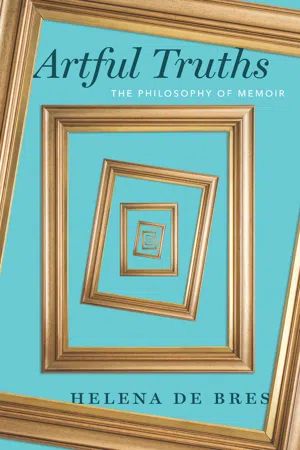
Artful Truths offers a concise guide to the fundamental philosophical questions that arise when writing a literary work about your own life. Bringing a philosopher's perspective to a general audience, Helena de Bres addresses what a memoir is, how the genre relates to fiction, memoirists' responsibilities to their readers and subjects, and the question of why to write a memoir at all. Along the way, she delves into a wide range of philosophical issues, including the nature of the self, the limits of knowledge, the idea of truth, the obligations of friendship, the relationship between morality and art, and the question of what makes a life meaningful.
Written in a clear and conversational style, it offers a resource for those who write, teach, and study memoirs, as well as those who love to read them. With a combination of literary and philosophical knowledge, de Bres takes the many challenges directed at memoirists seriously, while ultimately standing in defense of a genre that, for all its perplexities—and maybe partly because of them—continually proves to be both beloved and valuable.
- English
- ePUB (mobile friendly)
- Available on iOS & Android
eBook - ePub
About this book
Information
Publisher
University of Chicago PressYear
2021Print ISBN
9780226793801
9780226788135
eBook ISBN
9780226793948
Topic
PhilosophySubtopic
Literary CriticismNotes
Chapter One
1. Paul Fussell, Class: A Guide through the American Status System, 15.
2. Daniel Mendelsohn, “But Enough about Me.”
3. Friedrich Wilhelm Goethe, Poetry and Truth, Goethes Werke, 602.
4. William H. Gass, “The Art of Self.”
5. A good book-length example of philosophy in memoir is Mike W. Martin, Memoir Ethics: Good Lives and the Virtues.
6. One exception is Christopher Cowley, The Philosophy of Autobiography.
7. One partial exception here is G. Thomas Couser, Vulnerable Subjects: Ethics and Life Writing. Couser’s valuable and pioneering discussion of the ethics of self–life writing is both extensive and insightful. However, his book (1) focuses exclusively on ethics, (2) restricts itself to especially vulnerable subjects of memoir, (3) doesn’t restrict itself to literary self–life writing, and (4) is intended mainly for fellow scholars.
8. Roy Pascal, Design and Truth in Autobiography, 8.
9. Cited in J. Isaiah Holbrook, “Departures and Returns: A Conversation with Sarah M. Broom.”
10. Virginia Woolf, Moments of Being, 75.
11. Sue William Silverman, Fearless Confessions: A Writer’s Guide to Memoir.
12. Philippe Lejeune, On Autobiography.
13. Woolf, Moments of Being, 65.
14. Phillip Lopate, The Art of the Personal Essay, is the classic introduction to and anthology of the genre.
15. Michel de Montaigne, The Complete Essays of Montaigne, 76.
16. Edward Hoagland, “What I Think, What I Am.”
17. Cited in Charles Trueheart, “The Den of the Literary Lions.”
18. David Lazar, “Occasional Desire: On the Essay and the Memoir,” 106.
19. Cited in Alex Zwerdling, The Rise of the Memoir, 126.
20. On essentialism and antiessentialism about literature, see Peter Lamarque, The Philosophy of Literature.
21. Arthur Danto, “The Artworld.”
22. See David Davies, Aesthetics and Literature, 9–16.
23. Sophie Harrison, “Life before Loss.”
24. André Maurois, Olympio: The Life of Victor Hugo, 157.
Chapter Two
1. Cited in Martha Mulroy Curry, ed., The “Writer’s Book,” 275–76.
2. Letter to Mrs. J. G. Holland, October 1870, cited in Theodora Ward, ed., The Letters of Emily Dickinson, 482.
3. Vivian Gornick, The Situation and the Story: The Art of Personal Narrative, 92.
4. This chapter’s historical survey of philosophizing about the self draws on the very helpful John Barresi and Raymond Martin, “History as Prologue: Western Theories of the Self.”
5. René Descartes, Meditations on First Philosophy, 23.
6. See The Fourth Ennead, third tractate, in Plotinus, Ennead VI. 6–9.
7. John Locke, An Essay Concerning Human Understanding.
8. See, inter alia, Galen Strawson, “The Self.”
9. Strawson, 425.
10. David Hume, Treatise of Human Nature, 252.
11. Friedrich Nietzsche, The Will to Power, notes 490, 485.
12. On Buddhist theories of the self, see Mark Siderits, “Buddhist Non-Self: The No-Owner’s Manual.”
13. Marya Schechtman, The Constitution...
Table of contents
- Cover
- Title Page
- Copyright Page
- Dedication
- Contents
- one What Is Memoir?
- two Is All Memoir Really Fiction?
- three Should Memoirists Aim to Tell the Truth?
- four What Do Memoirists Owe the People They Write About?
- five Why Write a Memoir?
- Acknowledgments
- Notes
- Bibliography
- Index
Trusted by 375,005 students
Access to over 1.5 million titles for a fair monthly price.
Study more efficiently using our study tools.
Frequently asked questions
Yes, you can cancel anytime from the Subscription tab in your account settings on the Perlego website. Your subscription will stay active until the end of your current billing period. Learn how to cancel your subscription
No, books cannot be downloaded as external files, such as PDFs, for use outside of Perlego. However, you can download books within the Perlego app for offline reading on mobile or tablet. Learn how to download books offline
Perlego offers two plans: Essential and Complete
- Essential is ideal for learners and professionals who enjoy exploring a wide range of subjects. Access the Essential Library with 800,000+ trusted titles and best-sellers across business, personal growth, and the humanities. Includes unlimited reading time and Standard Read Aloud voice.
- Complete: Perfect for advanced learners and researchers needing full, unrestricted access. Unlock 1.5M+ books across hundreds of subjects, including academic and specialized titles. The Complete Plan also includes advanced features like Premium Read Aloud and Research Assistant.
We are an online textbook subscription service, where you can get access to an entire online library for less than the price of a single book per month. With over 1.5 million books across 990+ topics, we’ve got you covered! Learn about our mission
Look out for the read-aloud symbol on your next book to see if you can listen to it. The read-aloud tool reads text aloud for you, highlighting the text as it is being read. You can pause it, speed it up and slow it down. Learn more about Read Aloud
Yes! You can use the Perlego app on both iOS and Android devices to read anytime, anywhere — even offline. Perfect for commutes or when you’re on the go.
Please note we cannot support devices running on iOS 13 and Android 7 or earlier. Learn more about using the app
Please note we cannot support devices running on iOS 13 and Android 7 or earlier. Learn more about using the app
Yes, you can access Artful Truths by Helena de Bres in PDF and/or ePUB format, as well as other popular books in Philosophy & Literary Criticism. We have over 1.5 million books available in our catalogue for you to explore.