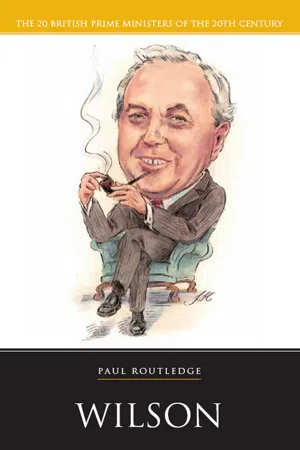
Harold Wilson held out the promise of technology and of 'the Britain that is going to be forged in the white heat of this revolution'. A balance of payment crisis, leading to devaluation in 1967, frustrated the fulfilment of his primeministerial promises. Meanwhile foreign affaris were dominated by the issue of Rhodesia, in which Wilson took a personal initiative in diplomacy with Ian Smith but failed to make any progress.
eBook - ePub
Wilson
About this book
Information
Print ISBN
9781904950684
Subtopic
Historical BiographiesPart One
THE LIFE
Chapter 1: England Made Me
Rievaulx is a tiny hamlet almost hidden in the steep-sided, wooded vale of the River Rye in the north Yorkshire moors. Its scattered pantile and limestone cottages, dominated by the magnificent ruin of the 12th-century Cistercian Abbey, are a far cry from Harold Wilson’s vision of a hi-tech 20th century. When he took the title of Lord Wilson of Rievaulx, the choice entertained cynical observers, who assumed that the old man was seeking to cash in on one of his home county’s most celebrated cultural landmarks.
There was nothing ‘Wilsonian’ about the decision. His family originated there, and the parish registers are full of Wilsons going back generations. The first reliable evidence of his roots lies in the records of Helmsley church, where his great-grandfather John Wilson was baptised in 1817. He was a cobbler in Rievaulx, and also farmed the land as his forebears had, but he later took charge of workhouses, first in Helmsley and then in York. Harold’s grandfather James, born in Rievaulx around 1843, forsook agriculture and went into the drapery trade, initially in York and then in Manchester, where he flourished, to the extent of marrying Eliza Thewlis, the daughter of a Huddersfield millowner. This was a step up in the world, not merely socially, but politically. The Thewlis family were well known in northern Liberal politics. Herbert, Eliza’s brother, an umbrella manufacturer in Stockport, became Lord Mayor of Manchester.
James and Eliza were blessed, as his Congregationalist fellow-worshippers would no doubt have put it, with six children. The eldest, Jack, showed the earliest signs of political interest, twice acting as Keir Hardie’s election agent at the turn of the century. Harold’s father, James Herbert, was born in Manchester in 1882. Despite showing a prodigious memory and intellectual precocity, particularly in maths (traits that would reappear in his son), he left school at 16 and went to work in Levinstein’s, a local dye factory. He qualified as an industrial chemist, and in his spare time flung himself into the family’s political activity. At the age of ten, Herbert (as he was invariably called) was giving out handbills for the Liberals, but in 1906 he worked for John Hodge, of the steel smelters’ union, who won the Gorton constituency. This was the year of the ‘Lib-Lab Pact’, a secret anti-Tory agreement that brought in the first wave of Labour MPs.
Herbert has been described at this stage as ‘a radical, but certainly no socialist’, and in his choice of a wife, he found a political and religious soulmate. Soon after that historic general election, he married Ethel Seddon, a big, strong-minded lass, a schoolteacher from Openshaw and the daughter of a white-collar railwayman on the Manchester, Sheffield and Lincolnshire Railway. Ethel may have shared Herbert’s strict Nonconformist Christian views, but they also had in common a zest for life and ‘getting on’. In 1912, the couple moved to Milnsbridge, a mill village outside Huddersfield in the Colne valley, where Herbert had found work as an industrial chemist. He was a departmental manager in a synthetics factory, and his £300 a year salary was paid by cheque, a sign of his arrival into the middle class. The Wilsons were not proud, being Christian Dissenters, and they were not well off. But they were not poor, like the workers in Herbert’s charge. In later years, Harold Wilson liked to stress his humble origins. The riverside streets about him may have been lowly, but his family circumstances, though sometimes straitened by Herbert’s unemployment, were not. The family lived first at 4 Warneford Road, Cowlersley, a respectable three-up and three-down stone terrace with a bathroom, rented for 12 shillings (60p) a week. The Wilsons were stalwarts of their local Baptist chapel, there being no Congregationalist place of worship. Herbert ran the Scouts, and the amateur dramatics while Ethel saw to the Girl Guides and the Women’s Guild. The couple were organisers, not the organised.
James Harold Wilson was born in the mid-morning of Sunday, 16 March 1916, in the middle of the Great War, the couple’s second child. His father had been exempted from military service because he was engaged in vital war work, and his firm was flourishing, in large part from the manufacture of TNT. Harold, as he always called, after an uncle who was an electrician, dates his first memories to the house where the Wilsons moved when he was a toddler, at 40, Western Road. Even Harold, always at pains to stress his humble origins, admitted this was a substantial, stone-built terrace partly detached from its neighbour by a ginnel (an alleyway), though in his memoirs he omitted to mention that his father bought the property for £440, paying half the price from cash savings. Towards the end of the war, Herbert Wilson moved jobs, to an acid-manufacturing firm, where he was paid £425 a year. In the company of Tories, he remained defiantly ‘working class’, but in truth he was a quite senior manager, with chemists and process workers under him, charged with sacking employees, a duty he found distasteful and only to be invoked where drink or carelessness was involved.
Young Harold was despatched to the local New Street council school, a terrifying experience with a schoolteacher, Miss Oddy, whom he later identified as incompetent or a sadist, probably both. She was probably no more of a dragon than most of her kind in those post-war years. His earliest recollection is of being required to write on the board the longest word he knew: ‘committee’. He culled it from the cover of his exercise book, printed with the legendary West Riding Education Committee. His precocious memory was already beginning to impress, even if he was not regarded as particularly brilliant. At the age of seven, Harold underwent an appendicitis operation, memorable chiefly for urging his parents as he recovered from the anaesthetic to go off to vote for Philip Snowden, Labour’s first Chancellor, that evening. That he should demonstrate such early political development was unusual; that he should retell the anecdote was not. By his own admission, Harold had a very provincial upbringing, but unlike most of his classmates, he visited London and posed for a memorable photograph outside 10 Downing Street, a bashful eight-year-old in short trousers, his face almost lost under a wide flat cap.
He was not above making the most of his experiences, even as a child. At the age of nine, his mother took him to Australia for six months. Ethel was keen to see her father, who had emigrated, perhaps for the last time. The Seddons had flourished ‘down under’. Ethel’s brother Harold became a state legislator (though for the conservative Liberal Party) and was eventually knighted. Young Harold travelled to Kalgoorlie into the outback, and on his return wrote A Visit to an Australian Gold Mine. The article was rejected by Meccano Magazine and Scout, but published in his secondary school magazine and he gave a polished talk on his experiences. Harold was a keen scout, winning a Yorkshire Post competition on ‘my greatest hero’ – Baden Powell – at the age of 12. He also took a full part in Chapel activities, in a straightforward, decent way, unencumbered by religiosity, that would easily be misunderstood in today’s satirical, agnostic world. Growing up in the 1920s, he was surrounded by poverty and unemployment, and the Christian message had a practical, though not yet socialist, meaning. His upbringing found echoes later in the nurture of Gordon Brown.
In 1927, Harold won a county minor scholarship to Royds Hall Grammar School, Huddersfield, a school opened six years earlier across the valley and geared to strongly academic education. Pupils dressed in brown uniforms with blue piping, and the curriculum was demanding. Initially, he failed to shine, not entering the ‘A’ stream until his fourth year. The headmaster, E F Chancy, found him no better than the average intelligent lad, but possessed of an inquiring mind and ‘determined to make a success of anything he tackled’. Surprisingly, perhaps, in view of his later taciturnity, he was also popular with his schoolfellows.
Just as he was making academic headway, Harold caught typhoid from milk he drank on a scout camp. Six of his fellow scouters died, and if Harold had not knocked over his glass, the nation might have been deprived of a future Prime Minister. As it was, he hovered close to death and emerged weighing only four and a half stones. He returned home from the isolation hospital in January 1930 ‘like a skeleton’ to find that his father was another victim of the Depression spreading across Britain. It was two years before he found work again, at a chemical works in Cheshire. The family moved across the Pennines, and Harold entered Wirral Grammar School, Bebington, even newer than Royds Hall; so new, in fact, that he was the only sixth-former and enjoyed one-to-one tuition from senior masters. Frank Allen, his classics tutor, was a socialist, and according to Wilson, had more influence on his teenage political development than anyone else. The intensive instruction paid off. In 1934, he won an open scholarship to Jesus College, Oxford, worth £60 a year. Harold learned of his success when his father read out the examination results from the Manchester Guardian.
Success with girls had hitherto eluded him, but now, aged 18, he chanced upon the woman who would share his life. At a summer tennis event where his father was engaged in a mental arithmetic contest, Harold’s eye fell on Mary Baldwin, the daughter of a Congregational minister in nearby Rockferry. They both attended the same church, and had not met because he went in the morning and she in the evening. They were soon ‘walking out’, and Harold announced that he was going to marry her. He also vouchsafed that he would become an MP, and Prime Minister. Mary was a quiet girl, and might have had second thoughts had she known he really meant it.
Before any of these hi’falutin notions were put to the test, young Wilson had to get a degree. At Jesus College, he was a Stakhanovite student, at his books for as many as 46 hours a week, including Saturdays. He lived sparingly, not smoking, and drinking only the occasional glass of beer. He switched from History to Philosophy, Politics and Economics (PPE), the coming subject, and began to make an academic name for himself by winning the Gladstone Prize with an 18,000-word essay on ‘The State and the Railways in Great Britain, 1823-63’. He claimed to have read 400 books on the subject, and to have found Gladstone’s draft Bill for nationalising the railways when he was President of the Board of Trade – a portent of things to come.
Politics were not a consuming passion during his undergraduate days. Despite efforts later in life to portray himself as a budding socialist, keen to convert liberal-minded fellow students to the Left, Wilson actually rejected socialism in favour of the Liberal Party, of which he was a member for most of his university career. He claimed never to have read Marx after failing to get past a (non-existent) long footnote on page two of Das Kapital, and spurned the University Labour Club after attending only one meeting. He subsequently rationalised his dislike by claiming that it was dominated by public-school Marxists who knew nothing of the way of life of the proletariat they professed to be in the business of liberating. His rebuff to Labour was something of an embarrassment in later life, when he tried to gloss over his early adherence to the Liberals as the product of ignorance and vanity that he might convert them to his middle-of-the-road Colne Valley outlook.1
Wilson’s first known political statement comes in a letter to his sister Marjorie, seven years his senior, in October 1934, recording attendance at a Jesus College discussion group of the Anti-War movement, when he tried to counteract the Labour element with Christian arguments, advocating closer co-operation with the churches and similar bodies. It must be said that the undergraduate Wilson comes across as rather priggish in his social outlook, and cautious in the extreme in his speeches to the annual conferences of university Liberal Societies. He was an efficient treasurer of the Liberal Club, restoring its financial fortunes, but he made virtually no political impact during his time at Oxford.
However, his relationship with Mary prospered. She wrote to him regularly, and came to Oxford once a term to see him. The rival pleasures of undergraduate life in the late 1930s evidently had little appeal for him, and there were no others. He duly got his First in PPE, the best of his year (as he never ceased to remind people) and won the George Webb Medley Senior Scholarship, worth £300 a year. Academia beckoned, and they planned to marry. Mary would have liked nothing better than being married to an Oxford don. But an early marriage was ruled out when Harold’s father again lost his job, and Wilson had to supplement his parent’s exiguous income with some of his scholarship money. Like millions of his less fortunate countrymen, he was obliged to look for work.
Finding it in the late 1930s was no easy task. On the advice of his tutor, Wilson sought employment in journalism. The Manchester Guardian offered him a summer vacation job, writing leaders. This could have led to a permanent appointment, but he felt the Webb Medley scholarship had given him sufficient financial security to look for academic posts. It is otiose, but interesting, to speculate what kind of journalist Wilson would have made. He was undoubtedly brilliant, but he lacked the common touch and the intense human curiosity needed to make a good reporter. He would probably have preferred the ivory-tower anonymity of the leader writers’ office, and we should have been deprived of a politician of the first rank.
Sir William Beveridge (1879– 1963), creator of the modern Welfare State, was born in India and served as director of the London School of Economics and Master of University College Oxford. His report on Social Insurance and Allied Services was published in 1942 and argued that the government should fight the ‘five giants’ of ‘want, disease, ignorance, squalor and idleness’. It proposed that people should pay a national insurance contribution in return for a welfare state and benefits to the most vulnerable. His arguments were widely accepted, and after the War Attlee’s government set about creating the welfare state he envisaged.
Instead, Wilson became research assistant to Sir William Beveridge, who gave his name to the report that founded the British welfare state. Beveridge, an outstanding academic of his day had just become Master of University College, Oxford, was on the lookout for a bright young man and Wilson fitted the bill admirably. Technically, he was engaged in a PhD entitled ‘Aspects of the Demand for Labour in Great Britain’. The thesis was never written, but it did give Wilson hard labour for many months, some of it at Beveridge’s cottage in rural Wiltshire where he was expected to put in two hours’ work before breakfast. He also found part-time work lecturing at Oxford, and as Beveridge’s protégé secured a fellowship in University College in 1938, worth £400 a year.
About this time Wilson came into contact with G D H Cole, also a Fellow at University College but a much more well-known and influential figure most emphatically of the Fabian Left. Cole, Wilson insisted later, was a substantial intellectual lever in his conversion to the Labour Party. There is little evidence to substantiate the claim, or of his active involvement with the party, membership of which he dates from this period. Wilson stood aloof from the famous ‘appeasement by-election’ of September 1938, when the socialist Master of Balliol, Sandy Lindsay, stood on a Popular Front ticket against the Tory, Quintin Hogg. The campaign attracted progressive students right across the political spectrum from Denis Healey, then a Communist, to Edward Heath, Wilson’s future Tory rival at the Despatch Box. Hogg won. In his memoirs, Wilson does not even mention the event, memorably described by the communist historian Christopher Hill as ‘good against evil, democracy against fascism, Balliol against All Souls’.
Bigger events were taking shape, however, that would put his fledgling academic career and political vacillation into a harsher context. Having spent the summer with his head buried in labour market statistics for a book on the trade cycle, to be written jointly with Beveridge, Wilson drove to Dundee in late August to attend a meeting of the British Association. Its proceedings were rudely interrupted on 1 September by news of Hitler’s invasion of Poland. Wilson delivered his paper on the trade cycle to the roar of departing car exhausts, and set off south. He was probably in chapel with his future in laws in Fleetwood, Lancs, when Chamberlain made his momentous announcement two days later that Britain was at war with Germany.
Aged 23, and unmarried, Wilson was a prime candidate for the call-up. He was not in a reserved occupation, and had no obvious physical defects. His childhood illnesses seem not to have stunted his physical development, indeed he enjoyed cross-country running, the sport of the solitary intellectual. Wilson presented himself at the local labour exchange on the date appointed for his age group, to register under the Military Service Act. However, he did not strive officiously to enlist, preferring to remain at Oxford until his considerable talents could be employed in the wartime civil service. Classified as a ‘specialist’, he was soon given work as a £3-a-week temporary clerk in t...
Table of contents
- Cover Page
- Title Page
- Copyright
- Contents
- Introduction: Morning Departure
- Part One: The Life
- Part Two: The Leadership
- Part Three: The Legacy
- Notes
- Chronology
- Further Reading
- Picture Sources
- Index
Trusted by 375,005 students
Access to over 1.5 million titles for a fair monthly price.
Study more efficiently using our study tools.
Frequently asked questions
Yes, you can cancel anytime from the Subscription tab in your account settings on the Perlego website. Your subscription will stay active until the end of your current billing period. Learn how to cancel your subscription
No, books cannot be downloaded as external files, such as PDFs, for use outside of Perlego. However, you can download books within the Perlego app for offline reading on mobile or tablet. Learn how to download books offline
Perlego offers two plans: Essential and Complete
- Essential is ideal for learners and professionals who enjoy exploring a wide range of subjects. Access the Essential Library with 800,000+ trusted titles and best-sellers across business, personal growth, and the humanities. Includes unlimited reading time and Standard Read Aloud voice.
- Complete: Perfect for advanced learners and researchers needing full, unrestricted access. Unlock 1.5M+ books across hundreds of subjects, including academic and specialized titles. The Complete Plan also includes advanced features like Premium Read Aloud and Research Assistant.
We are an online textbook subscription service, where you can get access to an entire online library for less than the price of a single book per month. With over 1.5 million books across 990+ topics, we’ve got you covered! Learn about our mission
Look out for the read-aloud symbol on your next book to see if you can listen to it. The read-aloud tool reads text aloud for you, highlighting the text as it is being read. You can pause it, speed it up and slow it down. Learn more about Read Aloud
Yes! You can use the Perlego app on both iOS and Android devices to read anytime, anywhere — even offline. Perfect for commutes or when you’re on the go.
Please note we cannot support devices running on iOS 13 and Android 7 or earlier. Learn more about using the app
Please note we cannot support devices running on iOS 13 and Android 7 or earlier. Learn more about using the app
Yes, you can access Wilson by Paul Routledge in PDF and/or ePUB format. We have over 1.5 million books available in our catalogue for you to explore.