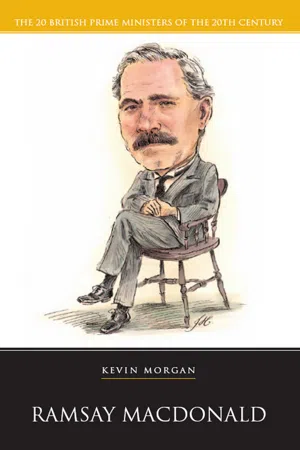
The Labour party's first Prime Minister
eBook - ePub
Ramsay Macdonald
About this book
Information
Print ISBN
9781904950615
Subtopic
Biografie in ambito storicoPart One
THE LIFE
Chapter 1: The Making of a Socialist: 1866–96
MacDonald’s mother, Anne Ramsay, was not quite the ‘Scotch servant girl’ that John Bull alleged. Nor was the ‘Scottish peasant parents’ of Labour accounts entirely accurate either.1 Though family conditions were hard and Anne had certainly worked as a servant, she is described by MacDonald’s official biographer, David Marquand, as a skilled seamstress. According to one Lossiemouth old-timer, she was also so outspoken in her radicalism that during the South African War of 1900–2 she was burned in effigy.2 Moreover, though MacDonald lacked a father, his mother was helped in bringing him up by his grandmother, Bella Ramsay, who was an ardent churchgoer with a strong sense of her social standing. It is Bella who is said to have ruled out MacDonald’s genuine peasant father as a marriage partner for her daughter. It was also in Bella’s home that the family lived, and where her stock of Celtic folklore and mysticism is said to have fed the brooding, romantic side of the youngster’s character.3 Brought up as an only child in a tiny ‘but and ben’ – a two-roomed Scottish cottage – MacDonald went without many things. He did not, however, want attention, nor a sense of his own calling to a higher station.
Nor, for one of such humble circumstances, did he entirely lack an education. A beneficiary of the greater opportunities enjoyed by the able but disadvantaged child in Scotland, MacDonald was to pay warm tribute to the master (or dominie) at the parish school he attended at nearby Drainie. The machinery, he wrote, was as old as Knox; the education was the best ever given to the sons and daughters of men.4 The formal schooling was more than adequate. More important still were the readings to which the dominie introduced his gifted pupil, including such staples for awakening late Victorian minds as Carlyle and Ruskin. Briefly MacDonald is said to have begun work as a farm labourer. Whether derived from that experience, or from the dominie’s editions of Henry David Thoreau, a sense of the rugged independence of such work was to have an important influence on MacDonald’s wider social philosophy. Nevertheless, with his passionate appetite for learning it was inevitable that he should take up the opportunity of continuing at Drainie as a pupil teacher when it was offered him. Already while still in his teens, his intellectual interests began to flourish. In 1883 he set up a Lossiemouth Field Club and produced a cyclostyled magazine for it. He also took part in the debates of the local Mutual Improvement Society. The literary and oratorical skills on which he was to make his national reputation were first honed and tested in this Scottish fishing village.
The whole of my part of Scotland was Radical, and we seemed to have been born with the democratic spirit strongly developed in us.
MACDONALD
For any young man with ambitions, however, Lossiemouth was not big enough to contain them. Scouring the situations vacant column in the Scotsman, in 1885, at the age of 19, MacDonald was taken on as assistant to a Bristol clergyman who was setting up a boys’ and young men’s guild. Though he remained in Bristol barely six months, he had no intention now of returning permanently to Lossiemouth and early the following year made what turned out to be the permanent move to London. Lossiemouth would remain a crucial point of reference for MacDonald and even as Prime Minister he would several times a year retreat to the home he had built there for his mother. Paradoxically, however, that depended on his having made good in the capital. For the time being, some 550 miles from home, the wrench must have seemed complete.
MacDonald did not need London to introduce him to radicalism. Already in Lossiemouth, the writers with whom he became familiar included the American Henry George, whose panacea of the land tax had a special resonance in the Scottish highlands. MacDonald is also said to have seen the Christian Socialist of J L Joynes, who in 1883 had helped set up a Land Reform Union on Georgeite lines. The whole of my part of Scotland was Radical, he later wrote, and we seemed to have been born with the democratic spirit strongly developed in us.5 Nevertheless, if radicalism was pervasive, the socialism he would later embrace was at this point still an esoteric creed, barely established as a political movement. MacDonald could have spent a long time on the Moray coast without making any direct acquaintance with it. Even in Bristol, one of its main provincial centres, he is said to have had recourse to a policeman to help seek it out.6 The socialism of the Independent Labour Party (ILP), with which he was to be so intimately associated, is typically regarded as having grown ‘from the bottom up’, in the shadowy provinces. MacDonald’s distinctiveness was that almost from the start it was associated with the bustle and opportunity of the capital.
The whole of my part of Scotland was Radical, and we seemed to have been born with the democratic spirit strongly developed in us.
MACDONALD
Already in Bristol he had become active in the Marxist Social Democratic Federation (SDF). Curiously, that prefigured Ernest Bevin, another of Labour’s pantheon of illegitimates and a native of the city. There, however, the resemblance between them ends, and at the climacteric of MacDonald’s career in 1931 he and Bevin seemed to personify almost diametrically opposed conceptions of the labour movement. Where Bevin remained active in the local industrial movement, only finally emerging into Labour politics as secretary of Britain’s largest trade union, MacDonald’s move to the capital introduced him to a new and kaleidoscopic world of meetings, campaigns, discussion circles, publications – and career opportunities. Socialism was important, but it was only a part of what London had to offer. Educationally, MacDonald discovered the Guildhall Library, the Birkbeck Institute and the British Museum reading room. Politically, he was to be attracted by a range of different organisations, from the Scottish Home Rule Association to the ‘ethical’ movement and the Fellowship of the New Life. And professionally, he was to make his first fateful connections on the radical wing of the Liberal Party.
All this was not untypical of fin-de-siècle London. On arriving in the capital MacDonald was active in a shortlived moderate SDF breakaway called the Socialist Union. Nevertheless, though London was a centre for the SDF and for the militant ‘New Unionism’ of dockers and other unskilled workers, the tradition of independent Labour politics was never to be as strong here as in the provinces. Instead, ‘constructive’ socialism was dominated by the idea of a broader progressivism, actively sponsored by the very much London-based Fabian Society. Founded in 1884 and still existing today, the early Fabian Society is usually seen as the vehicle of a new social stratum, or nouvelle couche sociale, of the talented but propertyless salariat. Drawn towards the expanding commercial and professional opportunities of the imperial metropolis, these typically lacked advantages of birth or education. Nevertheless, they found the doors of the old class society just sufficiently ajar to feed ambitions of a new social order in which their talents would be utilised and rewarded, if only in status. Though formally speaking MacDonald’s relationship with the Fabian Society was to become somewhat fraught, he remained in many respects typical of this nouvelle couche sociale. Even as he became drawn into independent Labour politics, he was also to show a strong and persistent tendency towards the cross-party conceptions of the Fabians.
For his first year or two in London, MacDonald made an exiguous living in dead-end clerical jobs. As he described it many years later, I went every morning to the City in the wake of the monarchs of finance; scrawled and scribbled and added and subtracted all day … and felt that I was one of those undistinguished ants who would be lucky if they continued by honest and effective service to earn a latch key and daily bread.7 Desperate for an escape route, or simply frustrated by his work, he nurtured hopes of obtaining a science scholarship at South Kensington and pursued his political and educational commitments so intensely as to bring him to the point of breakdown.
It was thus one of the key moments in his career when in 1888 MacDonald secured a position that for the first time promised to satisfy both his material and his emotional needs. This was as secretary to the radical politician Thomas Lough, who at this time was Liberal candidate for West Islington, organising secretary of the Home Rule Union and well connected with metropolitan Liberal circles. ‘Secretaryships were important stepping-stones in MacDonald’s career’, Elton notes laconically; and Lough’s produced the ‘startling evolution’ of a ‘starving young Scottish peasant’ into ‘the arresting young politician who argued with the Fabians in their prosperous drawing rooms, and lunched with successful journalists in Fleet Street’.8 Ironically, it was also through these London connections that MacDonald enjoyed his first important electoral experience nearer to home, assisting the radical Seymour Keay in a parliamentary by-election at Moray and Nairn. Through all the vicissitudes that were to follow, MacDonald was henceforth to make his way through his facility with words, whether as journalist or politician. In 1892, he left Lough’s employment, not, it appears, because of any political falling out, but because he now felt either assured or frustrated enough to embark on a career as a freelance journalist and lecturer. Positioned on the radical fringe of Gissing’s New Grub Street, it provided at first only a tenuous income. It did, however, allow him a sense of independence and a space in which he could dream of making his own mark.
George Gissing (1857–1903) published his first novel Workers in the Dawn in 1880. Its hero, based in many respects on Gissing himself, is made wretched by his marriage to an unlettered prostitute whose manners and morals he had sought to improve. Torn between self-interest and a misconceived altruism, he dies by throwing himself off the Niagara Falls. Gissing’s most famous novel was New Grub Street (1891). It provides a memorable picture of the toils of literary hackwork with which MacDonald himself was familiar. Though posthumously acclaimed by writers like George Orwell, Gissing himself met with little literary success during his own lifetime.
A political career, in the form of a parliamentary seat, thus began to loom larger on MacDonald’s horizons while at the same time remaining entirely beyond his reach. MacDonald was later to observe how evident it was to the social reformer how powerful the letter, the nod, the wink of a Member of Parliament was.9 Having worked so hard to get Keay and Lough into Parliament, perhaps he pondered what better qualifications they had for such work than he.
It was the disappointment of any such expectations in the Liberal Party that underlay his adoption of the cause of independent Labour politics in the summer of 1894. Far away from London, the ILP’s formation in Bradford the previous year had signalled a wider determination to sweep away such obstacles. The ILP’s support was nevertheless concentrated mainly in the north, and MacDonald remained hopeful of achieving a Liberal candidacy with the support of the TUC-sponsored Labour Electoral Association. It was only the dashing of these hopes, first in Dover and then in Southampton, that decided him to join the ILP in July 1894. He announced his adhesion in a letter to the ILP’s founder and chief inspiration, Keir Hardie:
My dear Hardie, I am now making personal application for membership of the ILP. I have stuck to the Liberals up to now, hoping that they might do something to justify the trust that we had put in them… .
Between you and me there was never any dispute as to object. What I could not quite accept was your methods. I have changed my opinion. Liberalism, and more particularly local Liberal Associations, have definitely declared against Labour, and so I must accept the facts of the situation and candidly admit that the prophecies of the ILP relating to Liberalism have been amply justified. The time for conciliation has gone by …10
Though clearly expressing MacDonald’s personal sense of frustration, there is little sign here of any major ideological cleavage. On the other hand, perhaps the same might have been said about Hardie’s repudiation of the Liberal caucus just a few years earlier. The combination of a robust organisational rivalry with profound ideological indebtedness was to characterise MacDonald’s relations with Liberalism almost throughout his career.
Its contradictory character can be detected from the start. In the 1895 election MacDonald fought his first parliamentary campaign as an independent Labour candidate in the two-member constituency of Southampton. Gaining fewer than 1,000 votes and finishing at the bottom of the poll, his one achievement appears to have been to have deprived a sympathetic Liberal of his seat – or at least to appear to have done so. Certainly, when MacDonald returned to Lossiemouth after the election, he found his fellow villagers were all turned keen politicians and swearing at me for having knocked out a ‘Radigal’.11 MacDonald himself, at least to Liberal friends, blamed much on the leadership of Hardie, who by his own incapacity lost his seat and none of us – being scapegoats – got it …12 When almost immediately one of the successful Southampton candidates was unseated over alleged electoral malpractices, MacDonald sanctioned a secret tradeoff in which the ILP’s abstention in the resulting by-election would ensure the Liberals only contesting one of the seats in the next general election. Already on his first venture into electoral politics, MacDonald was thinking on the lines of the national electoral pact that he would negotiate with the Liberals in 1903. In Southampton, when in 1897 he spent a night en route for the USA with the local Liberal chief rather than his ILP supporters, the suggestion was made that he take his candidacy elsewhere.13
Though the ILP ...
Table of contents
- Cover Page
- Dedication Page
- Title Page
- Copyright
- Contents
- Introduction: A Hybrid Ancestry
- Part One: The Life
- Part Two: The Leadership
- Part Three: The Legacy
- Notes
- Chronology
- Further Reading
- Picture Sources
- Index
Trusted by 375,005 students
Access to over 1.5 million titles for a fair monthly price.
Study more efficiently using our study tools.
Frequently asked questions
Yes, you can cancel anytime from the Subscription tab in your account settings on the Perlego website. Your subscription will stay active until the end of your current billing period. Learn how to cancel your subscription
No, books cannot be downloaded as external files, such as PDFs, for use outside of Perlego. However, you can download books within the Perlego app for offline reading on mobile or tablet. Learn how to download books offline
Perlego offers two plans: Essential and Complete
- Essential is ideal for learners and professionals who enjoy exploring a wide range of subjects. Access the Essential Library with 800,000+ trusted titles and best-sellers across business, personal growth, and the humanities. Includes unlimited reading time and Standard Read Aloud voice.
- Complete: Perfect for advanced learners and researchers needing full, unrestricted access. Unlock 1.5M+ books across hundreds of subjects, including academic and specialized titles. The Complete Plan also includes advanced features like Premium Read Aloud and Research Assistant.
We are an online textbook subscription service, where you can get access to an entire online library for less than the price of a single book per month. With over 1.5 million books across 990+ topics, we’ve got you covered! Learn about our mission
Look out for the read-aloud symbol on your next book to see if you can listen to it. The read-aloud tool reads text aloud for you, highlighting the text as it is being read. You can pause it, speed it up and slow it down. Learn more about Read Aloud
Yes! You can use the Perlego app on both iOS and Android devices to read anytime, anywhere — even offline. Perfect for commutes or when you’re on the go.
Please note we cannot support devices running on iOS 13 and Android 7 or earlier. Learn more about using the app
Please note we cannot support devices running on iOS 13 and Android 7 or earlier. Learn more about using the app
Yes, you can access Ramsay Macdonald by Kevin Morgan in PDF and/or ePUB format. We have over 1.5 million books available in our catalogue for you to explore.