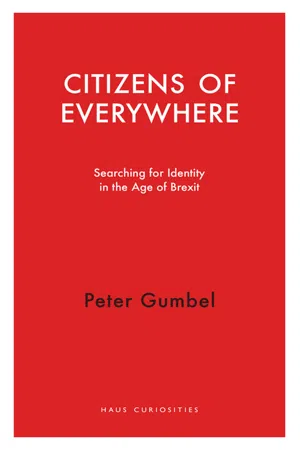
In 1939, as war loomed, Peter Gumbel's Jewish-born grandparents fled Nazi Germany for England. But within a matter of decades, their grandson, appalled by the Brexit referendum, had become a citizen of the country they fled eighty years ago. How had it come to this?
Drawing on one family's migration stories, Citizens of Everywhere explores the nature of belonging amid cycles of pluralism and nationalism. In an increasingly global world, nativist and diasporic impulses pull many people in contradictory directions that can be difficult to even understand. In Citizens of Everywhere, Gumbel grapples with this complexity through his own family history, revealing the personal costs of Britain's recent isolationist retreat. Along the way, he laments the decline of British pluralism at the worst possible moment—as it rejects the European project and engages in an ill-fated struggle against an ever more interconnected world.
- English
- ePUB (mobile friendly)
- Available on iOS & Android
eBook - ePub
About this book
Information
1
Exile, or the Perilous Illusion of Belonging
All four of my grandparents were proud German citizens until the Nazis decreed that they were not German at all but members of an inferior race that needed to be eradicated. On both sides of my family, the implications of this violent undermining of their identity took a long time to sink in and even longer to act upon, until it was almost too late. The consequences, both physical and psychological, were traumatic. Even today, among later generations, the idea that we may not fully “fit in” remains a family demon.
Most of the history I recount in this essay concerns my mother’s side of the family. This is because I possess detailed correspondence documenting some of the ordeals her parents experienced during the Third Reich. After my maternal grandmother’s death in 1989, I found carbon copies of letters her husband had written fifty years previously. These letters trace their flight from Germany and arrival in England. As well as a record of dates and names, the correspondence provides precious glimpses of the emotion they felt. On my father’s side, by contrast, the only first-hand documentation available is almost entirely from my father’s own memoirs, which are filtered through his upbeat personality and coloured by time; he experienced Hitler’s accession to power in January 1933 as a law student in Berlin and left Germany three months later. He went on to study in Zurich and London and only put pen to paper six decades later.
Both sides of my family had ample reason to see themselves as German through and through. In their respective local communities, they were well established and evidently respected. My father’s father, Gustav Gümbel, started his career in the family wine business before opening a bank in the Rhineland town of Bingen. Family lore has it that he faced down a mob of political radicals who threatened to storm the bank in the chaotic aftermath of the French march into the Ruhr in 1923. A few years later, his bank was acquired by Deutsche Bank, and he then served as president of the regional Chamber of Commerce and Industry until he was forced to resign after Hitler took power. Even so, as late as July 1934, he was decorated for his wartime service, having been wounded in a road accident during the First World War. That same year, he and my grandmother decided to build themselves a new house on a plot of land they had acquired in Bingen – not the sort of decision you would take if you had any doubt about your longer-term prospects.
On my mother’s side, the family pedigree and rootedness in the local community was even stronger. My great-grandfather Max Grünebaum was an entrepreneur who moved from the family home in Lippstadt to the town of Cottbus, about eighty miles southeast of Berlin, in 1872. At the time, Cottbus was a thriving hub of the German textile industry and Max began work in a cloth mill. Four years later, he and a brother-in-law set up their own company. Demand soared across Europe for the high-quality worsted yarn the factory produced, and it was quickly riding the powerful industrialisation and export wave of those years. Max made a fortune and eventually bought out his partner. He built himself a sumptuous villa in the centre of Cottbus. Not content with just leading a comfortable life, he became socially and politically active. With his wife Caroline, he created a pension fund for his employees and set up a foundation that gave grants to the local children’s hospital to combat scarlet fever. He financed city parks and a riverside promenade.2 Together with other affluent families, he also supported the construction of a magnificent Art Deco theatre, which still stands, and for which his factory wove the first curtain. He was recognised for his civic activities in October 1908, when Cottbus awarded him the freedom of the city. Five months later, in March 1909, Kaiser Wilhelm bestowed on him the honorary title of Kommerzienrat – commercial counsellor. He was active in local municipal politics for three decades and, during the First World War, stepped in to serve as acting mayor. By then he was in his early sixties.
The high standing in which both families were held probably contributed to a false sense of security once Hitler came to power. How could such pillars of the local community be at risk? Both great-grandfathers were luminaries in their respective local Jewish communities. The entrepreneurial Max Grünebaum served for a time as a board member of the Cottbus synagogue. On his death in 1925, the synagogue published a notice in the local newspaper that lauded him for “openly professing his Jewish faith throughout his life”. On my father’s side, too, the family gave financial support to the Bingen synagogue. Yet several family members had severed their ties to Judaism long before the Nazis took power. They included my maternal grandmother Carla, who had converted to Christianity more than two decades previously; among her papers, I found her certificate of baptism into the Protestant church, dated February 1910. Her husband, Ernst, converted in January 1923. My father, too, was deeply ambiguous about his Jewish roots. In a family memoir published privately before he died in 1995, he wrote: “As a family, we tended to look upon our Jewish heritage as a legacy of the past which would continue to recede but had lost most, if not all, of its social as well as its spiritual hold.”
This shifting relationship with Judaism is not atypical. Some academic studies have noted a general tendency at that time among bourgeois Jewish families in Germany to assimilate; one theory is that they wanted to differentiate themselves from the shtetl Jews in Eastern Europe whom they viewed as less affluent, less integrated, and less cultured.3 My family papers contain no trace of an explanation about the intergenerational shift in faith other than a brief reference by my father in his memoir: “Curious as it may sound, there was even a whiff of anti-Semitism in the air at our home. We sensed that after a thousand years of ghetto life in towns and cities, it was time to escape from it into a larger, more open, more outward-directed world with wider interests, different values, and new ideals.”
While my grandparents saw themselves as thoroughly German, to the Nazis they were Jews. Conversion to Christianity was no help, and local churches simply fell into line with that racial logic. In December 1938, the Cottbus Protestant church wrote to my grandmother informing her that, despite more than a quarter century of active membership, the local synod had unanimously voted to reject her annual dues and was refunding the instalment she had already paid. In other words, she was being kicked out of the church.
That episode was just one indication of how Ernst and Carla’s once comfortable world was collapsing around them. Humiliations became part of their daily experience. They were obliged by law to add “Israel” and “Sara” to their official names at the city registry office; they initially ignored the police order to do so but responded to the second warning with a curt letter saying that they had complied. They had to surrender their passports, which meant Ernst could no longer leave Germany to meet international clients, and they were obliged to fire their maid, Käthe, because of the Nazi race laws; she was deemed to be Aryan and thus not allowed to work for people who weren’t. My grandparents found her a new employer, but she was so eager to remain with them that she lodged a request with the local labour office for special dispensation to stay on. The police promptly called her in for questioning. The minutes of her deposition, housed in the city archives, suggest that they peppered her with questions about the family, including insidious ones about whether Ernst had ever shown signs of “immoral” behaviour. She insisted that they were model employers, but her request to continue working for them was nonetheless denied.
My grandparents finally saw the writing on the wall and started to respond. In the spring of 1937, they sent their sixteen-year-old twin daughters – my mother Ellen and aunt Marion – to a boarding school in Switzerland. Less than eighteen months later, they entrusted their son into the hands of Quakers promising to spirit him out of the country by train and boat to a destination yet to be determined, but most likely Canada. Once the children had been taken care of, the future of the family business needed to be secured. The looming threat was “Aryanisation”, Nazi shorthand for confiscation. Business had already become more difficult in 1935, when Jewish-owned companies were excluded from public-sector contracts. Raw material supplies dried up; they were allocated by quota and the factory was cut out. Ernst knew he had to relinquish ownership, but he wanted to ensure the company would keep going. After consulting friends in the business, he engineered a “sale” to an up-and-comer who would be acceptable to the Nazis. Hermann von Müffling fit the bill: as a relative of a famed Prussian field marshal, he had impeccable Aryan credentials – but could not raise sufficient funds to buy the factory, even at a knock-down price. My grandfather arranged a loan of 240,000 Reichsmarks, the equivalent of almost £1.4 million today, borrowing funds from his mother-in-law, presumably knowing that the loan may never be repaid.
Once the sale had gone through, Ernst and Carla needed an exit plan for themselves and for Carla’s mother, who lived in a wing of their villa. Towards the end of October 1938, Ernst began writing letters to his business contacts around Europe seeking help. He didn’t yet know that he would be arrested just two weeks later, on 9 November, during “Kristallnacht”, when the Nazis set fire to the Cottbus synagogue and smashed thousands of shops and other Jewish-owned buildings throughout the Reich. Yet it was obvious they needed to get out of Germany. England was their best hope. “There is little to say about our future,” Ernst wrote to a friend in Switzerland. “I am looking for a new country in which to work. I have turned to my friends in England, since England with its cultured and highly developed industry naturally interests me the most.” To another contact, the director of an import-export company in Yorkshire who had been a good customer, he wrote: “England is the mother of industry. Do you think, my most esteemed Mr Hodgson, that there might be a company in your country that would be interested i...
Table of contents
- Cover Page
- Halftitle
- About the Author
- Title
- Copyright
- Contents
- Acknowledgements
- Prologue
- Chapter 1
- Chapter 2
- Chapter 3
- Chapter 4
- Chapter 5
- Chapter 6
- Notes
Trusted by 375,005 students
Access to over 1.5 million titles for a fair monthly price.
Study more efficiently using our study tools.
Frequently asked questions
Yes, you can cancel anytime from the Subscription tab in your account settings on the Perlego website. Your subscription will stay active until the end of your current billing period. Learn how to cancel your subscription
No, books cannot be downloaded as external files, such as PDFs, for use outside of Perlego. However, you can download books within the Perlego app for offline reading on mobile or tablet. Learn how to download books offline
Perlego offers two plans: Essential and Complete
- Essential is ideal for learners and professionals who enjoy exploring a wide range of subjects. Access the Essential Library with 800,000+ trusted titles and best-sellers across business, personal growth, and the humanities. Includes unlimited reading time and Standard Read Aloud voice.
- Complete: Perfect for advanced learners and researchers needing full, unrestricted access. Unlock 1.5M+ books across hundreds of subjects, including academic and specialized titles. The Complete Plan also includes advanced features like Premium Read Aloud and Research Assistant.
We are an online textbook subscription service, where you can get access to an entire online library for less than the price of a single book per month. With over 1.5 million books across 990+ topics, we’ve got you covered! Learn about our mission
Look out for the read-aloud symbol on your next book to see if you can listen to it. The read-aloud tool reads text aloud for you, highlighting the text as it is being read. You can pause it, speed it up and slow it down. Learn more about Read Aloud
Yes! You can use the Perlego app on both iOS and Android devices to read anytime, anywhere — even offline. Perfect for commutes or when you’re on the go.
Please note we cannot support devices running on iOS 13 and Android 7 or earlier. Learn more about using the app
Please note we cannot support devices running on iOS 13 and Android 7 or earlier. Learn more about using the app
Yes, you can access Citizens of Everywhere by Peter Gumbel in PDF and/or ePUB format, as well as other popular books in Politics & International Relations & Social Science Biographies. We have over 1.5 million books available in our catalogue for you to explore.