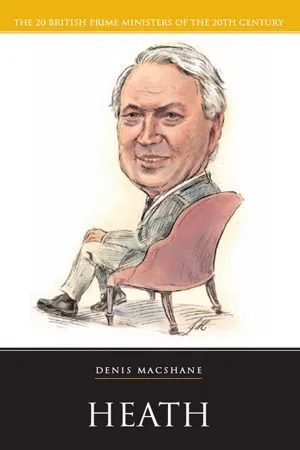
Former British Prime Minister Edward Heath is best known for taking Britain into the European Union.
eBook - ePub
Heath
About this book
Information
Print ISBN
9781904950691
Subtopic
Historical BiographiesPart One
THE LIFE
Chapter 1: Early Years
Edward Heath was born in east Kent on 9 July 1916 in the middle of the Somme offensive and in the same year as Harold Wilson and François Mitterrand. Responding to Europe’s long civil war between 1914 and 1945 by ensuring that such barbarity could never happen again was the leitmotif in Heath’s political life. English popular history sees only the fighting between 1914 and 1918 and 1939 and 1945, yet there was not a day of full peace in Europe for the three decades between the summer of 1914 and the spring of 1945. And even if soldiers were not firing shots, there was the grim oppression of authoritarian regimes of the left and right denying basic rights to millions of Europeans. Another theme in Heath’s life was resistance to socialism and he and Harold Wilson were locked in direct political combat for a decade. Wilson emerged the winner in terms of elections won but it was Heath who had the bigger historic impact by taking Britain into Europe. And shortly after both men left high office, the politics of Britain was fundamentally reshaped by the arrival of a new hard neo-liberal Toryism which became known as Thatcherism, which, in turn, gave birth to New Labour. Finally, Heath’s life was intimately bound up with France. All British politicians are divided between those who are romantic about France, like Churchill, Macmillan and Heath, and those petty Francophobes who find France irritating and ever in the way of English desires and designs. Heath’s private walk with the French president Pompidou in the gardens of the Elysée in 1972 allowed the breakthrough to let the United Kingdom join the European Community.
Making Europe safe from conflict. Arguing against statist socialism. Seeking a rapprochement with France. These three themes wove their way through Edward Heath’s life. He came from modest origins. His father was a hands-on builder and carpenter who put in 16-hour days six days a week. Harold Wilson’s biographer, Ben Pimlott, contrasted the ‘northern lower-middle-class’ roots of Wilson’s parents compared to ‘Harold’s later opponent, and Oxford contemporary, Edward Heath, whose manual working-class roots are indisputable’1 but Heath’s own biographer John Campbell says Heath was ‘born into the upwardly mobile, socially aspiring skilled working class just where it merges into the lower middle class’.2 The writhing of British historians and sociologists about the divisions and frontiers of the country’s class system and where exactly to locate each Briton has been a 20th-century obsession and the object of satire by observant comedians like John Cleese and Ronnie Corbett. What is clear is that Heath was 100 per cent English. Kent is the garden of England. Its coast running from Dover up the Thames estuary is not the same as the fields and woods where Churchill bought his country house, Chartwell, or where the British Foreign Secretary has a handsome Jacobean house at Chevening. The Kent coast is a hard-working region. There were coal mines just 20 miles from Broadstairs, Heath’s home town. The Medway towns, Sittingbourne, Chatham, Dartford and Sheerness are towns where manual employees co-exist with the service and professional middle classes. Broadstairs, Ramsgate and Margate were holiday towns for Londoners on modest incomes. Whichever party wins this part of England usually forms a government. Heath later adopted the costume and habits of the ruling Conservative class, but his roots were not theirs. His mother had the strong-faced beauty of a Julia Roberts to judge from photographs. Heath was extremely close to her and she did everything to protect and promote her son. In the summer, the family took in boarders, giving up rooms in their small house for paying guests to supplement household income. The family was never poor but Heath could not go to Oxford without a council scholarship and support from an educational charity. His parents were protective of him and his brother John who was four years younger. Like all small boys he was sent off to learn the piano but unlike most small boys the playing of music gripped him and swept Teddy, as he was called, into a world where his fingers and ears could make it his own. To master an instrument and become fully musical requires a kind of celibacy, a monastic discipline to surrender part of oneself to the art and craft of music. As other teenagers were out chasing girls, larking about or sneaking into pubs under-age, Heath was hunched over the piano and then the organ learning to play as if his future depended on it.
His other passion was reading. He had few friends. His sports were swimming and cycling, not team sport although he was scorer to the First Eleven – the job given to the school swot or weed who cannot be trusted with bat or ball. He won a scholarship to Chatham House, a grammar school in Ramsgate and became a prefect – the English system of turning boys into whips – at the age of 16. There was something puritanical, priggish and tightly focused about Heath. He wanted to do his school certificate – the equivalent today of GCSEs – at the age of 14 and persuaded his father to appeal to the school head to drop his objections to Heath taking the exam so young. Not keen on sport, Heath became a chorister and organ player at the local church. But he did like debates and spoke in a school debate that repeated the famous 1933 Oxford Union motion that ‘this House would fight for King and Country.’ Heath spoke in favour of fighting for ones country and unlike the pacifist neutralists at Oxford, Heath’s team won a majority for the motion. I suppose I just liked arguing,3 he wrote in order to explain this desire to take part in and win debates. Heath kept a home at his father’s house in Broadstairs until the end of the 1960s. There he was completely at ease meeting childhood friends and in due course learning to sail. It was the most secure part of his life.
Like Neil Kinnock, Heath was the first member of his family to go to university. He set his heart on going to Oxford. Leaving the confined horizons of Broadstairs and the north Kent shoreline was important. As with so many, Oxford was the catalyst to a rebirth and an injection of confidence and a sense that anything can be achieved. He tried first for Keble, that dull redbrick Oxford Movement college dumped in the 19th century on the outskirts of the university town, but was turned down. But it was a blessing in disguise as Heath won a place at Balliol, a college where politics and appreciation of hard serious work went hand in hand. After a term he won an organ scholarship which required playing each morning in the college chapel. Harold Wilson never met his contemporary Edward Heath at Oxford but he did go to hear Heath playing the organ in the chapel at Balliol. If the Anglican Church was the Tory Party at prayer, playing the church’s music each morning in Balliol was to live in a stable, ordered world as an undergraduate.
In his autobiography, Heath writes about his time at Oxford, which thanks to his music scholarship stretched to four years, not the usual three, with tenderness, yearning and detailed interest in all he did and all he met. For Heath, Balliol, the starting point for so many in British public life, provided a breadth of human experience, and understanding that I had never previously experienced. The College was also rightly renowned for its emphasis on public service, tolerance and intellectual integrity.4 Unlike so many of his contemporaries – Roy Jenkins, the student communist Denis Healey, or Anthony Crosland – Heath was not tempted towards the fashionable leftism of the student 1930s. On the contrary, he rose to head the university Conservative Association and became President of the Union. There already the Heath of the 1970s was evident as he called in a firm of management consultants from London and reorganised the union so that it offering food and other facilities in order to increase membership.
Heath’s Oxford, with its focus on Oxford Union politics, was different from that of his contemporary, Harold Wilson. The northern boy was a swot, working 14 hours a day to get a first at the Welsh college, Jesus. He never went to the Union and although Wilson was to become a better House of Commons debater than Heath, his speaking powers were developed later. Heath was taught to marshal arguments and learnt to speak well and then went into politics, while Wilson was an intellectual – a university don while Heath was still an undergraduate – who learnt to speak after he was elected to the Commons. Success in Oxford undergraduate politics and its debating society, the Oxford Union, is little guide to future political ability. The quick-witted repartee that wins votes in the Oxford Union debates seduces those who have the gift of talking well into thinking that is all that is required for a political career. Wilson said nothing of note at Oxford but survived longer in Downing Street than his contemporary.
Clearly, at Oxford Heath gained the confidence to know that he could lead people, run institutions and effect change. But perhaps the most important part of his four student years were spent not at the university but on trips abroad. Political tourism is now fashionable but there can be few post-war European leaders – an exception might be Willy Brandt – who saw first-hand the shape of European politics in the 1930s to the extent that Heath did. Heath was in Spain during the Civil War where he met Jack Jones, a young trade unionist from Liverpool who was in the International Brigades. He was at Nuremberg for the Nazi rallies and shook hands with Göring and Himmler, recalling the weak, clammy hand of the SS leader. In August 1939, Heath was in Danzig being urged to quit Poland by the British ambassador before the war started. He took in the music festival at Salzburg and hitchhiked his way across France, picking up a knowledge of wine that never left him. If he mastered music, he had trouble with foreign languages. No linguist like Denis Healey he worked hard at his French and German. Much scorned for his strong English accent when he spoke in French at the moment of Britain joining the European Community, it remains no bad thing that from time to time there is a Prime Minister who can read more than his or her own language.
These vivid holidays spent in the political front-line of a Europe fighting to save democracy from Francoism or Hitlerism or Mussolini’s buffoonish but murderous adventures in Africa were as important as the eight weeks he spent three times a year in Oxford. It meant that Heath’s Conservatism turned quickly to that of Churchill’s resistance of the appeasement of dictators which was the policy of Baldwin and Chamberlain in the 1930s just as it was the policy of a Conservative Prime Minister and Foreign Secretary in relation to Serbia and Rwanda in the 1990s. Heath was also attracted to the ‘Middle Way’ theories of Harold Macmillan, whose book of that name stunned his party and his class by arguing for a planned approach to economic development along the lines of Roosevelt’s New Deal and based on the theories of John Maynard Keynes. Macmillan attacked the Conservatives as ‘a party dominated by … company promoters – a Casino Capitalism – that is not likely to represent anything but itself’.5
He supported the Master of Balliol, Alexander Lindsay, in the 1938 by-election for the university seat when Lindsay stood as an anti-appeasement candidate against Quintin Hogg, who ran as a pro-Chamberlain Tory. Heath continued to develop his musical profile, singing in the renowned Bach Choir and performing Brahms Requiem in memory of King George V who died in 1935. On his visits to Europe Heath always found time to spend hours in art galleries. His contemporary, Denis Healey, was equally passionate about music and art but in the philistine Tory world Heath had to rise through, his deep culture was a private passion and rare in British politics which puts a premium on bluff, hearty Englishness and does not know how to deal with someone who loves and is deeply moved by European culture.
‘I think he [Heath] was always very lonely. I would come home having made a great speech in the House and my wife would ask how many infinitives I had split. Or if I came home after a stinker of a day in the department she would give me a whiskey and calm me down. Poor Ted used to go back to that flat over Downing Street utterly alone with no-one to talk to.’
PETER WALKER
Heath left Oxford in 1939 a changed man. He spent the autumn on a curious debating tour of the United States – one of the more intriguing episodes of the ‘Phoney War’ when so much of life ran along normal lines. The annual trip by two of the best student debaters from British universities to debate with their opposite numbers in the United States is a much-prized opportunity to see America. Despite the outbreak of war it was decided to continue the visit. Like his travels in Europe, Heath got a chance to get to know America from top to bottom and understood that the United States, despite speaking English, is a profoundly foreign country with no more regard for British interests and needs than any other faraway land with its own different culture, politics and traditions.
The Heath of 1940 was already much formed. He had a girlfriend with whom he shared bike rides and concerts back in Kent but his passion was for music and his energies were reserved for politics. Did Heath ever have sex with a woman? The question is not important, yet the absence of women, of family, of the difficulties of sustaining a relationship with another person and one’s children left Heath without some reference points that might have let him become a more rounded, a fuller human being as a political leader. His protégé and Cabinet colleague, Peter Walker, believes that Heath had one serious relationship in the past but once that broke down he just relapsed into permanent bachelorhood. ‘But he was marvelous with my five children and when he stayed at my house in Worcester for the Three Counties festival he would play cowboys and Indians with them and they adored him. I think he was always very lonely. I would come home having made a great speech in the House and my wife would ask how many infinitives I had split. Or if I came home after a stinker of a day in the department she would give me a whiskey and calm me down. Poor Ted used to go back to that flat over Downing Street utterly alone with no-one to talk to.’6 Chris Patten, who was also selected by Heath to run the Conservative Research Department as a bright young Balliol graduate said it was ‘difficult to like Ted. He just wasn’t a likeable man’.7 Patten’s judgement was made in a tone of regret and sadness. A Labour generation of post-war politicians who had all been at Oxford in the 1930s became and stayed friends across many political divides. Heath in his autobiography claims in the last paragraph that I have, and always have had, many friends in all walks of life.8 He protests too much. Heath was socially autistic. His self-centredness allowed him time to work and do things that those who have to bring up families lose in exchange for the unique joy of being a parent. Heath was never a fully-formed man. Oxford helped make him but he left Balliol still incomplete as a human being. But as with so many other young men unsure of their worth, their abilities and their role in life, Oxford opened many doors for Heath. Now he would go off to fight in a war and prepare for power.
Chapter 2: War and Into Parliament
Heath had a good war. He volunteered at the outbreak of war and enrolled in the Royal Artillery. He was posted as a Second Lieutenant to the 107th Heavy Anti-Aircraft Regiment which was defending Merseyside from Luftwaffe attacks. As at the Oxford Union, or his later service in the whips’ office, it is his command of organisation that come to the fore. He became adjutant of his regiment with the rank of captain in March 1942. He also took charge of the battery band. Once he was traveling with the band to play in Chester in an ambulance an army medic had leant the musicians. It was caught up in a traffic jam and Heath used the stop to rehearse. A senior officer who turned up was astonished to hear dance music being played from the back of an ambulance. ‘Typically’, said a Colonel later, ‘Heath had got his band rehearsing to avoid wasting time.’1 Fellow officers noticed his obsession with paperwork. He was a stickler for detail, for doing things by the book. When his troops found an abandoned stock of champagne he would not drink it as it was, in his eyes, stolen property. One of his earlier commanding officers sent Heath to his next posting with the warning ‘I am sending you the future Prime Minister of England.’2 Before 1944 he travelled up and down the length of Britain mounting anti-aircraft defences. The army is one of Britain’s great public institutions. Its order, hierarchy, tradition and history – and under pressure its ability to reinvent itself – makes the British Army in wartime an organisation in which hard work and politeness to superiors brings big rewards.
He arrived in France in July 1944 and was quickly in action before Caen. Later he suffered a scalp wound in Decem...
Table of contents
- Cover Page
- Dedication Page
- Title Page
- Copyright
- Contents
- Foreword
- Part One: The Life
- Part Two: The Leadership
- Part Three: The Legacy
- Picture Sources
- Notes
- Chronology
- Further Reading
- Index
Trusted by 375,005 students
Access to over 1.5 million titles for a fair monthly price.
Study more efficiently using our study tools.
Frequently asked questions
Yes, you can cancel anytime from the Subscription tab in your account settings on the Perlego website. Your subscription will stay active until the end of your current billing period. Learn how to cancel your subscription
No, books cannot be downloaded as external files, such as PDFs, for use outside of Perlego. However, you can download books within the Perlego app for offline reading on mobile or tablet. Learn how to download books offline
Perlego offers two plans: Essential and Complete
- Essential is ideal for learners and professionals who enjoy exploring a wide range of subjects. Access the Essential Library with 800,000+ trusted titles and best-sellers across business, personal growth, and the humanities. Includes unlimited reading time and Standard Read Aloud voice.
- Complete: Perfect for advanced learners and researchers needing full, unrestricted access. Unlock 1.5M+ books across hundreds of subjects, including academic and specialized titles. The Complete Plan also includes advanced features like Premium Read Aloud and Research Assistant.
We are an online textbook subscription service, where you can get access to an entire online library for less than the price of a single book per month. With over 1.5 million books across 990+ topics, we’ve got you covered! Learn about our mission
Look out for the read-aloud symbol on your next book to see if you can listen to it. The read-aloud tool reads text aloud for you, highlighting the text as it is being read. You can pause it, speed it up and slow it down. Learn more about Read Aloud
Yes! You can use the Perlego app on both iOS and Android devices to read anytime, anywhere — even offline. Perfect for commutes or when you’re on the go.
Please note we cannot support devices running on iOS 13 and Android 7 or earlier. Learn more about using the app
Please note we cannot support devices running on iOS 13 and Android 7 or earlier. Learn more about using the app
Yes, you can access Heath by Denis MacShane in PDF and/or ePUB format. We have over 1.5 million books available in our catalogue for you to explore.