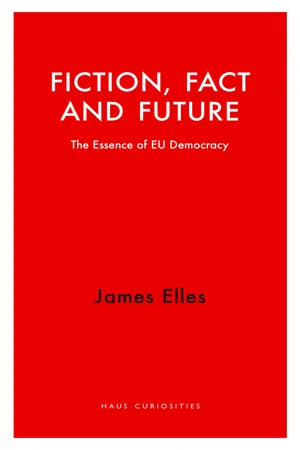
Since its inception, the European Union has developed to become an open and transparent system which is democratically accountable to more than five hundred million European citizens. James Elles explains how the EU functions, emphasizing the emerging role of the European Parliament in the process. Elles reviews the history of Britain's relationship with the EU and illustrates how a reluctance to consult the British people on multiple Treaty changes led to a lack of understanding about Brussels. Looking to the future, Elles assesses the global long-term trends that lie ahead to 2030 and underlines that closer European cooperation, for example on environmental and digital policies, will help them to be more easily resolved. As the next decade unfurls, the EU with President Macron at the forefront of the debate will progress and the European Parliament will continue to develop as a platform for the voice of the European people. From the disinterest of political leaders to the ambitions of emerging nations, Fiction, Fact and Future is not only a guide to why Britain failed to make the most of its EU membership, but also an optimistic message to a younger generation to help shape their future in the 21st century.
- English
- ePUB (mobile friendly)
- Available on iOS & Android
eBook - ePub
About this book
Trusted by 375,005 students
Access to over 1.5 million titles for a fair monthly price.
Study more efficiently using our study tools.
Information
1
Fiction
Thanks to the votes cast by the British people in the referendum on 23rd June 2016, the UK decided to leave the EU. Looking back over the period of membership, there have been many times, not least since the referendum, when it has been legitimate to ask whether we as a country really ever understood what our commitments to EU membership were. As we shall see, many politicians were (and still are) seemingly totally unaware of the nature of the EU institutions and of their legal obligations – and the fundamental fact that the EU is a rules-based legal system with elected representatives to help create the laws applying to all its people.
I should explain that, during my professional life, I have had a greater opportunity than most to observe this at close quarters, having started working at the European Commission in February 1976, starting as a ‘stagiaire’ (trainee) before becoming a full-time administrator on both commercial and agricultural policy for a seven-year period. On leaving the European Commission in June 1984, I was elected as an MEP for the European Parliament constituency of Oxford and Buckinghamshire. I remained an elected MEP for 30 years before voluntarily standing down in June 2014.
The general lack of understanding of the EU was nicely put in an article in The Times by Simon Nixon, who commented, ‘The reason why the Brexit debate has gone round in circles for the past two years – and why the UK’s negotiations have been almost completely stalled for months – is that much of the British political class have never fully understood what the EU is or how it works.’1 He ended the piece by indicating that the UK had failed to cooperate effectively within the EU’s systems:
The British political class increasingly resembles a British tourist asking a foreigner for directions: unable to make itself understood, it simply shouts louder. Complaints about EU “theologians” only reveal a worrying lack of understanding of the realities of an organisation of which the UK was a member for 43 years. If Britain is to avoid finding itself unexpectedly stranded without a deal in March, it will need to start learning the language.2
On being elected as a MEP in June 1984, I found myself with a European Parliament constituency of around half a million voters stretching across the Thames Valley. The experience was a sharp learning curve, but I had the good fortune to share a parliamentary office in Amersham with the MP Ian Gilmour, Baron Gilmour of Craigmillar (who was then Sir Ian Gilmour), as well as benefitting from the advice of a canny political agent, Robert Nairne. Furthermore, not only did I have the luck to be a full-time member of the Budget Committee in Brussels, but I also started a regional network called TARGET to promote training in skills and technologies with my neighbouring MEP (my mother, Baroness Elles!). As it turned out, TARGET was a highly successful venture reaching more than 5,000 small and medium-sized enterprises across the Thames Valley, linking businesses with colleges and training providers.
But my incoming enthusiasm to do things for my voters in the Thames Valley was soon dampened by some advice which I received from the Party Chairman at the time, Norman Tebbit, during a visit to 10 Downing Street to meet the Prime Minister, Margaret Thatcher, with my MEP colleagues. When I told him about my interest in doing things for constituents, he said to me privately, ‘Don’t bother with that. That is not your task. Your duty is to tell those in Brussels what we think of them. We will look after the rest!’
There is more to be said about the nature and effectiveness of EU parliamentary democracy (see Chapter 2), but for now the question to answer is why it was that there could be several changes to the European treaties, changing the way in which our country is governed, with so little explanation to the British people about the EU institutions, and specifically the role of MEPs in UK public life – including awareness of the impacts of EU rules and regulations on Britons’ lives, and the degree to which their ability to trade, travel and do business in Europe has been founded on them. Essentially, the fiction was maintained that Britain had joined an economic entity which had no political consequences.
UK entry into the EEC and the subsequent 1975 referendum
Initial statements by Prime Ministers of the two leading political parties at the time recognised that British membership of the European Economic Community (EEC) – which had been created by the Treaty of Rome in 1957 – would have political consequences. Labour Prime Minister Harold Wilson said:
Whatever the economic arguments, the House will realise that, as I have repeatedly made clear, the Government’s purpose derives above all from our recognition that Europe is now faced with the opportunity of a great move forward in political unity and that we can – and indeed must – play our full part in it.3
Later, Conservative Prime Minister Edward Heath wrote in The Illustrated London News:
The community which we are joining is far more than a common market. It is a community in the true sense of that term. It is concerned not only with the establishment of free trade, economic and monetary union and other major economic issues – important though these are – but also … with social issues which affect us all. 4
In the House of Commons debates in the lead-up to UK membership of the EEC, Social Democratic Party founder David Owen agreed with Enoch Powell that the issue of cession of parliamentary sovereignty could not be disputed:
Of course that means that one gives up sovereignty, and a lot of the debate in this House has been focussed upon sovereignty, and rightly so, because this is a central matter to many of the people who fundamentally do not wish us to go into Europe. They do not wish to give up any measure of sovereignty. … It is, however, foolish to try to sell the concept of the EEC, and not admit that this means giving up some sovereignty.5
The real disagreement was over what pooling of sovereignty meant in practice. Heath argued that the conception of sovereignty was too narrow:
It is right that there should have been so much discussion of sovereignty …. If sovereignty exists to be used and to be of value, it must be effective. We have to make a judgment whether this is the most advantageous way of using our country’s sovereignty.6
Writing on the debates in 2016, public policy consultant Greg Rosen summarised the nature of the controversy:
At the heart of this debate was not deception but genuine disagreement, over whether the economic benefits of EEC membership combined with the opportunity for greater collective power through pooled sovereignty outweighed the infringement upon narrow national sovereignty that EEC membership entailed.7
In the subsequent debates on the June 1975 referendum – which asked the public, ‘Do you think the United Kingdom should stay in the European Community (the Common Market)?’ – Prime Minister Harold Wilson won sufficient concessions from the EEC to enable a vote of two-thirds in favour of remaining. On this occasion, much of the Yes campaign focussed on the credentials of its opponents. According to Alistair McAlpine, the Yes campaign treasurer, ‘The whole thrust of our campaign was to depict the anti-Marketeers as unreliable people – dangerous people who would lead you down the wrong path.’8
In Conservative campaign notes, a message from Margaret Thatcher, Party Leader at the time and campaigning to stay in, underlined that “the Community gives us a chance to influence world affairs. Britain’s instincts have never been isolationist and membership of the Community enables us to play a full part in the counsels of Europe and a continuing role in the affairs of the world”.9
So the referendum was won by a large majority, with a well-organised campaign in favour of staying in the EEC, but downplaying the question of sovereignty. Indeed, the Conservative Party’s Yes campaign literature noted that Britain had already “pooled her nuclear capacity under the auspices of NATO and undertaken to share her oil supplies by the terms of the International Energy Programme”. It also said that “every member state effectively has a veto on all matters of vital national interest raised in the Council of Ministers. The powers of the Commission are confined largely to administrative matters”.10 Thus, at the start of our EEC membership, it was certainly implied that we were joining more than a free trade arrangement. After all, as Jean Monnet had pointed out in 1962, you could not operate a common market without ‘common rules applied by joint institutions’.11 Furthermore, it was well known at the time that there were draft plans for the EEC to move ahead towards economic and monetary union (as per the Werner Report, which was presented in 1970). However, if there was recognition of the general destination of the European project, a statement by the Prime Minister at the time of entry did little to clarify what the ultimate consequences for Britain might be. In a television broadcast, Heath said, ‘There are some in this country who fear that going into Europe we shall in some way sacrifice independence and sovereignty. These fears, I need hardly say, are completely unjustified.’12
As time went on, there were those who highlighted vigorously the absence of clarity concerning sovereignty. In 2001, the journalist Christopher Booker cogently argued that efforts were made time and again to conceal what was really going on as the European project developed on the continent. The real long-term aim, he pointed out, was always that the countries of Western Europe should eventually come together in complete political and economic union:
Britain’s politicians have at every stage along the way, had to go through that process with which we are now so wearingly familiar: whereby first they express opposition to much of what their continental partners are proposing; then find themselves having to agree to more than they intended; and finally have to hide from the British people just how much they have given away …. The real problem for the British has been that, from the moment our politicians first decided in the 1960s and 1970s that we should join the project, they have never dared to admit openly to the British people that this was its true nature and purpose.13
There recently came to light a Foreign & Commonwealth Office document that provides an insight into what a senior official expected to happen once Britain joined the EEC. In essence, the classified paper – dated April 1971 and locked away for decades under the Official Secrets Act – predicted the emergence of an economic and monetary union as well as a common foreign and security policy. The author also alluded to the fact that the increased role of Brussels would lead to a ‘popular feeling of alienation from Government’.14
Stephen Wall summarised perfectly this conundrum. He concluded in his book A Stranger in Europe that while many of those involved in taking the UK into the EEC understood the political implications, those who came afterwards deliberately chose not to, often for narrow reasons of short-term political advantage.15
Critical treaty changes during UK membership of the EU
Given that the course was set among the British political class that the essence of sovereignty would not be lost through UK membership of the EEC, it is not surprising that tensions gradually mounted over the years as one revision to the Treaty of Rome succeeded another. Five changes were ratified by the House of Commons between 1987 and 2009, all transferring more competences to the EU institutions and, at the same time, giving incremental powers to the European Parliament to ensure more effective democratic legitimacy and accountability in the EU institutions (see Chapter 2).
The original idea behind the EEC was to achieve a union of European countries with common economic goals, avoiding once and for all further wars on the European continent. By the mid 1980s, the members of the European club wanted to drive towards the goal of the single market through signing the Single European Act in 1986 (it was ratified in 1987). A European area without frontiers would be created, enabling the free movement of goods, services, people and capital. This was the first major change to the Treaty of Rome. The Prime Minister, Margaret Thatcher, was an enthusiast for breaking down barriers to trade that were of a regulatory nature. But the political consequences of the Single European Act do not seem to have been taken fully into account or explained – specifically the fact that, as a result of the shift to more majority-voting decision-making, Brussels and the European institutions would become more powerful.
The second treaty change of a fundamental nature was the Maastricht Treaty, signed in 1992 and effective from November 1993. It underpinned the basic shift from the EEC to the EU, introducing a number of substantive changes through a three-pillar structure. The first pillar was the European Communities, including an economic and monetary union, from which the UK could opt out. The second pillar was the Common Foreign and Security Policy. The third was Police and Judicial Cooperation in Criminal Matters (the development of cooperation in the fields of justice and home affairs), where, again, the UK had an opt-out. At this time, the concept of being a citizen of the EU was introduced.
The third treaty change was the Treaty of Amsterdam, signed in October 1997, that principally focussed on alterations that would be required for the enlargement of the EU to incorporate countries of Central and Eastern Europe. It entered into force in 1999, and made changes in the areas of fundamental rights, employment and the free movement of people. Hot on its heels was the fourth major change, the Treaty of Nice, signed in 2001, also preparing for eastward expansion and resulting in an EU of 25 rather than 15 member states. This involved structural change and streamlining decision-making processes.
The fifth and last major change was the Treaty of Lisbon, which followed the unsuccessful attempt to introduce the Treaty Establishing a Constitution for Europe that was rejected by French and Dutch voters in 2005. The Treaty of Lisbon, signed in 2007, amended the Maastricht Treaty (now officially called the Treaty on European Union) and also renamed the Treaty of Rome (which became the Treaty on the Functioning of the European Union). It eventually came into force in December 2009, having initially been rejected by Ireland in a 2008 referendum. The Irish resubmitted the treaty to their voters in a second referendum in 2009, having been given certain guarantees regarding EU action in sensitive areas of national competence, and the treaty was approved.
An aside on ratification: in the case of the Maastricht Treaty, which ushered in the single currency, Denmark, France and Ireland held referendums as required by their constitutions. On that occasion, Denmark narrowly failed to ratify the treaty in its referendum of 1992. Following the addition of the Edinburgh Agreement, which granted Denmark four exceptions to the Maastricht Treaty, a second Danish referendum in 1993 led to successful ...
Table of contents
- Cover Page
- Halftitle
- About the Author
- Title
- Copyright
- Contents
- Preface
- Acknowledgements
- 1 Fiction
- 2 Fact
- 3 Future
- 4 Conclusions
- Endnotes
Frequently asked questions
Yes, you can cancel anytime from the Subscription tab in your account settings on the Perlego website. Your subscription will stay active until the end of your current billing period. Learn how to cancel your subscription
No, books cannot be downloaded as external files, such as PDFs, for use outside of Perlego. However, you can download books within the Perlego app for offline reading on mobile or tablet. Learn how to download books offline
Perlego offers two plans: Essential and Complete
- Essential is ideal for learners and professionals who enjoy exploring a wide range of subjects. Access the Essential Library with 800,000+ trusted titles and best-sellers across business, personal growth, and the humanities. Includes unlimited reading time and Standard Read Aloud voice.
- Complete: Perfect for advanced learners and researchers needing full, unrestricted access. Unlock 1.5M+ books across hundreds of subjects, including academic and specialized titles. The Complete Plan also includes advanced features like Premium Read Aloud and Research Assistant.
We are an online textbook subscription service, where you can get access to an entire online library for less than the price of a single book per month. With over 1.5 million books across 990+ topics, we’ve got you covered! Learn about our mission
Look out for the read-aloud symbol on your next book to see if you can listen to it. The read-aloud tool reads text aloud for you, highlighting the text as it is being read. You can pause it, speed it up and slow it down. Learn more about Read Aloud
Yes! You can use the Perlego app on both iOS and Android devices to read anytime, anywhere — even offline. Perfect for commutes or when you’re on the go.
Please note we cannot support devices running on iOS 13 and Android 7 or earlier. Learn more about using the app
Please note we cannot support devices running on iOS 13 and Android 7 or earlier. Learn more about using the app
Yes, you can access Fiction, Fact and Future by James Elles in PDF and/or ePUB format, as well as other popular books in Politics & International Relations & Democracy. We have over 1.5 million books available in our catalogue for you to explore.