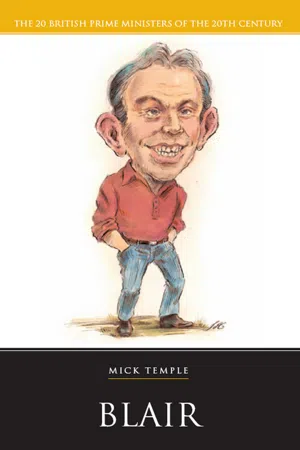
Biography of the last British Prime Minister of the 20th Century.
eBook - ePub
Blair
About this book
Information
Print ISBN
9781904950738
Subtopic
Historical BiographiesPart One
THE LIFE
Chapter 1: Tony Blair’s Childhood
All his biographers have commented upon Tony Blair’s desire for secrecy in both his public and private life. Elements of his family background may be an important contributory factor in this concern. At first glance, Tony Blair appears to have been born into an ordinary middle-class family, one perhaps relatively privileged by the standards of the time, but apparently representing certain solid values of family and religion. His father Leo Blair, a former army officer, had trained as a lawyer and when Tony was born had a post as a law lecturer at Edinburgh University. Leo’s Conservative Party membership further supports the picture of an almost stereotypically conventional middle-class family, albeit one where the father had ambitions to become an MP. Behind this normality, the reality is more exotic.
Tony Blair bears a remarkable physical resemblance to his mother. His emotional closeness to her was considerable; she was the rock of his early life and her strong religious conviction was passed on to him. Perhaps crucially for her son’s development, she did not wholly share her husband Leo’s centre-right views. Hazel Blair is the key to Tony Blair’s core beliefs. She was born Hazel Corscaden in 1923 in Bally-shannon, County Donegal, Ireland, into a devout Protestant family. Her father died when she was just six months old and her mother married a Ballyshannon man, William McLay. The family moved to Glasgow where Hazel’s stepfather became a successful butcher. From what little we know, her home life was happy and stable. She left school at 14; despite possessing a quick intelligence (as well as an occasionally hot temper) her education was limited, not unusual for women then. When war broke out she joined the Navy as a Wren, visiting Australia in the course of duty. The war over, she went to work as a typist at the Ministry of National Insurance in Glasgow where she was eventually to meet Tony’s father.
Leo Blair was born in 1923, the illegitimate son of two touring variety actors. His mother, Celia Ridgeway, was already married, although she was later divorced by her husband for her adultery and married Leo’s father Charles Parsons in 1926. Charles’ stage name was Jimmy Lynton; Leo was later to adopt Charles and Lynton as his own middle names and his two sons were to be christened William James Lynton and Anthony Charles Lynton. Celia and Charles asked Mary and James Blair, who had become friends during shows in Glasgow, if they could look after baby Leo until they were able to give him a greater degree of stability. Information is sketchy about his natural parents’ subsequent contact with their son, although when they later tried to remove the 13-year-old Leo from his foster parents, Mary threatened to commit suicide if he left.1 Leo stayed, and assumed for many years that his natural parents had subsequently lost interest in his life.2 As Anthony Seldon has noted, it is impossible to gauge the precise effect of such emotional turmoil upon Leo, but a sense of abandonment and rejection was to affect him all his life. In fact, they had written many times to him but Mary had first hidden and later burned the cards and letters. She eventually wrote to Celia and Charles telling them he was missing, killed in action, and his parents died never knowing the truth.3
Such a cruel act by an essentially kind and decent woman, who adored Leo and was adored by him in turn, can only be explained by his status in her life. After two miscarriages she had been unable to bear children and Leo was an unexpected blessing. Her husband James, a shipyard rigger (when work was available in the harsh realities of the 1930s Depression) was frequently ill and died young. Leo was the centre of her life and to lose him would have been more than she could bear. She gave him everything, encouraging and supporting him in his wish to better himself. He showed his debt to his foster parents a few months before his marriage to Hazel, when he changed his name by deed poll from Parsons to Blair.
While he was given great love and support, Leo’s upbringing was harsh. Tenement living in Govan bred toughness and left-wing politics were the norm. His foster mother was a staunch Communist and Leo imbibed the language of Marxist-Leninist ideology. He went to work for the party newspaper the Daily Worker when he left school. He was an active Communist Party member and, intelligent and blessed with considerable organisational ability, he began to think seriously about a career in politics. His wartime experiences, as with many other servicemen, were to radically change his politics, but Leo went in the opposite direction ideologically to most of his compatriots. He began the war as a private but in the ‘people’s war’ class barriers were being broken down. He was commissioned and found to his surprise that he enjoyed the company of the officers’ mess. His foster mother had instilled in him a desire for self-improvement and his discovery that men on the other side of the class war were far from the demons he had been told they were weakened his faith in Communism and convinced him that Conservative ideology made a lot of sense. He had no desire to spend his life in a tenement block sharing an outside toilet with other families. Although he voted Labour in 1945, by 1947 he had joined the Conservative Party.
Intelligent and motivated, upon discharge from the army as a second lieutenant he began studying part-time for a law degree at Edinburgh University while working full-time for the Inland Revenue. He met Hazel and they fell in love. Upon qualification he began working at the university as a law lecturer, a considerable indication of his intellectual abilities; he must have made a very favourable impression upon his own tutors. He taught himself to play the piano, singing popular songs well to his own accompaniment, and friends and acquaintances found him charming and amusing company. In 1948 he married Hazel and their wedding picture shows an attractive and personable looking couple. For Jon Sopel, Leo Blair was a ‘walking advertisement for social mobility’.4
Despite some biographers’ assertions of a strong, often authoritarian father, Tony speaks of him with clear affection, while acknowledging that for the first 11 years of Tony’s life his father’s political and business interests made him a relatively remote figure. What veteran Labour parliamentarian Leo Abse described as a ‘house of secrets’ may be at the core of Blair’s personality. Abse’s entertaining (if highly speculative) psychological examination of Blair supports the sense of both father and son as outsiders. Abse alleges that the spectre of Celia, whom he calls judgementally Tony Blair’s ‘promiscuous grandmother’, hung over Leo Blair and the family. Amazingly, Blair told his early biographer Jon Sopel that he was unaware of the origins of his Christian names and had been surprised when Sopel informed him.5 As Tony Blair has remarked, his father’s parentage was something that was not a topic of conversation. Abse argues the reason neither he nor his brother asked was because they knew it was a question they must never ask; ‘secret, forbidden territory’.6
Arguably, secrecy, even down to his essential beliefs, has been a characteristic of Blair’s life. As one of his schoolteachers was later to note, ‘you
couldn’t call him reserved, but you never saw his real self. He didn’t like to expose himself in case someone spotted a weakness [and] he has always been conscious of how he appears to other people.7 It is entirely possible that this sense of secrecy relates back to the shame Leo Blair felt about his parentage. In the days before the sexual revolution of the 1960s, illegitimacy brought with it real social stigma.
‘He [Blair] didn’t like to expose himself in case someone spotted a weakness [and] he has always been conscious of how he appears to other people.’
DAVID REYNOLDS
William Blair was born in Edinburgh in 1950, and Anthony Charles Lynton Blair followed three years later on 6 May 1953. The coronation less than a month later of the young Queen may have been heralded with cries of a new Elizabethan age but Britain in the 1950s was a grey, conformist world where compulsory national service still existed and memories of wartime dominated. The certainties of Empire and British superiority had yet to be questioned. In late 1954, the Blair family sailed for Australia, where Leo had obtained a post as a lecturer in administrative law at the University of Adelaide. Leo and Hazel’s third child, Sarah, was born in Australia in 1956, completing the family. Although they were there for just three years, some maintain you can still hear a tinge of Antipodean in Blair’s vowels.
The family enjoyed their time in Adelaide, living in a pleasant house in the eastern suburb of Dulwich. Both Leo and Hazel had known real hardship in their childhood and the welcoming atmosphere of Australia was refreshing after the constraints of British society. Blair told Anthony Seldon that Australia – with its can-do attitude, laid-back approach to social niceties and relative lack of class-consciousness – affected him deeply and its people and culture were to be a ‘profound influence’ on him throughout his life. Given that he was four when he left and can have few if any memories of his time there, it’s difficult to see how the country could have had such a lasting influence. However, coming from the openness and brightness of Australia to a cold, dark British winter cannot have been too pleasant for any of the family.
Returning to Britain in early 1958, the family settled in the university city of Durham. When they left Britain, postwar austerity had still bitten hard, but the country was now experiencing the fruits of an economic boom. Leo lectured at the university but his ambitions for himself and his children required a more affluent lifestyle and practising law, rather than merely teaching it, would provide this. Leo was called to the Bar and set up his own law practice in Newcastle upon Tyne. The practice prospered and his ambitions to become a Conservative MP were reignited. He became Chairman of Durham’s Conservative Association and his hopes of a winnable parliamentary seat were nearing fulfilment. The family moved from the centre of Durham, close to the university, into a new four-bedroom house on the edge of the city. They were a two-car family in an age when one car was a luxury. Most years, they holidayed in Ireland, close to Hazel’s birthplace. The family was upwardly-mobile, popular with their neighbours, and seemed to be an exemplar of Harold Macmillan’s boast that Britons ‘had never had it so good’. Clearly, Leo Blair was a man to watch; charming, talented, hard-working and politically ambitious. There appeared no limit to his prospects.
Bill was entered into the renowned Durham Chorister School, while Tony went to Western Hill, a private ‘pre-preparatory school’ for the children of the affluent middle classes. Three years later he joined his elder brother as a dayboy. Both boys were very happy at Choristers; Tony, as the younger of two brothers at the same school, was known as ‘Blair Two’. Neither brother was a chorister, but otherwise both took a full part in school life. Tony played rugby and cricket for the school teams, was a keen athlete, acted in a number of school productions (although only in minor parts) and was a leading participant in school debates. According to his headmaster he was the sort of boy who was ‘the backbone’ of the school.8 He was popular with both his fellow pupils and with the staff. A recurring theme throughout Tony’s life and a considerable part of his early political appeal is his ability to charm women. The school matron, Rita Jakes, quickly became an ‘ally and confidante’9 and her support at school was to be invaluable during the first major crisis of his young life.
In July 1964 the family’s life was changed forever and Leo’s political ambitions permanently ended. In the early hours of 4 July, American Independence Day, Leo had a severe stroke. He was 40. Tony was woken early next morning by his mother and knew immediately that something serious had happened. Despite the tragedy, Tony was sent to his normal Saturday morning school session and, that afternoon, Hazel came from the hospital to watch him play rugby for the school. She told him his father was ‘probably going to live’.10 Leo had come very close to death and his recovery was slow. For the next three years he struggled to regain his speech, helped patiently by Hazel. His university salary continued and he gradually returned to teaching duties, but his law income was severely cut. Their social position suffered and one of the cars had to be sold. More importantly, shortly afterwards young Sarah was in hospital for two years with a form of childhood rheumatoid arthritis. Hazel’s devotion and commitment to her family was crucial, and guided Tony through what must have been a traumatic experience. Although Leo was often away on both legal and party business (he was a popular guest speaker with Conservative Associations) and may have been a more distant figure than many modern fathers, his influence on the family was considerable and Tony Blair’s fondness and respect for his father remains apparent.
Outwardly, Tony continued to present the same smiling and likeable persona to his schoolmates and teachers. Undoubtedly, the closeness and warmth of his family – Bill returned for the summer holidays from Fettes College and his solid good sense was invaluable – combined with the pastoral care of the staff at Choristers, helped him. Hazel’s stepfather’s contribution to the boys’ school fees was also important in maintaining family spirits; the fall in the family’s income would not be allowed to affect Bill and Tony’s schooling and dent their future chances of success.
Tony’s apparent lack of emotional response to his father’s illness has been hinted at by biographers as something unnatural, but children, especially those with the support of a strong and loving family, are generally tougher than they are given credit for. It’s also probable that the sense of privacy which has seemed to his biographers a feature of both Tony Blair’s public and private life, perhaps instilled by Leo’s anxieties about his own illegitimate background, was important. Keeping it in the family meant that Tony kept such emotions for his mother’s eyes. He later admitted that he became emotionally aware for the first time that nothing is permanent; it was the day my childhood ended.11 But whatever the shock of his father’s sudden illness, Tony Blair clearly regards his early childhood in Durham and his time at Choristers School as happy. This childhood happiness was to be challenged by his move away from home to boarding school.
In 1966, Tony entered Fettes College in Edinburgh, ‘Scotland’s Eton’ as it liked to be known. A rather forbidding set of buildings and a new set of arcane rituals would have been daunting to any boy, but unlike many new boys Tony’s prep school experiences had been as a dayboy at a school where pastoral care was an important ingredient. His mother’s daily affection had been crucial in the difficult years following Leo’s stroke. He was relatively unprepared for dormitories, dodgy institutional food and pupil-administered discipline. Tony also had a lot to live up to at Fettes. His brother Bill had already been there for three years and was enormously popular and academically successful, eventually gaining a prestigious scholarship to Balliol College, Oxford. Tony was put into Bill’s house and as he had won a scholarsh...
Table of contents
- Cover Page
- Title Page
- Copyright
- Contents
- Introduction
- Part One: The Life
- Part Two: The Leadership
- Part Three: The Legacy
- Notes
- Chronology
- Further Reading
- Picture Sources
- Index
Trusted by 375,005 students
Access to over 1.5 million titles for a fair monthly price.
Study more efficiently using our study tools.
Frequently asked questions
Yes, you can cancel anytime from the Subscription tab in your account settings on the Perlego website. Your subscription will stay active until the end of your current billing period. Learn how to cancel your subscription
No, books cannot be downloaded as external files, such as PDFs, for use outside of Perlego. However, you can download books within the Perlego app for offline reading on mobile or tablet. Learn how to download books offline
Perlego offers two plans: Essential and Complete
- Essential is ideal for learners and professionals who enjoy exploring a wide range of subjects. Access the Essential Library with 800,000+ trusted titles and best-sellers across business, personal growth, and the humanities. Includes unlimited reading time and Standard Read Aloud voice.
- Complete: Perfect for advanced learners and researchers needing full, unrestricted access. Unlock 1.5M+ books across hundreds of subjects, including academic and specialized titles. The Complete Plan also includes advanced features like Premium Read Aloud and Research Assistant.
We are an online textbook subscription service, where you can get access to an entire online library for less than the price of a single book per month. With over 1.5 million books across 990+ topics, we’ve got you covered! Learn about our mission
Look out for the read-aloud symbol on your next book to see if you can listen to it. The read-aloud tool reads text aloud for you, highlighting the text as it is being read. You can pause it, speed it up and slow it down. Learn more about Read Aloud
Yes! You can use the Perlego app on both iOS and Android devices to read anytime, anywhere — even offline. Perfect for commutes or when you’re on the go.
Please note we cannot support devices running on iOS 13 and Android 7 or earlier. Learn more about using the app
Please note we cannot support devices running on iOS 13 and Android 7 or earlier. Learn more about using the app
Yes, you can access Blair by Mick Temple in PDF and/or ePUB format. We have over 1.5 million books available in our catalogue for you to explore.