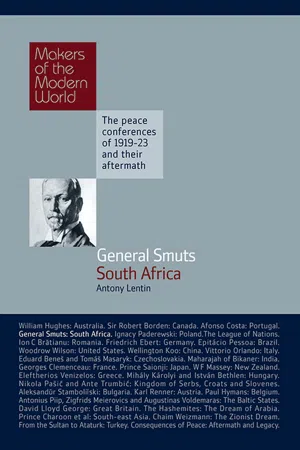
Jan Smuts was one of the key figures behind the creation of the League of Nations; Wilson was inspired by his ideas, including the mandates scheme. He pleaded for a magnanimous peace, warning that the treaty of Versailles would lead to another war.
- English
- ePUB (mobile friendly)
- Available on iOS & Android
eBook - ePub
About this book
Information
Topic
HistoireSubtopic
Biographies politiquesI
The Life and the Land
1
Smuts – Scholar, Statesman, Soldier: 1870–1914
South Africa first impinged on European history in 1488, when the Portuguese explorer Bartholomew Diaz rounded what was later named the Cape of Good Hope. European settlement dates from 1652, when the Dutchman Jan Van Riebeeck established a victualling station there for the Dutch East India Company. The 17th and 18th centuries saw the gradual expansion of this Dutch possession until the start of Britain’s wars with Revolutionary and Napoleonic France, when Britain seized Cape Town as a staging post on the route to India. After briefly ceding the Cape Colony to Holland (then the Batavian Republic, a French satellite) under the Peace of Amiens in 1803, Britain annexed it in 1806 when Napoleon annexed Holland to the French Empire.
The Boers (the word means ‘farmers’) were mainly of Dutch Calvinist descent, who intermarried with French Huguenots and Germans. Many of them disliked British rule, not least because of Britain’s abolition of slavery throughout the Empire in 1833. Not for another two centuries would these Calvinists concede equality in any sense to the black men who served them as hewers of wood and drawers of water, and there was resentment among the Boers at British pressure on their outlook and way of life. In 1836 there began the Great Trek, when Boers from the frontiers of the Cape Colony struck out north and east with their ox-wagons and their cattle in search of freedom from British rule. Anticipating their penetration to the Indian Ocean, Britain annexed Natal in 1843. The Boer pioneers, the Voortrekkers, established their independence beyond the Rivers Vaal and Orange, driving the native peoples from their land in what eventually became the Boer Republics of the Transvaal and Transoranje (later the Orange Free State). From the first, the Boer Republics were land-locked, hemmed into the interior by piecemeal British annexation of adjacent territories. They were also inward-looking and exclusive. The Transvaal Constitution laid down that there should be ‘no equality between coloured people and the white inhabitants, either in Church or State’.1
Antagonism between the British and Boers intensified with the discovery of diamonds on the Orange River in 1867. Findings of still richer deposits three years later at Kimberley in Griqualand West on the border of the two Boer Republics led to Britain’s annexation of that territory in 1877. An attempt to seize the Transvaal itself ended disastrously for Britain in the First Boer War (1880–1881), when Boer guerrillas wiped out a British force at Majuba Hill. When gold was also discovered in the Transvaal on the Witwatersrand around Johannesburg in 1883, an influx of prospectors and adventurers began. The economy of South Africa was transformed, the Transvaal producing one-third of the world’s annual gold supply and more than half its diamonds. Among the magnates with a commanding interest in both commodities was Cecil Rhodes, founder of the De Beers Diamond Company and the Consolidated Goldfields of South Africa. As non-Boer immigrants, known as Uitlanders (foreigners), mainly British, many from Cape Colony and Natal, continued to pour into the Transvaal in their thousands, the Boers felt their devout, pastoral and patriarchal way of life to be under threat. ‘They have grown fat on my land,’ complained the President of the Transvaal, the dour and autocratic Paul Kruger, who had come north with the Voortrekkers as a boy of 10. ‘They are richer than our own people.’2 What more, he asked indignantly, did the Uitlanders want? What they wanted, as the main taxpayers in the Transvaal, was political representation; but Kruger doggedly tightened existing restrictions on the franchise and told them to leave if they did not like it. Meanwhile Britain was entering a more aggressive phase of expansionist imperialism and the cause of the Uitlanders offered a ready-made excuse for intervention.
The first Smuts came to Cape Town from Holland as a settler in 1692. His descendant, Jan Christian Smuts, was born a British subject on 24 May 1870 in his father’s modest farmhouse at Bovenplaats, near the Boer hamlet of Riebeeck West in the rich, wheat-growing Malmesbury district to the west of the Cape Colony, 45 miles from Cape Town. The Smuts’s had farmed here for four generations. Jan’s father, Jacobus Abraham Smuts, was a pillar of the Dutch Reformed Church and an inconspicuous member of the Colonial Parliament at Cape Town. His eldest son, Michiel, was intended for the ministry, and it was customary for the younger son not to be sent to school; so Jan, who, it was planned, would one day take over the farm, was brought up by his mother. His childhood was simple and frugal. Until he was 12, he tended the sheep and cattle on the farm. Here, amid meadows, veld and mountains, in the shadow of the Kasteel mountain and the Great Winterhoek range beyond, he developed a passion for nature,3 a Wordsworthian sense of intimate communion with the natural world. Those hills of my beginnings always have a great effect on me,4 he wrote.
On Michiel’s sudden death from typhoid, it was decided that Jan should take his place and be educated with a view to entering the church. So at the age of 12 he first attended the village school at Riebeeck West. Afrikaans was his mother tongue. At school he heard English virtually for the first time. He immediately revealed a passion, wholly unexpected, for learning, and matching powers of absorption. He took the higher school examination within four years instead of the usual 11 and entered Victoria College (later Stellenbosch University) in 1886 at the age of 16.
Smuts always spoke with the distinctive Malmesbury burr, a guttural pronunciation of the letter ‘r’. The accent, typical of the Western Cape, while not harsh, sounds to some more German than the accent of the northern Afrikaner. To one Englishman his accent was ‘rather like that of a Welshman’.5 Settling down to his studies at Stellenbosch, Smuts found that he was required to take Greek. During the holidays he locked himself in his room and, with tremendous application and endowed with a photographic memory, mastered a Greek grammar and a book of Attic prose in a week and came top in the Greek matriculation examination. He also became proficient in Netherlands Dutch and German. But he was always at his best in English.
In his years at Stellenbosch, Smuts, 5 feet 10 inches tall, fair-skinned and blond, was of slender build, a ‘pallid, slight, delicate-looking man’,6 reserved, fastidious, serious-minded and solitary, a devotee of the library who shunned the sports field, a regular attender at the Dutch Reformed Church, an occasional Sunday-school teacher7 and, as he admitted, something of a prig. He held himself aloof from his fellow students, with one exception: the pretty and highly gifted Sybella Krige – known as Isie – whom he fell in love with at the age of 17 and would marry 10 years later. The two found companionship in books, poetry (especially Goethe and Shelley) and music. They sang German Lieder together with Isie at the piano. Isie was more outgoing than Jan and it was she, he wrote, who recalled me from my intellectual isolation and made me return to my fellows.8
In 1891, Smuts gained a double first in the joint literature and science degree at Stellenbosch. He won a scholarship to read law at Cambridge, and made the first of many journeys to England, suffering, as he always did, agonies of seasickness. At Cambridge, he was elected a Scholar of Christ’s College, but money was short and he led an austere life, hardworking and lonely. A rare friend was a reclusive middle-aged don named John Wolstenholme. Some fellow students from South Africa once took him to London to see the Boat Race, but he gave them the slip and spent the day in the library of the Middle Temple. Smuts read widely, deeply and retentively, as he was to do all his life, in classical, biblical and modern literature, science and philosophy. At Cambridge, he wrote, I read much, walked much and thought much, and when I left the University I had probably drunk as deeply of the well of knowledge as most.9 He proved to be one of Cambridge’s most outstanding law students. His tutor, the great legal scholar Frederick Maitland, considered him the best he ever taught. He sat both parts of the Law Tripos simultaneously, an achievement without precedent, headed the list of candidates with a double first and won prizes in jurisprudence and Roman law. He was also developing, independently, the holistic philosophy which he was later to make his own; and while still an undergraduate he wrote a book, unpublished in his lifetime, entitled Walt Whitman: A Study in the Evolution of Personality,10 which contained the germ of holism. Whitman’s poetry liberated him from an outlook that had been, he said, severely puritanical.11
In 1894 he paid a brief visit to Strasbourg, then in Germany, to study literature and philosophy. Returning to England, he read for the Bar as a student of the Middle Temple, and after call practiced briefly as a barrister. Turning down a law fellowship at Christ’s – Maitland said he had the makings of a great scholar of Roman law – he returned to South Africa in 1895 to set up in practice at Cape Town. He failed initially to make his mark in the law, but threw himself into politics and supported himself with journalism. He joined the Afrikaner Bond Party of Jan Hendrik Hofmeyr, which, while representing Boer interests, shared the aspirations of the Cape Dutch and Cape English for a common South African nationhood, a cause also championed by the Prime Minister of the Cape Colony, Cecil Rhodes.
THE JAMESON RAID
The Transvaalers, a small, devout and pastoral people, found their way of life and independence threatened by the influx of prospectors, mainly British expatriates, known as Uitlanders (foreigners). 30,000 Boer voters lived in the Transvaal with 60,000 Uitlanders, whose enfranchisement was tightly restricted. The Uitlanders’ grievances were exploited with a view to overthrowing the government of President Kruger by a raid on Johannesburg and a local uprising of Uitlanders in December 1895. The raid was planned by Cecil Rhodes, Prime Minister of the Cape Colony, and mounted by Leander Starr Jameson (himself later also Prime Minister of the Cape Colony). The raid brought Anglo-Boer relations to a dangerous low. The Transvaal, enriched by the revenues from the goldmines, began importing arms, concluded an alliance with the Orange Free State in 1897 and intrigued for Germany’s support, while the British Colonial Secretary, Joseph Chamberlain, welcomed the escalation of tension as an opportunity to annex the Boer Republics. Smuts wrote later that the Jameson raid was the real declaration of war13 leading to the Second Boer War, 1899–1902.
The Transvaalers, a small, devout and pastoral people, found their way of life and independence threatened by the influx of prospectors, mainly British expatriates, known as Uitlanders (foreigners). 30,000 Boer voters lived in the Transvaal with 60,000 Uitlanders, whose enfranchisement was tightly restricted. The Uitlanders’ grievances were exploited with a view to overthrowing the government of President Kruger by a raid on Johannesburg and a local uprising of Uitlanders in December 1895. The raid was planned by Cecil Rhodes, Prime Minister of the Cape Colony, and mounted by Leander Starr Jameson (himself later also Prime Minister of the Cape Colony). The raid brought Anglo-Boer relations to a dangerous low. The Transvaal, enriched by the revenues from the goldmines, began importing arms, concluded an alliance with the Orange Free State in 1897 and intrigued for Germany’s support, while the British Colonial Secretary, Joseph Chamberlain, welcomed the escalation of tension as an opportunity to annex the Boer Republics. Smuts wrote later that the Jameson raid was the real declaration of war13 leading to the Second Boer War, 1899–1902.
Smuts was an enthusiastic supporter of Rhodes. He believed fervently in a partnership between the two Teutonic peoples, Dutch-speaking and English-speaking, together comprising some half-million whites at the southern corner of a vast continent peopled, as he put it, by over 100 million barbarians.12 This view of the majority population, though tempered by a paternalistic and kindly attitude to individual blacks, remained his lifelong conviction. Rhodes was a Promethean figure, carried away by his imperialist vision of British rule from Cape Town to Cairo, and his reckless impatience brought disaster. His involvement in the Jameson Raid into the Transvaal in December 1895, that fatal and perfidious venture,14 revealed to Smuts that his trust in Rhodes, now discredited and ousted from the Premiership, had been misplaced; and that Rhodes’s ambition, in which the British Colonial Secretary, Joseph Chamberlain, was also implicated, was for nothing less than a British takeover of the Boer Republics.
In 1896, deceived in Rhodes and utterly disenchanted, Smuts left the Cape Colony for the Transvaal, renouncing his British citizenship to throw in his lot with his own people. Setting up as a lawyer in Johannesburg, he married his sweetheart, Isie Krige, in 1897. Twins were born to them prematurely in 1898 but died shortly after. Smuts’s legal expertise attracted the attention of the 74-year-old Kruger, who in 1898 appointed him, aged only 28, as Staats Procureur or State Attorney, responsible for law and order in the Transvaal and legal adviser to the government. When Kruger summarily dismissed his Chief Justice, an action widely denounced as unconstitutional, Smuts took the opposite view and forcefully defended Kruger’s action. A deep mutual regard sprang up between these two very different men. Their relations, Smuts recalled, were like those of father and son.15 Smuts, for all his Cambridge learning, admired Kruger’s rugged integrity, while Kruger perceived in the bright young lawyer an ‘iron will’16 and predicted he would play a great part in the history of South Africa. Smuts now moved to the capital, Pretoria, and soon had a leading voice in the counsels of the Transvaal as it faced growing tension with the Uitlanders.
He strove conscientiously to address the Uitlanders’ legitimate grievances while defending the sovereignty of the Republic from British pressure. He urged franchise reform on Kruger and believed he had come close to agreement with Joseph Chamberlain. God alone knows, he wrote, how deeply I wished, how hard I worked that peace might be maintained.17 Kruger, however, was convinced, and rightly so, that the cause of the Uitlanders was a pretext for annexation. At a final meeting with the British at Bloemfontein in August 1899 to see whether compromise was possible, Smuts accompanied Kruger as his adviser. ‘It’s our country that you want,’18 Kruger told Sir Alfred Milner, Governor-General of the Cape and High Commissioner for South Africa. Milner, like Rhodes an ardent imperialist, who treated Smuts with marked hostility, was indeed bent on forcing the issue in Britain’s favour. In October Kruger sought to pre-empt Milner while British troops in South Africa were still few. He issued an ultimatum, drafted by Smuts, demanding their withdrawal. This led immediately to the Second Boer War, known to the Boers as the Second War of Liberation.
The Second Boer War
Having done his utmost to avoid war, Smuts was now totally committed to defending the independence of his adoptive country. In all but name he was First Minister of the Transvaal and, though without military experience, he showed a remarkable grasp both of strategy and of the need to husband and deploy the resources at his disposal. He wrote an impassioned Afrikaner manifesto, A Century of Wrong, in which he called on Boers from across South Afric...
Table of contents
- General Smuts: South Africa
- Contents
- Preface and Acknowledgements
- Prelude: ‘I have fought and worked for a different peace’
- Part I: The Life and the Land
- 1. Smuts – Scholar, Statesman, Soldier: 1870–1914
- 2. War and Peace: 1914–18
- Part II: The Paris Peace Conference
- 3. Peacemaking: November 1918–February 1919
- 4. The Fight for Revision (i): March–April 1919
- 5. The Fight for Revision (ii): May 1919
- 6. ‘Wilson Peace’ or ‘Scrap of Paper’? 29 May–2 June 1919
- 7. ‘The Last Battle of the War’: June 1919
- Part III: The Legacy
- 8. ‘A Carthaginian Peace’? 1919–1939
- 9. Smuts and the Second World War: 1939–45
- 10. ‘Superhuman Courage’: Smuts 1945–50
- Conclusion
- Notes
- Chronology
- Further Reading
- Picture Sources
Trusted by 375,005 students
Access to over 1.5 million titles for a fair monthly price.
Study more efficiently using our study tools.
Frequently asked questions
Yes, you can cancel anytime from the Subscription tab in your account settings on the Perlego website. Your subscription will stay active until the end of your current billing period. Learn how to cancel your subscription
No, books cannot be downloaded as external files, such as PDFs, for use outside of Perlego. However, you can download books within the Perlego app for offline reading on mobile or tablet. Learn how to download books offline
Perlego offers two plans: Essential and Complete
- Essential is ideal for learners and professionals who enjoy exploring a wide range of subjects. Access the Essential Library with 800,000+ trusted titles and best-sellers across business, personal growth, and the humanities. Includes unlimited reading time and Standard Read Aloud voice.
- Complete: Perfect for advanced learners and researchers needing full, unrestricted access. Unlock 1.5M+ books across hundreds of subjects, including academic and specialized titles. The Complete Plan also includes advanced features like Premium Read Aloud and Research Assistant.
We are an online textbook subscription service, where you can get access to an entire online library for less than the price of a single book per month. With over 1.5 million books across 990+ topics, we’ve got you covered! Learn about our mission
Look out for the read-aloud symbol on your next book to see if you can listen to it. The read-aloud tool reads text aloud for you, highlighting the text as it is being read. You can pause it, speed it up and slow it down. Learn more about Read Aloud
Yes! You can use the Perlego app on both iOS and Android devices to read anytime, anywhere — even offline. Perfect for commutes or when you’re on the go.
Please note we cannot support devices running on iOS 13 and Android 7 or earlier. Learn more about using the app
Please note we cannot support devices running on iOS 13 and Android 7 or earlier. Learn more about using the app
Yes, you can access General Smuts by Antony Lentin in PDF and/or ePUB format, as well as other popular books in Histoire & Biographies politiques. We have over 1.5 million books available in our catalogue for you to explore.