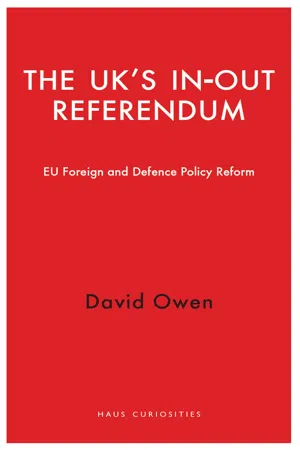
As David Owen notes in The UK's In-Out Referendum, the European Union's attempts at conflict resolution have left much to be desired. In the Ukraine, Baltic States, Turkey, and much of the Middle East, a lack of coherent policy has dominated. This book argues that the negotiations around the United Kingdom's referendum vote represent an opportunity to enact wide-scale reform, not least to ensure that the nations of an increasingly politically integrated Eurozone do not come to dominate the foreign and security policy of the European Union in the years to come. To allow them to do so, Owen argues, would almost certainly see the policy of "common defense" advance at the expense of alasting US commitment to NATO. Ultimately, Owen contends, Britain's continued membership of a largely unreformed European Union would have serious implications for the United Kingdom's security, and that foreign policy and security belong at the heart of the reforms the European Union so desperately needs.
- English
- ePUB (mobile friendly)
- Available on iOS & Android
eBook - ePub
About this book
Information
The UK’s In-Out Referendum
There is a grave danger that the European Union will go on pretending, despite the UK negotiation, that it can avoid or delay making the structural changes that it urgently needs to convince the people in its Member States that it can overcome the formidable problems it now faces. Six years on, the Eurozone is still in the midst of an economic crisis. Greece’s problems are not resolved. The French and Italian economies are still not confronting their need for radical change and there are serious weaknesses in other Eurozone economies. Geopolitically, the EU’s pursuit of conflict resolution leaves much to be desired. The EU policy over its Association Agreement with the Ukraine triggered the conflict in that country and there are now serious related military tensions developing on the Russian Federation’s borders with the three Baltic states, Estonia, Latvia and Lithuania, to which NATO is responding. There is trouble brewing in Bosnia-Herzegovina where the behaviour of the Bosnian Serbs shows few signs of being checked by Serbia. Public tolerance is stretched by uncontrolled economic migration into the EU from Syria and other countries, like Eritrea and even Afghanistan. The so-called Islamic State is now occupying Iraq and Syria, has attacked Beirut in Lebanon and a Russian plane over Egypt, and operates from Darnah in Libya. The EU has yet to agree a coherent policy towards Turkey. Its policy of ‘common defence’ within the European Common Security and Defence Policy1, CSDP, risks deeply damaging competition with NATO planning and its cohesion.
This booklet is about how the foreign and defence policies of the EU and the geopolitical problems of the wider Europe are inextricably linked to the negotiations prior to the UK voting on whether to remain in or leave the EU. That vote will have to take place by the end of 2017, though it looks as if the government will try and rush it through in the summer of 2016. If the EU dismisses this period of negotiation as one of little significance to them and as a matter just for the British, it will sleepwalk into a catastrophe. The outcome will have profound economic and geopolitical consequences, not just for those parts covered by the EU and NATO, but for the whole of wider Europe (see diagram below).

When an ever more integrated Eurozone emerges and starts to vote en bloc within the EU, it will be vital for a Non-Eurozone qualified majority to have been established and to be able to prevent Eurozone domination in not just the Single Market but in all aspects of the EU, particularly foreign and security policy. The extent to which the Eurozone moves to give more authority to voting in the Eurozone bodies and the European Parliament depends on how ready Eurozone Member States are to mirror the democratic procedures of a single country, give up unanimity, rely more on a simple majority or increase the number of Member States needed to form a blocking minority – all steps towards a United States of Europe. If the Eurozone deals with its democratic deficit through democratic enhancement, then it is essential to establish the right for a Non-Eurozone Member State to block or opt-out of changes to the architecture of not just the Single Market but also EU foreign and defence policies and, if need be, revert to the consensus of European Community Political Cooperation for foreign and security policies.
Amending the treaties’ language is being refused in advance of France and Germany holding their elections in 2017. But since the Maastricht Treaty was written assuming that all EU countries would inexorably join the Eurozone, which they are clearly not doing, why can’t this change be made by unanimity in the European Council? That mechanism was part of the Lisbon Treaty. The cardinal sin of the EU was in abandoning the supranational and the intergovernmental pillared structure that was part of the Maastricht Treaty compromise. Eurozone integration will not establish a consensus decision-making body but one where the majority gets its way; inevitably this will overflow into foreign and defence decision-making unless new powers to check this are built into the treaties.
Ever greater political integration is the fundamental issue behind and within the UK demand for a major renegotiation and a referendum. It is why the government has singled out the wording ‘ever closer union’. Though it applies to the peoples and not to the nations in the treaties, a formulation accepted even by Margaret Thatcher, it has come through persistent application of what is called the Community Method to mean nations. It was these words ‘ever closer union’ that David Cameron strongly objected to and was the reason for his party withdrawing from the Christian Democratic grouping in the European Parliament, deeply resented by Angela Merkel. To change that interpretation requires more than a statement – it needs treaty change too. Not surprisingly, those who have already started today to campaign for the UK to remain in the EU are often people who have supported Eurozone membership for the UK on every past occasion it has been open to debate. Many of them still passionately wish to maintain the option of Eurozone membership for the future. Many also resisted the European Act 2011 that triggers a referendum in the UK before any further loss of British sovereignty can be conceded by ministers. This Act was William Hague’s achievement when Foreign Secretary, along with EU recognition that foreign policy decisions have to also be described as Member States’ decisions to be legally approved. But the Act alone is not enough. We cannot have referenda on every issue and yet ever greater unity is built up on the basis of many small decisions not least by the European Court of Justice (ECJ).
US politicians and officials should be much franker when commenting on whether the UK should remain in or leave the EU. It took centuries to develop a single currency across the USA and that country, moreover, had from its foundation chosen to have a single language. We are dealing with very sensitive issues of national identity and human instinct in the EU the more it develops. It should surprise no one, given public resistance to ever closer union in many countries, that we have already adopted a union of different speeds; there are manifest signs that the pace of integration chosen by the Commission in Brussels is all too frequently either too fast or wrongly designed for people in some Member States. The test for European political leaders now is: how sensitive can they become to the realities of the need for treaty amendment? On this there are few grounds for optimism; too often the European institutions are resistant to treaty change. Restructuring is not about a two-speed Europe, but a Europe of many different speeds reinforced by treaty change with which the ECJ have to reckon.
The newly appointed chief economist to the IMF, Maurice Obstfeld, previously an adviser to President Obama, has been outspoken on the ‘trilemma’ the Eurozone faces, namely that it cannot pursue cross-border financial integration and maintain stability while protecting national fiscal independence. He is very clear: ‘Parallel moves towards political union are an essential complement in ensuring that national electorates accept the legitimacy of decisions made in the common interest.’ The problem in the EU now is that more and more national electorates are increasingly not accepting that transferring money from their country to another is in the common good on such a wide scale as envisaged by some in the Eurozone. The resistance over transferring to Greece did not just come up against public opinion in Germany; it was a vocal issue in Finland, Lithuania and Slovenia as well as the Netherlands and Belgium.
A restructured European Single Market is not a massive task. The EU’s variable geometry has been evolving ever since the Maastricht Treaty negotiations on the euro ended in December 1990. As I argue in the ebook version of Europe Restructured. The Eurozone Crisis and the UK Referendum2, restructuring the EU necessitates two distinct elements: a Eurozone grouping and a Non-Eurozone grouping, both together within the Single Market of the existing European Economic Area (EEA) which comprises all EU Member States plus Norway, Iceland and Liechtenstein. These three countries at present are not full voting members, but this should change along with all new members being given full voting rights under qualified majority voting (QMV).
A wider Europe membership of the EEA should also be offered, starting with invitations to Switzerland and Turkey, the latter already an associate EU member. It would involve all the advantages and obligations of full EEA membership except that such countries would not be automatically offered the freedom of movement within the EU of people and labour. This is not a necessity for the effective working of a Single Market, but it is essential for membership of a more integrated Eurozone. EU countries like the UK th...
Table of contents
- The UK’s In-Out Referendum
- EU Foreign and Defence Policy Reform
- Notes
Trusted by 375,005 students
Access to over 1.5 million titles for a fair monthly price.
Study more efficiently using our study tools.
Frequently asked questions
Yes, you can cancel anytime from the Subscription tab in your account settings on the Perlego website. Your subscription will stay active until the end of your current billing period. Learn how to cancel your subscription
No, books cannot be downloaded as external files, such as PDFs, for use outside of Perlego. However, you can download books within the Perlego app for offline reading on mobile or tablet. Learn how to download books offline
Perlego offers two plans: Essential and Complete
- Essential is ideal for learners and professionals who enjoy exploring a wide range of subjects. Access the Essential Library with 800,000+ trusted titles and best-sellers across business, personal growth, and the humanities. Includes unlimited reading time and Standard Read Aloud voice.
- Complete: Perfect for advanced learners and researchers needing full, unrestricted access. Unlock 1.5M+ books across hundreds of subjects, including academic and specialized titles. The Complete Plan also includes advanced features like Premium Read Aloud and Research Assistant.
We are an online textbook subscription service, where you can get access to an entire online library for less than the price of a single book per month. With over 1.5 million books across 990+ topics, we’ve got you covered! Learn about our mission
Look out for the read-aloud symbol on your next book to see if you can listen to it. The read-aloud tool reads text aloud for you, highlighting the text as it is being read. You can pause it, speed it up and slow it down. Learn more about Read Aloud
Yes! You can use the Perlego app on both iOS and Android devices to read anytime, anywhere — even offline. Perfect for commutes or when you’re on the go.
Please note we cannot support devices running on iOS 13 and Android 7 or earlier. Learn more about using the app
Please note we cannot support devices running on iOS 13 and Android 7 or earlier. Learn more about using the app
Yes, you can access The UK's In-Out Referendum by David Owen in PDF and/or ePUB format, as well as other popular books in Politics & International Relations & Politics. We have over 1.5 million books available in our catalogue for you to explore.