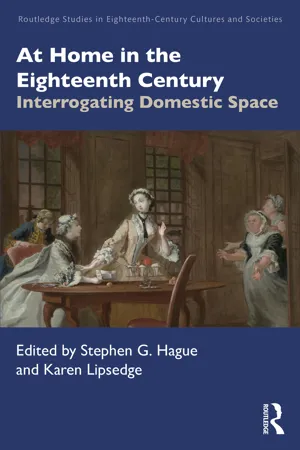
The eighteenth-century home, in terms of its structure, design, function, and furnishing, was a site of transformation – of spaces, identities, and practices. Home has myriad meanings, and although the eighteenth century in the common imagination is often associated with taking tea on polished mahogany tables, a far wider world of experience remains to be introduced. At Home in the Eighteenth Century brings together factual and fictive texts and spaces to explore aspects of the typical Georgian home that we think we know from Jane Austen novels and extant country houses while also engaging with uncharacteristic and underappreciated aspects of the home. At the core of the volume is the claim that exploring eighteenth-century domesticity from a range of disciplinary vantage points can yield original and interesting questions, as well as reveal new answers. Contributions from the fields of literature, history, archaeology, art history, heritage studies, and material culture brings the home more sharply into focus. In this way At Home in the Eighteenth Century reveals a more nuanced and fluid concept of the eighteenth-century home and becomes a steppingstone to greater understanding of domestic space for undergraduate level and beyond.
eBook - ePub
At Home in the Eighteenth Century
Interrogating Domestic Space
- 360 pages
- English
- ePUB (mobile friendly)
- Available on iOS & Android
eBook - ePub
At Home in the Eighteenth Century
Interrogating Domestic Space
Part I
The Organization and Arrangement of Space
1 Staging Fictions for Domestic Privacy in Early Eighteenth-century London Households
DOI: 10.4324/9780429297267-1
On 17 April 1706 a woman named Rebecca Lowther, who described herself as the wife of Robert Lowther, a coffee man and draper, offered oral testimony before the Recorder of the London Court of Arches. In her deposition, Lowther explained that nine years previously, late in 1697, a man named Lewis Anthony de Morais arrived on the doorstep of the Lowthers’ rented house in Shoreditch. This east-end London suburb was home to theater – Shakespeare's early plays a century beforehand saw their first performances in this district salted with “base tenements and houses of unlawful and disorderly resort” and known also for its “poor cottages, and habitations of beggars and people without trade, stables, inns, alehouses, taverns, garden-houses converted to dwellings, ordinaries, dicing houses, bowling alleys, and brothel houses.”1 Morais sought short-term lodging here “for a country gentlewoman and her child,” and he asked Rebecca Lowther whether she would take said woman in. Morais’ inquiry proved fruitful. In the language of the deposition text, Lowther consented to the same and, soon after, Phebe Harrison alias Morais came to lodge and board at the Lowthers’ habitation, “and a child of about a month or five weeks old, which she declared was her child, was brought to board and lodge with her, and Phebe nursed her child and lodged and boarded at the deponent's husband's house about or upwards of a year to the deponent's best remembrance of time, during which time Mr. Morais visited Phebe there several times but how often remembers not, and Mr. Morais paid for Phebe's lodging and boarding there.”2 This deposition references a single mother in London, a servant, who in the decade from 1694 to 1706 materially created a fictive picture of her life in order to secure lodgings in the metropolis for herself and her child. Consideration of materiality entails looking at objects surrounding us in our daily lives in order to determine how these influence and define our activities. Phebe Harrison relied on domestic settings and artifacts order to shape community perceptions in her favor and thereby protect herself from official parish scrutiny.
This chapter explores the idea that for people in early eighteenth-century London, the attainment of domestic privacy actually required an element of performance. The urban setting fostered a literal theatricality of domestic life because there was no real way to escape the gaze of others. As long as desired tableaux could be convincingly staged in their habitations, even people of small means had available to them a way of acquiring personal agency. Certainly, domestic servants working in close contact with their employers knew many intimate details of their employers’ lives simply by virtue of proximity, but middling and bourgeois people were also keenly attuned to the pressures of household scrutiny. The London dwelling was a stage for the enactment of self-presentation. The fabric of habitations in the metropolis gave structure to the performances that took place within them and wherever those performances were successful, the reward was community acceptance of the veracity of the performer's role.
The accounts that follow based on depositional evidence suggest that no one was able to self-isolate for very long in London houses, irrespective of their social or economic class: Poor people shared living quarters with strangers; the middling sort rented out lodgings in their dwellings; artisans and tradespeople very often lived where they worked; the wealthy shared their households with multiple servants; and almost all householders employed at least one domestic, so even nominally single people were not completely alone. People of all classes rented long-term accommodations at inns. Cookshops and coffeehouses effectively became adjuncts to houses because not all dwellings in the metropolis offered kitchen access. It was unremarkable for people to set up their habitations within other people's houses. In practical terms, people in the metropolis did not necessarily rely on domestic interiors as indoor spaces to which they withdrew when they sought privacy of action or privacy of information exchange. Instead, evidence suggests that people of widely varying social and economic circumstances effectively considered their dwelling houses – and the belongings arranged within them – as self-advertisements. Privacy relied on presentations staged and performed within the fabric and among the contents of Londoners’ homes.
At the start of the long eighteenth century, London was the biggest urban center in all of Europe, but with just over 600,000 inhabitants it was what we would now think of as a small city. People in all sectors of society were closely packed together and also highly mobile. Enough people were responsive to the London Season, the annual migration to the capital that ran from November through May (both as direct participants in the social scene and as members of the trades and services that followed it) to affect metropolitan population levels semi-annually.3 A high level of itinerancy obtained for workers between positions, and in this way “the metropolitan experience was precocious in its organization.”4 Life in the metropolis at the start of the century entailed considerable interaction with strangers, yet London neighborhoods were known to their inhabitants at a level of detail appropriate to a small town. For example, house numbers were not yet customary, so houses were located by physical description even in the addresses of letters. Indeed, the primary orality of this urban culture, the fact that literacy was not yet a requirement for full participation in public life, shaped people's relations with one another in ways that now seem alien to us. Instead of the sharply focused, self-aware communicative processes that result from the habitual production of writing and the consumption of print materials, people in London in this period relied on memory and socialization as the basis of their interactions with others.5
Visual observations and spoken depictions were dominant in shaping social discourse. For these reasons, the fabric and contents of their dwellings mattered a great deal to people in the metropolis. For people in London at the start of the century, interpersonal relations primarily took place in non-institutional settings, in buildings that were primarily domestic. At the same time, dwellings in the preindustrial metropolis were routinely the locus of events that still reflected an essentially public mode of living in the urban environment. This essay investigates whether, in such an environment, the way in which a person inhabited their home may have been central to their public self-presentation and therefore to their survival within neighborhood networks. Both literary and non-literary texts reflect an image of the home as a private refuge from the public world, but they also reflect insecurity about whether this state was actually achievable.
Phebe Harrison labored as a servant in London but she also described herself as “country gentlewoman” in order to obtain lodgings in the metropolis. Harrison used the materiality of the houses in which she lived and worked to shape community perceptions of her identity. She staged her belongings in a series of habitations as a way of crafting a persona for herself that cast her in a far better light than did her actual social and economic circumstances. Harrison relied on domestic objects in domestic spaces to present the notion that she was securely “at home” in order to convince parish officers that she had not birthed a bastard son and then, afterward, to ensure her own and her child's survival by acquiring parish settlement.6 Her aim eventually became to secure from the Court of Arches, the highest English ecclesiastical court, a stipend for child support from her son's father, himself a well-respected London jeweler. People who offered testimony in Harrison's suit ranged from affluent professionals, artisans, and tradespeople to laborers and servants. Several described their own homes in their depositions and all spoke of domestic privacy in terms that were predicated on arrangements of domestic space, furnishings, and durable goods. The indeterminacy of urban domestic space, coupled with inexact record-keeping practices that relied mostly on parish information, meant that such tableaux could be persuasive. Even people who said Phebe Harrison belonged to their households were unable to determine conclusively for more than a decade whether she was a married woman or not.
If an analysis of the ways in which people organized, used, and controlled domestic space “simultaneously reflects social relations and has an input into how social relations are made real,” the use of domestic space in London in this period is difficult to assess clearly. For example, alehouses, taverns, and inns were effectively commercial spaces created within domestic spaces.7 For early modern people, the word “household” evoked contractual relationships and the head of a household was nominally responsible for the welfare of all of the people living under their roof, including servants, apprentices, and journeymen.8 In the preindustrial metropolis, the house containing that household was also, very often, a workplace. “Home,” in contrast, was a term describing the ineffability but also the power of affective relationships. For people in early modern London, the experience of living “at home” in a dwelling, in domestic space, was emotionally anchored, while the productive activity that was the mainstay of a household was more fundamentally contractual. It is important to tease out these definitions of household and home because the early eighteenth-century court records that are the evidential basis of this essay reflect the nuance in their respective meanings.
The Social Jest and Earnest Domesticity
In the early decades of the century, the design and fabric of London houses precluded privacy in the modern, secluded sense. People inhabited their homes in such a way that they interacted with others unpredictably. Perhaps not coincidentally, domestic comfort in late seventeenth-century London was more readily associated with peace of mind than with material amenities.9 Tension was manifest around the idea that home was a place where earnestness was sought after but was not always appropriate. In this way, urban people staged their own dwellings as platforms on which they performed what Daniel Defoe called the social jest, that is, the effort to sustain an outward-facing, jesting social posture. Community witnessing and, preferably, approbation were fundamental to its success.
Ideally, the jest of staging social fictions became unnecessary after a person crossed the threshold into their own habitation. As an astute chronicler of his urban environment, Defoe sketched out the early eighteenth-century ideal of fostering a domestic setting that was conducive to earnestness of intention and behavior. He also suggested that such a setting was unstable inside contemporary London dwellings. A publicly created jesting posture, set against the possibility of private earnestness of expression, is clear when Defoe uses one of his female protagonists, Moll Flanders, to convey that while honesty should prevail at home, establishing earnest integrity is a fraught endeavor even in one's habitation. In a London kitchen set in the second decade of the eighteenth century, Moll's prospective mother-in-law admits: “It's bad jesting,” but “if you are in earnest you are undone.” She instructs her son concerning his intentions toward Moll: “Since you tell me that you could not make her believe you were in earnest, what must we believe about it? For you ramble so in your discourse, that nobody knows whether you are in earnest or in jest … Are you in earnest or no?”10 Defoe saw home as a potential refuge suitable for unadorned self-expression, whereas being out in the public world of the metropolis required the active maintenance of a social façade. He depicted nominally private conversations taking place within domestic settings but his characters also expressed anxiety about whether urban homes could truly be sanctuaries from an untrustworthy world.
Like Defoe's fictional personae (who he claimed were quite real), people in the metropolis wanted to feel that at home it was possible to drop the masks they wore in public as protection from community scrutiny. In William Hogarth's London caricatures, produced a generation after Defoe's work, the same idea is expressed visually. Hogarth relied on mask iconography in many of his London-themed paintings and prints to convey either jest where a mask is worn or, alternatively, earnestness where the wearer discards it (see F...
Table of contents
- Cover
- Half Title
- Series Page
- Title Page
- Copyright Page
- Dedication
- Contents
- List of Illustrations
- Preface
- Notes on Contributors
- Introduction
- PART I The Organization and Arrangement of Space
- PART II Money, Value, and Consumption
- PART III Different Perspectives on Home
- Conclusion: Assessing Eighteenth-Century Domestic Space
- Further Reading
- Index
Trusted by 375,005 students
Access to over 1.5 million titles for a fair monthly price.
Study more efficiently using our study tools.
Frequently asked questions
Yes, you can cancel anytime from the Subscription tab in your account settings on the Perlego website. Your subscription will stay active until the end of your current billing period. Learn how to cancel your subscription
No, books cannot be downloaded as external files, such as PDFs, for use outside of Perlego. However, you can download books within the Perlego app for offline reading on mobile or tablet. Learn how to download books offline
Perlego offers two plans: Essential and Complete
- Essential is ideal for learners and professionals who enjoy exploring a wide range of subjects. Access the Essential Library with 800,000+ trusted titles and best-sellers across business, personal growth, and the humanities. Includes unlimited reading time and Standard Read Aloud voice.
- Complete: Perfect for advanced learners and researchers needing full, unrestricted access. Unlock 1.5M+ books across hundreds of subjects, including academic and specialized titles. The Complete Plan also includes advanced features like Premium Read Aloud and Research Assistant.
We are an online textbook subscription service, where you can get access to an entire online library for less than the price of a single book per month. With over 1.5 million books across 990+ topics, we’ve got you covered! Learn about our mission
Look out for the read-aloud symbol on your next book to see if you can listen to it. The read-aloud tool reads text aloud for you, highlighting the text as it is being read. You can pause it, speed it up and slow it down. Learn more about Read Aloud
Yes! You can use the Perlego app on both iOS and Android devices to read anytime, anywhere — even offline. Perfect for commutes or when you’re on the go.
Please note we cannot support devices running on iOS 13 and Android 7 or earlier. Learn more about using the app
Please note we cannot support devices running on iOS 13 and Android 7 or earlier. Learn more about using the app
Yes, you can access At Home in the Eighteenth Century by Stephen G. Hague, Karen Lipsedge, Stephen G. Hague,Karen Lipsedge in PDF and/or ePUB format, as well as other popular books in History & World History. We have over 1.5 million books available in our catalogue for you to explore.