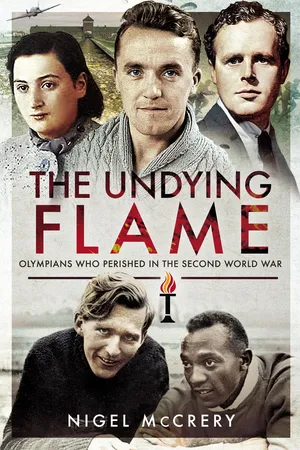
Over 60, 000, 000 people died worldwide during the course of the Second World War and, in contrast to those slaughtered in The Great War, it was civilian populations that bore the brunt. They perished in the Holocaust, in internment camps, in bombed towns and cities and as ‘collateral damage’, in war zones, such as the Eastern Front and in Asia. Among this carnage were hundred of individuals of all nations who had competed in Olympic Games. Imagine the loss of so many of the world’s greatest sportsmen and women of the present era. The author has painstakingly researched the lives, achievements and circumstances of death of almost five hundred athletes of the period. While many were household names at the time, this exceptional work honors these fallen Olympians and reminds us of the futility and wastefulness of war.
- 256 pages
- English
- ePUB (mobile friendly)
- Available on iOS & Android
eBook - ePub
About this book
Trusted by 375,005 students
Access to over 1.5 million titles for a fair monthly price.
Study more efficiently using our study tools.
Information
Mini Biographies

Stefan Adamczak (1892–1939), Polish, pole vault, 1924 Paris.
Stefan Adamczak was born on 27 November 1892 in Mansfeld, Germany. He competed in the men’s pole vault in the 1924 Paris Olympics. He finished fifteenth. He was killed in action in the defence of Katowice in September 1939.

Herbert Adamski (1910–41), German, rowing, 1936 Berlin (Gold).
Herbert Adamski was born on 30 April 1910 in Berlin. Between 1936 and 1939 he was German champion in the coxed pairs with Gerhard Gustmann and cox Dieter Arend. Selected for the 1936 Olympics in Berlin, he won gold in the coxed pair competition (again with Gustmann and Arend). In 1937 they were European champions and in 1938 runners up. In 1939 he was German champion in the coxed fours. He was killed in action on 11 August 1941 on the Russian front.
Iwao Aizawa (1906–unknown), Japanese, sprint, 1928 Amsterdam.
Iwao Aizawa was born on 29 August 1906. He competed in the 1928 Amsterdam Olympics. He took part in the men’s 100 metres coming fourth, the 200 metres and the men’s 4 × 100 metres; he failed to reach the final in either event. He was killed in the Philippines in the war.

Abdurahman Ali (1911–unknown), Filipino, swimming, 1932 Los Angeles.
Abdurahman Ali was born on 6 June 1911 in Jolo in the Philippines. He competed in the men’s 100 metres freestyle at the 1932 Los Angeles Olympics. He failed to reach the finals. He was killed some time in the Second World War.

Arno Almqvist (1881–1940), Finnish, modern pentathlon, 1912 Stockholm.
Arno Axel Almqvist was born on 23 September 1881 in Pori. He competed for Russia in the modern pentathlon in the 1912 Stockholm Olympics, finishing twentieth. In the First World War he served as a captain at the Kronstadt naval fortress. He was arrested by the Bolsheviks and spent five months as a prisoner before escaping to Finland. He later fought with the White Guard as a commander of artillery and served as a prison warden. He died in the bombing of Mikkeli on 5 March 1940 while working for the Finnish army as a voluntary civilian.

Erich Altosaar (1908–41), Estonian, basketball, 1936 Berlin.
Erich Altosaar was born on 14 August 1908 in Tallinn. He was part of the national team that was placed ninth in the 1936 Berlin Olympics, where he also served as the flag bearer for Estonia. He held national titles in volleyball (1927, 1929, 1931, 1933 and 1935–39), basketball (1927, 1930–1 and 1941) and association football (1930). Altosaar also played in sixteen international basketball matches for Estonia. He was arrested by Stalin’s NKVD and died in a gulag in 1941.
Max Amann (1905–45), German, water polo, 1928 Amsterdam (Gold).
Max Amann was born on 19 January 1905 in Magdeburg. He was European water polo champion in 1931, second in 1934 and third in 1926. Together with his team, SC Hellas Magdeburg, Amann earned German national titles in 1924–6, 1928–31 and 1933. He added another title, this time for swimming with the 4 × 100 medley relay, in 1924. He competed in the 1928 Amsterdam Olympics. The German water polo team took the gold medal. He played in all three matches and scored three goals. He was reported missing on the Russian front in 1944 and his death was confirmed in December 1945.

Artur Amon (1916–44), Estonian, basketball, 1936 Berlin.
Artur Amon was born on 17 February 1916 in Tartu. He graduated from Tartu High School in 1933 and attended the Tallinn Technical University. He played for Tartu NMKA (1932–36), Tallinna Kalev (1936–40), and Tallinna Dynamo (1940–41). He also competed in the 1939 European Championships. He was capped twelve times for Estonia. He competed for Estonia in the 1936 Berlin Olympics, finishing ninth. He was killed in action on 3 September 1944 in Tartu.

Jan Geert Ankerman (1906–42), Dutch, field hockey, 1928 Amsterdam (Silver).
Jan Geert Ankerman was born on 2 March 1906 in Wommels. He took part in the Amsterdam Olympics of 1928 as a member of the Dutch field hockey team. He played in all four matches as a halfback, the team going on to win the silver medal. Jan later married Viola von Boronkay and they had four children. He was captured in the Japanese invasion of Burma and died there on 27 December 1942 in a prison camp in Rangoon.

Shigeo Arai (1916–44), Japanese, freestyle swimming, 1936 Berlin (Gold and Bronze).
Shigeo Arai was born on 8 August 1916 in Shizuoka. He took part in the 1936 Olympics in Berlin, winning gold in the 4 × 200m freestyle relay and bronze in the 100 metres freestyle. He also won three national titles in the 100 metres and four in the 200 metres freestyle between 1937 and 1940. He was killed serving with the Imperial Japanese Army in Burma on 9 July 1944.
Álvaro de Arana (1904–37), Spanish, Sailing, 1928 Amsterdam.
Álvaro de Arana Churruca was born on 3 October 1904 in Bilbao. He represented Spain at the 1928 Amsterdam Olympics in the sailing mixed 6 metres. He came thirteenth. I have been unable to find very much about his life or death. He died in Bilbao in the Spanish Civil War on 16 July 1937.

Kalle Arantola (1913–40), Finnish, skiing, 1936 Berlin.
Kalle Reino Arantola was born on 24 September 1913 in Sotkamo. He took part in the 1936 Winter Olympics in Garmisch-Partenkirchen, competing in the military patrol, which was allowed as a demonstration sport. The Finnish team came second but were not awarded medals.
Kalle was killed in action on 12 February 1940 in Kuhmo.

Hikoroku Arimoto (1915–44), Japanese, artistic gymnastics, 1936 Berlin.
Hikoroku Arimoto was born on 11 October 1915. He competed with the Japanese gymnastics team in the 1936 Olympics in Berlin. The team finished ninth. His best individual result was thirty-fifth in the floor exercises. It is believed he was killed in Burma in 1944.

Albert Arnheiter (1890–1945), German, rowing, 1912 Stockholm (Gold).
Albert Stephen Arnheiter was born on 20 July 1890 in Ludwigshafen. He was a fine rower and athlete. He rowed in the 1909 German Championships, his eight coming second. In 1910 in the same event he came third with the coxless fours, and in 1912 came second. He competed in the 1912 Olympics in Stockholm. He was bow in the coxed four which took the gold medal. The others in the crew were Hermann Wilker (d.1941), Rudolf Fickeisen (d.1944), Otto Fickeisen (d.1963) and Otto Maier (d.1957). Albert was killed on 26 April 1945 in Italy.

Jochen Balke (1917–44), German, swimming, 1936 Berlin.
Joachim Balke was born on 12 September 1917 in Dortmund. He was selected to swim for the German team in the 1936 Berlin Olympics. He came sixth in the 200 metres breaststroke. Two years later he became European champion in the same event. Nationally he won the German 200 metres breaststroke titles in 1936, 1938, 1940 and 1941. He set a new world record of 1 minute 9.5 seconds in the 100 metres breaststroke in 1938, although the event was not an official contest at that time. Joining the German army, he was eventually sent to a punishment battalion in 1943 suffering from battle fatigue. He was reported missing in action in Veliky Novgorod in Russia in January 1944, although he wasn’t officially declared dead until 17 September 1957.

Ernst Balz (1904–45), German, Art, 1936 Berlin.
Ernst Balz was born on 24 February 1904 in Forchtenberg. He was selected to take part in the art competition at the Berlin Olympics, competing in the mixed sculpturing, but he failed to win a medal. He was married to fellow sculptor Doris Balz (née Gerstel), the daughter of his art teacher.
He was reported missing in action in 1943. His death was assumed by the local court in Berlin-Zehlendorf to have taken place before 31 December 1945. No place of death is recorded.
Franz Barsicke (1905–44), German, long-distance running, 1936 Berlin.
Franz Barsicke was born on 15 May 1915 in Warsaw, Poland. A talented runner, he became the 1936 German marathon champion. In 1935 he ran with the winning marathon team at the national championships. He competed in the marathon in the 1936 Berlin Olympics but was forced to withdraw from the race after nine kilometres having torn a muscle in his leg. Franz was reported missing in 1944 near Stalingrad. His death was later assumed. His brother Richard was also a marathon runner and a member of the 1935 winning German team.
Franz Bartl (1915–41), Austrian, field handball, 1936 Berlin (Silver).
Franz Bartl was born on 7 January 1915 in Vienna. He competed in the field handball event in the 1936 Berlin Olympics. He played in three games as part of the Austrian team, helping them to take the silver medal. He was killed in action on 12 July 1941.

Helmut Barysz (1916–45), Polish, swimming, 1936 Berlin.
Helmut Barysz was born on 31 August 1916 in Poland. He competed in the men’s 4 × 200 fre...
Table of contents
- Cover
- Title
- Copyright
- Dedication
- Contents
- Acknowledgements
- Introduction
- The Holocaust
- The Dutch Women’s Gymnastics Team
- The Katyn Massacre
- 1908
- 1912
- 1920
- 1924
- 1928
- 1932
- 1936
- Mini Biographies
- Appendix – Olympic Games Venues 1900–36
- Bibliography
Frequently asked questions
Yes, you can cancel anytime from the Subscription tab in your account settings on the Perlego website. Your subscription will stay active until the end of your current billing period. Learn how to cancel your subscription
No, books cannot be downloaded as external files, such as PDFs, for use outside of Perlego. However, you can download books within the Perlego app for offline reading on mobile or tablet. Learn how to download books offline
Perlego offers two plans: Essential and Complete
- Essential is ideal for learners and professionals who enjoy exploring a wide range of subjects. Access the Essential Library with 800,000+ trusted titles and best-sellers across business, personal growth, and the humanities. Includes unlimited reading time and Standard Read Aloud voice.
- Complete: Perfect for advanced learners and researchers needing full, unrestricted access. Unlock 1.5M+ books across hundreds of subjects, including academic and specialized titles. The Complete Plan also includes advanced features like Premium Read Aloud and Research Assistant.
We are an online textbook subscription service, where you can get access to an entire online library for less than the price of a single book per month. With over 1.5 million books across 990+ topics, we’ve got you covered! Learn about our mission
Look out for the read-aloud symbol on your next book to see if you can listen to it. The read-aloud tool reads text aloud for you, highlighting the text as it is being read. You can pause it, speed it up and slow it down. Learn more about Read Aloud
Yes! You can use the Perlego app on both iOS and Android devices to read anytime, anywhere — even offline. Perfect for commutes or when you’re on the go.
Please note we cannot support devices running on iOS 13 and Android 7 or earlier. Learn more about using the app
Please note we cannot support devices running on iOS 13 and Android 7 or earlier. Learn more about using the app
Yes, you can access The Undying Flame by Nigel McCrery in PDF and/or ePUB format, as well as other popular books in History & Historical Biographies. We have over 1.5 million books available in our catalogue for you to explore.