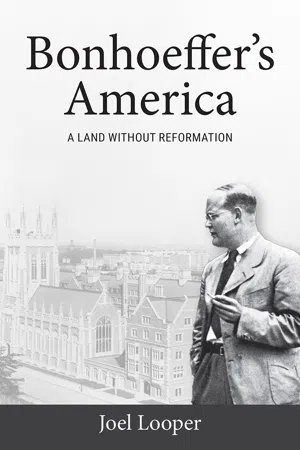
Bonhoeffer's America
eBook - ePub

Bonhoeffer's America

A Land without Reformation

  1. 272 pages
  2. English
  3. ePUB (mobile friendly)
  4. Available on iOS & Android
eBook - ePub

Bonhoeffer's America

A Land without Reformation

About this book

In the 1930s, Dietrich Bonhoeffer came to Union Theological Seminary looking for a "cloud of witnesses." What he found instead disturbed, angered, and perplexed him. "There is no theology here," he wrote to a German colleague. The New York churches, if possible, were even worse: "They preach about virtually everything; only one thing is not addressed... namely, the gospel of Jesus Christ, the cross, sin and forgiveness, death and life." Bonhoeffer acts for American Protestantism as an Alexis de Tocqueville, whose Democracy in America, a cultural and political analysis of the new republic, appeared a century prior. But what the Berlin theologian found was, if possible, more significant than the observations of the French aristocrat: Protestantism in America was a "Protestantism without Reformation."

Bonhoeffer's America explicates these criticisms, then turns to consider what they tell us about Bonhoeffer's own theological commitments and whether, in fact, his judgments about America were accurate. Joel Looper first brings Bonhoeffer's reformational and Barthian commitments into relief against the work of several Union theologians and the broader American theological milieu. He then turns to Bonhoeffer's own genealogy of American Protestantism to explore why it developed as it did: steeped in dissenting influences, the American church became one that resisted critique by the word of God. American Protestantism is not Protestant, Bonhoeffer shows us, not like the churches that emerged from the Continental Reformation. This difference gave rise to the secularization of the American church.

Bonhoeffer's claims against the church in the United States, Looper contends, hold strong, even after considering objections to this narrative--Bonhoeffer's experience with Abyssinian Baptist Church in Harlem, and the possibility that Bonhoeffer, during his time in Tegel Prison, abandoned the theological commitments that undergirded his critique. Bonhoeffer's America concludes that what Bonhoeffer saw in America, the twenty-first-century American church should strive to see for itself.

Frequently asked questions

Yes, you can cancel anytime from the Subscription tab in your account settings on the Perlego website. Your subscription will stay active until the end of your current billing period. Learn how to cancel your subscription.
At the moment all of our mobile-responsive ePub books are available to download via the app. Most of our PDFs are also available to download and we're working on making the final remaining ones downloadable now. Learn more here.
Perlego offers two plans: Essential and Complete
  • Essential is ideal for learners and professionals who enjoy exploring a wide range of subjects. Access the Essential Library with 800,000+ trusted titles and best-sellers across business, personal growth, and the humanities. Includes unlimited reading time and Standard Read Aloud voice.
  • Complete: Perfect for advanced learners and researchers needing full, unrestricted access. Unlock 1.4M+ books across hundreds of subjects, including academic and specialized titles. The Complete Plan also includes advanced features like Premium Read Aloud and Research Assistant.
Both plans are available with monthly, semester, or annual billing cycles.
We are an online textbook subscription service, where you can get access to an entire online library for less than the price of a single book per month. With over 1 million books across 1000+ topics, we’ve got you covered! Learn more here.
Look out for the read-aloud symbol on your next book to see if you can listen to it. The read-aloud tool reads text aloud for you, highlighting the text as it is being read. You can pause it, speed it up and slow it down. Learn more here.
Yes! You can use the Perlego app on both iOS or Android devices to read anytime, anywhere — even offline. Perfect for commutes or when you’re on the go.
Please note we cannot support devices running on iOS 13 and Android 7 or earlier. Learn more about using the app.
Yes, you can access Bonhoeffer's America by Joel Looper in PDF and/or ePUB format, as well as other popular books in Theology & Religion & North American History. We have over one million books available in our catalogue for you to explore.

Notes

Introduction

1 Eric Metaxas, “Should Christians Vote for Trump?” Wall Street Journal, October 12, 2016.
2 Christopher Morse addressed my topic in his inaugural lecture as Dietrich Bonhoeffer Professor of Theology and Ethics at Union Theological Seminary. Christopher Morse, “The Need for Dogmatic Theology: Bonhoeffer’s Challenge to the US in the 1930s and the 1990s,” The Ecumenical Review 47, no. 3 (1995): 263–67; also, perhaps most famously, Stanley Hauerwas, “Dietrich Bonhoeffer’s Political Theology,” in Performing the Faith: Bonhoeffer and the Practice of Nonviolence (Grand Rapids: Brazos, 2004), 33–54.
3 DBWE 15, 438–62.
4 DBWE 15, 225.
5 Alexis de Tocqueville, Democracy in America and Two Essays on America, trans. Gerald E. Bevan (London: Penguin, 2003), 336.
6 Thomas Cuming Hall, The Religious Background of American Culture (Boston: Little, Brown, 1930).
7 Reggie Williams, Bonhoeffer’s Black Jesus: Harlem Renaissance Theology and an Ethic of Resistance (Waco, Tex.: Baylor University Press, 2014); Larry Rasmussen with Renate Bethge, Dietrich Bonhoeffer: His Significance for North Americans (Minneapolis: Fortress, 1990).
8 See Robert T. Handy, A History of Union Theological Seminary in New York (New York: Columbia University Press, 1987); Gary Dorrien, The Making of American Liberal Theology: Idealism, Realism, and Modernity, 1900–1950 (Louisville: Westminster John Knox, 2003); idem, “The American Protestant Theology Bonhoeffer Encountered,” in Interpreting Bonhoeffer, ed. Clifford J. Green and Guy C. Carter (Minneapolis: Fortress, 2013), 101–9.
9 Charles Marsh, Strange Glory: A Life of Dietrich Bonhoeffer (New York: Alfred A. Knopf, 2014).

1. “There Is No Theology Here”

1 Tocqueville, Democracy in America, 55.
2 Hannah Arendt, On Revolution (New York: Viking, 1965), 50.
3 Joseph Epstein, introduction to Alexis de Tocqueville, Democracy in America, trans. Henry Reeve (New York: Bantam, 2004), xlii.
4 Tocqueville, Democracy in America, 269–322.
5 The men arrived in the United States about ninety-nine years and four months apart.
6 Ruth Zerner has previously referred to Bonhoeffer as a “theological Tocqueville.” Ruth Zerner, “Dietrich Bonhoeffer’s View on the State and History,” in A Bonhoeffer Legacy: Essays in Understanding, ed. A. J. Klassen (Grand Rapids: Eerdmans, 1981), 149.
7 Eberhard Bethge, Dietrich Bonhoeffer: A Biography, ed. Victoria J. Barnett, trans. Eric Mosbacher, Peter and Betty Ross, Frank Clarke, and William Glen-Doepel (Minneapolis: Fortress, 2000), 142.
8 Bethge, Dietrich Bonhoeffer, 143. The phrase “social gospel” would have meant something different to a German. For an example, see Adolf von Harnack and Wilhelm Herrmann, Essays on the Social Gospel, ed. Maurice A. Canney and trans. G. M. Craik (New York: G. P. Putnam’s Sons, 1907).
9 I certainly would not want to deny that Bonhoeffer intended to engage and make a contribution to social theory in Sanctorum Communio. But the study was “carried out on the foundation of Christian theology.” Bonhoeffer’s purpose was “to understand the structure of the given reality of a church of Christ, as revealed in Christ, from the perspective of social philosophy and sociology.” DBWE 1, 32–33.
10 W. A. Visser ’t Hooft, The Background of the Social Gospel in America (Haarlem: H. D. Tjeenk Willink und Zoon, 1928), 186.
11 DBWE 10, 200.
12 DBWE 10, 205.
13 DBWE 10, 198–99.
14 DBWE 10, 306.
15 For more on Union theology and American liberal theology generally during this period, see Dorrien, Making of American Liberal Theology; Handy, History of Union Theological Seminary; idem, A Christian America: Protestant Hopes and Historical Realities, 2nd ed. (New York: Oxford University Press, 1984).
16 DBWE 10, 261. Enttäuscht, the word here, can also connote disillusio...

Table of contents

  1. Cover
  2. Title Page
  3. Copyright Page
  4. Dedication
  5. Contents
  6. Abbreviations
  7. Acknowledgments
  8. Introduction
  9. I. What Bonhoeffer Saw in America
  10. II. Renarrating the Story of American Protestantism
  11. III. Objections
  12. Notes
  13. Bibliography
  14. Index