This book offers a re-evaluation of the emergence, development and outcome of the peace process in Northern Ireland. Drawing on interviews with many of the key participants of the peace process, newly released archival material and the existing scholarship on the conflict, it explains the decisions that shaped the peace process in their proper context.
O'Kane argues that although the outcome of the process can be seen as a success, it is not the outcome that was originally expected or intended by most of its participants. By tracing the process and highlighting the pragmatic decisions of the parties that shaped it the work explains how Northern Ireland moved from conflict to peace. The book concludes by examining what the implications of Brexit are for Northern Ireland's hard-won peace and political stability.
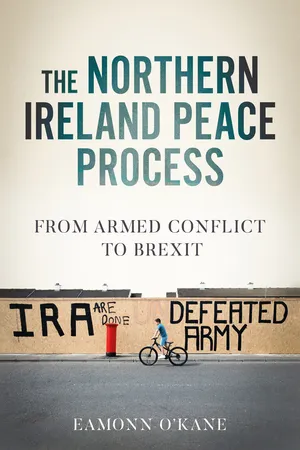
- 238 pages
- English
- ePUB (mobile friendly)
- Available on iOS & Android
eBook - ePub
About this book
Information
1
The origins of the peace process
The peace process in Northern Ireland resulted in an outcome that few expected – a sustained power-sharing government headed by the Democratic Unionist Party (DUP) and Sinn Féin, via a route that no one envisaged. The fact that the peace process period resulted in such an apparent success in Northern Ireland, ending Europe’s longest running post-war conflict, explains the interest that the case has attracted. Yet what is most striking about the politics of Northern Ireland in the last decade of the twentieth and the first decades of the twenty-first century is how ad hoc and ‘messy’ the process was. Given the time that has now elapsed since the origins of the peace process, a fuller picture is emerging which makes it possible to explain and evaluate the factors that caused, sustained and, on occasions, nearly destroyed, the fundamental changes that Northern Ireland witnessed during the period.
One of the main ambitions of this book is to seek to examine the peace process in the context of the times that the decisions were taken. There is a real danger of ‘reading back’ into the peace process its outcome. In recent years several accounts have, with some justification, critiqued decisions taken by participants and argued that mistakes were made in both the design and implementation of the peace process. These range from the necessity or desirability of concessions to Sinn Féin and the Irish Republican Army (IRA), or later, to the DUP, the failure to protect the leadership of David Trimble and the Ulster Unionist Party (UUP), a lack of support for the Social Democratic and Labour Party (SDLP), an unwillingness to exclude Sinn Féin from government, the imposition of new preconditions during the peace process and the design of the institutional structures that it resulted in. At different stages of the peace process different criticisms were to the fore, and no party to the quest for a solution to the conflict was immune from censure. Given the complexity of the peace process, and the competing agendas and aspirations of those involved, it is unsurprising that different interpretations of the process and different prescriptions for its advancement exist. As a result of the new evidence that has become available to scholars in recent years, reinterpretation of the period and how it was handled is both inevitable and desirable. However, it needs to be remembered that such evidence may not have been available to all parties during the peace process. The reason that this is notable is that criticism of actors’ and parties’ actions (or inaction) has on occasion been based upon a knowledge that the parties did not have at the time that decisions were taken. This does not, of course, invalidate criticism; reflection and reinterpretation are essential activities for historians and political scientists. Where such criticisms are problematic is when commentators seek to extrapolate lessons from Northern Ireland which are based on scenarios that were unrealistic given the available evidence at the time. This is why this work seeks to examine the peace process in the context of the time that decisions were taken. It does offer a critique of decisions taken by actors when the evidence suggests that such decisions were not only unhelpful or counterproductive but, crucially, when such decisions were taken in the face of available evidence that meant actors should have been cognisant of the likelihood that the decisions were unlikely to be beneficial.
Examining (and critiquing) the peace process is also made more difficult as the parties to the process had competing and, at least ostensibly, incompatible objectives. This has resulted in differences between commentators regarding what the desirable outcome or advisable action may have been during the process, in terms of its overall outcome. There are several reasons for such differences of interpretation. In part they are a result of differences over the significance and availability of evidence. Different writers will place differing weight on particular evidence, and this will inevitably lead to competing conclusions. There are also ideological differences between authors, which may well feed into how they prioritise evidence and the critiques they offer (from which this author is obviously not immune). What this book seeks to do is explain the peace process, and evaluate its progress and outcome.
Defining the peace process
The term ‘peace process’ emerged to explain the changes occurring in Northern Ireland in the early 1990s and has remained commonly used ever since. Indeed, Northern Ireland appears to have had a perpetual peace process that has lasted for over almost three decades. The term itself has become a symbol of Northern Ireland’s ‘success’ but its meaning has always been somewhat opaque. Northern Ireland’s politics in the third decade of the twenty-first century are clearly significantly different from the situation the region faced in the early 1990s. Yet the term continues to be used by many to describe Northern Irish politics. The term itself is not completely value-neutral and its usage has differed over time and between parties. In the early 1990s the term was invoked to describe the process of seeking to entice the IRA away from violence. During the time of the Brooke–Mayhew talks there were frequent references to a ‘talks process’ seeking to secure peace in Northern Ireland. However, given the exclusion basis of these talks, these were different to what became known as the peace process. The peace process became the label attached to the objective of seeking to secure an end to the violence in Northern Ireland and a move towards all-inclusive talks including those who were associated with groups that had advocated the use of violence to secure political ends (primarily Sinn Féin but also those associated with loyalist paramilitary groups). Republicans themselves frequently invoked the term. In August 1991 (three years before the ceasefire) Sinn Féin President, Gerry Adams, stated that his party ‘believe that peace can be achieved, we are prepared to take political risks, we are prepared to give and take, we are committed to establishing a peace process’ (English, 2003: 270). The term, though, tended to have less resonance with the unionist community in Northern Ireland. Whilst it was frequently invoked by nationalists, the British and Irish governments and international commentators, unionists took to talking of a ‘political process’ distinct from a peace process. The reason for this distinction is that for many unionists the ‘peace process’ came to represent the granting of undue concessions to republicans in a dishonourable attempt to ensure that the IRA did not return to violence.
Dating the peace process
The dates of the peace process are contested. It can be dated from the first IRA ceasefire of August 1994, or to the British and Irish governments’ Downing Street Declaration (DSD) of December 1993, which was designed to persuade the IRA to end their violence and participate in inclusive political dialogue. However, both the ceasefire and the DSD were only possible due to the contacts between the two governments and the IRA that had existed for several years. So, whilst the ‘visible’ peace process emerges post-1993/94, an ‘invisible’ one had been in operation before this. Debate continues as to when these contacts began. The difficulty here lies in the fact that a channel of communication had existed between the British government and the IRA since the early 1970s. This was an indirect channel that had been used sporadically during the Troubles period, notably in the early 1970s, in the run-up to the 1974–75 IRA ceasefire, during the 1980/81 hunger strikes and then in the run-up to the peace process (Ó Dochartaigh, 2009). The British government’s account suggests that the ‘backchannel’, as the link was known, was reactivated in 1990 as the person who had been the contact on the British side, Michael Oatley of MI5, was about to retire. Peter Brooke, the Secretary of State for Northern Ireland (NISS), gave approval for the backchannel to be reactivated so Oatley’s replacement, ‘Fred’ could be introduced to the Derry businessman who acted as the link to the republican movement, Brendan Duddy. It is clear that, from this period, there was relatively frequent contact between the British government and the republican movement via this backchannel (Sinn Féin, 1993; the Duddy Archive, Galway). Ed Moloney, however, has dated the links back further than 1990 and suggests that the contacts that existed between Gerry Adams and the then Secretary of State, Tom King, via Fr Alec Reid, of West Belfast, at the end of 1986 were instrumental in creating the peace process. This contact, which predated that acknowledged by the British, according to Moloney, necessitates ‘a fundamental reassessment of the genesis and origins of the peace process’ (Moloney, 2002: 249). Given the secrecy behind such contacts it is difficult to know either the extent or impact of any exchanges between the British government and the republican leadership via the intermediaries. It is interesting that, on occasion, the government appeared to be rather equivocal on the possibility of contacts. For example, on 24 November 1987, Mrs Thatcher told the House of Commons, ‘I think most of us believe that no one in this House should have contact with the IRA or Sinn Féin’. Labour’s Ken Livingstone then challenged the Prime Minister to give assurances that ‘there has been no further contact between the IRA and members of her intelligence services, MI5 or MI6, during the last eight years’. In reply Thatcher merely stated, ‘Ever since 1979, the policy of the Government has been that we have no contact at ministerial level with the IRA or other terrorist organisations’ (Thatcher, House of Commons, 24 November 1987, vol. 123, cols 137–139), thus not explicitly stating that there had been no indirect contact with the republican movement via intermediaries below ministerial level. The years that immediately followed these earlier exchanges were, however, as Moloney notes, ‘a turbulent and violent period in Northern Ireland, encompassing the smuggling of huge amounts of Libyan arms to Ireland, and an intensification of IRA violence’ (Moloney, 2002: 249). Henry Patterson has questioned Moloney’s interpretation of the importance of Adams’s attempts to engage Tom King. He has pointed out that it had long been a tactic of the IRA to seek dialogue with the British whilst continuing the violence; and this element of continuity has been downplayed. According to Patterson the ‘fact that Adams opened up a line of communication with King should not therefore be seen as a radical innovation which kick-starts the peace process’ (Patterson, 2011: 98–99). Evidence from the Irish government’s actions in that period suggests that Dublin did not see a potential major shift by the IRA at that stage. Whilst Adams was making overtures to the British government, he was also, again via Fr Reid, seeking a dialogue with Charles Haughey’s Irish government. Although this led to two instances of direct talks between Haughey’s advisor, Martin Mansergh, and republicans in Dundalk, the Irish government stopped the process as there was no commitment from the IRA to bring the violence to an end and so, according to Mansergh, the dialogue ‘could not be prudently sustained’ (Mansergh in Elliot, 2007: 110). So, whilst these earlier discussions and contacts may have been useful in setting the background to the peace process, it is the contacts and interaction that occur from 1990 onwards that appear to have been more influential. As a result, this work is primarily concerned with the period from the early 1990s.
Dating the peace process is also further complicated by the fact that it did not so much ‘begin’ as emerge. What became known as the peace process was just one of three initiatives that were in play in the early 1990s. The contacts with republicans that were to form the basis of the peace process were being pursued concurrently with the inter-party talks between the ‘constitutional’ parties and an intergovernmental dialogue about a possible joint declaration. The embryonic peace process was just one of three shows in town and, as will be discussed, at the time appeared to be less likely to be pursued than the other options.
The state of play at the outset of the peace process
In the period preceding the peace process, the parties to the conflict in Northern Ireland appeared to be polarised. It is worth briefly outlining the apparent views and aspirations of the main players in the conflict at the end of the 1980s/beginning of the 1990s.
The British government
The policy of the British government at the end of the 1980s was, at one level, the same as it had been since the early stages of the Troubles in the 1970s. British policy was driven by a commitment to upholding the principle of consent (the undertaking that the constitutional status of Northern Ireland could not be altered without the agreement of the majority of Northern Ireland’s citizens). In addition to this commitment, British policy was shaped by three other, interrelated, aspirations: to try and significantly reduce if not eradicate the violence resulting from the conflict; restore devolved government to Northern Ireland; and prevent the issue from disrupting the wider British political agenda to a problematic degree. Since Northern Ireland’s parliament was prorogued in 1972 it had been the stated aspiration of successive British governments to try and restore devolved government to Northern Ireland. The 1970s and 1980s were littered with failed initiatives in this regard. The Sunningdale Agreement of 1973 was the closest that the objective came to being fulfilled, with an Assembly created and a power-sharing Executive sitting for a few months in 1974, but this was to be short-lived, brought down by the Ulster Workers’ Council Strike in May of that year (McGrattan and McCann, 2017). In 1982, a plan for ‘rolling devolution’ to a new Assembly failed as nationalists boycotted the institution and it was finally wound up in 1986. In 1990 the British government had begun a new round of talks aimed at trying to broker agreement between the ‘constitutional’ parties in Northern Ireland (those that rejected the use of violence) that would enable the restoration of devolved government. These ‘Brooke–Mayhew’ talks (named after the Secretaries of State that oversaw them) ran between 1990 and 1992 but failed to achieve their objectives.
The failure to achieve sustained devolved government in Northern Ireland by the mid-1980s had led the government to pursue a slightly different tack. In 1985 the government signed the Anglo–Irish Agreement (AIA) with the Irish government. This agreement, which was registered as an international treaty at the United Nations, gave the Irish government a right of consultation over Northern Ireland. It was designed to not derogate from British sovereignty over Northern Ireland but the rationale behind it can be seen as an attempt to address the British objectives in Northern Ireland of reducing violence and the issue’s impact on wider British politics. For elements within the British government (notably the Prime Minister) the main purpose was to improve security cooperation with the Irish government against the IRA; for others in the government the desire to reduce international criticism or attention of other states on Britain’s government of Northern Ireland was a factor. The objective of creating an agreement as a tool to coerce the unionists to agree to share power in Northern Ireland with nationalists is less persuasive as an explanation for the AIA (Aughey and Gormley-Heenan, 2011).
What is notable about Britain’s position towards Northern Ireland by the end of the 1980s (and arguably long before this) is the pragmatism of policymakers. There were serious and fixed limits to this pragmatism, the most important of which was the commitment to the principle of consent, which was spelt out in Article 1 of the AIA. However, as long as consent was upheld, Britain’s policy towards Northern Ireland was largely a quest for an initiative that would reduce the violence and the impact of the issue at Westminster. At times, this pragmatism caused annoyance for the unionist community who often doubted the commitment of the British to uphold consent and feared that they would abandon the Union or seek to ‘persuade’ the unionists to agree to a united Ireland. The failure to make progress towards their desired objectives in Northern Ireland caused frustration in British policymaking circles and periodically this frustration spilled over into the public domain. In an unguarded moment in 1993 the Secretary of State, Sir Patrick Mayhew, told a German interviewer, ‘Most people believe we would not want to release Northern Ireland from the United Kingdom. To be entirely honest, we would with pleasure’ (O’Clery, 1999: 215). This was more a manifestation of frustration at the lack of progress than an indication of a weakening of commitment to the Union. However, as the frequent repetition of the principle of consent indicated, the commitment to the Union was conditional rather than absolute. It had long been the stated British policy that they would accept a united Ireland. This was again acknowledged in the AIA which asserted that in the event that ‘a majority of the people in Northern Ireland clearly wish for and consent to the establishment of a united Ireland’ the British and Irish governments would ‘introduce and support in the respective Parliaments legislation to give effect to that wish’ (AIA, Article 1c). For the British, ideology played a lesser role in policy formation than for many other parties. In general, almost any outcome would have been acceptable to the British state as long as it did not breach the consent principle, served to lessen the violence and, ideally, insulated British politics from the perceived negative influence of the Irish question. But it is important not to extrapolate indifference from pragmatism. Although there was an element of fluidity to British policy this was not insouciance. Consent was a real and serious condition for the British. Whilst by the late 1980s (if not for a considerable period before) there was no widespread emotional and ideological attachment to unionism of the Ulster variety amongst British politicians, there was a sense of commitment and obligation to both uphold consent and seek to defend the people of Northern Ireland. This necessitated trying to end or dissipate the violence they faced from non-state actors, notably the IRA. Again, though, pragmatism was evident here, and, as will be discussed, it was to be a contentious but key aspect of the emerging peace process.
Despite protestations of not talking to terrorists, as noted above, the British had periodically had indirect communication with the IRA, and indeed direct talks in 1972 and 1975. The British did not have a policy of never talking to republicans; the refusal to engage in direct dialogue was based on a belief that the IRA’s violence was illegitimate and by its use the republican movement had absented itself from the political process. It was the methods rather than the aims of the IRA that meant the British state would not engage in talks with its representatives. The result of this was that British policy was based on exclusion. Except for the AIA, the initiatives launched by the British throughout the Troubles were variants on the model of seeking an agreement between the constitutional parties. The aim of the initiatives was to get these parties to agree to a political accommodation that would bring stability to Northern Ireland and further isolate those that advocated violence. In this regard they were unsuccessful. By the late 1980s the British were beginning to contemplate a move to an inclusion-based approach which rested on enticing the IRA to abandon their armed campaign and enter all-party talks. Overtures were beginning to be made by the end of the 1980s aimed at this outcome. On 3 November 1989, Peter Brooke gave an interview in which he recognised ‘the fact … that in terms of the late twentieth-century terrorist, organised as well as the Provisional IRA have become, that it is difficult to envisage a milit...
Table of contents
- Cover
- Title Page
- Copyright Page
- Contents
- Acknowledgements
- List of Abbreviations
- 1 The origins of the peace process
- 2 The emergence (and collapse) of the peace process, 1990–1997
- 3 New Labour’s new peace process? Negotiating the Agreement, 1997–1998
- 4 Implementing the Agreement, from exaltation to exasperation, 1998–2003
- 5 The reconfiguration of Northern Ireland’s politics, from devolution to destruction, 2003–2017
- 6 Governing the present, dealing with the past and learning lessons for the future
- References
- Index
Trusted by 375,005 students
Access to over 1.5 million titles for a fair monthly price.
Study more efficiently using our study tools.
Frequently asked questions
Yes, you can cancel anytime from the Subscription tab in your account settings on the Perlego website. Your subscription will stay active until the end of your current billing period. Learn how to cancel your subscription
No, books cannot be downloaded as external files, such as PDFs, for use outside of Perlego. However, you can download books within the Perlego app for offline reading on mobile or tablet. Learn how to download books offline
Perlego offers two plans: Essential and Complete
- Essential is ideal for learners and professionals who enjoy exploring a wide range of subjects. Access the Essential Library with 800,000+ trusted titles and best-sellers across business, personal growth, and the humanities. Includes unlimited reading time and Standard Read Aloud voice.
- Complete: Perfect for advanced learners and researchers needing full, unrestricted access. Unlock 1.5M+ books across hundreds of subjects, including academic and specialized titles. The Complete Plan also includes advanced features like Premium Read Aloud and Research Assistant.
We are an online textbook subscription service, where you can get access to an entire online library for less than the price of a single book per month. With over 1.5 million books across 990+ topics, we’ve got you covered! Learn about our mission
Look out for the read-aloud symbol on your next book to see if you can listen to it. The read-aloud tool reads text aloud for you, highlighting the text as it is being read. You can pause it, speed it up and slow it down. Learn more about Read Aloud
Yes! You can use the Perlego app on both iOS and Android devices to read anytime, anywhere — even offline. Perfect for commutes or when you’re on the go.
Please note we cannot support devices running on iOS 13 and Android 7 or earlier. Learn more about using the app
Please note we cannot support devices running on iOS 13 and Android 7 or earlier. Learn more about using the app
Yes, you can access The Northern Ireland peace process by Eamonn O'Kane in PDF and/or ePUB format, as well as other popular books in History & British History. We have over 1.5 million books available in our catalogue for you to explore.