- 332 pages
- English
- ePUB (mobile friendly)
- Available on iOS & Android
eBook - ePub
About this book
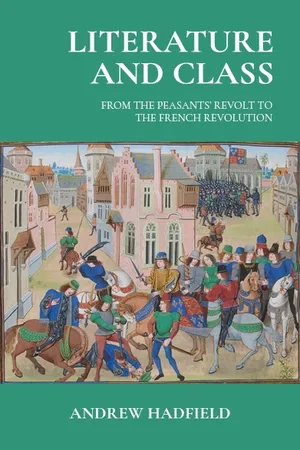
This book explores the intimate relationship between literature and class in England (and later Britain) from the Peasants' Revolt at the end of the fourteenth century to the impact of the French Revolution at the end of the eighteenth century and beginning of the nineteenth. The book argues throughout that class cannot be seen as a modern phenomenon that occurred after the Industrial revolution but that class divisions and relations have always structured societies and that it makes sense to assume a historical continuity. The book explores a number of themes relating to class: class consciousness; class conflict; commercialisation; servitude; rebellion; gender relations; and colonisation. After outlining the history of class relations, five chapters explore the ways in which social class consciously and unconsciously influenced a series of writers: Chaucer, Shakespeare, Behn, Rochester, Defoe, Duck, Richardson, Burney, Blake and Wordsworth.
Information
Chapter 1
Class in England from the late Middle Ages to the end of the eighteenth century
After the catastrophic impact of the Black Death (c.1348–49, 1361–62), great strain was placed on the social fabric of England.1 Not all of it was bad, however (not quite). As John Hatcher comments:
Just as the abundance of people prior to 1348 played a major part in reducing the standards of life of the peasantry and strengthening the power of landlords, so the progressive shortage of people in the ensuing era played a major part in undermining demesne agriculture [land retained by the feudal landlord] and in bringing about a fundamental redistribution of wealth.2
Before the advent of the plague, over-population led to the cultivation of unsuitable farming land, too many small, inefficient land holdings and widespread unemployment.3 Afterwards, serfdom and traditional principles of land tenure that disadvantaged peasant-tenants were eliminated in many areas and real wages grew to levels that were only exceeded in the nineteenth century.4 Some survivors were able to become relatively wealthy, inheriting the property of the deceased and having greater demand for their labour or produce, enabling a certain amount of conspicuous consumption, ostentation and social aspiration that was noted and condemned.5 The population was reduced by a third to a half, which led to the abandonment of many villages as local systems of agriculture collapsed.6 As far as can be calculated, population in Europe had reached the limit for an agrarian society in about 1300; England had a population of somewhere between 4 and 7 million which declined to about 2.5 to 3 million in 1400.7
However, if some people did gain, for most the reality was far more sobering and immiserating: ‘The fourteenth century witnessed considerable dislocation of both families and communities by reason of the tremendous mortality caused by disease and epidemic and the ensuing economic instability.’ 8 Traditional bonds between landlords and tenants could not be maintained as there were too few labourers to operate field systems and more skilled workers were over-stretched and in great demand. Furthermore, a feudal system of obligation, whereby a percentage of a crop was given to the landlord as rent, was mutating to a mixed economy based more on the exchange of money. As Paul Freedman has pointed out, the agrarian economy was much more complicated and diverse than was once envisaged and peasants did not simply work under a manorial system (although that system did dominate the economy), but often served a number of landlords (hence the need for a monetary economy); they held different amounts of land and, therefore, did not constitute a straightforwardly homogeneous social group.9 Classes higher up the social scale were also being squeezed by economic circumstances. The obligations of knighthood – especially military obligations – were proving ever more onerous in the thirteenth and fourteenth centuries. More land was being acquired by the church and estates were getting smaller as a result, which in a period of inflation meant that incomes of those who were ennobled were often inadequate for their needs. As Peter Coss has argued, ‘the knightly class was passing through a period of economic crisis, a crisis that was both extensive and prolonged’.10 The richer knights may well have done well out of straightened times and been economically empowered to buy even more land and so strengthen their position in society.11 But many of the less economically advantaged knights struggled and by the time of the late fourteenth century fulfilling traditional duties would have been a challenge, perhaps one reason why Chaucer's knight fights so many battles for dubious causes.12 In the late fourteenth century the interests of landlords and peasants were at odds in a dangerously under-resourced economy, making conflict likely, if not inevitable.
If anything, ‘class war’ (Samuel K. Cohn's phrase) was more pronounced in towns and cities, which were in any case closely integrated, economically and socially, with the countryside around them.13 Not all urban riots had a class dimension, and some were organized by court factions for their own ends. Most, however, did, making visible the class struggle that enveloped English towns and cities in the late thirteenth and fourteenth centuries. Disputes over wages, protests about working conditions, anger at the imprisonment of individuals and revolts against the crown or the papacy, were either triggered by, or triggered off, class conflict. Throughout Europe trade guilds protected the interests of their members, restricting access to the higher levels of their ranks to ‘the wealthy and privileged sons of existing masters … [blocking] the social advancement of anyone from the lower classes, aggravating existing inequalities’.14 Like rural life, inequalities in urban life ‘contributed to a state if discontent, which proved a favourable breeding ground for illicit “alliances” and the earliest social movements’.15 Social mobility was certainly not impossible, especially in the church where a man of relatively humble origin, such as Robert Grosseteste (c.1175–1253), reputedly from a villein...
Table of contents
- Cover
- Half-title page
- Title page
- Copyright page
- Dedication
- Contents
- List of figures
- List of tables
- Acknowledgements
- Abbreviations
- Introduction: hidden in plain sight
- Chapter 1: Class in England from the late Middle Ages to the end of the eighteenth century
- Chapter 2: Perceptions of class in the late Middle Ages
- Chapter 3: Class struggle in Renaissance literature
- Chapter 4: The Civil War and its aftermath
- Chapter 5: An increasingly commercial society, 1700–50
- Chapter 6: Gathering pace: Towards the revolutions, 1750–98
- Epilogue: Shelley in Ireland
- Bibliography
- Index
Trusted by 375,005 students
Access to over 1.5 million titles for a fair monthly price.
Study more efficiently using our study tools.
Frequently asked questions
Yes, you can cancel anytime from the Subscription tab in your account settings on the Perlego website. Your subscription will stay active until the end of your current billing period. Learn how to cancel your subscription
No, books cannot be downloaded as external files, such as PDFs, for use outside of Perlego. However, you can download books within the Perlego app for offline reading on mobile or tablet. Learn how to download books offline
Perlego offers two plans: Essential and Complete
- Essential is ideal for learners and professionals who enjoy exploring a wide range of subjects. Access the Essential Library with 800,000+ trusted titles and best-sellers across business, personal growth, and the humanities. Includes unlimited reading time and Standard Read Aloud voice.
- Complete: Perfect for advanced learners and researchers needing full, unrestricted access. Unlock 1.5M+ books across hundreds of subjects, including academic and specialized titles. The Complete Plan also includes advanced features like Premium Read Aloud and Research Assistant.
We are an online textbook subscription service, where you can get access to an entire online library for less than the price of a single book per month. With over 1.5 million books across 990+ topics, we’ve got you covered! Learn about our mission
Look out for the read-aloud symbol on your next book to see if you can listen to it. The read-aloud tool reads text aloud for you, highlighting the text as it is being read. You can pause it, speed it up and slow it down. Learn more about Read Aloud
Yes! You can use the Perlego app on both iOS and Android devices to read anytime, anywhere — even offline. Perfect for commutes or when you’re on the go.
Please note we cannot support devices running on iOS 13 and Android 7 or earlier. Learn more about using the app
Please note we cannot support devices running on iOS 13 and Android 7 or earlier. Learn more about using the app
Yes, you can access Literature and class by Andrew Hadfield in PDF and/or ePUB format, as well as other popular books in Literature & European Literary Criticism. We have over 1.5 million books available in our catalogue for you to explore.