Following the passage of the fifteenth and twentieth anniversaries of the entry of many former communist states into both NATO and the EU in 2019, this book takes a comprehensive look at the changed security conditions of these new member states. How has NATO and EU membership improved their overall defence protection, and what elements are still missing for them on an individual state basis?
Utilising alliance politics theory, convergence/divergence theory and defence policy theory, the book provides an invaluable assessment of defence policies, from the stable East Central European states to the most jeopardised Baltic states in the north of Europe. With chapters on the Cold War defence conditions during the last two decades of Soviet domination, post 1989–91 transformations in the direction of democracy and the impact of the 2014 Ukraine–Russia–Crimea crisis, this book is essential reading for those seeking to understand the changed landscape of European politics in the twenty-first century.
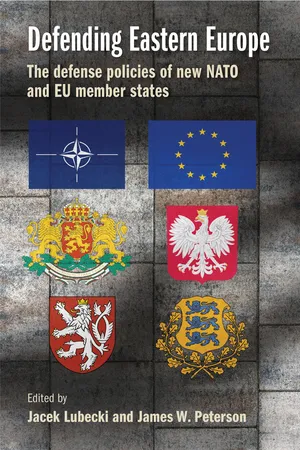
eBook - ePub
Defending Eastern Europe
The defense policies of new NATO and EU member states
- 230 pages
- English
- ePUB (mobile friendly)
- Available on iOS & Android
eBook - ePub
Defending Eastern Europe
The defense policies of new NATO and EU member states
About this book
Information
1
Introduction: membership anniversaries and theoretical security models
James W. Peterson and Jacek Lubecki
Controversy has swirled, again, around questions connected with membership in the North Atlantic Treaty Organization (NATO) in recent years, and financial contributions to the various defense budgets of members have been in the center of it. President Trump in particular has been threatening toward alliance partners that do not contribute at least 2% of GDP to defense expenditures. From a long-term perspective, however, there is nothing new in US calls on NATO allies to increase their defense burdens. On the other hand, the refugee issue, unprecedented in its scale and severity since World War II, has undone the solidarity of EU members, as strong nationalist political figures have resisted the openness of borders to the refugees as well as pressures to locate them in partner countries. The UK left the EU as the result of these and other pressures. Thus, the European security system, centered around NATO and the EU, is buffeted by new and old crises as forces of convergence and divergence are affecting the region.
Who are the three people to whom this book is dedicated? They are members of the Czech military who lost their lives in a suicide attack in Afghanistan on August 5, 2018, participating in a mission established under American leadership after the 9/11 attacks. Their deaths remind us of the value of the alliances and the varied contributions made by the new member states admitted 15–20 years ago. These contributions are important; some countries of “new Europe” contributed to NATO and US military operations and deployments at dramatically high levels. Poland, the biggest contributor, suffered 66 dead and 611 wounded soldiers in Iraq and Afghanistan and rotated some 50,000 troops through these countries in the state’s largest combat/stability operations since World War II.1 Poland was closely followed by Romania, Croatia, and Estonia in terms of their proportional military effort (if not the size, these being fairly small countries) of their contributions to the “war on terror.” Few people know that the nation of Georgia, not covered in this book, was, proportionally to its economy and population, the most generous military ally of the US/NATO in Iraq and Afghanistan.
It is time for an assessment of the foreign and defense policy experiences of Eastern European states in both NATO and the EU, at the time of the anniversaries of their several decades in both organizations. In light of the Balkan wars of the 1990s as well as of the post-9/11 Afghan and Iraqi Wars, the new alliance partners felt both pressure and the opportunity to take part in foreign conflicts as well as in the follow-up peacekeeping and peacemaking deployments. Then, crises and fissures intervened, most importantly, the Russo-Ukrainian conflict, the EU’s multiple crises, and the election of President Trump. What have the new members gained from participation in these allied commitments, and what have been the costs and benefits to them as a result? How should we assess the balance of these countries’ memberships in the Western security community and the prospects for their future roles? What conceptual and theoretical perspectives can help us in our inquiry?
Theoretical perspectives
In light of the fifteenth and twentieth anniversaries of the NATO and EU memberships of many East European states in 2019, it is important to examine their actual security and military defense conditions from theoretical perspectives that can inform future policy considerations.
First, we will use alliance theory as descriptive of the roots of the interactions of the states in alliance relationships. Alliances can offer a method for overcoming the geographic distance between and among the states in the region. They can also offer a conversational format for addressing sharp political systemic differences within that geographic space. Profound cultural and ethnic differences exist also within the area designated as Eastern Europe, and well-designed alliance frameworks can offer ways of establishing working agreements in spite of those sharp cultural contrasts. In other words, by “alliance theory” we refer to a set of theoretical perspectives, focusing on institutional factors which allow for cooperation regardless of potential geographical, cultural, ideological, and topological differences and distances (Hendrickson 2002). Especially, constructivism offers to us a more specific perspective on how different countries in question interact with the established institutional frameworks of NATO and the EU. In particular, “role theory,” as formulated by Aggestam (2004), offers a framework to understand how and why countries in question perceive what they “should” do or affect what they do within these institutions (Aggestam 2004).2
Second, convergence and divergence theories, derived from realism, liberalism, and constructivism, can reinforce the building picture of changing and evolving alliance patterns. These theories are particularly useful in portraying methods through which the alliance partners can cope with powerful variables that exist outside the alliances but affect their internal perspectives. One strong convergent force was communism and membership in the Warsaw Pact during communist times, and those patterns still provide “legacies” to states within the region. The pressure of Western practices and values has been the dominant theme during the past 30 years, and it is important to examine how they also have brought the various states together. Liberalism, especially, offers a powerful perspective that explains how the countries of Eastern/East-Central Europe were pulled toward the Western security community, found their place in it, and, today, coexist largely in peace as contrary to their previous pattern of inter-state war, suspicion, and hostility (Doyle 1986). Liberalism, also, expects countries’ foreign policy to be driven by economic imperatives of prosperity. In this respect, paradoxically, economic interests are driving many of the states in question to reach out to illiberal Russia and Asian states, especially China, for trade links and benefits. Of course, China has intruded with its economic interests into the area as well.
Divergent pressures are equally strong on the region and its alliance partnerships. For example, the states have been differently impacted by the Russian annexation of Crimea in 2014 and its implications for their own security. These differentials are obviously dictated by forces of geopolitics, and realism is the theoretical framework that best informs our understanding here. Briefly, there is a fundamental distinction to be made between “secure” countries which do not border Russia (the Czech Republic, Slovakia, Hungary) and “frontier” countries that do (Poland, the Baltic countries, and, indirectly, Romania – the latter through its connection to Moldova and its relationship with Transnistria). The former countries do not fear Russia and behave accordingly; the latter do and express their fear in massive efforts at military spending, while they also attempt to gain reassurance against Russia from NATO and the US by diplomatically and, disproportionally, materially supporting the US and NATO in Iraq and Afghanistan. In addition to this fundamental “realist” and geopolitical factor of divergence, the Balkans represents its own system of geopolitical insecurities determined by pro-Russian (Greece, Serbia, partially Bulgaria) and anti-Russian (Croatia, North Macedonia, Kosovo, and Albania) countries. Neighboring Turkey is a traditional NATO partner but has moved in an authoritarian and pro-Russian direction, and tugs on the Balkan defense policies in particular.
The flow of refugees into the region in 2015 and after has also had a differential impact, for the Balkan nations have felt those pressures in the most intense ways. This newly opened “Middle Eastern frontier” issue of the relationship of Europe to the flow of immigrants opened yet different dimensions of divergence and convergence in the region. Most East European countries, regardless of the actual impact that refugees had on them, reacted with hostility to the potential influx of “aliens,” thus reflecting not only the still fairly raw nationalisms of the region, but also, clearly, an attempt to counter-balance German attempts to dictate the EU’s refugee policies: a form of “soft realism.” Crucially, though, East-Central European countries across the board showed that they have a set of “strategic cultures” – yet another useful concept – resentful and hostile to any perceived infringement on their sovereignty. The constructivist concept of “strategic culture” as defined by Gray (1999) thus permits us to illuminate and explain both divergence and convergence in the respective countries’ policies on any number of issues, including the relationship with Russia, Germany, and the refugee issue.3
Third, and broadly, it is important to look at the domestic politics of the countries in question and how they dictate the respective countries’ defense and security policies. What we can broadly call “defense policy theory” is based on insights provided by the field of comparative politics and provides an insightful way of examining factors that play a role within the individual states and affect their respective alliance behavior. For instance, in some states, due to complex internal politics, there has been a significant growth of domestic illiberalism within their political party systems, with effects on defense policies.
There are many domestic factors that influence national security policy choices. The general environment in which policy choices are made is vital. How do public attitudes and elite perspectives inform conclusions about which states are adversaries and which are allies (Peters 2016, 397–9). Findings about this question can guide an understanding of why the Baltic states center their defense strategies on Russian ambitions while Hungary and the Czech Republic are less concerned. For the former countries’ public opinion, Russia is an adversary but for the latter it is less so. Technological capabilities are also significant, and the role of NATO senior partner America is critical in this environmental variable (Peters 2016, 404). Clearly, the technology of NATO/EU member Poland exceeds that of non-partner Serbia in the Balkans. Public opinion can also factor into defense policy decisions, and this has been important in US decisions about the continued military presence in Iraq and Afghanistan (Peters 2016, 404–5). It also conditions Czech apprehension about extended outside military commitments as well as Romanian willingness to take on broader regional obligations.
Terrorism and possibilities of ethnic or religious insurgencies have preoccupied partners in both alliances for a large part of the twenty-first century. All of the states in the region have concerns about these threats, and some have had actual experiences with them. Should anti-insurgency policies rest on liberal assumptions about the need to confront it with increased attention to the poverty and inequity that lies beneath the attacks? Conversely, should realist perspectives prevail, for they would establish firm costs that terrorists or insurgents must pay in efforts to cut off any possibility that they could realize their agendas (Cochran et al. 2003, 417–19)? Liberalism may be more likely in Bosnian calculations, given their tragic civil war in the 1992–5 period. However, realism may be the preferred Albanian strategy in light of the huge refugee flow of 2015–16. Further, there is no doubt but that civil liberties considerations factor into defense policy calculations as well. The United States experienced sharp legal and political challenges on that fundamental value after the 9/11 attacks (Kraft and Furlong 2013, 482–7). The Serbian record in the 1990s suggest that its reputation needs restoration on this vital factor, as it attempts to thread its national security policy between Russian and Western demands. With its attention to relationships among Bosniaks, Serbs, and Croats, Bosnia-Herzegovina and its leaders have built up structures and forms that attempt to balance defense policy moves with attention to the rights and liberties of each ethnic group.
Policy thus depends on a range of domestic calculations. The broad environment sets the stage in defining who is an adversary and who an ally, but available technology and public attitudes are conditioning variables as well. With the continuing threat from terrorism and insurgencies, liberal and realistic views often clash in the region in determining what steps to take to combat or eliminate the enormous dangers. Civil liberties are always an underlying policy concern, and protection of them in the face of tremendous threats to life and limb is a continuing challenge.
Therefore, in an anniversary year, it is possible to describe how all three sets of theoretical frameworks can work together to enlighten future needs of both the individual states and the two overlapping alliances that are available to them.
Historical background
Admission to NATO has been staggered over the 1999–2019 period. In 1999, the Czech Republic, Hungary, and Poland became formal members of NATO after several years’ participation in the Partnership for Peace (PfP) program. In 2004, the list of seven new NATO members included Bulgaria, Estonia, Latvia, Lithuania, Romania, Slovakia, and Slovenia. Then, in 2009, Albania and Croatia became formal members, with admission to Montenegro postponed to 2017. (North Macedonia received a promise of membership in the near future in 2018 and formal admission in 2020.) EU membership occurred in 2004 for eight of the states that joined NATO between 1999 and 2004, and plans were finalized with Romania and Bulgaria in 2007, while Croatia entered in 2013. The EU has also granted candidate membership to Albania, North Macedonia (formerly the Yugoslav Republic of Macedonia), Montenegro, and Serbia. Bosnia-Herzegovina and Kosovo have received promises of consideration for candidate status in the future, while Moldova remains neutral. Thus, 2019 is an important 15- or 20-year anniversary for most of these members, the ones that had joined the alliances in either 1999 or 2004.
Communist period
This section will center on the experience of the Eastern European states in the period preceding the fall of communist rule in their neighborhood. During the last two decades of the Cold War (1968–89), the security of the northern tier of the region under consideration was tied to the Soviet Union via the Warsaw Treaty Organization (WTO). However, the Balkans were different: here “independent” communist states of Yugoslavia and Albania coexisted with the bizarre phenomenon of a WTO member with a theatrically independent foreign and security policy: Romania, and only Bulgaria was a reliable Soviet ally. Here also two NATO member states, Greece and Turkey, seemed always to be on the brink of war against each other. Clearly, the Balkans looked like a nightmare for both NATO and WTO/Soviet strategists, and both sides of the Cold War de-emphasized the Balkans’ strategic importance, while focusing their main axis of confrontation on the German–Central European front.
In 1968, Moscow reacted to reforms in Czechoslovakia by mobilizing WTO partners in an invasion that quashed the Dubček reform movement. The four invading militaries included the Soviet Union, Poland, Hungary, and Bulgaria (Kramer 2010, 48–52). When the Polish Solidarity movement rallied much of the population of that nation to stand up for its rights in 1980, an expected WTO or Soviet invasion did not take place. Instead, Moscow was able to obtain the willingness of the Polish military to crack down on Solidarity and impose communist controls again. These hardline Soviet responses to cries for meaningful change ended with the 1985 advent of Mikhail Gorbachev to power in the Soviet Union and his unwillingness to use Soviet military force to suppress change.
Overall, the legacies of the communist period are multiple, often hidden but sometimes in “plain sight.” Strategic cultures of the countries in question were dramatically affected by the communist and late communist period: for instance, post-communist Hungary continued its tradition of demilitarization and security “opportunism” largely started under communism. Legacies of communism also matter, for the very desire to distance themselves from communism explains much about the eagerness with which the countries of the region embraced liberalism and liberal institutions in the 1989–2010 period (Barany 1995, 112–13). Forgetting the communist experience, in turn, explains a lot about the sudden eruption of illiberalism in the region, roughly after 2010.
The three theoretical perspectives that anchor this discussion of the late communist period are pertinent in linking it all to a range of broader dynamics in the international arena. Alliance theory calls attention to the basic relationship between Moscow and its Warsaw Pact partners. For instance, the Warsaw Pact invasion of Czechoslovakia as well as the crackdown on the Polish Solidarity movement may seem to have closed the distances that had been developing within the alliance. However, the harshness of Brezhnev’s reaction to reform pressures for democratization backfired, strengthening hopes ...
Table of contents
- Cover
- Half Title
- Title Page
- Copyright Page
- Dedication
- Contents
- List of tables
- List of contributors
- 1 Introduction: membership anniversaries and theoretical security models
- 2 Cold War security experiences of Eastern European states
- 3 Anti-communist revolutions and the emergence of states responsible for their own defense
- 4 NATO: Partnership for Peace (PfP) and a staggered admission process
- 5 The EU as a security provider in Eastern Europe
- 6 Secure East-Central European NATO members: the Czech Republic, Hungary, and Slovakia
- 7 Stable Balkan NATO/EU members: Albania and Bulgaria
- 8 Vulnerability of former Yugoslav NATO (Slovenia, Croatia, Montenegro, and North Macedonia) and non-NATO (Bosnia-Herzegovina, Kosovo, and Serbia) states
- 9 States with significant security issues: Poland, Romania, and Moldova
- 10 Challenged Baltic states: Estonia, Latvia, and Lithuania
- 11 Conclusion: moving beyond the 15–20–year anniversaries to stable policies in a time of constant political turmoil
- Bibliography
- Index
Trusted by 375,005 students
Access to over 1.5 million titles for a fair monthly price.
Study more efficiently using our study tools.
Frequently asked questions
Yes, you can cancel anytime from the Subscription tab in your account settings on the Perlego website. Your subscription will stay active until the end of your current billing period. Learn how to cancel your subscription
No, books cannot be downloaded as external files, such as PDFs, for use outside of Perlego. However, you can download books within the Perlego app for offline reading on mobile or tablet. Learn how to download books offline
Perlego offers two plans: Essential and Complete
- Essential is ideal for learners and professionals who enjoy exploring a wide range of subjects. Access the Essential Library with 800,000+ trusted titles and best-sellers across business, personal growth, and the humanities. Includes unlimited reading time and Standard Read Aloud voice.
- Complete: Perfect for advanced learners and researchers needing full, unrestricted access. Unlock 1.5M+ books across hundreds of subjects, including academic and specialized titles. The Complete Plan also includes advanced features like Premium Read Aloud and Research Assistant.
We are an online textbook subscription service, where you can get access to an entire online library for less than the price of a single book per month. With over 1.5 million books across 990+ topics, we’ve got you covered! Learn about our mission
Look out for the read-aloud symbol on your next book to see if you can listen to it. The read-aloud tool reads text aloud for you, highlighting the text as it is being read. You can pause it, speed it up and slow it down. Learn more about Read Aloud
Yes! You can use the Perlego app on both iOS and Android devices to read anytime, anywhere — even offline. Perfect for commutes or when you’re on the go.
Please note we cannot support devices running on iOS 13 and Android 7 or earlier. Learn more about using the app
Please note we cannot support devices running on iOS 13 and Android 7 or earlier. Learn more about using the app
Yes, you can access Defending Eastern Europe by Jacek Lubecki, James W. Peterson, Jacek Lubecki,James W. Peterson in PDF and/or ePUB format, as well as other popular books in Politica e relazioni internazionali & Politica comparata. We have over 1.5 million books available in our catalogue for you to explore.