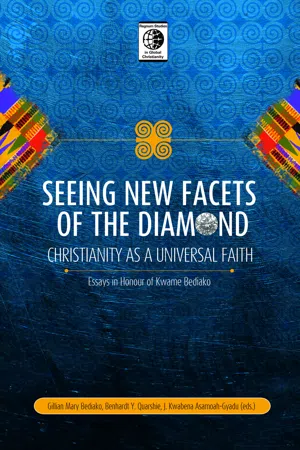
This collection of essays has sought to achieve a good representation of mentors, colleagues and disciples from around the world. The contributions come from a variety of countries, theological disciplines and perspectives, and represent either a direct outworking of his vision and initiatives or a connection with them. Taken together, they demonstrate Bediako's conviction that the theological creativity emerging in Africa is also for the benefit of the mission of the world church. All the essays key into the general theme from contributors' own particular perspectives and areas of specialisation and capture something of the vision that inspired Kwame Bediako, which he shared, and the legacy he has bequeathed. In addition, they make a contribution to a deep er understanding of world Christianity in our time and provide pointers to the ongoing sc holarly task in the service of the church in mission. For it is vital that we continue to see new facets of the diamond that is the universality of the Gospel, as lived and proclaimed thro ugh the world church.
- English
- ePUB (mobile friendly)
- Available on iOS & Android
eBook - ePub
Seeing New Facets of the Diamond
About this book
Information
Topic
Teologia e religioneSubtopic
Ministro del culto cristianoPart 1
Engaging the Thought of Kwame Bediako
‘Jesus, Pioneer and Perfecter of Faith’ (Heb. 12:2): Kwame Bediako’s Hebrews-based Ancestor Christology Revisited
Introduction
The Epistle to the Hebrews was Kwame Bediako’s favourite book of the Bible. For Bediako, Hebrews sets an example for all African Christians and poses a challenge to them to articulate what Jesus ‘looks like’ as the response to their deepest longings and as the answer to the questions that they are asking.1 It was this appreciation of Hebrews that led Bediako to base his ancestor Christology on that Epistle.
The ancestors are a vital part of the African religious heritage and total life. They constitute a reality that Africans have to engage with on virtually a daily basis. Dealing with the ancestors is thus a crucial existential and theological issue for African Christians. Following in the footsteps of the writer to the Hebrews, Bediako presents Jesus Christ as the ancestor par excellence.
This paper examines how Bediako read Hebrews and how that helped him to engage with his own African (Akan) heritage to find a place for Jesus Christ in that heritage in such a way that Jesus could feel at home in it and in other African cultural settings. The paper also seeks to determine what the African’s deepest yearnings really are and whether, on the basis of Hebrews, Bediako’s view of Jesus Christ could not be extended further to make Christ even more at home in Africa and thus even more relevant to the African Christian. What then is Bediako’s Hebrews-based ancestor Christology?
The Epistle to the Hebrews and Kwame Bediako’s Ancestor Christology
Bediako’s view of Hebrews
According to Bediako, ‘…the essential message of the Epistle to the Hebrews (is) that Jesus Christ embodies the fullest divine self-disclosure to humanity and is, therefore, superior to all other “revelations”, and that the good news or gospel that he embodies and has brought is altogether unique.’2 The high premium that Bediako placed on Hebrews becomes evident in his conclusion that ‘There is probably no writing in the entire New Testament that makes these claims more forcefully than the Epistle to the Hebrews.’3
Bediako maintained that the Epistle corrects the mistaken view that ‘the meaning of Christ for Jewish religious tradition was…relatively simple’.4 The writer is ‘aware that some Hebrews might be tempted to turn from the proclamation of the great salvation in Christ,’5 and constantly warns them against turning away from Christ even as he encourages them to remain faithful to him. Nevertheless, his desire is to give them ‘solid food’ for which he knows that at least some of them are not quite ready. ‘The clue to the Epistle’s teaching,’ Bediako asserted, ‘lies in its presentation of Christ. Hebrews is the one book in the New Testament in which Jesus Christ is understood and presented as High Priest. His priestly mediatorial role is fully explored and we are given one of the highest and most advanced understandings of Christ in the entire New Testament.’6 What is significant about his presentation of Jesus is that while on earth, Jesus did not qualify to be a priest because he did not belong to a priestly family (Heb. 8:4; 7:14). Hebrews, therefore, incorporates a priestly mediation role into the Jewish tradition for one who, humanly speaking, did not qualify for the role.
The starting point for this incorporation exercise, according to Bediako, is the achievement of Jesus Christ – his death and resurrection – which the writer of Hebrews then works ‘into the biblical tradition of sacrifice and high priestly mediation’.7 The writer of Hebrews underscores the universal significance of Jesus ‘as the saviour of all people everywhere…(making it possible for) the call to Hebrew people to take him seriously as their Messiah.’8 The high priesthood of Jesus is not traced to the first Hebrew high priest, Aaron, but rather to ‘the enigmatic non-Hebrew, and greater priest-king, Melchizedek (Hebrews 7 and 8)’.9 Jesus Christ’s universal significance flows out of the fact that though divine, he totally identified with the whole human race in order to die and to totally transform the human condition. ‘The uniqueness of Jesus Christ is rooted in his radical and direct significance for every human person and every human context and every human culture.’10 Jesus Christ is thus significant for the African person, context and culture.
For Bediako, as the writer of Hebrews engages with his Jewish cultural and religious heritage and re-interprets that heritage in the light of the Christ event, such that the deepest Jewish yearnings, especially as reflected in the Jewish cultus, are fulfilled in Christ, so the writer offers African Christians a paradigm for dealing with their own quests within the African universe. Bediako asserted that Hebrews not only answers specific questions faced by early Christians against the background of Old Testament ideas, but it ‘also communicates a scripturally sound method by which we may identify our own culturally rooted questions and so see our way to the answers to those questions’.11 On that score, Bediako, speaking as an African, could call Hebrews ‘OUR Epistle’.12 As already indicated, it appears this may well be the most important book in the Bible for Africans. This is because Bediako saw Hebrews as most relevant to the quest for an African theology and the rooting of the Christian faith in the African cultural soil. No wonder he could opine that ‘the Epistle to the Hebrews can very easily be called the “Epistle to African Christians”’.13 Bediako justified this description when he concluded that Hebrews ‘has a deep relevance to the culturally rooted questions that emerge from the background of ideas that confront us most often in African traditional religions and in their continuing impact in the religious lives and choices of our people’.14 It is in dealing with this continuing impact of African traditional religions that the issue of the ancestors emerges and must be addressed.
Bediako’s ancestor Christology
Kwame Bediako articulated his Hebrews-based Christology in three aspects. The first aspect has to do with sacrifice. Bediako believed that the Hebrews view of Christ’s self-sacrifice resonates with the African context. Sacrifices are meant to ensure a good and stable relationship between humans and the spirit powers of the spirit realm. Hebrews shows that for human sin, only the sacrifice of a perfect human being can address it (Heb. 9:12). Animal sacrifices are clearly inadequate; only Christ’s sacrifice of himself is powerful enough to deal with human sin and Bediako indicated that Hebrews warns of dire consequences if such a way out of human sin is rejected.
The second aspect is that of priestly mediation. Jesus as a human being had no priestly credentials (Heb. 7:14; 8:4). His divine origin and his incarnation, however, qualify him to play a mediatory role that no earthly priest or agent could play. Furthermore, Hebrews demonstrates that Jesus’ priestly ministry takes place not on earth in an earthly temple or shrine, but in heaven itself, in the divine presence, where all the decisions that matter are made. By his mediation, all who belong to him are brought along into the divine presence (Heb. 10:19–20). Christ’s priestly mediation thus renders all others obsolete and ineffective and not to accept this in Jesus Christ is to court disaster.
The focus on the third aspect, Christ’s ancestral function, brings to the fore Bediako’s ancestor Christology. He first attempted to settle the question of how Christ, who is not related to Africans in terms of family and lineage, can function as an African ancestor. He developed the idea that the power of the ancestors lies not in themselves but rather in the myth that created them: the ancestors embody the community’s ‘social values and spiritual expectations’15 that have been projected into the transcendent realm. Bediako concluded that ‘…the cult is the potency of myth’.16 Herein lies the role of the ancestors in ensuring harmony in the community and between the community and the spirit realm, and, furthermore, their prominence when it comes to various rites of passage and other celebrations in the community.17 They remain humans projected into the transcendent realm; they have no divine origin! The function assigned to them, however, leads to an appreciation of how Jesus Christ can be seen as fulfilling ‘our aspirations in relation to ancestral function too’.18
The ancestors, being of human origin, had no choice but to live among us. Jesus Christ, though divine (Heb. 1:3), chose to become human like us and to die for our sins (Heb. 2:11,14–15). His incarnation underscores Christ’s total identification with humanity, which completely surpasses anything that ancestors could achieve.19 Jesus Christ, furthermore, is superior to any ministry that the mere ancestral spirits can offer.
For Bediako, it is Jesus Christ’s absolute superiority that leads Hebrews to trace his priestly lineage to the enigmatic priest-king, Melchizedek. Nevertheless, Jesus’ superiority is again clear from the fact that he had an indestructible life (Heb. 7:16), which of course far transcends the ancestors. These ancestors, as human spirits, have not overcome death the way that Christ has and thus cannot in reality have the power to do the things that are claimed for them. Bediako then concludes that ‘since ancestral function as traditionally understood is now shown to have no basis in fact, the way is open for appreciating more fully how Jesus Christ is the only real and true Ancestor and Source of life for all mankind, fulfilling and transcending the benefits believed to be bestowed by lineage ancestors’.20 Jesus Christ creates a new humanity whose fellowship ‘is infinitely richer than the mere social bonds of lineage, clan, tribe or nation, which exclude the “stranger” as a virtual “enemy”.’21
The case for extension of Bediako’s views
Bediako’s appreciation of a quotation from John V. Taylor has already been noted. His book, Jesus in African Culture, actually begins with this quotation:
Christ has been presented as the answer to the questions a white man would ask, the solution to the needs that western man would feel, the Saviour of the world of the European world-view, the object of the adoration and prayer of historic Christendom. But if Christ were to appear as the answer to the questions that Africans are asking, what would he look like?22
The issue raised by Taylor is in a sense captured in Bediako’s own words thus: ‘Accepting Jesus as “our Saviour” always involves making him at home in our spiritual universe and in terms of our religious needs and longings.’23 An obvious question that arises is, what are the African’s ‘religious needs and longings’? Before turning our attention to this question, however, it must be acknowledged that the area of concern that Bediako circumscribes – ‘spiritual universe and…religious needs and longings’ – is rather narrow and must be enlarged to include the totality of life and not merely its spiritual or religious dimension. Indeed, the quotation from Taylor has broader implications, especially because of the African integrated view of life as inclusive of the spiritual and the physical. In effect, Christ must be presented to Africans in such a way that he answers all the questions that Africans are asking, meets all the needs that Africans have and that Christ feels at home within the world-view (an integrated one of the spiritual and the physical) with which Africans operate. What then are the African’s deepest yearnings?
This question has been answered in a variety of ways. It is fair to conclude that the consensus is that the African’s deepest yearnings pertain to this life, to the here and now and not the hereafter. This is reflected in the celeb...
Table of contents
- Cover
- Title
- Copyright
- Dedication
- Contents
- Editorial
- Prologue
- Part 1: Engaging the Thought of Kwame Bediako
- Part 2: Exploring Facets of Christian Universality
- Part 3: Universality in African Focus
- Epilogue
- Kwame Bediako, A Bibliography of His Published Writings
- Contributors
- Back Cover
Trusted by 375,005 students
Access to over 1.5 million titles for a fair monthly price.
Study more efficiently using our study tools.
Frequently asked questions
Yes, you can cancel anytime from the Subscription tab in your account settings on the Perlego website. Your subscription will stay active until the end of your current billing period. Learn how to cancel your subscription
No, books cannot be downloaded as external files, such as PDFs, for use outside of Perlego. However, you can download books within the Perlego app for offline reading on mobile or tablet. Learn how to download books offline
Perlego offers two plans: Essential and Complete
- Essential is ideal for learners and professionals who enjoy exploring a wide range of subjects. Access the Essential Library with 800,000+ trusted titles and best-sellers across business, personal growth, and the humanities. Includes unlimited reading time and Standard Read Aloud voice.
- Complete: Perfect for advanced learners and researchers needing full, unrestricted access. Unlock 1.5M+ books across hundreds of subjects, including academic and specialized titles. The Complete Plan also includes advanced features like Premium Read Aloud and Research Assistant.
We are an online textbook subscription service, where you can get access to an entire online library for less than the price of a single book per month. With over 1.5 million books across 990+ topics, we’ve got you covered! Learn about our mission
Look out for the read-aloud symbol on your next book to see if you can listen to it. The read-aloud tool reads text aloud for you, highlighting the text as it is being read. You can pause it, speed it up and slow it down. Learn more about Read Aloud
Yes! You can use the Perlego app on both iOS and Android devices to read anytime, anywhere — even offline. Perfect for commutes or when you’re on the go.
Please note we cannot support devices running on iOS 13 and Android 7 or earlier. Learn more about using the app
Please note we cannot support devices running on iOS 13 and Android 7 or earlier. Learn more about using the app
Yes, you can access Seeing New Facets of the Diamond by Gillian Bediako, G in PDF and/or ePUB format, as well as other popular books in Teologia e religione & Ministro del culto cristiano. We have over 1.5 million books available in our catalogue for you to explore.