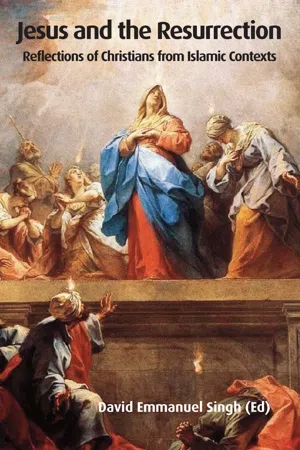
The idea of a trilogy containing reflections by Christians living in Islamic contexts was born in 2004. The first volume on Jesus and the Cross appeared in 2009. The second volume, Jesus and the Incarnation, was published in 2011. The third volume here is concerned with the theme of resurrection. Our aim here is to build a bridge between Muslims and Christians with Jesus in the centre of the discourse. As an idea, 'resurrection' is shared by and is central to the eschatologies of Christianity, Islam and Judaism. In Islam, the belief in life after death, resurrection and the day of judgement are so central that they are considered to be one of its 'Five Pillars'. Life has meaning because in resurrection, humanity will meet its maker on the Day of Judgement. The presence of such an idea in Islam is arguably evidence of the crossfertilisation across the monotheistic faiths. Although, traditionally, Muslims have denied the death of Jesus, 'the ignoble and accursed' death on the cross, both major branches of Islam maintain that Jesus is alive. There is room here for dialogue between Christians and Muslims. 'Christo-centricity' of this nature contrasts sharply with the secular worldview where there are no such common grounds. The idea of the living Jesus also relates to a widespread sub-tradition of Islam, Sufism, which shows a muted preference for sainthood and progressive revelation; the living Jesus plays a significant part in such traditions. Although there is an irreconcilable chasm between the traditional Muslim and Christian positions, there is a meeting of sorts also in their 'ordinary narratives' as they encounter the person of Jesus who touches their lives in tangible ways....
- English
- ePUB (mobile friendly)
- Available on iOS & Android
eBook - ePub
Jesus and the Resurrection
About this book
Information
Topic
Theology & ReligionSubtopic
Christian MinistryPART I
THE LIVING JESUS
Jesus, ‘the Living Wali’? A Revisionist Reading of Surah 18:60-82
David Emmanuel Singh
Dr. David Emmanuel Singh is Research Tutor in Islam and South Asian Studies at the Oxford Centre for Mission Studies, UK.
Introduction
Sufism and some supposed marginal traditions in Islam have for centuries showed a muted preference for the possibility of nabuwat (prophecy) leading to wilayat (sainthood) and the exoteric prophetic agency to the inwardness of the saints. The prophetic revelation here remains normative but the saints or the Sufis are seen as mediums for its fuller realisation. Arguably, despite diversity, the main message Sufism conveys is that ‘God speaks’ directly to the seekers of truth. ‘Courtesy’ appears to play an important role here. The direct connection between the seeker and God is not seen to be an independent route to God but as a ‘revelatory phase’ merely uncovering the ‘deeper’, ‘hidden’ or ‘spiritual’ meanings of prophecy. Could this possibly be evidence of aspiration among Muslims for progressive revelation?
In this paper, I review the Qur’anic account of Moses (a prophetic exemplar) and his mysterious companion, later identified with the Khidr, ‘the Green Man’ (a saintly exemplar). The intention is first to review sources on the identity of this mysterious companion in Muslim traditions and on the problem of the relationship between the prophets/prophecy and sainthood/saints. Do we have here, key evidence for a seemingly lost Muslim tradition the recovery of which may make it possible not just to appreciate that neither is the divine transcendence a defining characteristic of Islam nor is prophecy its end – sainthood enables the deepening of Islam through its access to ‘the hidden meanings’ of the prophecy?
The Qur’anic account involving Moses is common to both the Muslim and Christian traditions. What sets the two narratives apart is the baffling narrative of the Prophet Moses’ journey with the mysterious ‘saintly teacher’ of Moses who enables him to appreciate the deeper and hidden realities of life unavailable to him as a prophet.
How are Christians reading the Qur’an to understand the identity of this saintly teacher of Moses? In the context of some attempts to see the Prophet Muhammad in the Bible and similar thinking among some Christian theologians of religion, the possibility of the Khidr as a translated Muslim vision of ‘the living Jesus’ really does not seem far-fetched.
Moses and his Companion in the Qur’an
The prophets and prophecy are at the heart of the Qur’an. Many of these prophets are common to Islam and Christianity. God uses the prophets to forth-tell, foretell and, through these means, bring the erring back to the straight path. Neither Christians nor Muslims, in any significant numbers, attempt to use these shared traditions in reading their respective scriptures. The belief that the Qur’an borrows biblical characters and stories leaves no room for a serious engagement with it. The position that an Arab tradition of these characters existed independently of the Judeo-Christian traditions and informed the Qur’an may create space for that to happen. In this light, two objectives emerge: Muslim-Christian conversations may become a means of affirmation where traditions dovetail and, where the traditions diverge there is a possibility of gaining fresh or related perspectives as a basis for further dialogue.
Two central characters in the biblical tradition are Moses and Jesus: the former mediated the law of the transcendent God and the latter fulfilled this law by potentially connecting humanity with God; one represents the ‘old covenant’ and the other the ‘new covenant’. Many prophets from Islam share their names with characters in Christianity. Moses and Jesus are among the special messengers of God. Both Jesus and Moses find copious references in the Qur’an. The Qur’anic narrative of Moses (who is clearly considered a major prophet, being a messenger), for the most part, is similar to the Bible. The image of Jesus in the Qur’an is similar to and different from the other prophets, including Moses and this appears not to be accidental. The prophets in the Qur’an serve to support Muhammad’s call for the unity and the otherness of God. The prophets call people to worship this transcendent God and warn them of the impending punishment should they fail to heed the prophetic warning. The narratives involving the prophets are relevant because they serve as illustrations of what might happen to those who do not heed the warnings of Muhammad, the final prophet. The specific issue at the heart of the traditional Muslim objection to Christianity revolved around the relation between Jesus and God as well as humanity and God. God is one and utterly transcendent and Christology sacrifices this fundamental prophetic affirmation. Thus, the Qur’anic references involving Jesus can be read as projecting a Jesus who corrects this sort of immanent Christology.
Does the Qur’an contain anything that might suggest a possibility of the ‘fulfilment’ of the ‘prophets and law’ through intimacy with God? Sufis present possibilities of which Surah 18:60-82 is the most significant.1 We have here an early revisionist tradition which somehow got ‘left behind’ despite early redactions to conform the text of the Qur’an to a single dominant and exoteric tradition. This passage records the story of Moses’ apprenticeship with a mysterious person. The story provides the Sufis with a Qur’anic basis for the plurality of revelatory processes through the agencies of the prophet (nabi) and the saint (wali) – the former gaining knowledge of the one transcendent God through the angel of revelation, Gabriel, and the latter directly from God. Neither the similarity in the narrative content nor the difference in aims between the Qur’an and the Bible is the main issue here. It is what we have in the Qur’an itself about Moses and his mysterious companion that is fundamentally problematic. This additional narrative does not appear to conform to the main structure of the prophetic salvation history rather it appears to serve as a departure from it and, therefore, revisionist in intent.
This additional narrative concerns what appears to be introducing an alternative discourse on the nature of the prophetic revelation. It seems to be suggesting that the prophets (even the messengers) may be the means of revelation but neither are they perfect nor is the revelation through them ‘final’. This Qur’anic narrative of Moses’ transformation through his association with a mysterious figure known in the Islamic tradition as the Khidr (the Green One), though exceptional may be the evidence. This narrative is rather elaborate and approximates in its oddity to the biblical narrative of Abraham and the mysterious king of Salem, Melchizedek.
The main structure of the narrative is as follows: Moses, the quintessential prophet, is informed of this mysterious person; Moses searches and finds him at a place where ‘the two seas meet’ (a picture of the interface between the physical and spiritual worlds);2 his covenant with the mysterious companion, their journeys, conversations and Moses’ eventual ‘enlightenment’. The core of this Qur’anic narrative is repeated and expounded both in the canonical and Sufi traditions:
60. Behold, Moses said to his attendant, “I will not give up until I reach the junction of the two seas or (until) I spend years and years in travel.” 61. But when they reached the Junction, they forgot (about) their Fish, which took its course through the sea (straight) as in a tunnel. 62. When they had passed on (some distance), Moses said to his attendant: “Bring us our early meal; truly we have suffered much fatigue at this (stage of) our journey.” 63. He replied: “Sawest thou (what happened) when we betook ourselves to the rock? I did indeed forget (about) the Fish: none but Satan made me forget to tell (you) about it: it took its course through the sea in a marvellous way!” 64. Moses said: “That was what we were seeking after:” So they went back on their footsteps, following (the path they had come). 65. So they found one of Our servants, on whom We had bestowed Mercy from Ourselves and whom We had taught knowledge from Our own Presence. 66. Moses said to him: “May I follow thee, on the footing that thou teach me something of the (Higher) Truth which thou hast been taught?”67. (The other) said: “Verily thou wilt not be able to have patience with me!” 68. “And how canst thou have patience about things about which thy understanding is not complete?” 69. Moses said: “Thou wilt find me, if Allah so will, (truly) patient: nor shall I disobey thee in aught.” 70. The other said: “If then thou wouldst follow me, ask me no questions about anything until I myself speak to thee concerning it.” 71. So they both proceeded: until, when they were in the boat, he scuttled it. Said Moses: “Hast thou scuttled it in order to drown those in it? Truly a strange thing hast thou done!” 72. He answered: “Did I not tell thee that thou canst have no patience with me?” 73. Moses said: “Rebuke me not for forgetting, nor grieve me by raising difficulties in my case.” 74. Then they proceeded: until, when they met a young man, he slew him. Moses said: “Hast thou slain an innocent person who had slain none? Truly a foul (unheard of) thing hast thou done!” 75. He answered: “Did I not tell thee that thou canst have no patience with me?” 76. (Moses) said: “If ever I ask thee about anything after this, keep me not in thy company: then wouldst thou have received (full) excuse from my side.” 77. Then they proceeded: until, when they came to the inhabitants of a town, they asked them for food, but they refused them hospitality. They found there a wall on the point of falling down, but he set it up straight. (Moses) said: “If thou hadst wished, surely thou couldst have exacted some recompense for it!” 78. He answered: “This is the parting between me and thee: now will I tell thee the interpretation of (those things) over which thou wast unable to hold patience. 79. “As for the boat, it belonged to certain men in dire want: they plied on the water: I but wished to render it unserviceable, for there was after them a certain king who seized on every boat by force. 80. “As for the youth, his parents were people of Faith, and we feared that he would grieve them by obstinate rebellion and ingratitude (to Allah and man). 81. “So we desired that their Lord would give them in exchange (a son) better in purity (of conduct) and closer in affection. 82. “As for the wall, it belonged to two youths, orphans, in the Town; there was, beneath it, a buried treasure, to which they were entitled: their father had been a righteous man: So thy Lord desired that t...
Table of contents
- Cover
- Title Page
- Copyright
- Contents
- Foreword
- Introduction
- Part I: The Living Jesus
- Part II: Christian Thinking on the Resurrection
- Part III: Resurrection as Lived Praxis
- Bibliography
- Index
- Back Cover
Trusted by 375,005 students
Access to over 1.5 million titles for a fair monthly price.
Study more efficiently using our study tools.
Frequently asked questions
Yes, you can cancel anytime from the Subscription tab in your account settings on the Perlego website. Your subscription will stay active until the end of your current billing period. Learn how to cancel your subscription
No, books cannot be downloaded as external files, such as PDFs, for use outside of Perlego. However, you can download books within the Perlego app for offline reading on mobile or tablet. Learn how to download books offline
Perlego offers two plans: Essential and Complete
- Essential is ideal for learners and professionals who enjoy exploring a wide range of subjects. Access the Essential Library with 800,000+ trusted titles and best-sellers across business, personal growth, and the humanities. Includes unlimited reading time and Standard Read Aloud voice.
- Complete: Perfect for advanced learners and researchers needing full, unrestricted access. Unlock 1.5M+ books across hundreds of subjects, including academic and specialized titles. The Complete Plan also includes advanced features like Premium Read Aloud and Research Assistant.
We are an online textbook subscription service, where you can get access to an entire online library for less than the price of a single book per month. With over 1.5 million books across 990+ topics, we’ve got you covered! Learn about our mission
Look out for the read-aloud symbol on your next book to see if you can listen to it. The read-aloud tool reads text aloud for you, highlighting the text as it is being read. You can pause it, speed it up and slow it down. Learn more about Read Aloud
Yes! You can use the Perlego app on both iOS and Android devices to read anytime, anywhere — even offline. Perfect for commutes or when you’re on the go.
Please note we cannot support devices running on iOS 13 and Android 7 or earlier. Learn more about using the app
Please note we cannot support devices running on iOS 13 and Android 7 or earlier. Learn more about using the app
Yes, you can access Jesus and the Resurrection by David Singh in PDF and/or ePUB format, as well as other popular books in Theology & Religion & Christian Ministry. We have over 1.5 million books available in our catalogue for you to explore.