Music is an exciting aspect of African cultures south of the Sahara, abounding in creativity and full of life and movement. Christian worship music was added to the music mix by missionaries from Europe and North America in the nineteenth and twentieth centuries, and it has retained much of its Western flavor. This book is a case study of the African Christian community among the Songhai and its worship music. Drawing on extensive research conducted over a six-year period, the author explains the relationships between music, culture, and worship using the Songhai church as a case study. In the process, he builds a model for further research and experimentation in the worship of other Christian communities. Included in the discussion are insights from the disciplines of ethno- musicology, worship study, anthropology, theology, missiology, and history.
- English
- ePUB (mobile friendly)
- Available on iOS & Android
eBook - ePub
Worship Music Culture
About this book
Information
Topic
Theology & ReligionSubtopic
Christian Ministry1. Introduction
‘The person who has not travelled will not gain wisdom.’
Songhai Proverb1
My Personal Journey: A Liminal Identity
In his book How Musical Is Man?, ethnomusicologist John Blacking describes the posture of two types of people. The first are limited by their cultural understanding, unable to think outside the box of their culturally conditioned concepts of music and musical ability. Such people, Blacking says, mistake the means of culture for its ends and live ‘for culture’ (original emphasis).2 The second type of people are those who think and act outside the box of their cultural limitations. Blacking says these people live ‘beyond culture’ (original emphasis). They live in a state of liminality. The Oxford Dictionary of English gives two definitions of ‘liminal’: 1) ‘relating to a transitional or initial stage of a process’, or 2) ‘occupying a position at, or on both sides of, a boundary or threshold.’3 For my purposes, I am relying heavily on the second definition. It is a ‘state of continuity and discontinuity at the same time, a kind of bi-cultural identity.’4 To put it another way, it is a condition of living between worlds, or on the borderland between them, where life is unsettling and disconcerting.
The word liminal may be used to describe the state of ‘in-betweenness’ in common Western rituals such as graduation (between finishing coursework and receiving a diploma) or the period of engagement before marriage. Concepts of time such as twilight, noon, or New Year’s Day are liminal, since they are on both sides of a temporal boundary. There are also in-between places, such as planes, country borders, disputed territories, or airports. In addition, the concept of liminality has entered the popular discourse and culture through television programs such as ‘The Twilight Zone’ (1959–2003) and ‘Lost’ (2004–2010), through books like Offshore (by Penelope Fiztgerald [1979]), and through films such as ‘The Terminal’ (2004).
I have lived in a state of liminality most of my life. Born outside the United States, I lived nearly half my childhood outside my passport country. Since 1984, I have lived in Niger, where I have become an insider to the Songhai culture. For 16 years I lived in an isolated area of the country. As a result, I speak the language, wear appropriate dress, and observe many cultural practices and taboos. I eat local foods and bear a Songhai name and identity. I participate with people in their daily activities and rites of passage, share their ordeals, and advocate their cause.
I am what Paul Hiebert calls an outsider-insider.5 As the Songhai proverb vividly puts it, ‘Even though a log remains in the water a long time, it never becomes a crocodile.’6 I am a white stranger who will always be an outsider to Songhai culture. My passport culture continues to affect my thoughts and actions, even though I understand and appreciate many Songhai ways. While I have resided many years in Niger, my ignorance of Songhai culture comes out at inopportune times. Until I started my research in 2010, for instance, I knew little about Songhai music and had not learned the names of traditional instruments.
My identity as an outsider-insider is often confusing and ambiguous. Am I American or African? Am I more at home in the US or in Niger? I live in a state of continuity and discontinuity at the same time. My status is hybrid and dynamic, and the word ‘home’ is a vague and shifting concept for me. I desire to go beyond the stereotypes that a dominant culture imposes on anyone who is different, but I am limited by my cultural background. I live in a constant state of liminality between insider and outsider, between poverty and riches, between west and south, between the demands of people and the demands of time, between the past and the future, between continuity and discontinuity, between minority and dominant cultures, between the community and the individual. I am on the threshold of three worldviews: my Christian one, the traditional/Muslim/African one, and the secular/postmodern one. Who am I? I am multicultural, living in and for cultures but also beyond culture. I am a person who, like a chameleon, changes color to fit my environment. I am both/and and neither/nor. I am both a stranger and a ‘native’. My identity as both outsider and insider to several worlds has shaped my life and my identity.
As a Christian, of course, I have an identity in Christ that is unchangeable, but I also live in the world as a human being. I cannot completely divorce myself from my local context. It is easy to say that my home is in heaven, but it is hard to live without a true ‘home’ in this world. We all seek a stable home. I live on the margins of ‘home’. That is sometimes unsettling. I live with two types of liminality: the one between my Christian and my human identity, and the one between my differing human identities. I am rooted and grounded in Christ, but my human identities change with time and place.
My Research Journey: The Issue at Stake
Before starting my doctoral research in 2010, I had already acquired many academic and artistic qualifications in the areas of worship, music, and culture. I have extensive cross-cultural training and experience in African, European, and Asian settings. I learned French as a teenager and speak it well. I studied mathematics, theology, languages, linguistics, and the social sciences in secondary school and in university. Later, I earned a master’s degree in intercultural studies at Columbia International University. Involved in church and corporate worship from my youth, I have familiarity with liturgy and different liturgical styles. In addition, I have wide-ranging training and background in musical performance and technique. Taught to play piano at an early age, I played for many church and social functions in my youth. In adult life, I learned to play the acoustic guitar and lead congregational singing. I also have vocal experience in choirs, chorales, and musical ensembles.
When I began working among the Songhai, I quickly observed that most had little interest in singing or playing musical instruments. This seemed odd, especially in Africa south of the Sahara. It is not as if there is no music in the Songhai and related Zarma cultures of West Africa. In fact, they have a rich tradition of music, song, and dance going back at least five centuries. I started asking myself questions. What was going on here? How do the Songhai view music and musicians? Are the Songhai unique in their perspective? Why had I come to work with a people who seemed so ambivalent toward music?
As I got to know the Songhai/Zarma people and language better, I also got involved in the church and made more observations. I noticed that while Songhai Christians love music and singing, they retain some cultural attitudes and ideas toward music. What is more, they rarely seek to incorporate their musical traditions into church worship, relying mostly on borrowed forms of worship music. Very few Christian Songhai have composed worship songs for congregational singing. Almost all songs are translated from other languages and use a foreign melody. This provoked other questions in my mind: Why are the vast majority of worship songs coming from outside the country? Why do Songhai Christians seem so hesitant to use their local expressions of music in worship? How should believers best express their Christian and Songhai identities in music? To what extent is traditional music important to the church? The lack of worship music in the local idiom also seemed odd. Songhai Christians appeared indifferent to adopting new musical ideas and suggestions, for example, while the neighboring Gurmancé people would readily incorporate suggestions and ideas into worship and church functions. The following story illustrates the questions that I wrestled with.
In a church outside of Niamey it is a tradition for each ethnolinguistic group to sing a song in their language during part of the Sunday service. On the day we visited, the Zarma group in the church had just sung a song in their native language, a chorus translated from French entitled, ‘He Is the God of Miracles’. (The reader can hear the song at the following link: http://bit.ly/2lVk3Tl.) While the other linguistic groups like the Tuareg, the Hausa, and the Gurmancé sang original songs employing indigenous melodies and lots of movement, the Zarma had trouble coming up with a song, and their gestures seemed stiff and uncomfortable. When they were done, one of the members of the group made the following comment as a sort of apology: ‘The Zarma do not have any of their own [worship] songs. They are all translated from other languages’.7
While what this man said is an exaggeration, his words succinctly summarize the nature and scope of my longstanding questions. By comparison with other cultures in Niger and West Africa, the Songhai/Zarma people have very few worship songs composed by their own people. These sentiments are not unique. Another man had this to say about the current repertoire of music in the Songhai church: ‘A great majority of the Songhai people remain attached to their oral traditions. They can view this way of singing [in the church] as foreign to their reality.’8 One Zarma pastor made the comment: ‘Music is not exactly in the … Zarma culture.’9 A musician colleague expressed the same frustrations I have felt about the attitude toward music among the Songhai people.10
Even though they won’t sing or play instruments, the Songhai do appreciate music. They listen and dance to music a lot. I have witnessed their positive reaction to music. Here is another story relating a moment of surprise and inspiration I experienced:
Téra, Niger. December 25, 2002. The four small, recently formed churches in Téra, a large town in Niger, met for their first-ever joint Christmas celebration. It was a rather stiff, formal service. There was some congregational singing accompanied by a jembe and cymbals. Several people read Scripture, and my message, translated from French into Songhai, was rather bland. Each church presented a choral number. I sang a Christmas song with my family accompanied by my guitar. For the most part, it was all quite unexciting, and, I might say, rather boring.
All that changed, however, when the choir from a nearby village church got up. The people of this village are mostly poor, semi-literate farmers and are not Songhai. The choir was composed mainly of women, with a male leader and another man playing a small drum. The song was a simple, call-and-response chorus with the leader singing a line and the choir responding to his lead. They sang in Gurmancéma, a language unknown to most Songhai present.
As soon as they started, the congregation erupted. Drooping heads snapped up. Eyes lit up with a new glow. People began clapping and swaying to the beat. To my outsider eyes and ears, there was nothing remarkable about the song. The choir was neither swaying nor dancing. They were standing in place and singing rather quietly. They did not even seem to be together on the same note. The only movement was the occasional lifting of the arm of the leader as he stabbed the air to make a point and the tapping of the drum by the drummer. Nevertheless, the audience was standing, clapping, and dancing to the beat. Women began ululating. The tumult increased dramatically. People rushed forward and placed coins and bills at the feet of the choir or pressed them to the forehead of the leader, a sign of appreciation and encouragement.
As I stood watching, fascinated by the spectacle, I sensed that here was an authentic African expression of Christian worship. It meant very little to me, but it obviously meant a lot to those present, even though most did not understand the words. I wondered if this kind of music could be developed for worship in the Songhai language using Songhai musical styles and instruments. Would it be accepted? Would people enjoy it? Would they sing it? What effect would it have on believers and non-believers? Would urban churches like such music as well as rural churches? What was preventing the Songhai church from creating music like this? Would worship feel more comfortable and less alien to both believers and unbelievers if it contained some elements from the Songhai musical culture? What do I as a musician have to offer the Songhai, if anything? What kinds of music and song are appropriate for the Songhai in a worship setting? What model should be used for singing in Songhai churches?
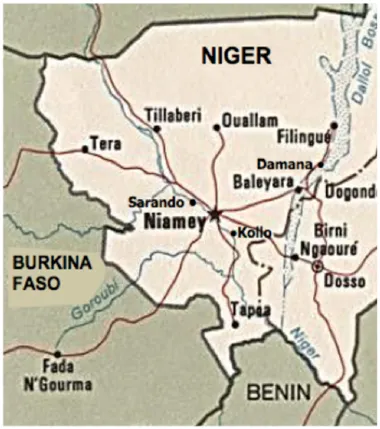
Map 1-1: Western Nige...
Table of contents
- Cover
- Title
- Copyright
- Content
- Acknowledgements
- Preface
- Abbreviations
- Chapter 1: Introduction
- PART I: HISTORICAL, CULTURAL, AND THEORETICAL FOUNDATIONS
- PART II: CULTURAL THEORY AND FIVE SONGHAI SUBCULTURES
- PART III: APPLICATION
- Glossary
- Songhai Pronunciation Guide
- Index
- Bibliography
- Back Cover
Trusted by 375,005 students
Access to over 1.5 million titles for a fair monthly price.
Study more efficiently using our study tools.
Frequently asked questions
Yes, you can cancel anytime from the Subscription tab in your account settings on the Perlego website. Your subscription will stay active until the end of your current billing period. Learn how to cancel your subscription
No, books cannot be downloaded as external files, such as PDFs, for use outside of Perlego. However, you can download books within the Perlego app for offline reading on mobile or tablet. Learn how to download books offline
Perlego offers two plans: Essential and Complete
- Essential is ideal for learners and professionals who enjoy exploring a wide range of subjects. Access the Essential Library with 800,000+ trusted titles and best-sellers across business, personal growth, and the humanities. Includes unlimited reading time and Standard Read Aloud voice.
- Complete: Perfect for advanced learners and researchers needing full, unrestricted access. Unlock 1.5M+ books across hundreds of subjects, including academic and specialized titles. The Complete Plan also includes advanced features like Premium Read Aloud and Research Assistant.
We are an online textbook subscription service, where you can get access to an entire online library for less than the price of a single book per month. With over 1.5 million books across 990+ topics, we’ve got you covered! Learn about our mission
Look out for the read-aloud symbol on your next book to see if you can listen to it. The read-aloud tool reads text aloud for you, highlighting the text as it is being read. You can pause it, speed it up and slow it down. Learn more about Read Aloud
Yes! You can use the Perlego app on both iOS and Android devices to read anytime, anywhere — even offline. Perfect for commutes or when you’re on the go.
Please note we cannot support devices running on iOS 13 and Android 7 or earlier. Learn more about using the app
Please note we cannot support devices running on iOS 13 and Android 7 or earlier. Learn more about using the app
Yes, you can access Worship Music Culture by John R DeValve in PDF and/or ePUB format, as well as other popular books in Theology & Religion & Christian Ministry. We have over 1.5 million books available in our catalogue for you to explore.