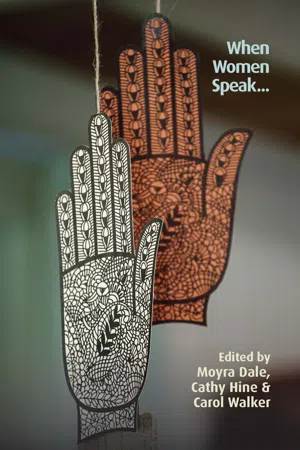
Women's voices are often unheard and unreported; and their place can be controversial. This book brings together the voices of Christian women scholars and practitioners at the nexus of Christianity, mission and Islam. It comes out of the colloquium of the same name, held in Melbourne, Australia in 2015, when twenty-eight women from different nations and nationalities, different ages and theological perspectives, and different religious backgrounds met together – those of Christian background, and also first and second generation Christians of Muslim background. The colloquium grew from a recognition that women's voices are underrepresented to such an extent that they are almost not present in much of the discussion around missiology and Islam, despite the numbers of women with both significant practical experience, and engaging in higher research and scholarship in the area.
eBook - ePub
When Women Speak
About this book
Information
Topic
Theology & ReligionSubtopic
Christian Ministry1
Veiled: Muslim Women in Modern Mission Strategies
Veiled: Muslim Women in Modern Mission Strategies
Cathy Hine
Introduction
In 1852, Mrs McKenzie, wife of an East India Company merchant, and Lady Mary Kinnaird, wife of a London banker, established the mission organisation that today is Interserve. They recognised that women, secluded in the zenanas1 of India, were hidden from the gospel and from education and health care. A deliberate and intentional engagement, challenging the prevailing cultural hegemony, took education and health in the name of Jesus to women who were otherwise marginalised. This innovation in mission practice opened new doors for women missionaries that included the opportunity to train as doctors,2 a field that had been closed to women until this time.
Today, while women still make up the largest proportion of mission workers, we are seeing their numbers3 decline. Few international mission organisations are led by women,4 despite women constituting the majority of workers throughout the history of mission.5 While the emergence and growth of the leadership of non-Western women may hold the key to the future of women in mission, the marginalisation of women with respect to missiology and mission strategy is dramatically affecting women’s access to the gospel.
This is particularly true in areas of the world where Islam is the dominant religion. Missiologies and mission strategies directed toward the house of Islam are shaped by particular definitions of contextualisation that have led to a priori assumptions that focus fulfilment of the great commission on reaching men first, and the community will follow. Fran Love has stated: “…Muslim women are too often left out of strategic church planting due to… a ‘gender-blind missiology’ This mission theory states that missionaries need first of all to influence heads of households and leaders who will in turn influence their families and those under their authority. While based on conventional wisdom… it is an incomplete perspective both for biblical and practical reasons.” (Love, 1996:135) What is the impact of contextualised mission strategies on Muslim women?
In missiology and mission practice women’s participation is often veiled, or ‘without faces’ (Ross, 2011, quoting Young Lee Hertig), which further veils women who live under Islam. Women’s work is often considered secondary in mission. In Interserve, forty-five percent of country team leaders are women, but this is due, in part, to views about the ‘unassigned spouse’, that the man’s ministry is too important for a role that is considered administrative and powerless.
Missiology and mission practice do not develop in a vacuum. In 2010, Interserve needed to produce a gender6 inclusivity statement, and now, a booklet on gender in its ‘Vision and Practice’ series. This has become necessary in an organisation started by women to reach women. Why? It is due, at least in part, to resurgent voices among evangelicals framing theologies that underpin missiologies that narrowly define how women may use their gifts and engage in ministry.
However, when we understand some of the reasons why women from within Islam become followers of Jesus, and how their journey with Jesus is walked out, we open possibilities for more gender-nuanced strategies for ministry.
Contextualisation
Phil Parshall pioneered modern expressions of contextualisation for ministry to Muslims. He defines contextualisation as “…the effort to understand and take seriously the specific context of each human group and person on its own terms and in all its dimensions – cultural, religious, social, political, economic – and to discern what the Gospel says to people in that context.” (Parshall, 2003:36) Contextualisation is not cultural relativism.7 It embraces a culture’s conceptual categories, forms and symbolic motifs, while at the same time critically assessing each individual aspect of the culture according to its compatibility with the scripture. Timothy Tennent says contextualisation is about Jesus being authentically experienced in the particularities of the local context. (Tennent, 2010)
Contextualisation in mission today has been developed from definitions of culture in secular anthropology.8 Christ and culture are seen as wholly separate, leaving little or no room for the Kingdom of God to break in. But, as David Greenlee says, true contextualisation deals with values and worldview, and is more than an approach to witness. (Greenlee, 2012) The Kingdom of God breaks in bringing transformation, the future breaking into the present. Tennent rightly asserts that all parts of culture are enhanced, or destroyed or enlivened when brought under the Lordship of Christ. (2010)
We will consider two contextualised strategies:9 family networks and the insider movement. Both of these have informed approaches to reaching people and building the Church in countries where Islam is the dominant religion. They have highlighted and wrestled with challenges at the interface of Islam and the gospel. The question is not whether we are for or against either of these, rather we want to explore the impact of pursuing these strategies for women who follow Islam.
Family Networks
Identifying married male, literate, rural farmers or fisherman, who were well-respected members of Muslim society, as their target group for evangelism, Phil Parshall and his team were clear who was not included: “In our context, young persons, or women of any age, would not be appropriate as an initial direction for evangelism. It was hoped that they would follow in the faith of their husband/father.” (Parshall, 2012:225) Parshall’s work in the 1980s was considered ground-breaking,10 and subsequent mission strategies for work among the peoples of Islam increasingly focused on male heads of families and communities.
Dudley Woodberry, scholar of Islam and mission, agrees, suggesting that for a movement to be born, family and community decision-makers must be the focus. (Woodberry, 2005) Research in Pakistan by Edwards Evans also seems to affirm this strategy. Evans found that of primary converts, the first to come to faith in a family, only ten percent were women, and no husband had followed. Where men were first to come to faith, at least twenty women and other family members had followed (Evans, 2012).11
The evidence seems irrefutable. Or is it? The work of women practitioners in the field seems to challenge the conclusion that if you reach the man you reach the family. Yvette Wray says this about work in Bangladesh: “We knew that if Muslim women would become believers, then the entire family would follow. Gaining access to Muslim women to share the gospel had been the impossible task…” (Wray, 2006:146) In Kazakhstan, women are coming to faith and being followed by their husband and family members. (Lindhal, 2006). Another worker noted: “Our organisation… has focused on mass evangelism and reaching men, believing that women would follow men. But in West Africa, Muslim-background believer (MBB) churches are mostly made up of men. Muslim women have not automatically followed their MBB husband’s faith… reaching Muslim men will not ensure that women are reached.” (Thompson, 2006:110) Mary McVickers also challenges this assumption that the gospel will move along kinship lines: “often the gospel is heard by men and moves through their relationships with one another rather than across gender lines within kinship”, although, she acknowledges, there are exceptions. (McVickers, 2005:128)
There is a cultural context issue that has not informed missiological and strategic thinking. Male BMBs are raised in cultures where women’s identity and value is ambiguous. Normative cultural, political and religious discourses have relegated women to the private sphere, controlling them through a range of social, legal, economic and educational practices. Contextualised strategies have often failed to negotiate these complexities, simplifying the framing of practice to the superficial, easily recognised ‘cultural norms’ around male headship. This is seen, for example, in the Believer from a Muslim Background (BMB) in the Middle East, with a strong witness as a musician, who said that he did not witness to his wife because she was ‘just an illiterate village woman’. (Stricker, 2006)
Rebecca Lewis has challenged conventional mission thinking on contextualisation and the family, saying: “The women of Islam could very well be the gateway of the Gospel in Islamic networks.” (Lewis, 2004:76) Within most communities of followers of Islam it appears that men are the power brokers shaping beliefs and practices. In the public sphere that is true. But the public and private spheres intersect. Religious power and authority are in the hands of both the Imam and women. Whereas the Imam’s power is community-based and exercised through the mosque, women engage in their rituals and practices in private, within the family context. (Mullin, 2006) The greatest keepers of tradition within Islam,12 along with the most vocal advocates for change, are women.13
When Parshall’s story of reaching Muslims in Bangladesh through family networks became a strategy for all countries where Islam is the dominant religion, the trajectory of mission strategies began to veil Muslim women. Assumptions were made about what would happen within family networks. The interplay between the public and private spheres was ignored. Women’s agency was denied. Their marginalisation increased.
Insider Movement
Kevin Higgins defines insider movements14 as: “A growing number of families, individuals, clans and/or friendship-webs becoming faithful disciples of Jesus within the culture of their people group, including their religious culture. This faithful discipleship will express itself in culturally appropriate communities of believers who will also continue to live within as much of their culture, including the religious life of the culture, as is biblically faithful. The Holy Spirit, through the Word and through His people will also begin to transform His people and their culture, religious life and worldview.” (Higgins, 2004:156) The practice of mission is premised on the gospel addressing the specificities of cultural contexts. The Insider Movement has adopted a particular approach to what that looks like.
The challenge of the Insider Movement for women followers of Islam is that it reifies culture and fails to accept that not every cultural expression of Islam is good for women. Women, their needs, their challenges in hearing about and following Jesus, are subsumed under a rubric that says the socio-political and religious norms and symbols of their community are enough; that they provide appropriate symbols of faith by which women should follow Jesus. Sherine Hafez’s work on women’s Islamic activism challenges such assumptions. She reminds us that the normative political, social and religious discourses that women live under leave them caught in the double bind of the Islamic agenda and their gender. (Hafez, 2011) The way women are imagined in their society and the impact of that on both their identity and space to act warns mission strategists of the dangers of uncritically embracing cultural and religious forms for the gospel.
The Insider Movement strategy has been debated at a range of levels, but whether by its proponents or opponents, it is almost exclusively debated by men.15 This absence of women’s voices reflects another aspect of their veiling within this strategy.
This critique of the Insider Movement is not a validation of its opponents. Opposition is largely masculine driven and often unable to hear the other.16 The demands for theological validity, within particular practical expressions, have blinded opponents to the religious hegemony being created. They have emphasised certain expressions of Christian faith, often with strong patriarchal interpretative overtones. This ‘anti-insider’ strategy is equally guilty of...
Table of contents
- Cover
- Preface
- Title
- Copyright
- Contents
- Introduction
- 1: Veiled: Muslim Women in Modern Mission Strategies
- 2: A Feminine Reading of Christian Missions or A Question of Belonging
- 3: (Re)forming Identities and Allegiances
- 4: Do Muslim Women Need Saving? Cultural, Theological, and Missiological Perspectives
- 5: Fire-words: Voicing the Pain
- 6: When Women Speak: A Missiology of Resistance
- Contributors
- BackCover
Trusted by 375,005 students
Access to over 1.5 million titles for a fair monthly price.
Study more efficiently using our study tools.
Frequently asked questions
Yes, you can cancel anytime from the Subscription tab in your account settings on the Perlego website. Your subscription will stay active until the end of your current billing period. Learn how to cancel your subscription
No, books cannot be downloaded as external files, such as PDFs, for use outside of Perlego. However, you can download books within the Perlego app for offline reading on mobile or tablet. Learn how to download books offline
Perlego offers two plans: Essential and Complete
- Essential is ideal for learners and professionals who enjoy exploring a wide range of subjects. Access the Essential Library with 800,000+ trusted titles and best-sellers across business, personal growth, and the humanities. Includes unlimited reading time and Standard Read Aloud voice.
- Complete: Perfect for advanced learners and researchers needing full, unrestricted access. Unlock 1.5M+ books across hundreds of subjects, including academic and specialized titles. The Complete Plan also includes advanced features like Premium Read Aloud and Research Assistant.
We are an online textbook subscription service, where you can get access to an entire online library for less than the price of a single book per month. With over 1.5 million books across 990+ topics, we’ve got you covered! Learn about our mission
Look out for the read-aloud symbol on your next book to see if you can listen to it. The read-aloud tool reads text aloud for you, highlighting the text as it is being read. You can pause it, speed it up and slow it down. Learn more about Read Aloud
Yes! You can use the Perlego app on both iOS and Android devices to read anytime, anywhere — even offline. Perfect for commutes or when you’re on the go.
Please note we cannot support devices running on iOS 13 and Android 7 or earlier. Learn more about using the app
Please note we cannot support devices running on iOS 13 and Android 7 or earlier. Learn more about using the app
Yes, you can access When Women Speak by Moyra Dale in PDF and/or ePUB format, as well as other popular books in Theology & Religion & Christian Ministry. We have over 1.5 million books available in our catalogue for you to explore.