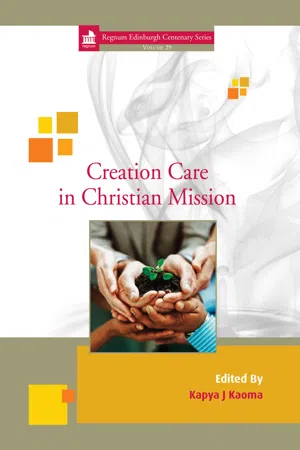
As the world comes to terms with the human-caused destruction of God's sacred creation, whether Global Christianity will celebrate a bi-centennial Edinburgh 2110 becomes a real question. Yet, as Creation Care in Christian Mission shows, the mounting and life-threatening ecological crisis is at the heart of the mission of God. The volume's contributing authors represent a wide range of Christian traditions and geographical regions on which they draw to initiate dialogue on creation care within the wider global Christian community. They explore hard questions relative to climate change, population growth, pollution, poverty, sustainability, economic justice, deforestation, gender, and land issues. Written with academics, missionary and development agencies, and ordinary Christians in mind, this work presents a global unified spiritual and ethical voice on Creation care. The diversity of contributors from established scholars and religious leaders makes this work a unique and critical resource for understanding human responsibility toward God's creation. The book offers hope to all Christians, for Christian mission can positively aid ecological responsibilities and actions.
- English
- ePUB (mobile friendly)
- Available on iOS & Android
eBook - ePub
Creation Care in Christian Mission
About this book
Information
Topic
Theology & ReligionSubtopic
Christian MinistrySECTION ONE
GLIMPSES OF HOPE
The ecological crisis mounts
And so are glimpses of hope.
Christian mission is like a mustard seed,
Planted by the Triune God,
In the field of the human heart,
Though the smallest of all seeds
And mostly invisible, yet grows,
Into the largest of garden plants,
And the largest tree it becomes,
And in its branches the birds perch!
– adapted from Matthew 13:31-32
CHRISTIAN MISSION AND EARTH CARE: AN AFRICAN CASE STUDY1
The Edinburgh 2010 resolve to publish a volume dedicated to Earthkeeping mission is another sign in world Christianity of a growing awareness of the global environmental crisis. Yet, despite the well-intended calls of western church leaders for their people to respect the integrity of creation, one cannot say that the restoration of an abused planet Earth has been identified by them as a frontier to be crossed by way of a comprehensively mobilised missionary outreach of the church. In this chapter I wish to draw attention to a case study of African Initiated Churches (AICs) in Zimbabwe that, over a fifteen-year period (1988–2003), developed a remarkable ministry of Earth-keeping. Their effort poses an arresting challenge to the world church.
Zimbabwe’s ‘War of the Trees’
The resolve in rural Zimbabwe to ‘declare war’ on deforestation, soil erosion, and related forms of environmental destruction grew in the context of a research project conducted during the mid-1980s. I was probing the crucial role of religion in the mobilisation of the liberation struggle (chimurenga) before Independence. During extensive discussions with traditionalists and AIC leaders, most of them key role players during the war, we agreed that the ‘lost lands’ that had been recaptured politically were still being lost ecologically at an accelerated and alarming rate. Something massive and revolutionary was required to arrest the slide towards environmental bankruptcy and the mood of helplessness in rural society. We therefore decided to launch a new movement of ‘green fighters’ as an extension of the pre-Independence liberation struggle, one shifted in this instance into the field of ecology. In the subsequent drafting of organisational plans and mobilising of a force of Earth-keepers, we declared hondo yemiti, the ‘War of the Trees’. Whereas the major concern to start with was nursery development and tree-planting, the new struggle, according to our organisational charter, had three aims: afforestation, the protection of water resources, and wildlife conservation.
At headquarters, the organisational and financially empowering agency was the Zimbabwean Institute of Religious Research and Ecological Conservation (ZIRRCON), the institutionalised and extended version of my research team. Founded in 1984, this body took responsibility for the initiation and development of two affiliated organisations: the Association of Zimbabwean Traditional Ecologists (AZTREC), which comprised the majority of chiefs, headmen, spirit mediums, former combatants, and a large group of commoners in Masvingo Province; and the Association of African Earth-keeping Churches (AAEC), which at its peak counted some 180 AICs, mainly prophetic Zionist and Apostolic churches, then representing an estimated two million adherents.
During the 1990s the entire movement of African Earthkeepers represented the largest non-governmental organisation for environmental reform at the rural grassroots, not only in Zimbabwe but in all of Southern Africa. According to internationally recognised ecological luminaries, such as Larry Rasmussen, Mary Evelyn Tucker and John Grim, who visited us in Zimbabwe, ZIRRCON’s inculturated and ritualised practices of Earth care was as innovative as any indigenous green movement they had observed elsewhere in the Two-Thirds World.
The accomplishments of the movement during the first fifteen years of its existence – the period during which I acted as ZIRRCON’s director – are briefly the following: fifteen to eighteen mother nurseries, some of which cultivated more than 100,000 seedlings in a given year, and a host of small-scale satellite nurseries run by women and schools were established. An estimated 12-15 million trees were planted during that period, in several thousand woodlots, by AZTREC and AAEC peasant communities, and also by women and school children in the central and south-eastern communal lands of Zimbabwe. The variety of trees planted included:
•fruit trees in orchards for personal and commercial use;
•exotics such as eucalyptus for building operations;
•indigenous trees for firewood and the restoration of denuded land;
•leucaena for cattle fodder, firewood, and nitrate-fixing in arable lands; and
•indigenous hardwood, such as kiaat and pod mahogany, as a long-term investment for future generations.
ZIRRCON’s Earthkeepers became known for cultivating more indigenous fruit tree seedlings, thorn trees, mountain acacias, and ancestor-related trees than any other institution had ever done in the country. Government officials, including President Mugabe, attended and participated in our annual tree-planting ceremonies.
The Women’s Desk, with several departments, ably supervised the income-generating projects of eighty women’s clubs, which included cloth manufacturing, bakeries, soap production, the pressing and refining of sunflower oil, and vegetable and fruit production. These clubs also facilitated the struggle against soil erosion by filling erosion gullies with stones and planting vetiver grass in the affected areas. The spirit mediums and male tribal elders in turn assisted the chiefs by restoring the customary laws on the protection of trees and wildlife in the ancestral sanctuaries of holy groves. Offenders were apprehended and brought to chiefs’ courts, where they were heavily fined and required to plant trees in denuded areas. Likewise, offenders who engaged in riverbank cultivation and spoiling the veld’s grass cover through the use of sleighs (hollowed out tree trunks, heavily loaded and pulled by donkeys or oxen) were served with heavy fines by the ‘green chiefs’.
Up to thirty youth clubs were developed at rural schools. The pupils concerned were taken on trips to identify birds and trees. In addition, members of Parks and Wildlife accompanied them to some of the larger game parks to teach them about big game and the species of game no longer found in the communal lands. They were also familiarised with issues of modern wildlife conservation. I personally introduced proposals for two major game conservancies: one in the communal lands, mainly for the protection of the endangered klipspringer antelope, and the other for a joint project of collective, interracial game farming, incorporating some fifty farms to the east of Masvingo town. These plans, already approved by ZIRRCON, had to be abandoned because of the farm invasions allowed by Mugabe in the year 2000. A few years later, an estimated 85% of the entire game population on Zimbabwe’s farms had been destroyed. So much for game conservation and protection of the country’s natural resources!
A Ritualised Mission
All tree-planting ceremonies were ritualised in either traditionalist or Christian fashion. The ritual component shaped the green struggle as a holy war, directed by the Creator-God and forces from the spirit world. The rituals drew large contingents of rural participants, highlighted publicly the resolve and commitment of the green fighters, and united people in a common cause, regardless of diverse religious persuasions and lingering conflicts of the past.
AZTREC’s Traditionalist Rituals
The ceremonies of the Association of Zimbabwean Traditional Ecologists resembled to a large extent the old rain-requesting rituals of the past, called mukwerere. Sacrificial finger-milled beer would be brewed for the senior clan-ancestors, the varidzi venyika (guardians of the land), whose graves are in sacred groves on holy mountains, at times encompassing large mountain ranges. Sacrificial addresses to these ancestors, on the basis of traditional cosmology, entrusted the seedlings to the protective care of these guardian ancestors and brought to the fore the neglected ecological obligations of old, with appeals for their revival and implementation.2 As is typical for all rain ceremonies, the clan ancestors were also requested to appeal to the African high god, Mwari, for ample rain, in this instance to sustain the newly planted woodlots of trees.
Towards the end of the rainy season (i.e. AZTREC’s tree-planting season), a delegation of traditionalist tree-planters would be sent to the high-god shrines, 300 kilometres to the west, to report to the oracle on the progress of the green struggle. This visit took place because of the belief that Mwari and the senior clan ancestors control all struggles in the country – be they for political or for environmental liberation – from within a spirit war-council.
In both the traditional tree-planting and the oracle-reporting ceremonies, Christian Earthkeepers were also in attendance. In order to demonstrate the retention of their Christian identity, they would refrain from drinking sacrificial beer, but they assisted their non-Christian counterparts once the actual tree-planting took place. Likewise, they refrained from full communion with the oracular deity, even as they engaged in close association and dialogue with cult officials at the shrines. Thus, in an open-ended inter-religious movement, the bitter strife between Zionist prophets and Mwari cultists of the past gave way to positive attitudes of understanding and tolerance in pursuit of a common cause.
The AAEC’s Tree-Planting Eucharist
The use by the Association of African Earthkeeping Churches of a tree-planting Eucharist integrated an Earth-keeping ministry with the sacrament of Holy Communion. This development3 was of pivotal importance, for it brought environmental stewardship right into the heartbeat of church life and biblically based spirituality. In African agrarian society this was a powerful way of witnessing to ‘a change of heart’ within the church, an illustration of re-envisioning the church at its core, allowing it to become a better vehicle for the missionary good news it wants to convey. Moreover, this ceremony highlighted the characteristic trends of an emergent AIC theology of the environment, one not written in books but symbolised in budding trees sustaining a ravished countryside.
Key activities of the outdoor tree-planting sacrament included the following:
•Preparations of the woodlot included digging of holes for the seedlings, fencing, and naming the woodlot ‘Lord’s Acre,’ which was the Christian equivalent of the traditional sacred grove, or marambatemwa (lit. ‘refusal to have the trees felled’).
•Dancing and singing around the stacked seedlings to praise God, the great Earthkeeper, and inspire Mwari’s Earthkeepers to engage in action.
•Several sermons by AIC bishops of different churches and ZIRRCON staff, followed by speeches of representatives of the Forestry Commission, Parks and Wildlife, government officials, and so forth, whereby the Eucharist evolved into an inclusive public, rather than an exclusive in-group, event.
•The sacrament itself was preceded by all Christian participants confessing publicly their ecological sins, such as tree-felling without planting any in return, promoting soil erosion through bad land-husbandry activities, river-bank cultivating, and spoiling wildlife by poaching game animals.
•After confession, each communicant picked up a seedling and moved with it towards the table where the bread and wine were administered. Thereby nature was symbolically drawn into the inner circle of communion with Christ the Redeemer, head of the church and of all creation. In such action, the salvation of all creation and the emergence of a new heaven and earth are anticipated and proclaimed.
•After the use of bread and wine, the Christian communicants were joined by their traditionalist counterparts, who up to this point had merely been observers of the proceedings. Then the green army moved in unison to the ‘Lord’s Acre’ to commit the seedlings to the soil.
•The seedlings were addressed as ‘relatives’ by the planters as they placed them in the soil:
You, tree, my brother… my sister.
Today I plant you in this soil.
I shall protect you
And give water for your growth.
Have good roots to keep the soil from eroding.
Have many leaves and branches.
Then we can breathe fresh air, sit in your shade, and find firewood (when some of your branches dry).
•At the conclusion, many of the tree-planters would kneel in queues in front of the prophetic healers for laying-on of hands and prayer. Thus, the healing of the barren earth and of human beings blended into a single event that witnessed to Christ, the crucified and resurrected Saviour of all the earth.
Ecumenical Sacrament and Mission Command
In the tradition of the Zimbabwean AICs, there are two mission-activating Eucharists. First, in Bishop Mutendi’s Zion Chri...
Table of contents
- Cover
- Title
- Copyright
- Contents
- Preface: Edinburgh 2010 Common Call
- Foreword
- Introduction
- Section 1: Glimpses of Hope
- Section 2: Earth Care in Christian Traditions
- Section 3: Greening Missiology – Issues and Challenges
- Bibliography
- Notes on Contributors
- Index
- Back Cover
Trusted by 375,005 students
Access to over 1.5 million titles for a fair monthly price.
Study more efficiently using our study tools.
Frequently asked questions
Yes, you can cancel anytime from the Subscription tab in your account settings on the Perlego website. Your subscription will stay active until the end of your current billing period. Learn how to cancel your subscription
No, books cannot be downloaded as external files, such as PDFs, for use outside of Perlego. However, you can download books within the Perlego app for offline reading on mobile or tablet. Learn how to download books offline
Perlego offers two plans: Essential and Complete
- Essential is ideal for learners and professionals who enjoy exploring a wide range of subjects. Access the Essential Library with 800,000+ trusted titles and best-sellers across business, personal growth, and the humanities. Includes unlimited reading time and Standard Read Aloud voice.
- Complete: Perfect for advanced learners and researchers needing full, unrestricted access. Unlock 1.5M+ books across hundreds of subjects, including academic and specialized titles. The Complete Plan also includes advanced features like Premium Read Aloud and Research Assistant.
We are an online textbook subscription service, where you can get access to an entire online library for less than the price of a single book per month. With over 1.5 million books across 990+ topics, we’ve got you covered! Learn about our mission
Look out for the read-aloud symbol on your next book to see if you can listen to it. The read-aloud tool reads text aloud for you, highlighting the text as it is being read. You can pause it, speed it up and slow it down. Learn more about Read Aloud
Yes! You can use the Perlego app on both iOS and Android devices to read anytime, anywhere — even offline. Perfect for commutes or when you’re on the go.
Please note we cannot support devices running on iOS 13 and Android 7 or earlier. Learn more about using the app
Please note we cannot support devices running on iOS 13 and Android 7 or earlier. Learn more about using the app
Yes, you can access Creation Care in Christian Mission by Kapya John Kaoma in PDF and/or ePUB format, as well as other popular books in Theology & Religion & Christian Ministry. We have over 1.5 million books available in our catalogue for you to explore.