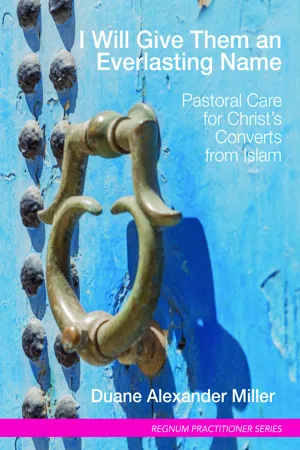
What are the challenges faced by Christ's converts from Islam, and how can their Christian friends help them to overcome those challenges? In this book, Duane Miller draws on years of pastoral experience and academic research to propose practical resources and ideas that have proved successful in the past. This book is not a work of clinical counseling, but a resource ready to be read and applied by the experienced pastor as much as someone who is new to ministry among Muslim-background seekers and converts from Islam. Addressing topics from church history to baptism, and from finances to prayer, the book is being published at a time when the global Church is seeing unprecendetend numbers of new disciples coming from Muslim backgrounds, and was written to help the Church in providing them with a new and welcoming home.
- English
- ePUB (mobile friendly)
- Available on iOS & Android
eBook - ePub
I Will Give Them an Everlasting Name
About this book
Information
Topic
Theology & ReligionSubtopic
Christian Ministry1: THE CHALLENGE
People often assume that the main challenge faced by converts from Islam is persecution. Two notes on this:
First, persecution is often very real and sometimes quite dramatic. Being tossed into jail, forced to confess, smuggled over borders, falsely accused – all of these things can and sometimes do happen.
Second, the reality of persecution tends to deeply touch the hearts of Christians, especially those in the West. They have been reading the Gospels for many years and have heard the many counsels and warnings about persecution Jesus himself issued. They are often excited to meet someone who has actually experienced those persecutions in their own body. But there is a potential error here: don’t lionize the convert. They are likely quite immature in their faith, and despite their own bodily connection with the sufferings of Christ, they have not learned that valuable lesson that Mother Theresa, that great Albanian saint, taught us: it is only by being humiliated that we learn humility.
On the other hand, there is advice for the pastor or leader in the Muslim world: don’t be overly suspicious of this new convert. Perhaps they are indeed a Judas or Absalom. Treat them as your Lord treated Judas: with embrace, with welcome, with vulnerability. That last word is an important one. The word vulnerable derives from the Latin word vulna, meaning wound. Someone who is vulnerable is someone who opens oneself to being wounded. If you are wounded, you are wounded with Christ and for Christ. “For just as the sufferings of Christ are ours in abundance, so also our comfort is abundant through Christ.”1
But the primary challenge for converts from Islam to Christ is actually the formation of a firm identity. This was proposed in the groundbreaking work by Seppo Syrjanen, his 1984 study of Pakistani converts, “In Search of Meaning and Identity: Conversion to Christianity in Pakistani Muslim Culture” (Finnish Society for Missiology and Ecumenics).2 It was again observed by Kathryn Kraft in her work on converts from Lebanon and Egypt in her doctoral thesis, “Community and Identity among Arabs of a Muslim Background who Choose to Follow a Christian Faith” (University of Bristol, 2007), later abbreviated in Searching for Heaven in the Real World (Wipf & Stock, 2013).3 Tim Green observed a similar concern with identity in his 2012 article, “Identity issues for ex-Muslim Christians, with particular reference for marriage.”4 In that article, he observes, “For converts from Islam, the issues of identity really never go away. This is not only because they are so intractable, but also because the issues themselves unfold during the course of a lifetime” (page 448).
So the main difficulty faced by these converts is not persecution. Persecution tends to be sporadic and only lasts for a limited time. These converts are seeking to completely construct a new identity in Christ and his community, the Church. Many of them are being challenged, constantly, by family members or Muslims as to why they converted and how they could have “betrayed their people” by leaving the “true religion”. As Viswanathan says, “The underlying tension between the transgressive and the assimilitative aspects of conversion erupts most obviously and most dramatically in situations […] where the adopted identity of the convert is at variance with the cultural meanings sanctioned by that society.”5
This then leads us to the question: what is meant by identity? This is one of those questions we could take dozens of pages to explore. But I’m content with a brief summary here – Core identity: who am I to myself? Social identity: who am I in relation to my group or groups? And Collective identity: what is my group’s identity in relation to the world?6 Furthermore, religious conversion is always related to the issue of identity, for conversion is “…a comprehensive personal change of religious worldview and identity, based on both self-report and attribution by others.”7
The purpose of this work is to assist people engaged in pastoral care for ex-Muslim Christians so they can answer the questions above in a coherent, integrated and confident manner, both for themselves and anyone who may ask them – be they a Christian pastor, an academic researcher, a Muslim imam, or their father, mother, sister, son, or grandmother.
The practices or teaching points outlined in this book are meant to be used in order to assist the convert from Islam in the formation or creation of a new, integrated, perduring identity on all of those levels. This can be especially difficult because, for many CMBs (Christians from a Muslim Background) and the communities they come from, to leave Islam is nothing less than a defection from their family and ethnic or national group.
With that in mind, let us begin.
ENDNOTES
1 2 Corinthians 1:15. Unless otherwise noted, Scripture is taken from the New American Standard Bible, La Habra, CA: The Lockman Foundation, 1995. Used by permission.
2 Seppo Syrjanen, “In Search of Meaning and Identity: Conversion to Christianity in Pakistani Muslim culture”, Annals of the Finnish Society for Missiology and Ecumenics (1984).
3 Kathryn Kraft, “Community and Identity among Arabs of a Muslim Background who Choose to Follow a Christian Faith” (PhD dissertation, University of Bristol, 2007) and Kathryn Kraft, Searching for Heaven in the Real World (Eugene, OR: Wipf and Stock, 2013).
4 Tim Green, “Identity issues for ex-Muslim Christians, with Particular Reference for Marriage,” St Francis Magazine 8:4 (August 2012), 435–481.
5 Gauri Viswanathan, Outside the Fold: Conversion, Modernity, and Belief (Princeton: Princeton University, 1998), 87.
6 Green, “Identity issues”, 440.
7 Henri Gooren, Religious Conversion and Disaffiliation: Tracing Patterns of Change in Faith Practices (New York: Palgrave MacMillan, 2010), 3.
2: EXPLORE THEIR CHRISTIAN HERITAGE
It happened twice, once in North Africa and once in Constantinople. I had been invited to give some lectures to congregations consisting mostly of CMBs. As a professor I had a number of topics I could address, I explained to the pastors: biblical studies, spirituality, theology, and Church history. They knew their congregations, I reasoned, so they would know what topic would be most propitious. On both occasions they chose Church history, and local Church history at that.
At first this struck me as a curious choice. I was previously professor of Church history (and theology) at a seminary in Nazareth, so I had no doubt that it was an important and interesting topic. I have also published a number of articles and chapters on the topic, though mostly with a focus on the history of Anglicanism in the Middle East.1 But why delve into the topic with these CMBs?
I eventually came to understand the reason. As was pointed out at the end of the previous chapter, it is common for apostates from Islam, and especially for converts to Christianity, to be construed as betraying their people. This reality comes across quite clearly in the many autobiographical books written by CMBs – that there was a genuine struggle for them in formulating and explaining that, while they had left Islam, they were still loyal citizens of their nation.
The intention of the two pastors in selecting Church history was, I suspect, to provide the CMBs with the historical resources whereby an intelligent and informed answer could be given to the question, Why have you betrayed your people by leaving Islam?
Both North Africa and Constantinople have vibrant and influential Christian roots. Both areas are today almost entirely Islamic. Furthermore, especially in the case of Turkey, the ethnicity of the people in the region has changed – there were no Turks in Constantinople in the first five centuries AD. Nonetheless, both groups of CMBs could now answer their inquisitive brother or antagonistic co-worker with an informed, “Actually, I have decided to return to the ancient religion of this land, the religion that was here before Islam.” Being informed of the history allows for the convert’s identity to have a historical rooting.
Now that historical rooting might be geographical, as in my examples, or it might be ethnic. An example of the later might be an Arab convert from some region with no history of Christianity at all – though even countries like Yemen and Saudi Arabia do have historical, indigenous Christian communities. While their region might not have a history they can look back to for an anchor, there is no question that Arab Christianity does have a long and respected heritage.
Familiarity with history also allows for the recognition of selfworth and value for one’s local Christian community. It was striking to see how CMBs in North Africa were energized by hearing that their local bishop martyr, Cyprian, had made such a lasting and profound impact on Christian theology and ecclesiology. Cyprian was neither Arab nor Berber, as were my students, he was Roman through and through. But they knew Carthage; many had been there (it is a neighborhood in Tunis, today).
You might think, “That’s very nice, but I am not a church historian!” I respond that we all need to do some background research and work to better minister to the people around us. It is somewhat like designing a syllabus the first time you teach a class. It is a lot of work up front, but once it is designed you can continue to use and reuse it with modifications if they are needed. Once you do your own research into the history of Persian Christianity, for instance, you will have some basic resources and background, and you will have found some articles, movies or books to share with the converts under your care. Furthermore, it is not unlikely that as colleagues and converts learn of your own background for helping a certain type of Christian that you will have those believers referred to you by others.
A key purpose here is the construal2 of the convert’s culture as being, in some way or to some degree, a Christian one. In other words, so the convert may see their conversion as returning to an older heritage, for example. “Culture gives us what we so desperately need in human life: a set of meanings. Once we know the meaning and significance of things, we are able to develop that comfortable sense of belonging, or the feeling of ‘being at home’ in one small section of the world, a sense of identity and security” (emphasis is mine).3
Are there any groups that have absolutely no Christian heritage – either ethnically or geographically? Possibly. Are there examples of ethnic groups in a region who have negative feelings about the historical Christian communities that had lived there? Probably. Regarding the latter group, however, I would scrutinize whether this is because the person is in fact misinformed about the historical Christian presence. It is common in Islamic historiography to interpret everything in terms of the triumph of Islam or, when the Muslims lose, the heroic victimhood of noble Muslims suffering under the insidious heel of Zionists or Crusaders or whomever. So if your convert tells you they have studied that history, and they were using Muslim sources, they were probably exposed to pious hagiography, not actual history.
It is also true that some communities do not have written histories. As you are looking for historical information, be aware that not all cultures have a strong tradition of writing down their histories. All cultures have histories, though, but many are oral or spoken. In a way that’s harder to investigate – it can’t be done with Google or at the local library. But it can be done, and doing so can be a great contribution to the Kingdom of God among those people. Go to a village and ask the old people over a cup of tea what memories they have of the Christians. Don’t assume these histories are unbiased or correct in every detail. But as you put them together, you will be able to unearth some elementary insights into the earlier Christians. If you do not have access geographically to these areas, it is more difficult, though you can try contact local Christian ministers and even a professor at the local college or university. Regardless of their religious background they will often be pleased to hear...
Table of contents
- Cover
- Title
- Foreword
- Introduction
- 1. The Challenge
- 2. Explore Their Christian Heritage
- 3. Teach Them to Read, Interpret and Apply the Bible
- 4. Memorize the Creeds
- 5. Teach Them to Pray, Right Away
- 6. Teach Them the History of Your Tradition
- 7. Baptism
- 8. Coming Out as Christ’s Disciple
- 9. Use the Liturgical Calendar
- 10. Meet Their Family and Parents
- 11. Getting to Know the Personality of God
- 12. Cancel the Previous Covenant
- 13. Patronage and Money
- 14. Your Church is Their New Home
- 15. The Role of Apologetics and Polemics
- Conclusion
- Bibliography
Trusted by 375,005 students
Access to over 1.5 million titles for a fair monthly price.
Study more efficiently using our study tools.
Frequently asked questions
Yes, you can cancel anytime from the Subscription tab in your account settings on the Perlego website. Your subscription will stay active until the end of your current billing period. Learn how to cancel your subscription
No, books cannot be downloaded as external files, such as PDFs, for use outside of Perlego. However, you can download books within the Perlego app for offline reading on mobile or tablet. Learn how to download books offline
Perlego offers two plans: Essential and Complete
- Essential is ideal for learners and professionals who enjoy exploring a wide range of subjects. Access the Essential Library with 800,000+ trusted titles and best-sellers across business, personal growth, and the humanities. Includes unlimited reading time and Standard Read Aloud voice.
- Complete: Perfect for advanced learners and researchers needing full, unrestricted access. Unlock 1.5M+ books across hundreds of subjects, including academic and specialized titles. The Complete Plan also includes advanced features like Premium Read Aloud and Research Assistant.
We are an online textbook subscription service, where you can get access to an entire online library for less than the price of a single book per month. With over 1.5 million books across 990+ topics, we’ve got you covered! Learn about our mission
Look out for the read-aloud symbol on your next book to see if you can listen to it. The read-aloud tool reads text aloud for you, highlighting the text as it is being read. You can pause it, speed it up and slow it down. Learn more about Read Aloud
Yes! You can use the Perlego app on both iOS and Android devices to read anytime, anywhere — even offline. Perfect for commutes or when you’re on the go.
Please note we cannot support devices running on iOS 13 and Android 7 or earlier. Learn more about using the app
Please note we cannot support devices running on iOS 13 and Android 7 or earlier. Learn more about using the app
Yes, you can access I Will Give Them an Everlasting Name by Duane Alexander Miller in PDF and/or ePUB format, as well as other popular books in Theology & Religion & Christian Ministry. We have over 1.5 million books available in our catalogue for you to explore.