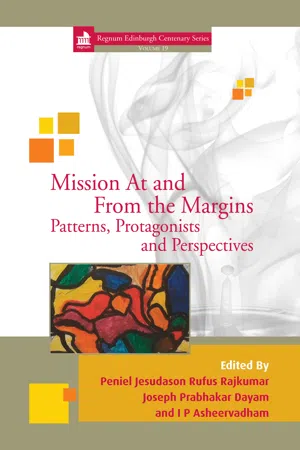
Mission At and From the Margins: Patterns, Protagonists and Pespectives revisits the 'hi-stories' of Mission from the 'bottom up' paying critical attention to people, perspectives and patterns that have often been elided in the construction of mission history. Focusing on the mission story of Christian churches in the South Indian state of Abdhra Pradesh, where Christianity is predominantly Dalit in its composition, this collection of essays, ushers its readers to re-shape their understanding of the landscape of mission history by drawing their attention to the silences and absences within pre-dominant historical accounts.
- English
- ePUB (mobile friendly)
- Available on iOS & Android
eBook - ePub
Mission At and From the Margins
About this book
Information
Topic
Theologie & ReligionSubtopic
Christlicher DienstMALAS AND MADIGAS: THEIR LIFE AND LIVELIHOOD (C.1860-1932)
Why should we the Pariah scorn
When his flesh and blood were born
Like to ours? What caste is he
Who doth dwell in all we see’.
(19th century translation of a Telugu folk song)
The purpose of this paper is to explore some aspects of the life and changing conditions of Malas and Madigas in Telugu speaking areas during the period of British rule from about 1860 to 1932.1 This was a period of considerable change and development, not only for the higher castes, and especially for elites more closely associated with British rule, but also for the ‘depressed classes’ or ‘untouchables’ as they were commonly called – not the least of these developments being the emergence of group movements into the local Christian churches.
While some papers in this volume explore the history of particular Christian movements in various parts of what became Andhra Pradesh, our main concern here is to explore, as far as possible, the context in which these movements developed. Indeed there is a wealth of material about life among the Madigas and Malas in census reports and also in other types of ‘colonial’ as well as missionary comment. However, it is important not to take this material and comment at its face value, but to attempt to assess its value and reliability as data providing genuine insights into the life of the common people – a people who were, by and large, illiterate2 and who, from the point of view of Europeans and higher caste Hindus, can only be described as ‘the other’.
Accessing ‘The Other’?
There are two major types of source material on the social, economic and religious life of Madigas and Malas (a) British administrative material such as the census and district manuals or handbooks, and Edgar Thurston’s voluminous work on Castes and Tribes of Southern India3 and (b) missionary material, including letters and reports. A third minor and totally untapped source, and one which could capture the voice of the people themselves, are folk songs if recorded at the time and possibly also family histories reaching back into the 1930s or even earlier.
Official Data: Including the Census and Edgar Thurston’s Ethnographic Survey
The Government of India introduced and carried out a series of censuses after the Indian uprisings of 1857-58, producing census reports which they hoped would provide a picture of the ‘progress’ of British rule.
Leading census organisers such as W.R. Cornish and successive Census Commissioners in Madras, as well as prominent commissioners in some other parts of India, were concerned with two main issues. One of these was the role which the census could play in the development of effective administration. Commenting on this aspect of what became a decennial India–wide enquiry, H.H. Risley, Census Commissioner of India in 1901, remarked that:
The relations of different castes to the land, their privileges in respect to rent, their relations to trade, their social status, their internal organisation, their rules as to marriage and divorce – all these are matters intimately concerned with practical administration. For instance, the marriage and divorce customs of the lower castes are constantly coming into the courts, and it would be a decided advantage to judicial officers if accurate information could be made available on the subject. Again, the distribution of the various castes in each district has a direct and important bearing on the relief of distress, as different classes of the population may require different types of relief. In order to deal effectively with a famine, we want to know what is the characteristic occupation of each caste in the distressed area, what is their social status, and from whose hands they can take cooked food or sweetmeats, respectively without losing caste.4
The second major and related reason for the census and, indeed, for district manuals and gazetteers was ethnographic research including the acquisition of knowledge more generally. And this was also quite clearly the main reason for the compilation of Thurston’s volumes on the castes and tribes of southern India. Interest in ethnographic and anthropological studies was fast developing in Britain and Europe, and in 1901 the Government of India established what was known as the Ethnographic Survey of India. Thurston, a government official and director of the Madras Museum5, was appointed Superintendent of the Survey in the Madras Presidency with the assistance of K. Rangachari who was placed in charge of the survey for a short period during Thurston’s absence in Europe.
In the scheme for the Ethnographic Survey, superintendents were asked to supplement the ‘information obtained from representative men’ by their own enquiries and researches into the considerable mass of information which lay buried in official reports, in the journals of learned societies and in various books. The research involved extensive reading, correspondence with experts (including missionaries) and travel in the countryside. Somewhat frustrated at being tied to his desk in Madras for nine months in the year, Thurston made the most of his short visits to the Mofussil for the remaining time available. And for him, as well as for Risley, research was all the more urgent because he believed that ‘civilisation’ was already bringing about ‘a radical change in indigenous manners and customs and mode of life’ of India’s people.6
Missionary Commentary
One of the problems facing government officials in attempting to obtain information from people belonging to different classes in the population was the latter’s suspicion of government motives. Thurston’s enthusiasm for anthropometry, involving the use of various instruments to measure stature, height and breadth of nose, and length and breadth of head sometimes created considerable difficulty and reveals a high degree of suspicion of government motives. ‘In carrying out the anthropometric portion of the survey,’ he wrote, ‘it was unfortunately impossible to disguise the fact that I am a Government official, and very considerable difficulties were encountered owing to the wickedness of the people, and their timidity and fear of increased taxation, plague, inoculation and transportation.’7 Few officials investigating the state of the people used anthropometric measurement as one of their techniques of social research; nevertheless there were concerns about official intentions. As yet there has not been adequate research on precisely how census takers or volunteers obtained all their information. It appears, however, that one of the practices was to consult heads of panchayats about the number and condition of families in village communities8, and, if this method was followed in acquiring information about Malas and Madigas in their hamlets, then there may be little reason to doubt information respecting their numbers and life-style.
However, even if official returns in the census are reasonably accurate, they lack the intimacy of direct personal and detailed accounts that are often found in missionary sources. The fact of the matter is that many of the missionaries lived among depressed class people, while government officials including Indian subordinates (invariably of a higher caste) paid occasional visits to some particular place or maintained their headquarters at a distance in a nearby town.
The contrast between the luxury and distance of officialdom and the life-style and availability of the missionary is clearly reflected in comments of the Rev A.H. Arden, a CMS (Church Missionary Society) missionary working near Masulipatam in the Kishna district in 1874:
There is very little in common between the tent life of a Collector or any other Government official, and the rounds of a Missionary in his district. Still less between the latter and the few weeks of tent life which many ladies thoroughly enjoy in the cold season in the company with their husbands. A Collector’s tent allowance about equals the whole of the Missionary’s salary. The best site (often in a tope of mango trees) is selected and countless officials are dancing attendants and only too glad to have the opportunity of adding anything by their exertions to the required supplies.
Sometimes a Missionary does take out his family with him, but in the case of children it is not very easily managed on a small allowance. For the most of the year the rounds are made alone and the wife and children left at home…The District Missionary’s time is chiefly spent in the Pariah villages, and as it would often be impossible to take a tent, both on the score of delay and expense, his time is often passed in some little hut in the Pariah hamlet attached to some well-to-do caste village. The people are as a rule very poor and consequently the villages are exceedingly dirty.9
While missionaries often made comments about the social, economic and religious condition of Mala and Madiga it is important to recognise that some were keener observers and more enlightened commentators than others. Indeed, differences in their background, length of stay, location and experience while in the region together with their familiarity with the local language were all factors which could affect the type and quality of comment. In view of the varied nature of the land and conditions in the Telugu speaking areas it is especially necessary to place missionary and other comments in their proper context, recognising that what applied in one part of the country may not have applied in another. For example, missionary comments about the condition of Malas in the Kistna district, may not have been true of their state in Nellore or in parts of what is now known as Telengana.
A third type of source, but one which needs to be used with great care for the period c.1860-1930, is comprised of post-colonial village and other studies.10 While it is important to recognise that these studies apply to a very different period, they often include references to local history, provide insights and raise questions about the life of the people or about customs or traditions of an earlier era.
These three categories of source material as mentioned above – the official governmental sources and missionary and post-colonial commentaries clearly reflect something of the life and struggles of marginalised people in what is now Andhra. The possibility of an additional source, reflecting even more clearly the voice of the Malas and Madigas themselves, has already been mentioned; and if traditional Mala and Madiga folksongs and their own accounts of family history, even for the 1930s, could be recovered then this would enrich still further the range of material for an understanding of their life and livelihood during the period under consideration.
Telugu Country: Then and Now
Before the creation of Andhra Pradesh state in 1956 the Telugu speaking areas of India comprised the north-eastern districts of the Madras Presidency and the eastern part of the Niza...
Table of contents
- Cover
- Title
- Copyright
- Contents
- Foreword
- Acknowledgements
- Preface
- Introduction
- The Patterns of Mission
- The Protagonists of the Mission (Hi)Story
- Biblical Perspectives on Mission
- Perspectives On/For Mission
- Postscript
- Bibliography
- List of Contributors
- Back Cover
Trusted by 375,005 students
Access to over 1.5 million titles for a fair monthly price.
Study more efficiently using our study tools.
Frequently asked questions
Yes, you can cancel anytime from the Subscription tab in your account settings on the Perlego website. Your subscription will stay active until the end of your current billing period. Learn how to cancel your subscription
No, books cannot be downloaded as external files, such as PDFs, for use outside of Perlego. However, you can download books within the Perlego app for offline reading on mobile or tablet. Learn how to download books offline
Perlego offers two plans: Essential and Complete
- Essential is ideal for learners and professionals who enjoy exploring a wide range of subjects. Access the Essential Library with 800,000+ trusted titles and best-sellers across business, personal growth, and the humanities. Includes unlimited reading time and Standard Read Aloud voice.
- Complete: Perfect for advanced learners and researchers needing full, unrestricted access. Unlock 1.5M+ books across hundreds of subjects, including academic and specialized titles. The Complete Plan also includes advanced features like Premium Read Aloud and Research Assistant.
We are an online textbook subscription service, where you can get access to an entire online library for less than the price of a single book per month. With over 1.5 million books across 990+ topics, we’ve got you covered! Learn about our mission
Look out for the read-aloud symbol on your next book to see if you can listen to it. The read-aloud tool reads text aloud for you, highlighting the text as it is being read. You can pause it, speed it up and slow it down. Learn more about Read Aloud
Yes! You can use the Perlego app on both iOS and Android devices to read anytime, anywhere — even offline. Perfect for commutes or when you’re on the go.
Please note we cannot support devices running on iOS 13 and Android 7 or earlier. Learn more about using the app
Please note we cannot support devices running on iOS 13 and Android 7 or earlier. Learn more about using the app
Yes, you can access Mission At and From the Margins by Peniel Rajkumar in PDF and/or ePUB format, as well as other popular books in Theologie & Religion & Christlicher Dienst. We have over 1.5 million books available in our catalogue for you to explore.