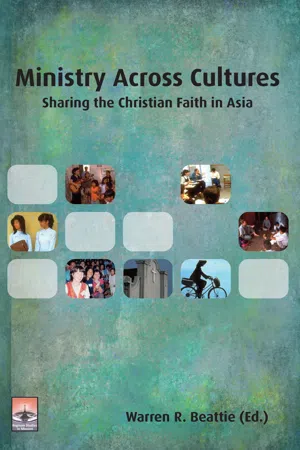
At a time when more and more Christians are coming across people from different cultural backgrounds this book addresses a number of important questions. How do we understand what culture is all about? How do we reach out to people from different cultures? What impact does culture have on "making disciples"? What impact does culture have on the local church? This book seeks to address and answer these questions – it is relevant to all Christians including those who are members or leaders of local churches who want to reach out to their neighbours and encourage them to be part of the church as well. It would also be useful for those about to engage in mission in a new culture. This book is, therefore, useful for missionaries, evangelists, tent-makers, theological educators and church leaders. It is in fact useful for all Christians living in a world where local realities are no longer mono-cultural. Dr. Robert Solomon (formerly Bishop of the Methodist Church of Singapore)
- English
- ePUB (mobile friendly)
- Available on iOS & Android
eBook - ePub
Ministry Across Cultures
About this book
Information
Topic
Theology & ReligionSubtopic
Christian MinistryPART ONE
CULTURE, WORLDVIEW AND MINISTRY
CULTURE AND CONTEXTUALIZATION
Les Taylor reminds us that as we build God’s church, we must engage with culture conscious of three things: 1) God is involved in every culture; 2) there is no “culture-less” church; and that 3) no culture remains “static.” He draws from current understandings of culture and from biblical examples – in particular, the attitude of the first cross-cultural communicators of the early church, as recorded in the book of Acts. He looks to anthropology to help cross-cultural workers be self-aware about their own cultures and how these cultures will shape their understanding of the gospel. With greater self-awareness, they will be better able to interpret other local cultures and to share creatively and contextually what God has done in Jesus Christ.
A realization of the importance of culture has grown over the eight years in which I have lived as a Christian in a South-East Asian community. My thinking has changed over time, largely through my practical experiences of ministry. Theological education has certainly helped me by providing me with a range of tools which, with practice, have enabled me to read and apply God’s live-giving text to church contexts. Nevertheless, when it came to real-life ministry and the work of developing a church, I felt like an apprentice who had been taught to make pre-fabricated churches but found himself in a situation where the materials did not seem to fit!
The Church-Builder and Local Materials
Imagine, if you will, a literal “church-builder” who moves to a new location and context. Here, all the buildings are perched on mountainsides – there are no level sites. Bamboo, coconut wood, and coconut thatch are plentiful but there is no pine wood or corrugated iron. Rope is cheap and readily available but nails are expensive, of limited sizes, and inferior quality. Woven bamboo panels can be purchased everywhere but the local hardware store has no particle boards. Local roofing materials require roofs to be steeper than at home, and the climate, with high levels of daily heat and humidity, requires them to be higher in any case, for reasons of ventilation. Faced with these changes in physical context, the church-builder would soon find that they change their approach to putting up church buildings.
The Christian who engages in ministry in a different culture, will find that developing a church for people with different cultural backgrounds requires the same shift in understanding as that experienced by the church-builder described above. After all, the New Testament describes churches as being built with “living stones!”1 Studying cultural anthropology has really helped me to have a different mindset when it comes to ministry. I have acquired tools and learned approaches that can be applied to churches in different contexts and settings. I have found that when living in a new context (and working with people who are shaped by this culture) the differences in culture mean that there has to be a new approach to developing churches – and many aspects of my understanding of church have had to change. In this chapter, I will discuss the concept of “culture” and show its significance for cross-cultural ministry. I want to offer a few reflections about culture for Christian workers, emphasizing three dimensions in particular: God is involved in culture; there is no ‘cultureless’ church; and finally the reality that cultures are not ‘static.’.
The Concept of Culture
The idea of culture is a relatively recent construct, originating in 18th century Europe2 and a renewed interest in culture among theologians may be related to the vibrant growth of indigenous Christianity in the non-western world.3 Charles Matthews describes “culture” as the human science’s “Swiss Army knife” – a concept with “ambiguities, marked by fluidity, complex inter-relatedness, and incompleteness.”4 He is making the point that the concept itself, like a Swiss Army knife, does many things – though none particularly well. An anthropologist has summarized earlier definitions of culture to conceive culture as “a coherent set of ideas, created, shared, transmitted by a group, which enable them to make sense of, and cope, in their (natural and social) world.”5
Culture has been conceived as a complex whole that is learned, and shared – including everything that people do, say, have, and think. Various writers have offered glimpses of how difficult it is to explain the exact nature of culture. As a keen observer of human societies, Clifford Geertz speaks of culture as “a web of significance in which humankind is suspended”; writing at the end of the 20th century, the theologian Kathryn Tanner speaks of culture being made up of the meaningful and ordered dimensions of social life, while for Kevin Vanhoozer, culture is everything humans do voluntarily – as opposed to involuntarily!6
Culture informs how people live their lives and it has an impact on the shared set of assumptions that people develop concerning “the way things are” which is commonly referred to as worldview.7
Three Dimensions of Culture
As Christian workers, who engage in ministry across cultures, we need to bring the authoritative text of God’s word to the different contexts of the world as we seek to build God’s church. As I have reflected on my own personal discovery of culture’s importance in the cross-cultural communication of what God has done in Christ, I would like to draw out some of the practical implications of the three dimensions of cultures outlined above for others engaged in ministry.
God is involved in culture
We need to remember that the creator God is involved in culture. Those who assume that the creator God is not involved in culture need to think again and think more biblically about their conception of culture. Gailyn Van Rheenen argues that the idea of a separation between the natural and the supernatural has led to unhelpful distinctions amongst Christian between cultural anthropology and theology. He rejects such a dichotomy, viewing it as an unhelpful approach that is not justified by the biblical writings: he would rather see these two areas of reflection interacting with each other and being unified so that “… a missiologist must become both a Christian anthropologist and a culturally-aware theologian. Anthropology cannot become Christian, nor be truly useful without the merging of these two disciplines.” 8
As he reads the bible, Van Rheenen describes several influences on culture: (1) God is the creator and sustainer of culture; (2) Christ is the transformer of culture; (3) and human beings are God’s designated rulers over culture and innovators within culture.9 There are a number of ramifications for understanding culture as being the subject of God’s creation and Christ’s cleansing and redemption of culture. God is the God of the nations and both the Old and New Testament attest to God’s role amongst the different peoples of the world.10 Unlike the modern nation-states that we now commonly associate with the term, these “nations” were ethnic groups marked by distinct language and identity. It is these nations that Jesus Christ calls us to make disciples of (Matt 28:19), and that we are told will eventually worship him (Rev 7:9; 15:4).
In terms of Jesus Christ’s impact on culture, God has sent him into the world at a moment in history to partake of a distinct human culture. Just like Abraham, Moses, and Daniel, Jesus of Nazareth emerged in a particular time, place, and culture, and Christians strive to be loyal to him in their own time, place – and culture. Both Christ Jesus (at a moment in history) and his followers (in the present) were in and of culture. Jesus Christ’s first disciples looked not to a figure who was outside, beyond, or transcendent to culture. Rather, he was a real person whose existence was completely within and a part of their culture. Nevertheless, Jesus was rightly believed by his first disciples to offer enduring wisdom, grace, and hope for all cultures. Their task, therefore, was to discern the meaning of that past cultural event for other cultures. The first disciples engaged in a dialogue with culture. Jesus of Nazareth had not been a figure outside of culture, but a person who spoke within a given culture, offering compelling truth about God’s intervention in the world.
There is no ‘cultureless’ church
This brings us to the second dimension of culture as it connects to the church – the reality that there can be no church that exists as a “cultureless” church. A story is told of kind-hearted baby monkey who, while playing in the trees over a pond, falls in. Upon scrambling out of the water, he notices that there is a fish in the pond. Immediately, he dives back into the water to “rescue” this fish, placing it safely in the tree. Up in the tree, he sees more fish. After wedging the thrashing fish in a fork in the tree, he heroically dives back into the pond to rescue the other fish. Just as monkeys are unaware of air – and fish of water – we are unaware of our culture.
Due to our lack of awareness of our culture, we are tempted to think of what we do as somehow being culturally neutral. Nevertheless, like any other building, a church building’s design and materials either conspicuously stand out or thoroughly fit into their contexts. In the same way, even among church initiatives that do not simply plant new churches, there is no such thing as a cultureless church. Christian communication, worship, and fellowship, either feels familiar, giving a feeling of being at home, or feels strange. The church-building apprentice, mentioned earlier, could have responded in other ways to his new context. He might have concluded that he would only build churches in places where a level site were possible, importing (perhaps even at considerable expense) foreign building materials in order to build the churches with which he was familiar. Alternatively, he may have built local designs with these foreign materials – or perhaps used local materials to build foreign designs.
The water of life in a cultural cup
To change the analogy, the task of the cross-cultural communicator of Christ can be likened to offering the water of life in a cultural cup. It is simply impossible to drink water out of nothing. Something out of which to drink must be chosen – what will it be? An elegant English cup? A trendy ceramic cup? A recyclable plastic, cardboard, or polystyrene mug? A glass? A shaped piece of bamboo? A clay cup? A plastic bag with a straw? While the options are numerous, when offering water to someone, one receptacle must be chosen because everyone drinks out of something. A decision to choose one option is a decision not to choose any number of others.
Reading the narratives in the book of Acts, as an anthropologist, a number of things strike. Although I am not surprised, I still notice the discrimination of the Hebraic Jews towards those who are Hellenized. Whilst “insiders,” in religious terms, those who originated in the Diaspora and spoke Greek were nonetheless perceived in Jerusalem as “outsiders.” We realize from this that while religion is an important social marker, so is language, and there are a number of factors that cause people to be viewed as culturally “other.” It is reasonable for us to assume that Greek-speaking Jews were the main victims of the persecution and scattering that followed the stoning of Stephen (Acts 7). Despite the fact that these religious refugees were Hellenized Jews, they were still Jews. In the places they were scattered, we are told these Greek speaking Jews shared what God had done in Christ with Jews alone (Acts 11:19). Then, we read the following words (in Acts 11:20-21):
Some of them, however, men from Cyprus and Cyrene, went to Antioch and began to speak to Greeks also, telling them the good news about the Lord Jesus. The Lord’s hand was with them, and a great number of people believed and turned to the Lord.
This story comes soon after the ground-breaking episode in...
Table of contents
- Cover
- Title
- Copyright
- Contents
- Preface
- Foreword
- Introduction
- Part I: Culture, Worldview and Ministry
- Part II: Reflections On Ministry
- Part III: Equipping for Ministry
- Bibliography
- Contributors
- Missional Church in Asian Contexts Series
- Mission Research Media
- Back Cover
Trusted by 375,005 students
Access to over 1.5 million titles for a fair monthly price.
Study more efficiently using our study tools.
Frequently asked questions
Yes, you can cancel anytime from the Subscription tab in your account settings on the Perlego website. Your subscription will stay active until the end of your current billing period. Learn how to cancel your subscription
No, books cannot be downloaded as external files, such as PDFs, for use outside of Perlego. However, you can download books within the Perlego app for offline reading on mobile or tablet. Learn how to download books offline
Perlego offers two plans: Essential and Complete
- Essential is ideal for learners and professionals who enjoy exploring a wide range of subjects. Access the Essential Library with 800,000+ trusted titles and best-sellers across business, personal growth, and the humanities. Includes unlimited reading time and Standard Read Aloud voice.
- Complete: Perfect for advanced learners and researchers needing full, unrestricted access. Unlock 1.5M+ books across hundreds of subjects, including academic and specialized titles. The Complete Plan also includes advanced features like Premium Read Aloud and Research Assistant.
We are an online textbook subscription service, where you can get access to an entire online library for less than the price of a single book per month. With over 1.5 million books across 990+ topics, we’ve got you covered! Learn about our mission
Look out for the read-aloud symbol on your next book to see if you can listen to it. The read-aloud tool reads text aloud for you, highlighting the text as it is being read. You can pause it, speed it up and slow it down. Learn more about Read Aloud
Yes! You can use the Perlego app on both iOS and Android devices to read anytime, anywhere — even offline. Perfect for commutes or when you’re on the go.
Please note we cannot support devices running on iOS 13 and Android 7 or earlier. Learn more about using the app
Please note we cannot support devices running on iOS 13 and Android 7 or earlier. Learn more about using the app
Yes, you can access Ministry Across Cultures by Warren Beattie in PDF and/or ePUB format, as well as other popular books in Theology & Religion & Christian Ministry. We have over 1.5 million books available in our catalogue for you to explore.