When it comes to disagreement, we are in perpetual fight-or-flight mode. Rather than respond with a posture of compassion and connection, we are encouraged to "resist" others personally and politically. Either we engage in fruitless arguments with people who refuse to see things our way or we retreat to our echo chambers where everyone agrees with us. But the real resistance, the kind that helps us grow, is learning to love others--especially those who disagree with us.
If you're tired of seeing your real-life and online communities in turmoil and you long to be an agent of peace, understanding, and reconciliation, it's time to join a new kind of resistance movement--one that pushes us toward personal transformation. Grounded in Scripture and illustrated with compelling true stories, this new book from Ashley Abercrombie will help you gain the confidence to communicate and connect with others, stop avoiding necessary tension, and resolve your internal and external conflicts.
When we make love our habitual reaction to the conflicts and divisions in our lives, we'll find that we can stay true to our convictions without sacrificing our relationships.
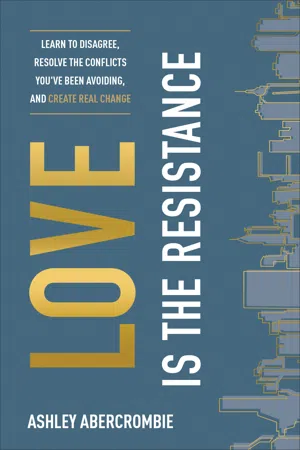
eBook - ePub
Love Is the Resistance
Learn to Disagree, Resolve the Conflicts You've Been Avoiding, and Create Real Change
- 208 pages
- English
- ePUB (mobile friendly)
- Available on iOS & Android
eBook - ePub
Love Is the Resistance
Learn to Disagree, Resolve the Conflicts You've Been Avoiding, and Create Real Change
About this book
Information
Topic
Theology & ReligionSubtopic
ReligionCHAPTER 1
Learning Love
Love is resistance. It is a push and a pull, forcing us out of our comfort zones, stretching our borders and beliefs, calling us higher, helping us migrate toward something new. Love is a taste, a melody, a memory. It is a people, a place, a vision, a hope. Love is a fight, a prayer, a counter to cynicism, bitterness, and rejection. It is sorrow and grief, leaving and staying, joy and gentleness, humility and horror.
It is the reason I ache and the reason I live. Words do love no justice. In our desire to discover the reason we are here, to resolve the difficult circumstances and conversations many of us find ourselves in, we must learn to know love. To know what it is and what it isn’t. To apply and relieve pressure in order to understand who we are and how our existence alone makes an impact.
Love, like justice, is often theoretical in our minds. It is somewhere out there, otherworldly, idealistic, rather than the quiet, ordinary, daily resolve to love right where we are. Whether we like our life or not. Love is pesky and bothersome because it is not supposed to be irritable and demands that we give up our hurry. Real love deflates our sense of self-importance and presses us to reimagine our time in order to be present and patient. To pay attention. To ask, in the situation I find myself, What is actually happening here? What is required of me? What will produce a great deal of good? Why does this moment feel insignificant and taxing? What (who) am I missing here, in my desire to be somewhere else, in my wishing for something better, something more, in my attempt to control the narrative or the outcome?
Love is a miracle. It is here now. Commanding us to rise from slumber, reviving us to life, testifying to a necessary urgency. You have one life. It is passing you by. Wake up. Live fully awake and alive. Do not miss the moment to live, really live, in a time where presence is needed. Patience is lacking, kindness is waning, and we are thirsty for real love. Love that makes us remember who we are, that reminds us we belong to God and to each other.

The apostle Paul, a complicated biblical character and a gifted leader in the early church after the death of Christ, wrote letters to pastors and people to encourage them in the faith. His significant offering of instruction, encouragement, and warning to believers about how to live together in the turmoil of the world is still profoundly valuable to us today. His words help us to love well while we’re in the process of becoming like Christ.
When I look across the spectrum of newsworthy Christianity, as well as the YouTube sermons, Instagram microblogs, self-described prophets, millions of resources, and perilous comments sections, my heart aches for words of wisdom, for truth that is bound by love. In spite of my gratitude for the easy access we have to clergy leadership, I believe we are longing for a deeper well. People are searching for voices of peace and justice who live with integrity, deal in reality, and instill hope when we are hard-pressed to find it. We need more people who will honestly say these are perilous times, everything is not okay, and while the future is uncertain, we are here together and the merciful Christ is with us.
Paul, often absent in body, remained present to his people through prayer, persecution, and the written word. In one of his letters to Timothy, whom he considered a son in the faith, his words feel like a prophecy fulfilled today.
But know this, that in the last days perilous times will come: For men will be lovers of themselves, lovers of money, boasters, proud, blasphemers, disobedient to parents, unthankful, unholy, unloving, unforgiving, slanderers, without self-control, brutal, despisers of good, traitors, headstrong, haughty, lovers of pleasure rather than lovers of God, having a form of godliness but denying its power. And from such people turn away! (2 Tim. 3:1–5 NKJV)
Why does this resonate so deeply as truth? Worse, why does it seem to accurately describe the very public witness of Christianity in the West? Unloving, unforgiving, slanderers . . . brutal . . . headstrong, haughty, lovers of pleasure rather than lovers of God . . . Good gracious, doesn’t that just feel like humanity’s baseline?
But why? What leads us toward selfishness? At what point does our generosity and vulnerability, our innocence and laughter, rust into stinginess and impenetrability, offensiveness and cynicism?
Perhaps we lack love. Culturally, it feels like an unbearable emptiness, a desperate need for significance, is perpetually driving us. We feel unable to rid ourselves of loneliness, no matter who surrounds us. Isolation is not reserved for single people or those who live alone. It belongs to those who cannot bond or attach due to past and familial trauma, to those who are perpetually trapped in toxic, dysfunctional relationships, to those whose addictions and anxieties keep them from fully engaging in the healthy practices of love, to those who long for a life other than the one they are living, to those whose majority connection is digital in nature.
Certainly, many people struggle to overcome pain related to love, which hinders us from both giving and receiving. And to be perfectly honest, genuine love is a holy horror show. To lay ourselves bare, to withhold nothing, to stand naked before another and quietly ask, “Do you still love me?” is a wonderful terror indeed. The places we are most resistant to love are the places we are invited to let love teach us, heal us, and help us see.
Life is constantly shaping us. We cannot control what we are born into. We do not choose the foundation of love, lack, or hatred we receive. Rarely is our situation all good or all bad but rather a grey matter of peace, pain, joy, dysfunction, connection, and grief. These established rhythms and routines, however chaotic, monotonous, or absent they are, shape our identity and teach us how we are to live with and relate to ourselves, God, and others. Before we are an adult, this is established at home, at school, and in our communities. We learn as we participate in these places with the people we spend the most time with, starting from birth and continuing throughout our lives. To better establish ourselves in relationships, it is imperative for us to understand where we come from so we can better understand where we are.
Think for a second about the best encouragement you ever received. Who offered it? What did it mean to you in the moment? How does it feel now to remember it? Did it shape who you are and your confidence in yourself and your abilities? Encouragement is powerful. My husband, Cody, talks about encouragement as an opportunity to “put courage in.” I’ve found that the places and spaces we’re raised, the people who shape our minds and hearts, either encourage or discourage us from becoming our truest selves.
As people, we tend to gravitate toward the bad stuff. It seals itself in our memory like a bad tape we can’t cut off. We play it over and over until it melts into the foundation of who we are. While that can be overcome—God wired our brains to change, to regenerate, to renew—we spend too much of our life and our time rehearsing those words and nursing old wounds. This deeply impacts how we connect and relate to each other, and it hinders or helps our ability to love and be loved. Our conflict and communication styles are informed by our upbringing. I love what Mike Foster, author and founder of People of the Second Chance, says: “We learn love from people who do not love us.” How true! Our patterns of relating and bonding with others are too often determined by those who love us the least.
Whether we grow up with two parents, a single parent, foster or adoptive parents, stepparents, other family members, or another kind of caretaker, the years we spend preparing to be an adult shape us tremendously. Peggy O’Mara, author of Natural Family Living, writes, “The way we talk to our children becomes their inner voice.”1 We internalize the voices we grow up with and carry them with us wherever we go. Absence is also a voice. When children are left to fend for themselves, rarely asked questions, and suffer from little engagement with a parent, as adults they might operate in the world as though they are a burden to others and struggle to share their dreams and desires and to ask for help in their struggles. If abuse is in the home, children may go on to be adults who perpetuate or put up with abuse, or become some of the almost twenty-one million Americans who wrestle with an addiction.2 Many adults do not have a fallback plan in the form of family. There is no person who can support them emotionally, spiritually, or financially. Even in homes where there is love, hospitality, generosity, and generational wealth/help, children will still experience some form of dysfunction, because no caretaker, parent, or child is perfect. Home is the first place we learn love and where our ability or struggle to be ourselves and trust and connect to others in meaningful, reciprocal ways begins.
Another critical pathway for our wiring around love and care is our education story. On average, children are in school six hours a day, 180 days per year, for thirteen years straight. That does not include after-school programs, sports, or time at the local library, recreation centers, YMCAs, or houses of worship, which can tack on another two to three hours per day. With commute times added in, this means that most children and teens spend their waking hours with other adults and children who will instill values, teach curriculum, and model community care. For many of us, education is a healthy combination of positive and negative experiences; others experience a long string of good or bad, depending on how authority figures established patterns of relating and potentially hierarchies based on intelligence, appearance, or socioeconomic status.
I mention houses of worship because many of us have a faith story. We had a youth group, faith community, Bible study, or other place we began to learn about God. Or perhaps we learned peripherally, if our only encounters were with people who claimed to follow God. We learned who God is, what he approves of, who he loves, and how we’re supposed to behave in order to please him or find his favor. For some of us, that meant discovering we are loved by a good God; that we have a Savior who loves us, a Holy Spirit who is our advocate and guide, and a community of people committed to walking alongside us in solidarity. For others, that might have meant learning God is a harsh, unforgiving father who cares more about our behavior than our connection with him, who sets us in community so we can learn the rules of faith—who is in and who is out—and how we can perform for God rather than be loved by him. The way we see God, as well as our worldview, is informed by our experiences with religion as we mature in age and stage.
Inside these spaces—our homes, schools, and religious gatherings—we develop our internal dialogue and establish well-worn patterns of relating to others and staying safe (or at least comfortable in our role, even if not safe) inside relationships. We are shaped by our familial and cultural upbringing, and that is a determining factor in how we see the world, ourselves, and other people as well as how we contribute positively or negatively to society. The internal dialogue we establish as a foundation in our lives dictates our direction. Or, as Alice Walker said,
Truly the suffering is great, here on earth. We blunder along, shredded by our mistakes, bludgeoned by our faults. Not having a clue where the dark path leads us. But on the whole, we stumble along bravely, don’t you think?3
Why do we do what we do? What led us to the person we are, and do we like the person we are becoming? We are blundering along, as Alice Walker says, “not having a clue where the dark path leads us.” Miraculously, when we fall we get up again, clinging to some thread of grace we’ve found that makes life worth living. There are times we struggle to face that darkness, when we find it difficult to deal with the conflicts and tensions in our lives. But confrontation is necessary for change. If we are to internalize the best of our upbringing and let go of the worst, we must honestly inspect and confront what, from our past and present, is shaping our responses to people and circumstances.
From the people who loved me, I learned ridiculous generosity—how to keep my hand and heart open, no matter my circumstances. We are a people who turn up with a casserole when there has been a death. We are people who can sit in pain and trauma and offer our presence so others are not alone in their suffering. We are people who shout and cheer and scream for each other, celebrating accomplishments and championing dreams. We are those who give money when we have it to help with adoptions, nonprofits, groceries, therapy appointments. From this love, I learned that I am welcome, that I can bring my whole self to the table, that I am enough, that I am not too much, that my ambition is holy. They taught me to love is to show up, to give myself to service, to push past barriers, to be a safe harbor, and to be inconvenienced.
But if we indeed also learn about love from people who do not love us, then I’ve also learned other confusing and sometimes similar messages. That love is silent, that love pretends, that love is always hard work and personal sacrifice—and because I’d been told to do it so many times, love is sitting still, looking pretty, and shutting up. To be loved, to survive, I found it necessary to contort my painful, confusing emotions into a smile, to twist the truth of my private life into a glowing public review, to ache with longing for space to be myself.
When I moved from my home of origin, I challenged, though did not overcome, the idea that love’s most important quality is staying stuck, remaining loyal, keeping quiet, and isolating unattended. The lie that to be at peace is to live in denial was crushing to me, and the more I denied, the more I repeated unhealthy ways of expressing pain. Growing up, and in my young adult years, love felt like constant tension to me. Depending on the person I was with or the place I was in, giving and receiving love felt marked either by fear, anxiety, and control or by a sense of home, con...
Table of contents
- Cover
- Endorsements
- Half Title Page
- Title Page
- Copyright Page
- Dedication
- Contents
- An Introduction Not to Be Skipped
- 1. Learning Love
- 2. Cancel Culture
- 3. Language Matters
- 4. Love Thy Neighbor
- 5. Love Is the Resistance
- 6. When Class, Gender, and Race Collide
- 7. Autonomy from Our Camp
- 8. For Lack of Justice There Is Waste
- 9. When Conflict Calls
- 10. Woe to the Offender
- 11. I’ll Love You till the Cows Come Home
- Conclusion
- Discussion Guide
- Acknowledgments
- Notes
- About the Author
- Back Ads
- Back Cover
Trusted by 375,005 students
Access to over 1.5 million titles for a fair monthly price.
Study more efficiently using our study tools.
Frequently asked questions
Yes, you can cancel anytime from the Subscription tab in your account settings on the Perlego website. Your subscription will stay active until the end of your current billing period. Learn how to cancel your subscription
No, books cannot be downloaded as external files, such as PDFs, for use outside of Perlego. However, you can download books within the Perlego app for offline reading on mobile or tablet. Learn how to download books offline
Perlego offers two plans: Essential and Complete
- Essential is ideal for learners and professionals who enjoy exploring a wide range of subjects. Access the Essential Library with 800,000+ trusted titles and best-sellers across business, personal growth, and the humanities. Includes unlimited reading time and Standard Read Aloud voice.
- Complete: Perfect for advanced learners and researchers needing full, unrestricted access. Unlock 1.5M+ books across hundreds of subjects, including academic and specialized titles. The Complete Plan also includes advanced features like Premium Read Aloud and Research Assistant.
We are an online textbook subscription service, where you can get access to an entire online library for less than the price of a single book per month. With over 1.5 million books across 990+ topics, we’ve got you covered! Learn about our mission
Look out for the read-aloud symbol on your next book to see if you can listen to it. The read-aloud tool reads text aloud for you, highlighting the text as it is being read. You can pause it, speed it up and slow it down. Learn more about Read Aloud
Yes! You can use the Perlego app on both iOS and Android devices to read anytime, anywhere — even offline. Perfect for commutes or when you’re on the go.
Please note we cannot support devices running on iOS 13 and Android 7 or earlier. Learn more about using the app
Please note we cannot support devices running on iOS 13 and Android 7 or earlier. Learn more about using the app
Yes, you can access Love Is the Resistance by Ashley Abercrombie in PDF and/or ePUB format, as well as other popular books in Theology & Religion & Religion. We have over 1.5 million books available in our catalogue for you to explore.