- English
- ePUB (mobile friendly)
- Available on iOS & Android
eBook - ePub
Education Reimagined
Information
Topic
EducationSubtopic
Education General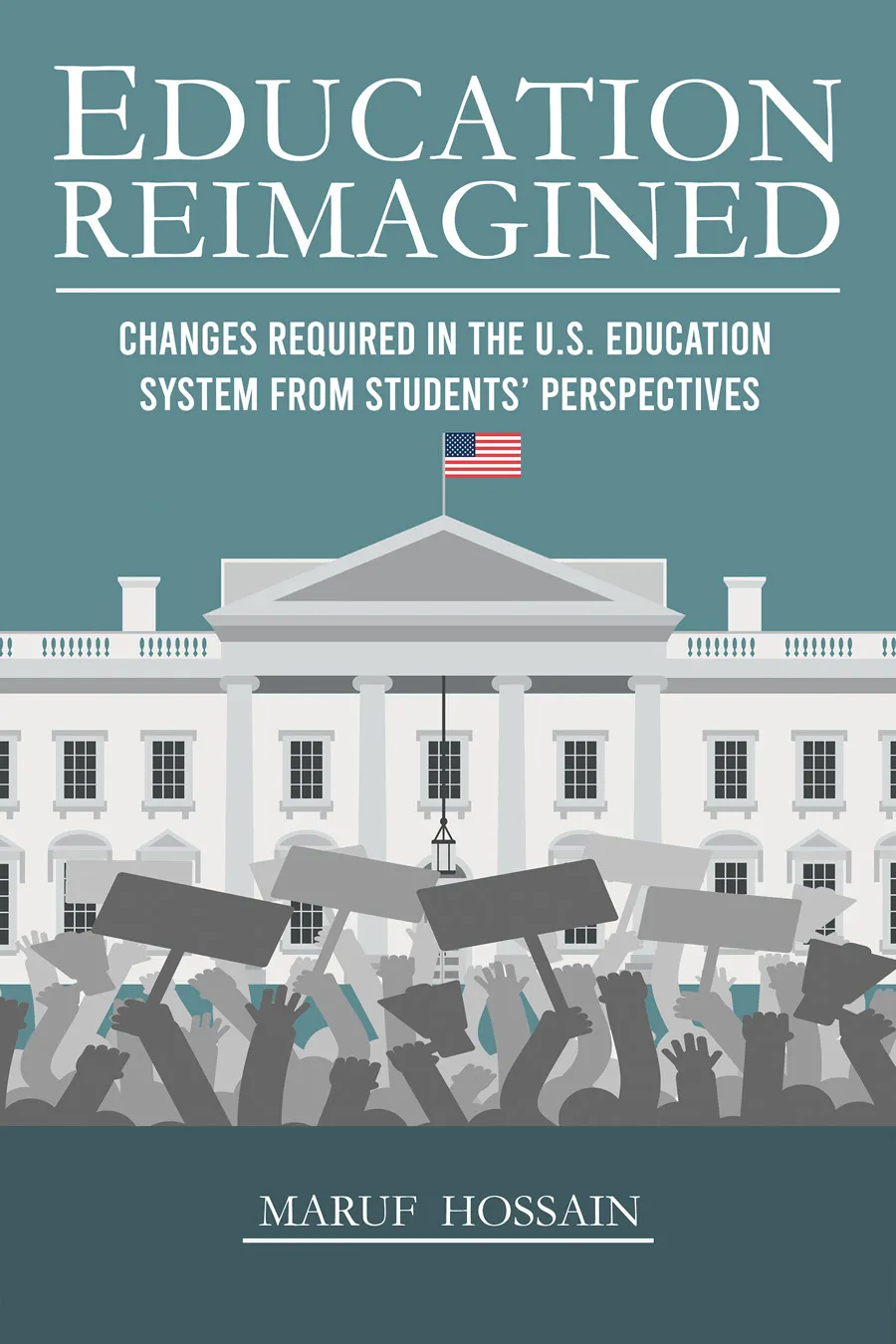
EDUCATION REIMAGINED
Changes Required in the U.S. Education System from Students’ Perspectives
Maruf Hossain

Copyright © 2021 Maruf Hossain.
All rights reserved. No part of this book may be reproduced in any form or by any electronic or mechanical means, including information storage and retrieval systems, without permission in writing from the publisher, except by reviewers, who may quote brief passages in a review.
ISBN: 978-1-956074-16-1 (Paperback Edition)
ISBN: 978-1-956074-17-8 (Hardcover Edition)
ISBN: 978-1-956074-15-4 (E-book Edition)
Book Ordering Information
Phone Number: 315 288-7939 ext. 1000 or 347-901-4920
Email: [email protected]
Global Summit House
www.globalsummithouse.com
Printed in the United States of America
Contents
Preface
Acknowledgements
Part I: The Reality of the Education System
- Standardized Testing
- The Bullying Epidemic
- Families and a Student’s Education
- Learning with Disabilities
- The Administration
- The Price of Our Education
- Preparing and Transitioning to College
- The College Experience
- Customized Education
- The Future of the US Education SystemPart II: Voices of the System
- Education’s Purpose by Corrina Blau
- A Diversified Approach to American Education by Raimondo Graziano
- Civics in Education: An American Approach by Raimondo Graziano
- Cut the Middle Man: Why Current High School Education Is Irrelevant by Scott Fleisher
- Mental Health of the Future by Urooj Ansari
- Discrimination Experienced by Students in the Education System by Nayema Laboni
- Freedom to Teach by Joy Lam
- Institutionalize Mandated Diversity by Yelena Dzhanova
- Student’s Education Institution Transition by Maruf HossainContributorsBibliographyAbout the AuthorPrefaceThe United States has always been the land of opportunity and equal rights. One of the biggest things that it is known for, especially by foreigners, is the U.S. education system—unless, of course, you study education systems around the world and compare it with the United States. For those that go through the US education system from the start in kindergarten to the end of college, we’ve seen and experienced the system and seen firsthand how everything plays out. Everyone’s experience is different. However, everyone can agree upon some of the major issues students face in the US education system. The United States government controls much of how the education system runs and how things should be. However, many students, parents, teachers, and education advocates have voiced their issues and concerns, and they go unheard and unchanged because the government refuses to change the system.Therefore, people who study the education system and follow what will compare the US education system with many of the education systems in Europe. We have come to a point in our education system where we understand that the students have become the government, and the government has become the students. The government may be in power, but they are not making major nationwide changes to benefit the students of the system. Through this understanding, this book was written to give students a voice to speak up and speak out against the education system and to bring into light some of the major issues in the US education system along with creative ideas and solutions from those that have contributed and volunteered to write for the book along with me, and education advocate.The contributors of this book were gathered through social media advertising and word of mouth multiple times. At first, many wanted to write for the book, but many of them also dropped out of their own will. Through this effort, I was left with the contributors that wrote a narrative for the book, along with my narrative. For the narratives, the contributors were asked to choose a topic or issue that they wanted to see a change for in the US education system. Furthermore, they were asked to share their personal story if they had any regarding the topic and how it affected them, and their experience with the topic. Afterward, they were told to explain the change required in the system regarding their topic of choice. Lastly, they were asked to talk about the future of the system in a general matter, if possible, and the future of the US education system with and without their proposal for change.We can no longer follow a corrupt education system that does not work for the students of our great nation. The ultimate hope is that the federal and state government, the board of education, teachers, parents, students, and others who oversee our schools and colleges worldwide read this book and understand where we, as students, come from. The book targets the students and parents who are victims of the education system and the lawmakers who oversee the education system and make nationwide changes to better the students in the system. There must be an understanding of the victim we have become and how invaluable our education system has become. Furthermore, through that understanding, the changes we ask for and require to be tested out and implemented. We are truly at a time with our education system where the students have become the government, and the government has become the students.AcknowledgmentsI want to acknowledge the contributors who have volunteered to write for part 2 of the book. Without their contribution, this book would not be as valuable as it is. This shows that students can come together to speak up and speak out to make a change for the future of our country and, more importantly, the future generations of the US education system. We can now only hope and move this cause forward to the best of our ability to get the government to hear us and make the changes we ask for as a starting point and get others to voice their opinions and see the changes we hope to see blossom and be effective for students of the United States’s education system.Thank you to Corrina Blau, Raimondo Graziano, Scott Fleisher, Urooj Ansari, Nayema Laboni, Joy Lam, and Yelena Dzhanova. Without all of you, this book would not have come to be. Thank you for volunteering, taking time out of your busy schedule to write narratives for this book, and looking at the bigger picture and cause for this book. Thank you for speaking up and speaking out against the US education system and giving insightful information on some of the major issues of the education system and expressing what many of you have personally gone through. I am amazed by reading so many of your stories, not just because of your stories but also because you expressed your concern for the issue you wished to write and your writing style. I think these forms of voices are required to see the changes we hope the government makes. We can no longer follow a corrupt education system that does not work for the students of our great nation. It’s time we see change.Part IThe Reality of the Education SystemStandardized TestingThe United States’ education system has become infamous for standardized testing. The most infamous concept of how a student is evaluated is through testing, which consists of in-class quizzes, tests, and major exams, along with the end-of-year state exams. Standardized tests are tests that are supposed to determine how well a student knows the material given in the test. These tests play a major role in determining how well students know the subject on certain topics every few weeks. Major tests at the end of the year determine if the student will pass the class or grade and move on to the next grade. Testing is introduced to children as young as five when they are in kindergarten. From there, these students are put through rigorous exams and quizzes while being taught what is asked of by the state and the local board of education rather than having a choice of what to learn. These tests have evolved into a key issue in the US education system that devalues a child’s intelligence and comprehension of information taught in class.The history of standardized testing began in 1838 when American educators began articulating the formal assessment of a student’s achievement.1 From there followed the creation of some of the major standardized tests we know today, such as the Scholastic Aptitude Test (SAT) that started in 19262 and the American College Testing Program (ACT) that started in 1959.3 Other tests such as SHSAT, Regents, and the citywide state tests students take at the end of the school year in elementary and middle school. If we are to evaluate the purpose of a test and why the US education system has chosen testing to be the end-all and be-all of student assessment, we can secretly see it for its own agenda.The US Congress Office of Technology Assessment describes the purpose of testing as the assessment of student learning, school accountability, and educational opportunities for students.4 However, testing as an assessment of student learning only shows a certain percentage of what the student may know regarding the test. What it does not show is their full understanding and full potential on the topics or the subject. At the end of the day, you should realize that schools, colleges, universities, and other educational institutions are funded by the state government in some way, but for them to be funded, they also have to submit statistical information on the performance of the entire school. Therefore, the only way they would be able to do that is through giving tests and using student quantitative data from testing and hiring a statistician to evaluate the school’s performance based on student’s grades that will be submitted to the government for future funding. Schools that do not do well or have a bad rep have a chance of shutting down unless it can improve. That is generally how the US education system is run.Nonetheless, all the testing and studying a student does only go so far during the actual testing. It does not take a psychologist or a psychology student to realize the strain testing can put on a child. We know some of the more common things are test anxiety, procrastination, over evaluating a test or a situation, all-nighters before exams, etc... These are only some of the psychological effects testing can have on a student, and it does not do any good to the student’s mental health and well-being. With testing, you are ultimately saying that a student is somehow supposed to understand, conceptualize, and internalize information well enough on not just one but multiple topics to do at least satisfactory work to maintain a good GPA. The reality of how students are and how studying is for them is a completely different story. Students do not choose what to focus on and when they are all given multiple homework and assignments outside of the studying, they all have to focus on. The education system has chosen testing as a way to take over the lives of students.There has to be a way for a child to be balanced in life between home, schooling, religious duties, extracurricular activities, social activities, and downtime on a daily and weekly basis. From age five, students go through this process of waking up for school, going to school, coming home, doing homework, studying, and then going to sleep, only to repeat the process. From K to 12, that is usually the case, aside from extracurricular activities and social time they may have allotted to within their day. Nevertheless, with everything they go through, schooling and testing take up most of their day, let alone their lives. While education is important and a priority, it should not be something that seems more of a job than the enjoyment of learning and getting educated. The education system takes the fun out of learning due to its rigorous standards and testing a student. The balance of home life, schooling, religious duties, extracurricular activities, social activities, and downtime on a daily and weekly basis. From age five, students go through this process of waking up for school, going to school, coming home, doing homework, studying, and then going to sleep, only to repeat the process. From K to 12, that is usually the case, aside from extracurricular activities and social time they may have allotted to within their day. Nevertheless, with everything they go through, school...
Table of contents
- Maruf Hossain
Trusted by 375,005 students
Access to over 1.5 million titles for a fair monthly price.
Study more efficiently using our study tools.
Frequently asked questions
Yes, you can cancel anytime from the Subscription tab in your account settings on the Perlego website. Your subscription will stay active until the end of your current billing period. Learn how to cancel your subscription
No, books cannot be downloaded as external files, such as PDFs, for use outside of Perlego. However, you can download books within the Perlego app for offline reading on mobile or tablet. Learn how to download books offline
Perlego offers two plans: Essential and Complete
- Essential is ideal for learners and professionals who enjoy exploring a wide range of subjects. Access the Essential Library with 800,000+ trusted titles and best-sellers across business, personal growth, and the humanities. Includes unlimited reading time and Standard Read Aloud voice.
- Complete: Perfect for advanced learners and researchers needing full, unrestricted access. Unlock 1.5M+ books across hundreds of subjects, including academic and specialized titles. The Complete Plan also includes advanced features like Premium Read Aloud and Research Assistant.
We are an online textbook subscription service, where you can get access to an entire online library for less than the price of a single book per month. With over 1.5 million books across 990+ topics, we’ve got you covered! Learn about our mission
Look out for the read-aloud symbol on your next book to see if you can listen to it. The read-aloud tool reads text aloud for you, highlighting the text as it is being read. You can pause it, speed it up and slow it down. Learn more about Read Aloud
Yes! You can use the Perlego app on both iOS and Android devices to read anytime, anywhere — even offline. Perfect for commutes or when you’re on the go.
Please note we cannot support devices running on iOS 13 and Android 7 or earlier. Learn more about using the app
Please note we cannot support devices running on iOS 13 and Android 7 or earlier. Learn more about using the app
Yes, you can access Education Reimagined by Maruf Hossain in PDF and/or ePUB format, as well as other popular books in Education & Education General. We have over 1.5 million books available in our catalogue for you to explore.