'Quite simply, and quite ridiculously, one of the funniest and most illuminating books I have ever read. I thought I was obsessive, but Keith Kahn-Harris is playing a very different sport. He really has discovered the whole world in an egg.' Simon Garfield
A thrilling journey deep into the heart of language, from a rather unexpected starting point.
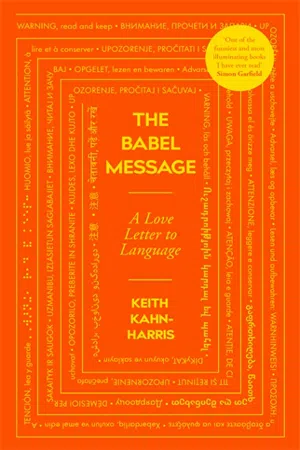
Keith Kahn-Harris is a man obsessed with something seemingly trivial - the warning message found inside Kinder Surprise eggs:
WARNING, read and keep: Toy not suitable for children under 3 years. Small parts might be swallowed or inhaled.
On a tiny sheet of paper, this message is translated into dozens of languages - the world boiled down to a multilingual essence. Inspired by this, the author asks: what makes 'a language'? With the help of the international community of language geeks, he shows us what the message looks like in Ancient Sumerian, Zulu, Cornish, Klingon - and many more. Along the way he considers why Hungarian writing looks angry, how to make up your own language, and the meaning of the heavy metal umlaut.
Overturning the Babel myth, he argues that the messy diversity of language shouldn't be a source of conflict, but of collective wonder. This is a book about hope, a love letter to language.
'This is a wonderful book. A treasure trove of mind-expanding insights into language and humanity encased in a deliciously quirky, quixotic quest. I loved it. Warning: this will keep you reading.' - Ann Morgan, author of
Reading the World: Confessions of a Literary Explorer
- 336 pages
- English
- ePUB (mobile friendly)
- Available on iOS & Android
eBook - ePub
About this book
Information
1
Part 1
Set the controls for the heart of the Message
3
Chapter 1
The Message
On the liminality of Kinder Surprise Eggs
How human it is to create something so complex!
Kinder Surprise Eggs are certainly complex things. Regular eggs have an inedible shell within which edible life gestates. The Kinder Surprise Egg has an inedible outer foil wrapped around an edible chocolate shell, containing a yolk-coloured but inedible capsule, that itself encloses further inedible objects. The Egg is what anthropologists would call a liminal object; one that straddles the boundary between edible and inedible.
Research suggests that children do have the ability to understand the ‘double nature’ of the Eggs.1 However, in some countries, most notably the United States, the liminal nature of an object like this is intolerable. In the US, after long legal battles, the Food and Drug Administration decreed in the 1990s that confectionery cannot contain inedible objects.2
The approach taken in other parts of the world, including within Europe, is to alert responsible adults to liminality. By legally mandating that warnings be included on and within the Egg, the adult purchaser will understand that special care should be taken to manage the dangers of an object that is both one thing and another thing.
Language – specifically written language – must bear a massive weight of responsibility here. Product warnings are strange things. Warnings contradict the temptations of 4products designed to be irresistibly tempting. They may tell the consumer not to use something they have actually bought (like cigarettes). Warnings can also be expressions of a kind of fear from the manufacturer. In the US, the annual ‘Wacky Warning Label Contest’ is both funny – one example is a fishing lure marked ‘Warning, harmful if swallowed’ – and draws attention to the over-litigious nature of American society that leads manufacturers to try to anticipate any conceivable misuse of their product.3
Warnings are expressions of an impersonal form of care. The anthropologist Margaret Mead is supposed to have said that the first sign of civilization in ancient culture was a broken femur that had healed, because this shows that someone stayed to help the victim recover. Whether or not she actually said this or it is historically accurate – and there is some doubt about both4 – is a moot point; what’s important here is that the capacity to care goes way back and way deep. To help someone recover from a broken femur, in ancient times or today, requires a degree of intimacy, even if it is just a doctor or nurse putting the leg into a splint. In contrast, written warning messages are distanced from the body. We don’t know the people who wrote them, and they do not know who will read them. If we fail to heed warning messages, their authors will not have the ability to care for us.
There is a whole body of academic literature on the construction of warning messages, that draws on psychology, law and graphic design.5 Ferrero appear to have adhered to best practice in constructing the Message: it conforms to various international and national legal regulations (some of which will be discussed later in the book). It includes both visual and written elements in the warning. It clearly identifies the nature 5of the hazard and the consequences for not avoiding it. The font is similar or identical to Helvetica; one that is frequently used on official signs and messages and is noted for its clarity and simplicity.
The biggest challenge to the Message’s efficacy is something that the manufacturers can do very little about: will the Message be read? After all, it is a competitor in a crowded market for attention.
Paying attention
When you first heard about this book, you might have found its premise amusing. A whole book on the warning messages in Kinder Surprise Eggs! The reason this seems funny is that the Message is usually among the many things in our lives that we relegate to the background. Other warnings might intrude into our life in ways that grab our attention, such as error messages – both visual and aural – on our computers or flashing accident lights on the motorway. The Kinder Surprise Egg cannot intervene in our lives in such a visceral fashion. It is one of the many objects in our lives that are festooned with text and that we do not pay too much attention to. Indeed, we cannot pay attention to them, since to do so would consume most of our lives. How would we ever cook dinner if we assiduously read the information on every component of the ingredients? One of the reasons why Obsessive-Compulsive Disorder is such a serious condition is that the sufferer is constantly paying too much close attention to the minutiae of everyday life.
The writer Georges Perec, in an essay first published in 1973, suggested that we needed to focus our attention on the ordinary, urging the reader to, among other things, ‘question 6your teaspoons’.6 Such attention can be a source of pleasure and a form of politics. As Perec argued:
In our haste to measure the historic, significant and revelatory, let’s not leave aside the essential, the truly intolerable, the truly inadmissible. What is scandalous isn’t the pit explosion, it’s working in coalmines.7
I am not going to claim that paying attention to the Message could change the world. However, the Message could help us reflect on the impossibility of bearing the burdens of responsibility that modern life places upon us. To buy a Kinder Surprise Egg for a small child is just one of those occasions when information is piled on us and, should we fail to read it closely or at all, it is we who will bear the consequences.
But let’s, for the moment, assume that most adults who buy Kinder Surprise Eggs were assiduous readers of the Message; that they seek out the version in their language and study it carefully, even keeping the Message indefinitely as they are told to do.
There would still be a problem.
That problem’s name is language. And it is beyond the ability of even the most experienced writer of warning messages to solve.
The slipperiness of language
To speak or to write is not a simple process in which a coherent message from our brain is transferred to someone else’s brain. That we are all meaning-making creatures doesn’t imply that we share an identical understanding of the system through which we make meaning. The capacity for language knits 7us humans together, but that doesn’t mean anyone ‘owns’ a language in its entirety. Nor are our individual and collective assumptions completely known to us.
The connection of language to the world beyond us is slippery and often tenuous. It has never been particularly controversial to note that the association of words to things is arbitrary (outside of onomatopoeia); the word ‘toy’ is not a property of toys themselves. In the early twentieth century, the Swiss linguist Ferdinand de Saussure went further than this, arguing that words – known as ‘signs’ – do not refer to things themselves, they refer to the mental concept of the things themselves. The sign is a combination of the ‘signifier’ (a sound) and the ‘signified’ (a concept).
Saussure’s work was a major contributor to a wider trend in twentieth-century humanities and the social sciences, known as the ‘linguistic turn’. The nature of language and how it shapes our world became the preoccupation for a host of disciplines. One of the fundamental questions is whether we can exist outside language in the first place: is there a world outside the sign? The intellectual currents known as postmodernism and post-structuralism, and their advocates such as Jacques Derrida and Jean Baudrillard, are often accused of treating the world as a purely linguistic construct with no intrinsic meaning. Certainly, their determination to reveal the arbitrariness of the connection between signifier and signified seems to treat meaning itself as equally arbitrary.
But you don’t have to be a dyed-in-the-wool postmodernist to recognise that meaning is an exceptionally slippery thing. We cannot get inside one another’s heads and know for sure that our own signifieds are the same as other people’s signifieds. All of us have known the anxiety of not being sure that 8the other understands what we are trying to say in the way we want to be understood. The fact that, through language, human beings can cooperate and get things done in the world is a kind of miracle.
The social sciences have revealed the messy process through which language works on an everyday basis. Detailed analysis of mundane language use shows, for example, how political talk involves a constant process of knitting together contradictory ‘interpretive repertoires’.8 Look in detail at conversation and you find an astonishing ability to turn fragments of talk into a meaningful dialogue. When I was doing postgraduate work, a fellow student analysed a conversation between a ‘psychic’ and her client. Pretty much everything the psychic said turned out to be incorrect, but she and her client ‘worked’ to turn the encounter into something that was revelatory. Conversation analysts have shown how our talk involves all kinds of implicit assumptions that we share without realising it. Harvey Sacks, a pioneer of this methodology, focused on the beginning of a story by a young girl – ‘The baby cried. The mommy picked it up’ – in order to reveal the implicit ‘rules’ through which we find it ‘obvious’ that the baby is the mother’s baby.9
The Message is suffused with assumptions: that the warning is addressed to the reader; that ‘read and keep’ refers to the Message itself; that ‘toy not suitable’ refers to the toy inside the egg; that ‘small parts’ refers to the small parts of the toy. The confidence of Ferrero that the Message is intelligible shows how far we rely on rules that were never explained to any of us. While we might be able to assum...
Table of contents
- Praise
- Title Page
- Dedication
- Contents
- WARNING, read and keep
- Introduction: A surprising obsession
- Part 1: Set the controls for the heart of the Message
- Part 2: The multilingual Message
- Part 3: Liberating the Message
- Part 4: The Babel Message
- Appendix: Warning! For true Manuscript fans only
- Index of languages
- About the Author
- Copyright
Trusted by 375,005 students
Access to over 1.5 million titles for a fair monthly price.
Study more efficiently using our study tools.
Frequently asked questions
Yes, you can cancel anytime from the Subscription tab in your account settings on the Perlego website. Your subscription will stay active until the end of your current billing period. Learn how to cancel your subscription
No, books cannot be downloaded as external files, such as PDFs, for use outside of Perlego. However, you can download books within the Perlego app for offline reading on mobile or tablet. Learn how to download books offline
Perlego offers two plans: Essential and Complete
- Essential is ideal for learners and professionals who enjoy exploring a wide range of subjects. Access the Essential Library with 800,000+ trusted titles and best-sellers across business, personal growth, and the humanities. Includes unlimited reading time and Standard Read Aloud voice.
- Complete: Perfect for advanced learners and researchers needing full, unrestricted access. Unlock 1.5M+ books across hundreds of subjects, including academic and specialized titles. The Complete Plan also includes advanced features like Premium Read Aloud and Research Assistant.
We are an online textbook subscription service, where you can get access to an entire online library for less than the price of a single book per month. With over 1.5 million books across 990+ topics, we’ve got you covered! Learn about our mission
Look out for the read-aloud symbol on your next book to see if you can listen to it. The read-aloud tool reads text aloud for you, highlighting the text as it is being read. You can pause it, speed it up and slow it down. Learn more about Read Aloud
Yes! You can use the Perlego app on both iOS and Android devices to read anytime, anywhere — even offline. Perfect for commutes or when you’re on the go.
Please note we cannot support devices running on iOS 13 and Android 7 or earlier. Learn more about using the app
Please note we cannot support devices running on iOS 13 and Android 7 or earlier. Learn more about using the app
Yes, you can access The Babel Message by Keith Kahn-Harris in PDF and/or ePUB format, as well as other popular books in Languages & Linguistics & Historical & Comparative Linguistics. We have over 1.5 million books available in our catalogue for you to explore.