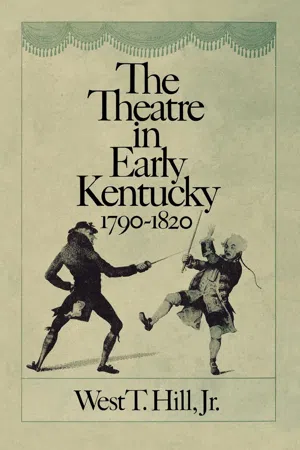
- 240 pages
- English
- ePUB (mobile friendly)
- Available on iOS & Android
eBook - ePub
Trusted by 375,005 students
Access to over 1.5 million titles for a fair monthly price.
Study more efficiently using our study tools.
Information
* 1 *
The Athens of the West
KENTUCKY, the “dark and bloody ground,” became a melting pot for many American pioneers after their struggle for independence. Restless people from southern coastal cities arrived in the Kentucky wilderness through the Cumberland Gap and the Wilderness Road. From Pittsburgh and other northern river settlements others floated down the Ohio River to a bustling northern Kentucky landing called Limestone, now Maysville. Settlers crowding these two routes converged in Kentucky and to their surprise found the thriving town of Lexington, which was such a contrast to the rugged surrounding wilderness that they called it “the Athens of the West.”
Lexington, established as a permanent settlement in 1779, supported in 1787 the first western newspaper, the Kentucke Gazette. In 1798 Transylvania University, the first university west of the Alleghenies, opened with “a group of well-trained scholars and students drawn from a wide radius.”1 One theatrical historian, in describing Williamsburg, Virginia, as the right place for the beginning of colonial theatrical development, mentions the public buildings, the college, and the shops loaded with merchandise.2 The same could be said for Lexington, for by 1800, with a population of 2,400,3 it was the largest city in the West. At this time Lexington could boast not only of a newspaper and a university but also of a post office, twenty-four retail stores, and tobacco and whiskey export industries. The university, a union of the Kentucky Academy and Transylvania Seminary, offered courses in such subjects as languages, natural philosophy, astronomy, mathematics, and geography. Both a medical and a law school served the students, who paid fifteen pounds a year for board, “paid half yearly in advance,” and who furnished their own bedding, washing, wood, and candles.4
One traveler on a tour of the western country in 1806 described Lexington as having roads which “were very wide and fine, with grazing parks, meadows, and every spot in sight cultivated.” He was impressed by the spacious streets (particularly the eighty-foot wide main street), the large brick houses, and the sidewalks. The courthouse, where many of the dramatic presentations were held, was a good, three-story brick building adorned with a cupola, a bell, and a clock. If this were not enough to draw the venturesome from the East, other Lexington attractions included a public library, three boarding schools for women, and several day schools for men, with one hundred pupils altogether.5
Like Williamsburg, this western community had the environment—the leisure, learning, and culture—necessary for theatre development. The real problem facing all the western settlements was transportation and communication. Travel between Lexington and eastern points was slow, difficult, and often dangerous. If a rutty, log-strewn clearing can be called a road, then the Cumberland Gap Road, completed in 1796, was the first road through the mountains. Settlers coming into Kentucky on this road from the southeast could haul as much as a ton of goods, providing they had four good horses. Advertisements in the Kentucky Gazette lured the more adventuresome over the mountains with assurances of abundant crops, road-side necessities, minimum expenses, and other chamber-of-commerce-like enticements;6 but the same newspaper announced daring Indian raids in and around Lexington as late as 1800. The other wagon road, from Limestone to Lexington, had been a thoroughfare since 1787, Limestone being the westernmost river landing during the early period. It was named “Smith’s Wagon Road” after the man who first brought a wagon team from Limestone to Lexington.7 Stagecoaches were operating in and around Lexington by 1803,8 but steamboat service on the Ohio River did not reach St. Louis until 1817.9 As late as 1815, Samuel Drake brought his theatrical troupe to Kentucky from New York by floating down the Allegheny and Ohio rivers on crude flat-bottomed boats. In 1816 he took two days to travel from Frankfort to Louisville, a distance of about fifty miles.10 It is understandable that John Bernard, manager of the Boston Theatre, refused an invitation to manage the newly organized Lexington Theatre in 1808.11
For those who successfully made the trip over the mountains or down the river, the bustling town of Lexington teemed with trade and politics, amateur entertainment and culture. Not only did Lexington have amateur stage productions before 1800; there were also musical concerts, debates, sermons, dancing, and a variety of homespun amusements reflecting the character of the pioneer people. Furthermore, there were the strolling charlatans—acrobats, wire-walkers, magicians, fortunetellers, gamblers, musicians, dancers—all the itinerant showmen who found their way over the mountains in pursuit of the gullible, fun-loving settler. This rabble of carnival folk always served as the forerunner to the professional actor, who was often a magician or a showman turned actor and who just as often reverted to his cruder talents when the necessity arose. But most entertainment came from the citizens themselves, who formed thespian societies, musical societies, debating societies, and numerous literary and political clubs.
The innkeeper in Lexington, like the innkeeper in Elizabethan England, assumed the role of entrepreneur, master of ceremonies, and theatrical agent. By necessity, but often also by choice, he offered his guests a variety of amusements and a hall or other place of performance not only for dramatic presentations but also for local debates, musicals, and exhibitions of various kinds. That innkeeping in early Lexington was a lucrative business is revealed by the numerous quaint signs in the Kentucky Gazette advertising The Red Lion, The Sign of the Buffalo, The Sign of the Green Tree, The Eagle Tavern, and The Sign of the Ship. Luke Usher, the first theatrical promoter in the West, advertised his inn accommodations in rhyme in the Gazette, May 8, 1818:
Entertainment For Travellers
Who’s not been in Kentucky hath not seen the world;
’Tis the state in which Freedom’s own flag is unfurl’d!
It is plenty’s headquarters—’tis Misery’s grave;
Where the ladies are lovely, and Men are all brave!
When the weary and hungry to Lexington trip,
Let them stop and regale at the sign of The Ship,
Where I promise to treat them as well as I’m able,
With a larder well stor’d and good liquors, and stable:
Luke Usher,
Ship Inn, in Short Street
2 doors from Limestone
at Lexington.
Competition among innkeepers to see which could promote the best or at least the most unique entertainment prepared the way for theatrical activity in the area after 1800. In 1806 local musicians performed in Bradley’s popular assembly room in Traveller’s Hall Inn. Here Lexingtonians could listen to both vocal and instrumental music in a room that was “superbly illuminated and kept warm.” The prices of admission were twenty-five and fifty cents. Proceeds from these performances went for “the relief of distressed humanity” (a worthy, if widespread, cause). Bradley’s room, advertised as being located in the public square in the center of the business district, measured fifty-four by thirty-two feet and served as both assembly room and dining hall. The Lexington Debating Society met at the Coffee House in 1807 to debate the practice of “Physic” in Kentucky, one resolution of which would prohibit anyone to practice who had not taken “a regular course of study.” A man named Nugent opened a dancing school in Bradley’s room in 1805 and advertised for twenty pupils. Such dancing schools were popular in Lexington as early as 1788, when John Davenport advertised for both ladies and gentlemen to be taught at Captain Young’s by the quarter. In 1789 Jeremiah Moriarty offered his services as a dancing instructor both in Lexington and in Danville; he also taught the use of globes, by the day or by the quarter, at five dollars per quarter. Students brought their own lunches. In 1801 the admirers of pulpit eloquence were invited to the store of McBean and Poyzer, where they could hear (if their applications were early) sermons on such lofty topics as “The Death of George Washington.”12 At the same time students at Transylvania University were pronouncing orations in the Presbyterian meetinghouse.13
Inns were not only the popular places for amusement and instruction in the early West; they served also as meetinghouses for more serious business. The town of Frankfort became the capital of Kentucky in 1792 at a meeting in Brent’s Tavern in Lexington.14 In 1795 a public library was established at McNair’s Tavern, and on March 12, 1805, the trustees of Lexington met at Wilson’s Tavern to hear claims on a property settlement.15
Not all the activities sponsored by the inn were cultural, instructional, or political. The innkeepers advertised a steady fare of more spectacular entertainments for those not interested in music or debating. At Postlethwait’s Inn the citizens had an opportunity to see “The Siamese Twin Brothers.” Candy’s Tavern advertised “The Gigantic Giraffe,” and “An African Lion” was displayed at Satterwhite’s Inn. One of the most popular forms of dramatic display, which swept the country during the eighteenth and early nineteenth centuries, was the wax figure exhibition. The Kentucky Hotel in Lexington advertised in 1809 an exhibition of wax figures representing such renowned historical figures as President Washington, Napoleon, Alexander Hamilton, Aaron Burr, and General Braddock.16 These wax figures were the first dramatic tableaux that many pioneer settlers had ever seen. One strolling actor performing before a rural audience overheard a spectator say that the performers in a particular scene were not wax figures since there were no strings attached.17 Apparently wax figures were not only displayed motionless but were also manipulated by strings like puppets.
The inn was by no means the only source of diversion for Lexington citizens. Animal fighting, bearbaiting, horseracing, gambling, and other activities, both indoors and out, helped the westerner pass his leisure hours. Just as the innyard had its influence on the construction of Elizabethan theatres, so did the bearbaiting and cockfighting pits. The gory particulars of bearbaiting in Kentucky at the beginning of the nineteenth century speak for themselves in a description i...
Table of contents
- Cover
- Half Title
- Title
- Copyright
- Dedication
- Contents
- Illustrations
- Preface
- Chapter One: The Athens of the West
- Chapter Two: The First Dramatic Performances
- Chapter Three: The First Permanent Theatres
- Chapter Four: Professional Players in Kentucky
- Chapter Five: The First Western Circuit
- Chapter Six: Arrival of the Drakes
- Chapter Seven: Drake’s Western Theatrical Empire
- Bibliography
- Appendix: Record of Performances, 1790-1820
- Index
Frequently asked questions
Yes, you can cancel anytime from the Subscription tab in your account settings on the Perlego website. Your subscription will stay active until the end of your current billing period. Learn how to cancel your subscription
No, books cannot be downloaded as external files, such as PDFs, for use outside of Perlego. However, you can download books within the Perlego app for offline reading on mobile or tablet. Learn how to download books offline
Perlego offers two plans: Essential and Complete
- Essential is ideal for learners and professionals who enjoy exploring a wide range of subjects. Access the Essential Library with 800,000+ trusted titles and best-sellers across business, personal growth, and the humanities. Includes unlimited reading time and Standard Read Aloud voice.
- Complete: Perfect for advanced learners and researchers needing full, unrestricted access. Unlock 1.5M+ books across hundreds of subjects, including academic and specialized titles. The Complete Plan also includes advanced features like Premium Read Aloud and Research Assistant.
We are an online textbook subscription service, where you can get access to an entire online library for less than the price of a single book per month. With over 1.5 million books across 990+ topics, we’ve got you covered! Learn about our mission
Look out for the read-aloud symbol on your next book to see if you can listen to it. The read-aloud tool reads text aloud for you, highlighting the text as it is being read. You can pause it, speed it up and slow it down. Learn more about Read Aloud
Yes! You can use the Perlego app on both iOS and Android devices to read anytime, anywhere — even offline. Perfect for commutes or when you’re on the go.
Please note we cannot support devices running on iOS 13 and Android 7 or earlier. Learn more about using the app
Please note we cannot support devices running on iOS 13 and Android 7 or earlier. Learn more about using the app
Yes, you can access The Theatre in Early Kentucky by West T. HillJr.,West T. Hill Jr. in PDF and/or ePUB format, as well as other popular books in Literature & Entertainment Industry. We have over 1.5 million books available in our catalogue for you to explore.