
eBook - ePub
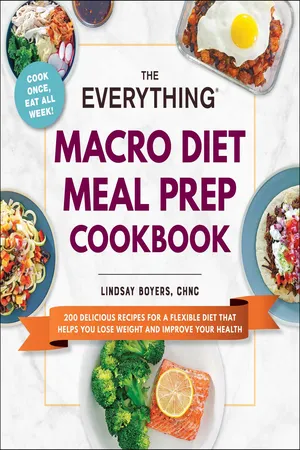
The Everything Macro Diet Meal Prep Cookbook
200 Delicious Recipes for a Flexible Diet That Helps You Lose Weight and Improve Your Health
- 272 pages
- English
- ePUB (mobile friendly)
- Available on iOS & Android
eBook - ePub
The Everything Macro Diet Meal Prep Cookbook
200 Delicious Recipes for a Flexible Diet That Helps You Lose Weight and Improve Your Health
About this book
Stop counting calories and transform your body in no time with these easy, make-ahead macro diet meals everyone will enjoy.
If you’re someone who wants to start making healthy choices and get in control of your diet, you’re not alone. The macro diet offers a specific number of proteins, carbs, and fats to stay under every day based on your goals. Rather than a strict calorie count, which can do more harm than good, this way of eating allows you to enjoy all of your favorite foods—as long as it’s within your macros.
All you need to be successful with this diet is organization and preparation and The Everything Macro Diet Meal Prep Cookbook is here to help. This customizable, sustainable, and most importantly, effective diet will help you reach your weight-loss goals by cooking and eating healthy meals all week long.
If you’re someone who wants to start making healthy choices and get in control of your diet, you’re not alone. The macro diet offers a specific number of proteins, carbs, and fats to stay under every day based on your goals. Rather than a strict calorie count, which can do more harm than good, this way of eating allows you to enjoy all of your favorite foods—as long as it’s within your macros.
All you need to be successful with this diet is organization and preparation and The Everything Macro Diet Meal Prep Cookbook is here to help. This customizable, sustainable, and most importantly, effective diet will help you reach your weight-loss goals by cooking and eating healthy meals all week long.
Frequently asked questions
Yes, you can cancel anytime from the Subscription tab in your account settings on the Perlego website. Your subscription will stay active until the end of your current billing period. Learn how to cancel your subscription.
No, books cannot be downloaded as external files, such as PDFs, for use outside of Perlego. However, you can download books within the Perlego app for offline reading on mobile or tablet. Learn more here.
Perlego offers two plans: Essential and Complete
- Essential is ideal for learners and professionals who enjoy exploring a wide range of subjects. Access the Essential Library with 800,000+ trusted titles and best-sellers across business, personal growth, and the humanities. Includes unlimited reading time and Standard Read Aloud voice.
- Complete: Perfect for advanced learners and researchers needing full, unrestricted access. Unlock 1.4M+ books across hundreds of subjects, including academic and specialized titles. The Complete Plan also includes advanced features like Premium Read Aloud and Research Assistant.
We are an online textbook subscription service, where you can get access to an entire online library for less than the price of a single book per month. With over 1 million books across 1000+ topics, weâve got you covered! Learn more here.
Look out for the read-aloud symbol on your next book to see if you can listen to it. The read-aloud tool reads text aloud for you, highlighting the text as it is being read. You can pause it, speed it up and slow it down. Learn more here.
Yes! You can use the Perlego app on both iOS or Android devices to read anytime, anywhere â even offline. Perfect for commutes or when youâre on the go.
Please note we cannot support devices running on iOS 13 and Android 7 or earlier. Learn more about using the app.
Yes, you can access The Everything Macro Diet Meal Prep Cookbook by Lindsay Boyers in PDF and/or ePUB format, as well as other popular books in Art & Culinary Arts. We have over one million books available in our catalogue for you to explore.
Information

What Is the Macro Diet?
The macro diet, often called âIf It Fits Your Macrosâ or âIIFYM,â isnât one specific diet but rather a set of principles that gives you a template for building out your meals. Instead of focusing on a set number of calories, the macro diet involves tracking your daily intake of macronutrients.
The Benefits of the Macro Diet
A properly balanced macro diet ensures that youâre getting the right nutrition for your goals, whether that be weight loss, improved fitness, or just wanting to feel better, and that youâre not over- or under-eating. This translates to better health and a reduced risk of chronic conditions, like heart disease, diabetes, and even Alzheimerâs disease, down the road. A macro diet also allows more flexibility than other nutrition plans, since there are no strict food rules surrounding what you âcanâ and âcanâtâ eat. Youâll uncover more about the benefits of the macro diet and each macronutrient later in this chapter.
A Breakdown of Macronutrients
Before starting a macro diet, itâs helpful to know what macros are and what they do for you. There are three macronutrients: carbohydrates, protein, and fat. Most foods contain some combination of all three, although there are foods that contain only one or two. For example, butter is mostly all fat with minuscule amounts of protein, while meat is mostly protein with some fat and zero carbohydrates. The calories in your food come from the macronutrients in that food:
- Carbohydrates have 4 calories per gram.
- Protein has 4 calories per gram.
- Fat has 9 calories per gram.
While calories are often described as some obscure measurement that pertains only to weight loss, theyâre actually units of energy. In other words, the calories in your food provide you with the energy you need to get through the day and perform basic, but necessary, functions like breathing and keeping your heart beating.
Some people say that it doesnât matter where your calories come fromâthat as long as youâre sticking to your calorie numbers, youâll reach your goals. While that may be true in some ways, thereâs lots of science that says if you want to feel (and look) your best, it does matter where calories are coming fromâand thatâs where the macro diet comes in.
Carbohydrates
The main function of carbohydrates, or âcarbsâ as theyâre often called, is to provide your body with energy. They exist in three main formsâsugars, starches, fibersâthat can be further broken down into simple and complex carbohydrates.
You should prioritize complex carbohydrates over simple ones whenever possible. Complex carbohydrates take longer to digest and thus provide a more sustained source of energy. Simple carbohydrates digest quickly and can provide an instant energy boost, but this is often followed by a crash that leaves you feeling hungry and worn out.
Complex carbohydrates are also often richer in fiber and starches, which have other health benefits. Fiber helps keep your digestion regular and can lower your risk of heart disease, while certain types of starches feed the good bacteria in your gut and help balance your gut microbiome.
Some of the best sources of carbohydrates in a macro diet are:
- Sweet potatoes
- White potatoes
- Brown rice
- Gluten-free rolled oats
- Legumes (beans, peas, lentils, chickpeas)
- Whole fruits
- Vegetables
- Nuts
- Seeds
Because carbohydrates are such a convenient source of energy, your body always prioritizes using them over fats and proteins. In some ways, this is a good thing. But if youâre constantly overeating carbohydrates, or any of the other macronutrients, it can lead to weight gain. Thatâs why tracking is important. (More on that later.)
Protein
Protein is often considered the most important macronutrient when following a macro diet. While the ultimate goal in this diet is to nail your numbers every time, protein is a good place to start if youâre new to macros.
Proteins have more functions than either of the other macronutrients. Theyâre involved in your metabolism, build and repair your bodyâs tissues, and help maintain proper fluid and pH balance. Proteins also provide the structural framework for all of your cells.
All proteins are made up of amino acids, which are often called the building blocks of life. When you eat protein, your body breaks it down into individual amino acids and then uses those amino acids to rebuild the new proteins you need to carry out daily functions. There are twenty standard amino acids. Nine of them are categorized as essential, and eleven are nonessential. Essential amino acids are those that your body canât make. The essential part comes from the fact that you must include them in your diet, otherwise your body wonât have access to them. On the other hand, your body can make nonessential amino acids. Theyâre not less important than essential amino acids; itâs just not as vital to include them in your diet since your body can make what it needs.
Proteins are further broken down into complete and incomplete proteins. Complete proteins provide all of the essential amino acids, while incomplete proteins are missing some. When choosing your protein sources, itâs best to fit in complete proteins whenever possible. You can also make a complete protein by eating complementary proteinsâtwo incomplete proteins that each have the essential amino acids the other is missingâthroughout the week. Some examples of complementary proteins are lentils and quinoa, rice and beans, and peanut butter and whole-grain bread.
Some of the best sources of protein in a macro diet are:
- Lean meats (beef, pork, lamb)
- Poultry (chicken, turkey)
- Seafood (fish, shellfish)
- Eggs
- Grass-fed dairy products
- Nuts
- Seeds
- Legumes (beans, peas, lentils, chickpeas)
The protein from complete protein sources, such as lean meat and poultry, is more bioavailable, meaning your body can digest and absorb it better than protein from other sources. That said, it is possible to get adequate protein solely from plant-based foods.
Fat
Fat may be the most misunderstood macronutrient of them all. In the 1990s, many health experts pointed the finger at this macronutrient, suggesting that it was the sole reason for weight gain and many other health problems, including heart disease. But, as it turns out, many of those initial theories were wrong, and science shows that fat is an essential part of a healthy diet. Itâs true that fat has more calories per gram than the other two macronutrients, but youâll reap big rewards when you work it into your diet in a strategic way.
Your body uses fat as a secondary fuel source, and itâs a major storage form of energy in the body. Fat also helps you absorb fat-soluble vitamins, cushions and protects your organs, helps you regulate your body temperature, and supports cell growth. Adding fat to your meals also helps you feel satisfied instead of unfulfilled after eating.
Just as with proteins, there are essential fatty acids, like omega-3s and omega-6s. Since your body canât make these types of fats, you have to get them from your diet to feel your best.
Some of the best sources of fat in a macro diet are:
- Fatty fish (salmon, mackerel, herring, sardines, albacore tuna)
- Nuts
- Seeds
- Grass-fed butter and healthy oils (avocado, olive, sesame)
- Avocado
- Olives
- Grass-fed meats
The recipes in this book capitalize on the benefits of these and other good sources of fat.
How to Calculate Your Macro Goals
Now that you know what macronutrients are and where you can find them, another important piece of the puzzle is learning how to calculate your macro goals and track how many youâre eating. The first step in calculating your macros is figuring out how many calories you need each day. The easiest way to do this is to use a free online calculator. Just search âcalorie calculatorâ online, and youâll be met with many options that will let you plug in your specifics, from your height and weight, to your fitness goals. Once you have that number, youâll use it to calculate the grams of each macronutrient. Thankfully, there are online calculators and apps that will do most of this work for you; just search âmacronutrient calculatorâ and/or âmacronutrient trackerâ and youâll get a ton of results.
Since the macro diet is adaptable, there arenât perfect macronutrient ranges that work for everyone, but here is a good starting point that online calculators work from:
- Carbohydrates: 30â40 percent of daily calories
- Protein: 25â35 percent of daily calories
- Fat: 20â30 percent of daily calories
Many people prefer a low-carb approach to macro counting. If you started a macro diet and youâre not seeing the results you want, or if you prefer to limit your carb intake, your macro breakdown should look more like this:
- Carbohydrates: 15â25 percent of daily calories
- Protein: 40â50 percent of daily calories
- Fat: 30â35 percent of daily calories
Figuring out your macronutrient sweet spot may take some t...
Table of contents
- Cover
- Title Page
- Introduction
- Chapter 1: Macro Diet and Meal Prep 101
- Chapter 2: Breakfast
- Chapter 3: Salads and Bowls
- Chapter 4: Soups, Stews, and Chili
- Chapter 5: Poultry Main Meals
- Chapter 6: Beef and Pork Main Meals
- Chapter 7: Seafood Main Meals
- Chapter 8: Vegetarian and Vegan Main Meals
- Chapter 9: Side Dishes
- Chapter 10: Snacks and Appetizers
- Chapter 11: Sweets and Treats
- Two-Week Meal Plan
- Standard Us/Metric Measurement Conversions
- About the Author
- Index
- Copyright